.png)


.svg)
.svg)

.svg)
This is a summary of an episode of Pioneers, an educational podcast on AI led by our founder. Join 3,700+ business leaders and AI enthusiasts and be the first to know when new episodes go live. Subscribe to our newsletter here.
TL;DR:
- Workers’ compensation is uniquely complex and personal, making full automation risky and often inappropriate.
- AI delivers the most value when it prepares work for humans rather than replacing adjusters or underwriters.
- Data readiness, workflow quality, and governance must come before deploying AI tools.
- Adoption depends on transparency, education, and positioning AI as support rather than replacement.
- Carriers should focus on solving real business problems instead of chasing flashy AI demos.
Before we dive into the key takeaways from this episode, be sure to catch the full episode here:
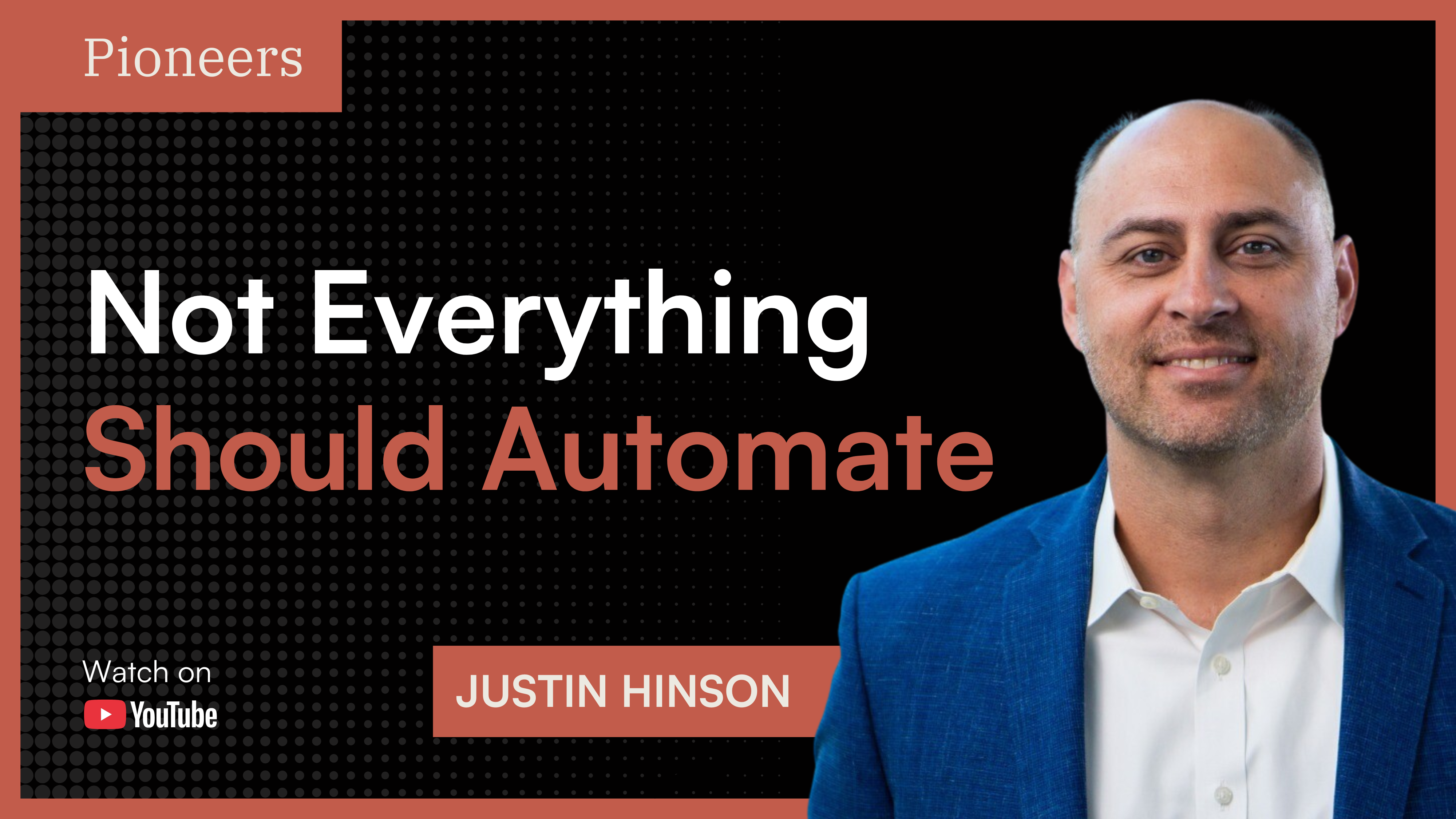
Meet Justin - Product Leader at CompSource Mutual
Justin Hinson is a senior product leader at CompSource Mutual, a monoline workers’ compensation carrier, where he leads core system modernization and digital transformation initiatives.
With over 25 years in the insurance industry, Justin has worked across claims, underwriting, billing, and product management.
His career began on the front lines as a claims adjuster and underwriter, giving him firsthand insight into the needs of injured workers, policyholders, and internal teams. That experience now informs his approach to product strategy and technology adoption.
At CompSource, Justin focuses on bridging business needs with emerging technology, ensuring AI is introduced thoughtfully, ethically, and with measurable value. He is a strong advocate for human-centered automation, where AI enhances speed, insight, and care without removing empathy from the process.
Why Workers’ Compensation Is Hard to Automate
Justin explains that workers’ compensation is fundamentally different from lines like auto insurance.
“No two people are the same. No two claims are the same,” he says. Injuries vary, recovery paths differ, and preexisting conditions complicate outcomes. Beyond complexity, workers’ comp is deeply personal. “These workers are scared. It’s their livelihood,” Justin notes.
Many claimants prefer human interaction, especially when navigating traumatic injuries. Unlike insuring property, “we’re helping repair people’s lives,” he explains. This variability and emotional weight make full automation inappropriate.
AI must respect nuance, vulnerability, and timing. As Justin emphasizes, technology should support adjusters and underwriters, not force injured workers into cold or impersonal workflows.
“Start with the business problem, not the technology.” — Justin Hinson
Where AI Actually Works in Insurance Today
Justin sees AI excelling in structured, preparatory tasks. “Reading loss runs, summarizing claim notes, pulling insights from third parties,” are areas where AI shines, he says.
These activities remove low value work from employees while improving speed and consistency.
However, he draws a clear boundary. “AI is great at preparing the work, but not owning the work,” Justin explains. Expecting AI to behave like a fully qualified adjuster or underwriter introduces risk. AI can take things too literally and miss nuance.
Used correctly, AI equips humans with better context faster, allowing them to make informed decisions without replacing judgment or empathy.
Preparing the Foundation Before Deploying AI
Justin repeatedly stresses readiness over speed.
“One of the worst things you can do is automate a really bad workflow.” — Justin Hinson
At CompSource, the team focuses first on clean data, well designed workflows, and governance. Without these, AI only amplifies problems. “Some carriers got distracted by the shiny new tool and they just weren’t quite ready,” he says.
Readiness also includes infrastructure and integration planning so data can be captured, reused, and learned from over time. Justin believes preparation is what separates sustainable AI adoption from short lived experimentation.
Choosing AI Vendors in a Noisy Market
Vendor selection requires discipline. “Start with the business outcome, not a fancy demo,” Justin advises. He looks for three things: deep understanding of insurance workflows, explainability to meet regulatory needs, and clean integration into existing systems.
Many vendors, he notes, understand AI but lack insurance experience, creating a gap between technology and reality. “That’s gold when you find someone who understands both,” he says. Justin cautions against creating new silos with narrow point solutions.
The signal comes from “clarity, transparency, and proven value,” while noise comes from vague promises and impressive demos without real adoption.
Adoption, Trust, and the Human Side of AI
For Justin, adoption hinges on trust. “Trust and adoption come from transparency and knowledge, not the technology itself,” he explains.
Fear of job loss or unclear intent can stall adoption. At CompSource, AI was introduced as an internal support tool, described as a “Google of CompSource,” to reduce anxiety and build familiarity.
Justin emphasizes explaining what AI will do and what it will not do. “Positioning AI as a support tool rather than a replacement reduces fear,” he says. Measuring adoption requires ongoing reviews and clear metrics tied to outcomes. Without trust, tools go unused and ROI disappears.
“Adoption is what ultimately determines ROI.” — Ankur Patel

.png)
.png)