
Retail Banking Automation With Agentic AI
Agentic banking is the use of autonomous AI agents to execute multi-step banking operations end-to-end, from customer onboarding, KYC/KYB, and loan origination to credit scoring, fraud detection, and AML compliance, with human oversight for every high-risk decision. Multimodal's AgentFlow platform lets retail banks, credit unions, and other financial institutions deploy AI agents inside their own infrastructure, so sensitive customer data never leaves their systems.
What Is Agentic Banking?
Traditional AI systems in banking wait for instructions: a chatbot answers a question, a model returns a score. Agentic AI systems go further. They interpret a goal, break it into tasks, pull relevant information from multiple systems, and execute tasks across the front and back office without constant human intervention.
Most AI in banking still refers to assistive tools: copilots and AI assistants that draft, summarize, or suggest. Retail banking AI built on agents is different: where traditional AI assists, banking agentic AI completes. The loan file is processed, the customer is identified and verified, and the suspicious transaction is escalated for human review.
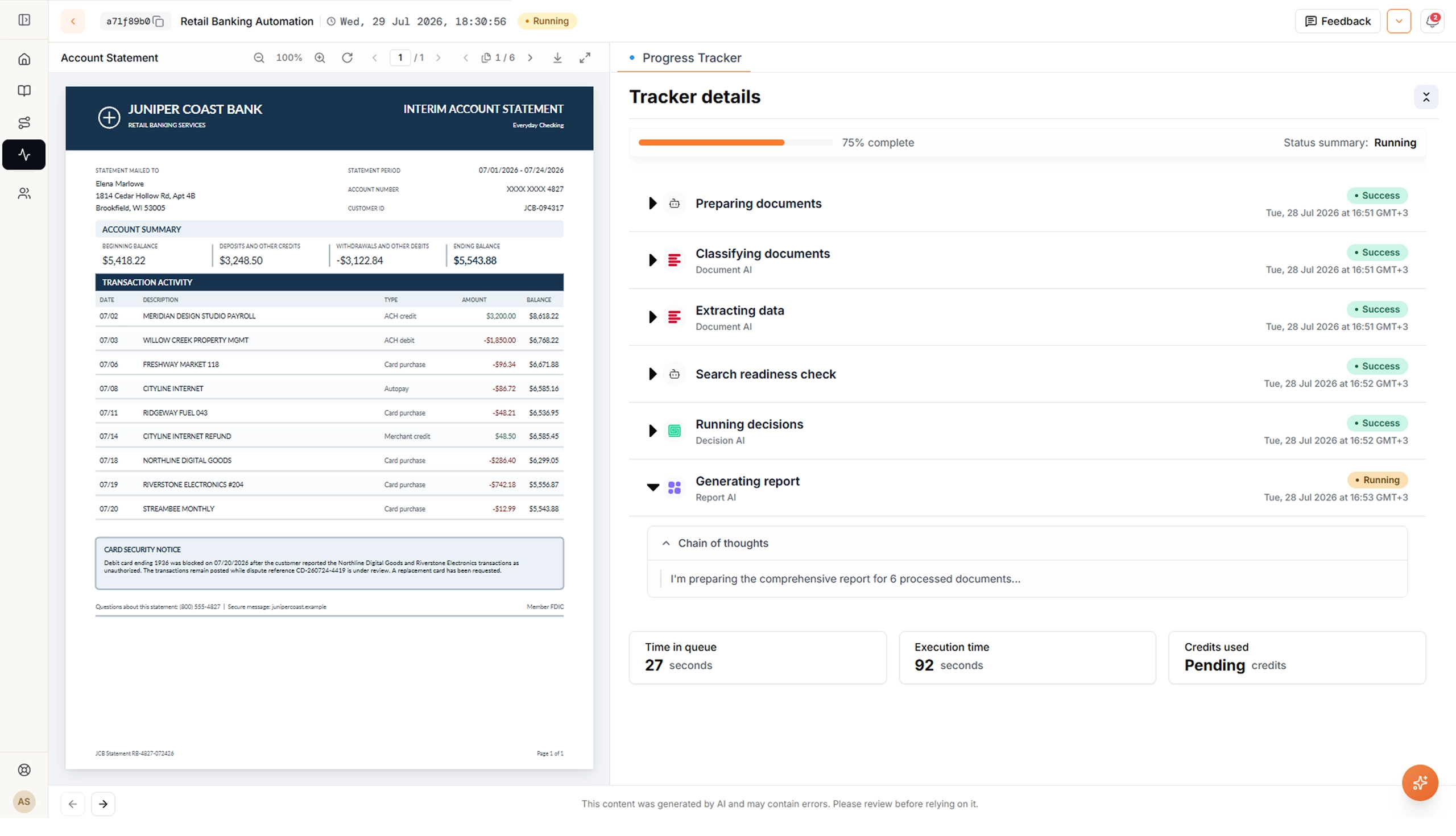
Multimodal's agents combine large language models, machine learning, and generative AI to work with structured and unstructured data (loan applications, transaction data, credit bureau data, transaction history) under a governed autonomy model: AI agents initiate actions only within defined authorization limits, and human oversight is mandatory for high-risk decisions. That is how banks embrace AI without giving up control, auditability, or customer trust.
One Platform for Front- and Back-Office Automation
AgentFlow is our secure, integrated agentic AI platform purpose-built for financial services: retail banks, credit unions, and private equity firms. It orchestrates autonomous AI agents, your operations teams, and your existing systems in one place, so AI initiatives don't stay stuck in fragmented pilots.

How Do Multimodal's AI Agents Work?
Our AI agents learn, think, and act with different built-in capabilities. We fine-tune AI models on your company data, not generic training sets, and deploy them as APIs through AgentFlow. High-quality data in, data-driven insights out.
Unstructured AI
Processes unstructured data for RAG architectures and downstream GenAI applications.
Document AI
Trained on your schema for document analysis: extracts, labels, and organizes customer data from structured and unstructured documents.
Decision AI
Ingests your internal manuals and underwriting guidelines to recommend decisions for complex tasks such as credit scoring, with human review before anything is finalized.
Database AI
Queries banking systems and databases to interpret datasets and surface relevant information for employees and customers.
Conversational AI
Goes beyond virtual assistants and chatbots: uses your internal data to support customers and staff as part of an agentic platform that processes the request, not just answers it.
Report AI
Generates reports, policies, and customer communications in your institution's style while meeting regulatory requirements.
What Results Do Banks See?
Direct Mortgage cut loan processing costs by 80% with our AI agents. AI automation helped Direct Mortgage process 200+ document types, approve applications 20× faster, and cut operational costs by 80% per processed document by replacing manual effort with automated document analysis and human review for exceptions.
Which Retail Banking Workflows Can You Automate?
Customer Onboarding & KYC/KYB
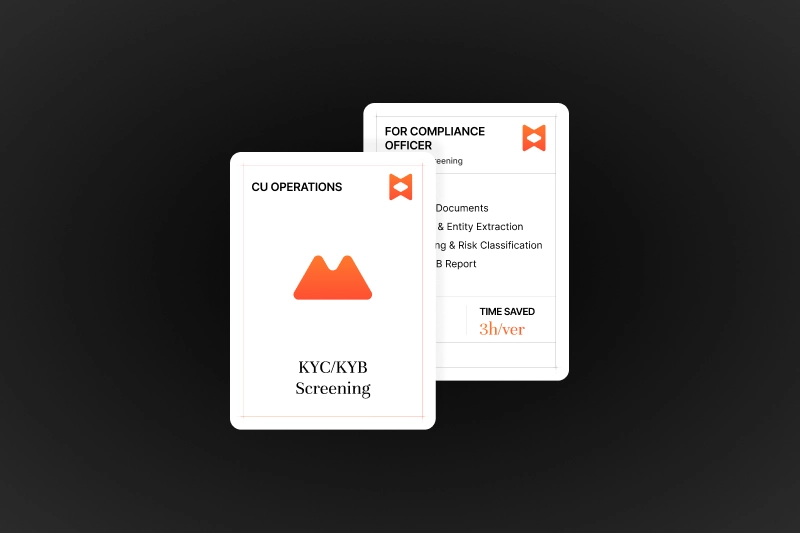
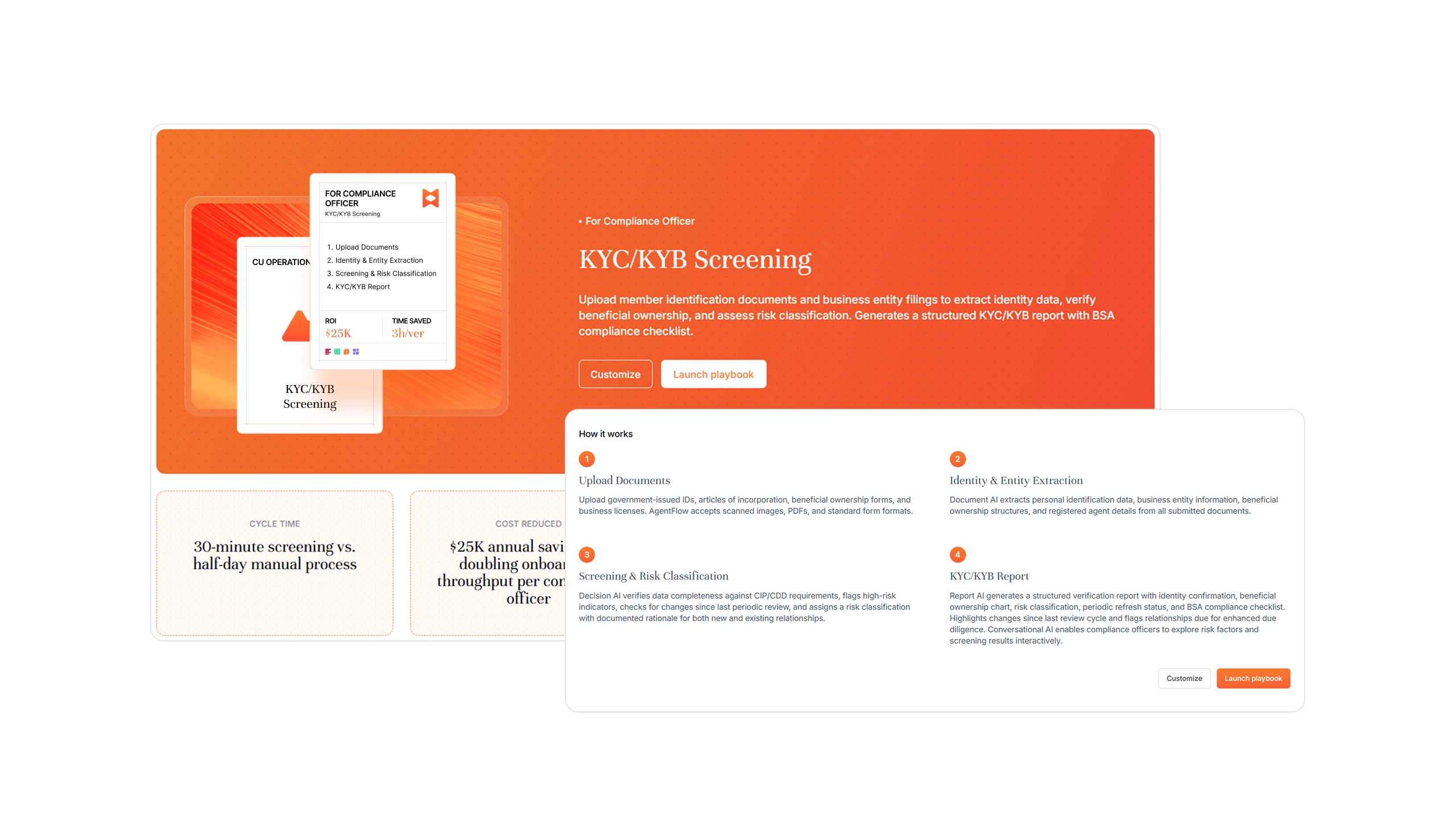
Automate the customer onboarding process end-to-end: identify customer records, verify identities against credit bureau data and external sources, run sanctions and AML screening, and document every step for examiners. Agents handle the repetitive tasks; your compliance team handles judgment. Explore KYC automation and KYB and KYC for banking.
Loan Origination & Underwriting
Extract customer data from applications instantly, assess files against internal underwriting guidelines, and route decision recommendations to underwriters, automating routine tasks in origination, servicing, and delinquency management while keeping humans on final approvals.
Fraud Detection & Risk Management
Analyze transaction data, spending patterns, and customer behavior to detect anomalies in real time. Agents flag suspicious activity for human review, strengthening risk management without adding headcount.
Personalized Banking & Customer Engagement
Meet rising customer expectations with proactive personalization: agents monitor transaction history and personal preferences to surface the right product at the right moment, turning customer interactions into stronger customer relationships and higher customer satisfaction.
| Workflow | What the AI agents do | Human oversight point | Verified outcome |
|---|---|---|---|
| Customer onboarding & KYC/KYB | Identity verification, screening, due-diligence file assembly | Exception review, EDD sign-off | Banks assign 10 to 15% of FTEs to KYC/AML |
| Loan origination & underwriting | Document extraction, guideline-based decision support | Final credit decision | 80% lower cost per document, 20× faster approvals |
| Document processing | Classification + extraction across 200+ document types | Flagged-file review | 99% classification accuracy |
| Fraud detection & compliance | Transaction monitoring, anomaly flagging, audit-ready logs | Alert investigation | 97% of incoming packets arrive incomplete; 20% carry a red flag |
Can Agentic AI Work With Your Existing Systems?
Yes. You don't need to rip out legacy systems to implement AI. AgentFlow agents deploy as APIs and integrate end-to-end with legacy cores, workbenches, and the banking systems you already run; the AI-ready infrastructure layer sits on top of what exists. Deployment is on your virtual private cloud or on-premises, so operations teams keep control of sensitive data while leveraging AI across front- and back-office functions.
PwC analysis finds banks that fully embrace AI across front and back office could improve their efficiency ratio by up to 15 percentage points (PwC, How AI is reshaping banking).
Across 445 prospect-facing conversations with mid-market financial institutions, including 70 credit unions, one $4B credit union found 97% of incoming lending packets arrive incomplete and 20% carry a red flag. Data quality, not model quality, is where most AI transformation stalls. That's why our agents start by reading and checking the file, not just scoring it.
How Do We Keep Your Data and Decisions Safe?
Flexible Deployment
On your VPC or on-premises. Your customer data stays within your systems.
Data Security
User privacy and compliance with regulatory requirements, by architecture rather than policy.
Governed Autonomy
Explainable agents, immutable audit logs, and human review on high-risk decisions support model risk management and satisfy examiners.
Why Do Retail Banks Choose Multimodal?
Transparent & Explainable
Track every decision. Explainability addresses the reliability and accountability concerns that stall most AI adoption, and helps manage bias risk in AI models.
Integration & Flexibility
End-to-end integration with legacy systems and existing workbenches.
Tailored Automation
Agents trained on your data, your guidelines, your customer needs, not a generic model.
Continuous Improvement
Agents learn from every customer interaction and adapt as regulatory requirements evolve.
Frequently Asked Questions
Agentic banking uses autonomous AI agents to execute multi-step banking operations (onboarding, lending, compliance, and fraud detection) end-to-end. Unlike traditional AI that reacts to prompts, agentic AI plans, acts across multiple systems, and escalates to humans at defined checkpoints.
Traditional AI systems assist by answering, scoring, or summarizing. Agentic AI systems execute: they complete workflows autonomously and proactively, within the bank's authorization limits, with human intervention reserved for exceptions and high-risk decisions.
AI agents extract and cross-reference customer data from multiple sources, run screening, apply rule-based risk logic, and generate audit-ready reports, thereby reducing the manual effort that consumes 10 to 15% of bank FTEs while maintaining compliance.
Yes. AgentFlow agents deploy as APIs and integrate with legacy cores and existing systems; they can be deployed in your VPC or on-premises, so sensitive data never leaves your environment.
No. Agents automate routine tasks and repetitive back-office work; your teams keep judgment calls. Gartner predicts that by 2029, agentic AI will autonomously resolve 80% of common customer service issues (Gartner, Mar 2025), freeing staff to focus on complex tasks rather than eliminating them.
Governed autonomy: defined authorization limits, explainable decisions, immutable audit logs, and mandatory human oversight on high-risk actions. These are the controls model risk management teams and regulators expect.
Contact us for pricing. Most institutions start with one high-volume workflow (onboarding or origination) and expand after ROI is proven.
.svg)

See Agentic Banking in Action
Book a 30-minute demo: see how AI agents execute a real workflow, discuss pricing and roadmap, and uncover the best AI use cases for your institution, whether you're starting your first AI initiative or scaling AI internally. A CIO, or chief technology officer, evaluating build vs. buy will leave with a concrete picture of the architecture.