



.svg)
.svg)

.svg)
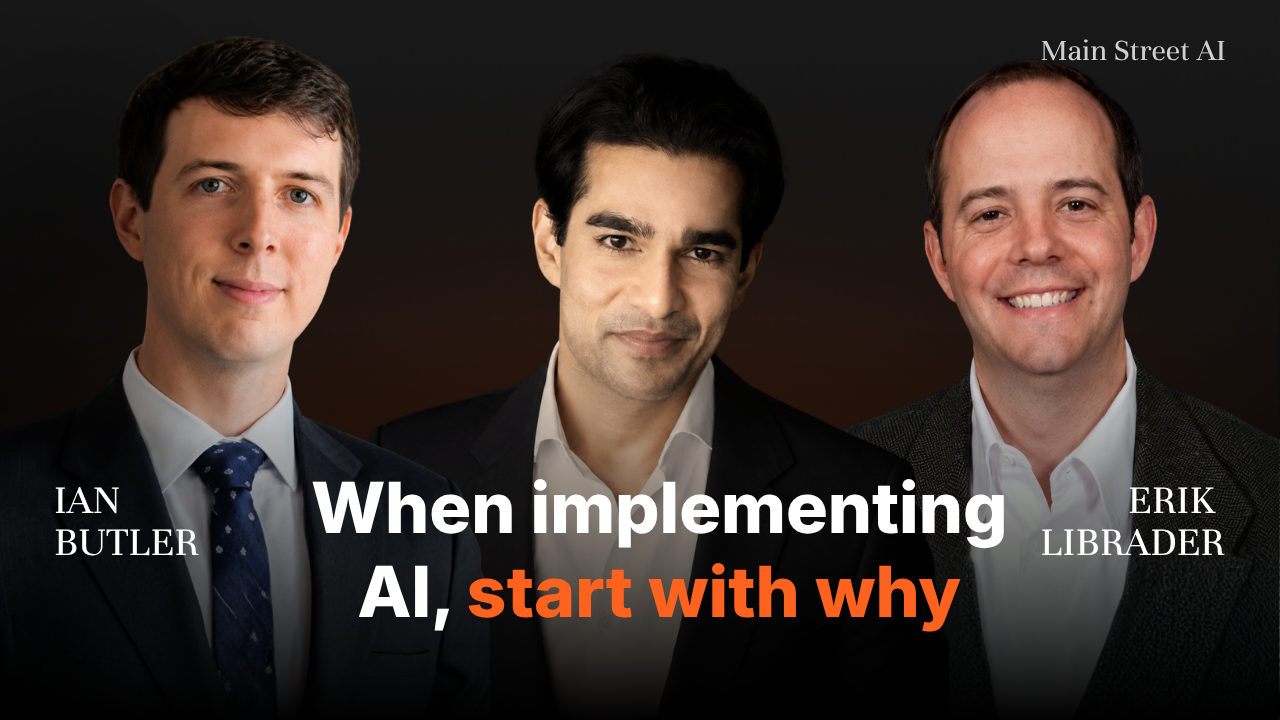
This is a summary of an episode of Main Street AI, an educational podcast on AI led by our founder. Join 3,700+ business leaders and AI enthusiasts and be the first to know when new episodes go live. Subscribe to our newsletter here.
TL;DR:
- Ian Butler says offloading expertise to AI also offloads decision making and direction, and AI works best paired with someone who has the expertise
- AI implementation starts with discovery, because clients arrive overwhelmed or asking for "AI" with no defined problem
- AI ROI depends on quantifiable goals set up front, since nothing can be measured at the end without them
- Most organizations want to repurpose headcount to do more, and junior staff lose the practice that once built their skills
- The top AI risk is data exposure, such as pasting nonpublic information into a public chatbot
- Leaders in 2027 will have budget, sponsorship, a dedicated owner, and a trained organization
Before we dive into the key takeaways from this episode, be sure to catch the full episode here:
What the First AI Call Sounds Like
Some clients arrive with a problem. Others simply say they want AI. Ian comes from software development, so he starts with discovery.
"The first step to the right solution is determining what the real problem is."
Erik adds that many clients are simply overwhelmed. Staff are experimenting with tools leadership can't see, and the usual refrain is "I just don't know where to begin."
AI Is the Tool, and the Outcome Comes First
Ian describes software as a craft, like building a chair. AI is the factory that produces it, and clients want the chair. Board and market pressure has created a fear of missing out, but AI fits some problems better than others.
"You don't need a full steel mill if you're just producing one chair."
Erik calls AI another technology transformation. It moves faster, but KPIs, use case selection, and adoption still decide the result. Ian says "ChatGPT for my business" is seldom the right answer, and Vistrada uses everything from small decision models to large language models depending on the job.
Offloading Expertise Means Offloading Control
Engineering took to AI first, Ian says, because software work is largely semantics and AI is good at semantics. His caution comes from being a developer himself.
"If you offload expertise to AI, you offload decision making to AI and you offload directioning to AI, and you lose that control." - Ian Butler
AI is most effective when a person with real expertise steers it. That creates a problem for junior staff, who used to build skill by doing the work. Ian doesn't claim to have the answer and asks how organizations teach differently. Erik sees roles shifting, with a developer becoming more of a prompter, but a human still does the job. Ian says he has always hired for critical thinking, and that hasn't gone away.
AI ROI Starts With Quantifiable Goals
Ian points to research showing most AI investment misses its return. The best-known source, MIT's NANDA report, found 95% of pilots showed no measurable P&L impact.
"If you don't start with quantifiable goals, then you will not end with quantifiable outcomes." - Ian Butler
Erik shares a client who hired two people "to do AI" with no plan. His checklist covers the outcome, the KPIs, whether the data is ready, and whether the organization is ready to use it. Ian also questions mandates to hit token limits, since staff end up spending money with no outcome attached.
Choosing Tools and Partners
Ian says most organizations would rather repurpose headcount to do more than cut it, and Vistrada's first product came from that thinking. On partners, he says one who arrives on day one with a solution can't know your business. The better approach maps your process first. For a decision step, that might be a small model deployed locally, or a chain of models that ends with a confidence score and a person who signs off.
Loan origination is his example. With AI built in correctly, a reviewer can trace which document drove a decision, correct a bad input, and rerun it. Erik adds that some platforms have a longer history in financial services than others, which is worth weighing.
AI Risk Management Starts With Data Exposure
Ian says the biggest risk is what an agent can see and where the data goes. One client used ChatGPT to speed up a quarterly report and SEC filings, which he calls a reason to hope they have good lawyers. Vistrada advises on data loss prevention, access controls, and the NIST and ISO frameworks for AI risk management. His goal is to reduce risk to a palatable level.
What Separates the Leaders in 2027
Erik names four questions: is the budget real, is there sponsorship from the top, is someone accountable full time, and is the organization ready. He says several clients recently asked for the same thing, which is training by role, with a curriculum for executives, developers, and service agents.
How This Works in Practice
Ian's test is simple.
"If doing more costs more, then you've failed again."
Multimodal's AgentFlow starts from one scoped workflow and shows before-and-after minutes per file on sample loan files, so credit union teams see the math before they scale.
Want more on financial services and AI? Check other episodes here.
Frequently Asked Questions
What happens when a company offloads expertise to AI?
It hands over decisions and direction along with the work. Ian says AI performs best when paired with someone who has the expertise.
Why do most AI implementation projects fail to deliver ROI?
They start without quantifiable goals. MIT's NANDA report found 95% of pilots showed no measurable P&L impact.
Should every business problem be solved with AI?
No. Ian says a workflow tool, a small model, or a process fix is sometimes the better answer. AgentFlow begins by scoping the one workflow worth automating.
What should a company do before starting an AI implementation?
Define the problem, the KPIs, and whether data and staff are ready. Discovery comes before any platform choice.
What are the biggest AI risks for regulated companies?
Data exposure, such as putting nonpublic information into a public chatbot. Controls include data loss prevention, access rules, and NIST and ISO frameworks.
Will AI replace jobs?
Not in most cases, according to Ian. Most organizations would rather repurpose staff to do more, and roles shift toward oversight and critical thinking.
What separates AI leaders from laggards?
Real budget, sponsorship from the top, a dedicated owner, and an organization trained by role.

%20(1).png)
%20(1).png)
.png)
