
Agentic Workflows in Banking: How They Work, Use Cases, and Where to Start
- Agentic AI systems execute complex tasks autonomously. Traditional AI models predict or generate, but they wait for a prompt and stop at output.
- The highest-ROI agentic workflows in banking today are document-heavy: lending origination and funding, customer onboarding and KYC, regulatory compliance, and fraud and dispute resolution.
- Gartner predicts agentic AI will autonomously resolve 80% of common customer service issues by 2029. McKinsey estimates moderate adoption can cut banking costs by 15% to 20%.
- Governance is the gating factor: model risk management, audit trails, and human oversight on high-risk decisions must be designed in from day one, not retrofitted.
- Start with one measurable, document-heavy workflow. Baseline it. Expand from there.
Agentic workflows in banking are processes where AI agents plan, reason, and execute complex tasks end-to-end with minimal human oversight. Instead of following a fixed script, an agent receives a goal, breaks it into steps, acts across multiple systems, checks its own output, and escalates to a human only when a decision exceeds its authority.
For financial institutions, that shift moves AI from drafting text to completing work: processing a loan file, running a KYC review, or resolving a dispute in minutes instead of days. Agentic AI refers to this class of goal-driven, self-correcting systems, distinct from generative AI that produces content and from traditional AI that scores or classifies but never acts.

What are agentic workflows in banking?
Agentic workflows are AI-driven processes in which autonomous agents pursue a defined business objective, plan the steps required to reach it, use tools and data to act, and adapt when conditions change during execution. The distinction matters because banking operations are full of multi-step processes that require judgment at every turn. A funding packet arrives incomplete. A customer's income documents contradict the application. A sanctions hit needs three data sources to clear. Traditional automation breaks on this kind of unexpected input. Agentic workflows do not, because the agent can recognize the gap, retrieve relevant information from internal and external sources, and decide what to do next.
"We are not a chatbot, and we are not a decision engine. We process the loan file."
In practice, most production deployments orchestrate multiple AI agents rather than one. A document agent classifies documents and extracts financial data from unstructured sources such as pay stubs and tax returns. A verification agent cross-checks that output against transaction data and third-party sources. A compliance agent applies policy and generates audit-ready documentation. Multiple agents, one accountable workflow.
How do agentic workflows work in a bank?
Every agentic workflow runs the same loop: plan, act, observe, adjust. The agent maps the steps toward the goal, executes them using APIs into core banking platforms and existing systems, checks the result of each action, and revises the plan when something fails or new relevant data appears.
A real-world example makes this concrete. Consider an indirect auto loan that has been approved but not yet funded.
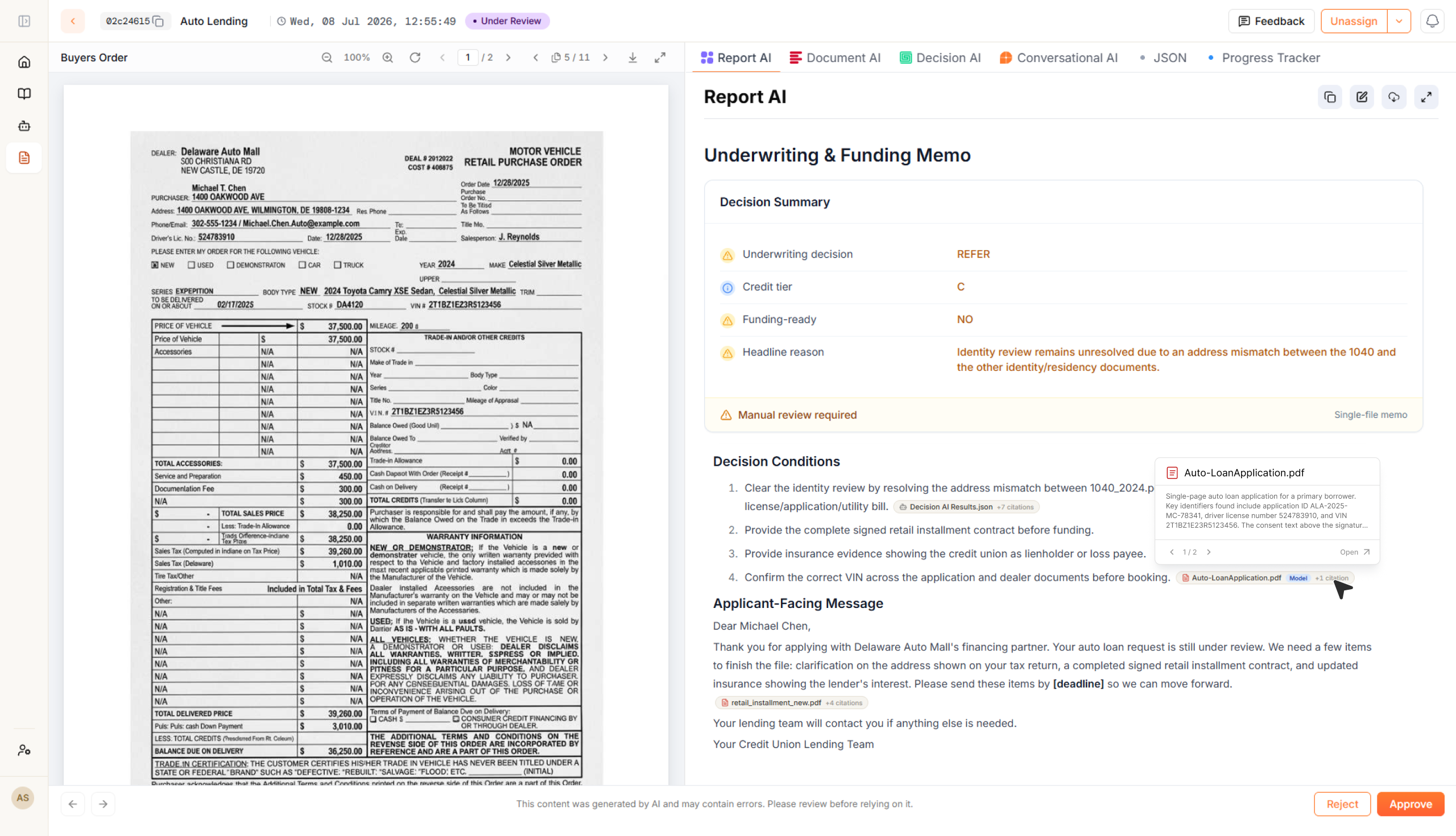
The workflow runs in four steps. Intake and classify: the agent receives the dealer packet, identifies each document type, and flags any missing items against a configurable funding checklist. Extract and validate: it pulls borrower data, income figures, VIN, and insurance details, then runs cross-document validation so the name, address, and VIN match across the contract, title work, and application. Verify: it checks income documentation against stated income and confirms stipulations are satisfied. Summarize or escalate: the output is a fund-ready summary, an exception list with citations back to source documents, or a drafted dealer follow-up for a human to approve.
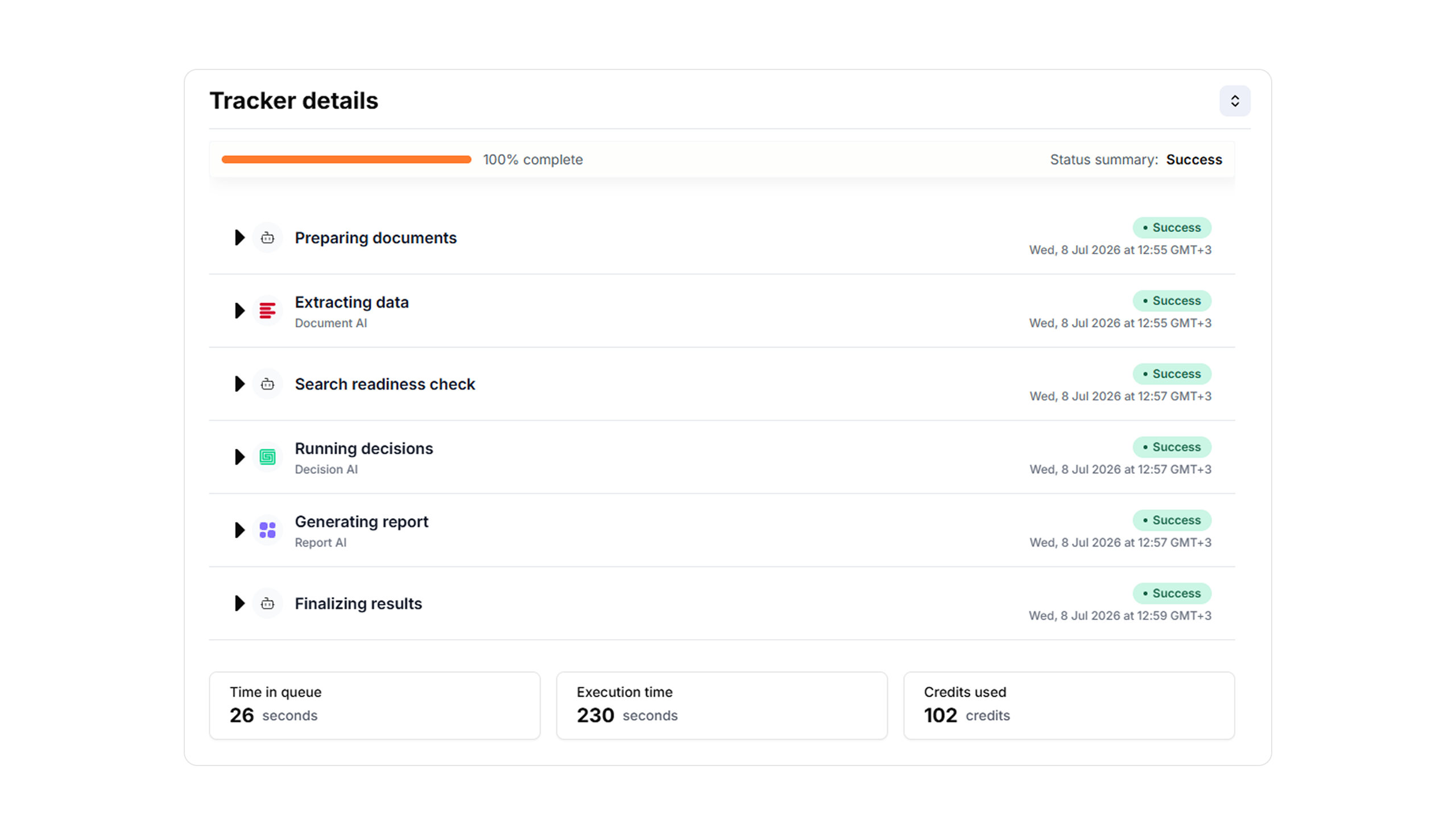
In Multimodal's 2026 Field Report, based on 445 sales conversations with financial institutions, manual funding review takes 40 minutes to 3.5 hours per application today. An agentic workflow compresses it to minutes, and tasks that used to take days across the lending pipeline complete the same morning.
Note what the agent does not do in this example: it does not approve the loan. Credit decisions, pricing, and other high-risk judgments stay with humans and existing decisioning systems. The agent owns the work between systems, where most of the manual processes and most of the human error actually live.
How are agentic workflows different from RPA and chatbots?
Robotic process automation has served banks well for repetitive, predictable data processing. But RPA follows fixed rules, breaks when a screen changes, and stalls on any exception. Chatbots and copilots built on generative AI can converse and summarize, but they stop at language. Agentic AI systems close the gap between understanding and execution.
The same Field Report found a consistent pattern across institutions running RPA: bots handle the first 80% of a process, and the remaining 20% — the exceptions, incomplete files, and judgment calls — still land on staff. That last 20% consumes the majority of the effort, and it is precisely the segment that agentic workflows are built to absorb.
What are the highest-ROI agentic workflow use cases in banking?
McKinsey estimates that moderate adoption of agentic AI could enable banks to reduce costs by 15% to 20%. The gains concentrate where document volume, exception rates, and compliance requirements collide. Five use cases dominate across the entire banking value chain.
Three of these deserve a closer look.
Lending and credit underwriting
Agents streamline the lending process by collecting documents, extracting income and credit history, and analyzing creditworthiness inputs before an underwriter ever opens the file. Enhanced risk assessment comes from breadth: the agent reads every page of every packet, checks transaction history where permitted, and surfaces inconsistencies a rushed human review misses. Loan applications that took days to process move in minutes, and credit risk teams spend their time on decisions instead of data entry.
KYC, AML, and compliance outcomes
Financial crime operations are the clearest case for implementing AI agents. McKinsey's research on agentic AI in financial crime found that agentic approaches can improve productivity in compliance tasks by 200 to 2,000%, far beyond the 15 to 20% uplift from traditional AI and generative AI tools. Agents automate KYC and AML workflows end-to-end: pulling internal and external data, scoring risk, drafting suspicious activity narratives, and generating audit-ready documentation automatically. Regulatory compliance stops being a headcount problem and becomes a solvable data quality problem.
Fraud detection and dispute resolution
Agentic AI provides real-time defense against fraud by investigating transactions as soon as they are flagged, checking device data, spending patterns, and merchant history for suspicious behavior, and clearing false positives before they reach an analyst. Gartner predicts that by 2029, agentic AI will autonomously resolve 80% of common customer service issues without human intervention, with a 30% reduction in operational costs. Disputes are where banking operations will feel that first: intake, evidence gathering, and provisional credit decisions are already agent-ready, with human oversight retained on final adjudication.
Beyond operations, the same architecture improves customer engagement. Agents that analyze transaction data and spending patterns can deliver personalized service at scale: timely outreach, tailored product guidance, and proactive alerts that anticipate needs rather than react to complaints. Rising customer expectations make this table stakes, and the institutions that meet them will do it with agents, because scaling personalized customer interactions with headcount alone does not pencil.
Can community banks and credit unions use agentic workflows?
Yes, and the economics arguably favor them. Community financial institutions face the same regulatory compliance burden as larger banks with a fraction of the staff, so every hour saved by automation compounds. The constraint has never been ambition; the constraint is that enterprise AI programs assume data science teams that a $500 million institution lacks.
That is why the platform-plus-partnership model matters at this tier. FORUM Credit Union, working with AgentFlow, reports 99% accuracy in document processing and 60% of loan applications auto-underwritten. Members get faster answers, lending staff handle exceptions instead of keystrokes, and member relationships — the asset credit unions actually compete on — get more human attention rather than less. Multimodal validated this pattern with a credit union research committee, testing agentic workflows against real funding checklists and exception matrices, including explicit incomplete-packet scenarios.
99% document-processing accuracy and 60% of loan applications auto-underwritten on Multimodal's AgentFlow. See our credit unions hub for deployment details.
How do banks keep agentic workflows safe and compliant?
Autonomous systems in a regulated industry require controls that examiners can inspect. Financial services leaders should hold any agentic AI in banking deployment to four standards.
Bounded authority
Each agent has access only to the data and tools its task requires. Actions that move money or change customer data require human approval above defined thresholds.
Human oversight on high-risk decisions
Credit decisioning, adverse action, and account closure remain human calls. Agentic workflows prepare the file and route judgment to people rather than automate it away.
Complete audit trails
Every action, data source, and policy applied is logged. Transparent trails make agent decisions explainable to regulators and to your model risk management function under SR 11-7.
Consistent policy application
Agents apply policy rules uniformly, every file, every time, which removes an entire class of human error and inconsistent compliance outcomes.
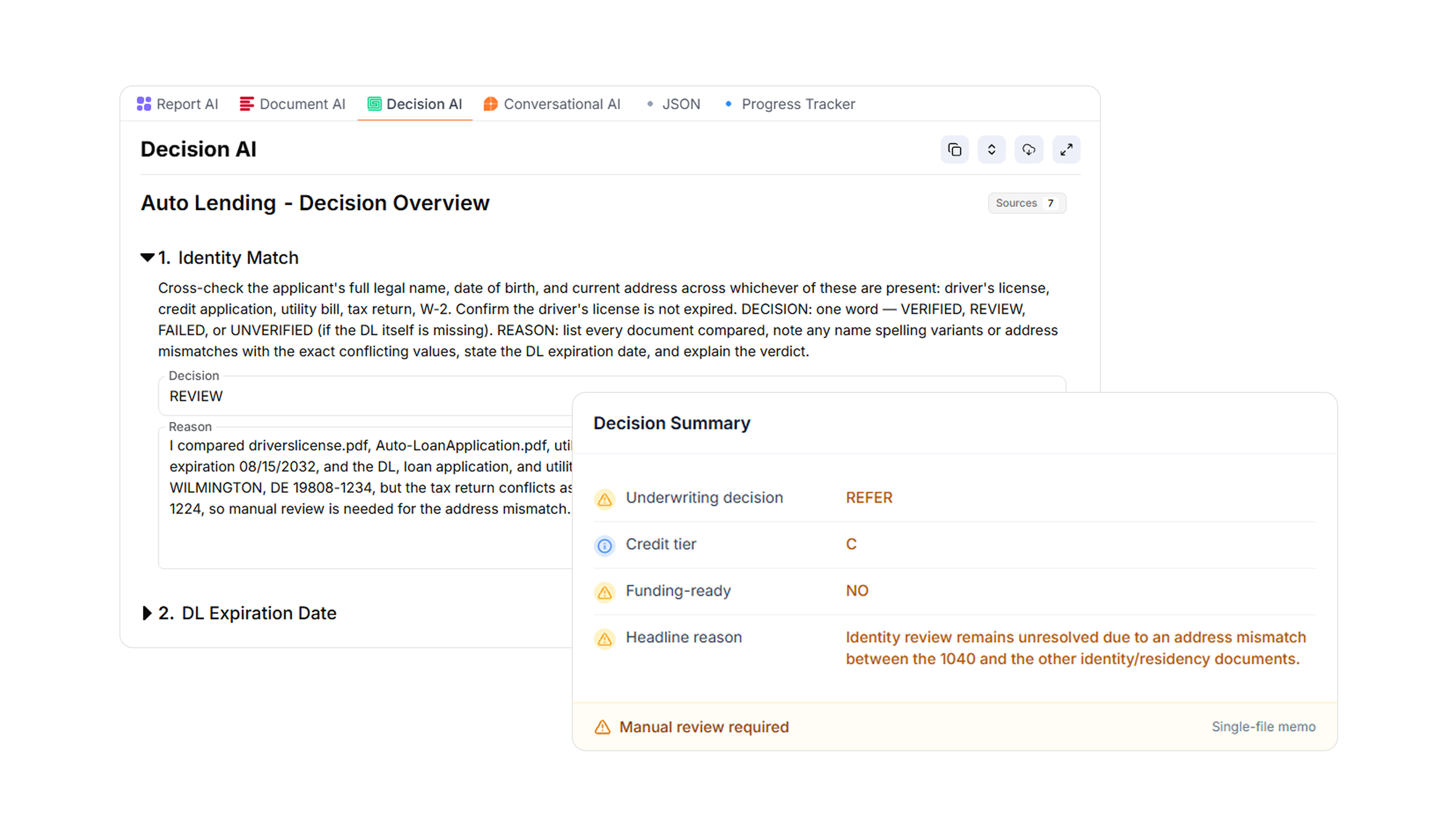
Model risk management teams should treat agents like any other model: documented, validated, monitored, and challenged. The institutions that struggle are the ones that bolt governance on after the pilot. Those who succeed design the control framework alongside the workflow.
How should a bank start with agentic workflows?
Most stalled AI programs fail on sequencing, not technology. The path that works, across the institutions in our Field Report, has four steps.
Pick one document-heavy workflow
Funding review, onboarding, or dispute intake, with a measurable baseline. Record current cost, cycle time, and error rate first; you cannot prove ROI against a baseline you never captured.
Fix the data path, not all the data
You do not need a multi-year data lake project. You need clean connections to the LOS, core, and document store for this one process. Data quality determines agent quality.
Ship with controls, then widen autonomy
Launch with tight approval thresholds and human review on every exception. As accuracy holds, raise the thresholds. Autonomy is earned in production, not assumed at kickoff.
Measure, audit, expand
Track cycle time and exception rates against your baseline, then extend to the next workflow so each expansion inherits a proven control framework.

This sequencing answers the question most vendors skip: not whether to implement agentic AI, but in what order, with what controls, and how business value gets proven at each step. The durable advantage goes to institutions that get their first workflow into production and compound from there. For a deeper view of where credit unions are moving agentic AI into core lending, fraud, and member-service workflows, see our AI for credit unions hub.
Agentic workflows in banking FAQs
Agentic workflows are banking processes executed by AI agents that plan, act, and adapt autonomously to reach a defined goal, such as assembling a fund-ready loan file or completing a KYC review. Humans set objectives and approve high-risk decisions; agents execute the multi-step work in between with minimal human intervention.
RPA follows fixed scripts and breaks on unexpected input, so exceptions fall back to staff. Agentic workflows are goal-driven: agents handle variation, work with unstructured data, and adjust mid-process. Banks typically keep RPA for stable keying tasks and deploy agents for exception-heavy work that RPA has not absorbed.
Yes, when governed properly. Safe deployments use bounded agent authority, human approval for money movement and credit decisions, complete audit trails, and validation under existing model risk management frameworks such as SR 11-7. Regulators do not prohibit agentic AI; they expect the same level of explainability and controls as with any other model.
Document-heavy, exception-prone processes deliver the fastest returns: loan origination and funding review, customer onboarding, KYC/AML operations, regulatory reporting, and fraud and dispute handling. These share high volume, unstructured data, and costly manual review, the exact conditions where autonomous agents outperform scripts and manual processes.
Yes. Smaller institutions often see faster payback because compliance and lending loads are fixed while staff are not. FORUM Credit Union reports 99% document-processing accuracy and 60% of loan applications auto-underwritten on Multimodal's AgentFlow.
A scoped first workflow typically reaches production in weeks to a few months, depending on data access and approval design. The variable is rarely the AI; it is how quickly the institution can connect existing systems, define approval thresholds, and complete model risk review.
Baseline the target workflow first, then track cycle time, cost per file, exception rate, and staff hours redeployed. Industry benchmarks: 15 to 20% cost reduction at moderate adoption and up to 200 to 2,000% productivity improvement in compliance tasks.
They replace tasks, not roles. Agents handle data gathering, document review, and exception triage; staff handle judgment work, member and customer relationships, and final decisions. Most institutions redeploy capacity toward growth: the same team handles multiple times the volume without added headcount.
.svg)


See what an agentic workflow does with your documents
.svg)
.svg)