2026 Multimodal Field Report

10 Insights on Agentic AI Adoption in Mid-Market Finance

What 450+ sales conversations told us about agentic AI adoption in mid-market financial services. Every quote verbatim. No customer names.

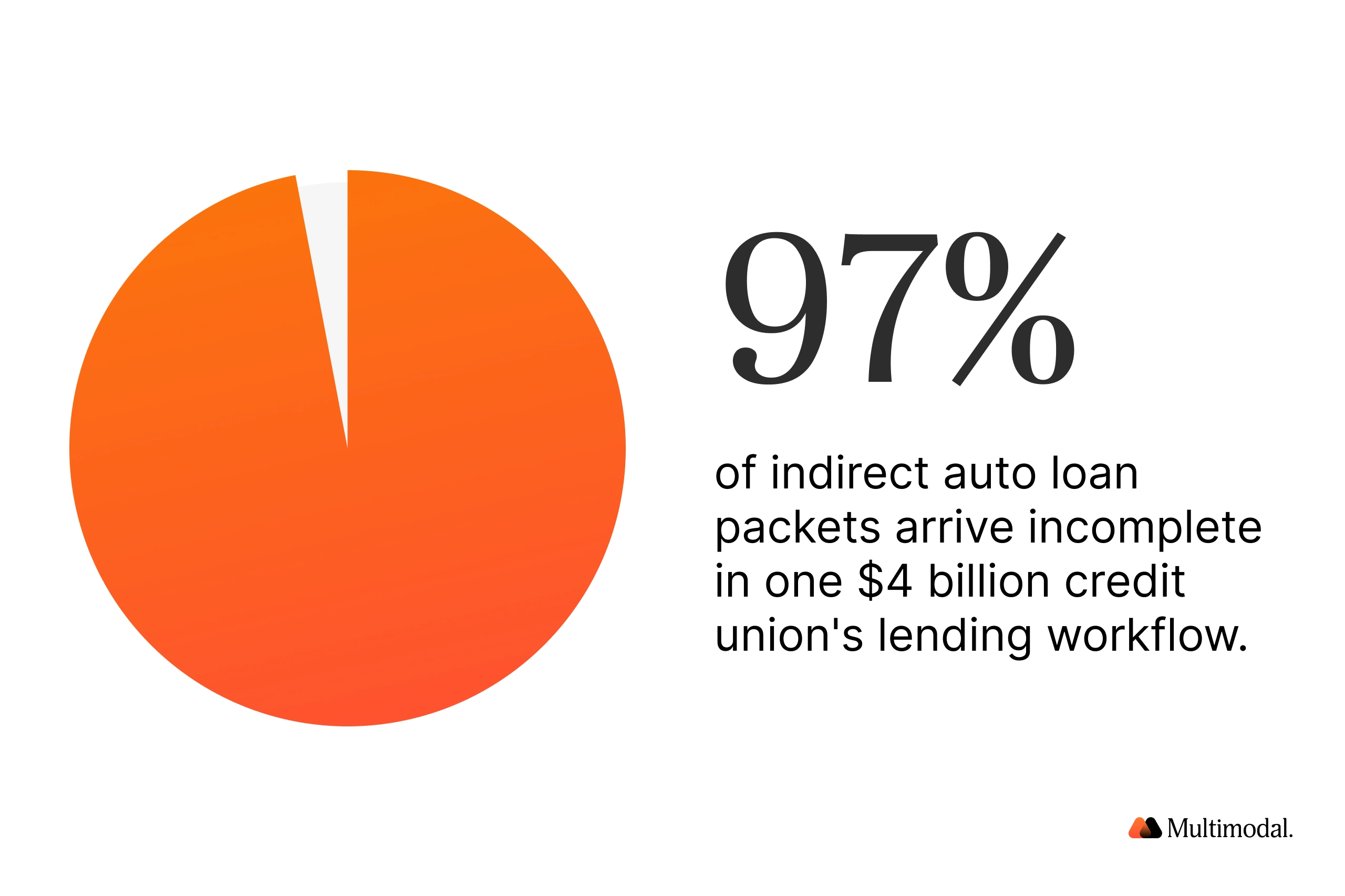
In one $4 billion credit union's indirect auto-lending workflow, 97% of incoming loan packets arrive incomplete, and 20% carry a red flag. The buyer mentioned it as a passing operational detail. We treated it as the most important number in our 2026 Field Report.

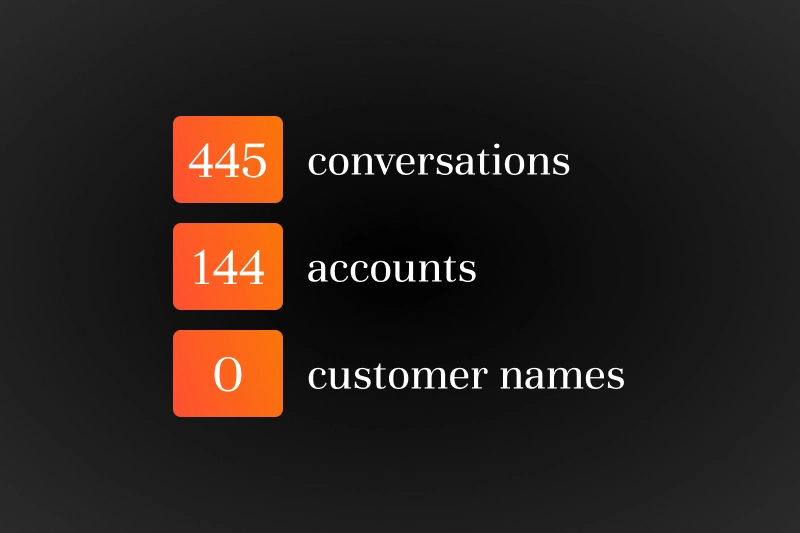
The technology is not what is stalling adoption of agentic AI in mid-market financial services. The bottlenecks are peer proof, Q1 budget cycles, and a data-completeness problem that nobody publishes. This piece walks through 10 patterns we observed across 445 prospect-facing conversations with mid-market financial institutions: credit unions, community banks, mortgage lenders, insurance carriers, and private equity portfolio companies. Every quote is verbatim. No customer names appear. The buyers are the protagonists. Multimodal is the lens.

A note on positioning We know this is a vendor writing about AI adoption. So we are putting the buyers' words first and our analysis second, and we are using their language where they used ours. Agentic AI refers to AI agents that pursue goals across end-to-end processes, plan their own next steps, and call tools or models as needed, with minimal human oversight on the routine paths and structured human intervention at defined decision points. That definition separates agentic AI systems from rule-based automation, generative AI assistants, and traditional AI that waits for a human to ask. It also frames what mid-market finance buyers told us they actually want.
97% of indirect auto loan packets arrive incomplete in one $4 billion credit union's lending workflow
The number the buyer disclosed unprompted.
Methodology

How we built the dataset

Total calls analyzed
445 prospect-facing conversations
Window
October 1, 2025 to May 21, 2026 (8 months)
Total call-hours
223 hours
Median call duration
28 minutes
Distinct accounts
144
Verticals included
Credit unions (70), community banks (32), mortgage lenders (72), insurance (77), PE-backed financial services (115), fintech (65), credit union advisory orgs (14)
1

Why mid-market banks refuse to be the first agentic AI customer

The most common deal-killer across credit unions, community banks, and insurance buyers is the explicit refusal to be the first reference customer. Skepticism about accuracy comes up far less often. Mid-market financial institutions want a peer of similar size, charter, and regulator profile to deploy first. That requirement is structural, baked into how risk-averse boards approve technology decisions.

The leadership tends to prioritize working with established companies that have demonstrated the solutions and implemented them. They don't want to be first in anything and are also somewhat conservative when it comes to AI.

Strategic lead, $4 billion credit union

We have board approval for a POC, but before we commit to production, we need to talk to a bank of similar size in a similar regulatory environment who's deployed this and is happy with it.

Operations leader, regional community bank

The conventional sales narrative says deals die over price or accuracy. The data says deals die over peer proof. The implication for vendors selling agentic AI into financial services: case studies belong at the top of the funnel, not after launch. The entire mid-market is, in effect, waiting for the entire mid-market to go first. Naming that paradox openly is more credible than pretending it does not exist.
2

"Agentic AI" is becoming a four-letter word inside credit unions

The category has burned out faster than the technology has matured. By Q1 2026, the term "agentic AI" carries vendor-fatigue baggage inside credit unions. Multiple buyer champions explicitly recommend not leading with the phrase.

One of the biggest obstacles you have in this industry right now is, you say 'agentic AI,' it's like a four-letter word, right? And so kind of demystifying it a little bit is really key. But once you start making ground in the credit union world, it's like wildfire, because we all talk.

Innovation lead, $4 billion credit union

What replaces the category language? Outcomes language. "Close loans five days faster." "Auto-approve 60% of clean packets." "Cut document processing time per file by 70%." The buyers we spoke with responded to operational metrics, and McKinsey's 2024 Global Survey on the State of AI documented a similar shift across financial services: the institutions reporting the highest realized value were those scoping use cases by business-unit outcomes rather than by capability category.

The implication for marketers and product leaders: the next 12 months of category positioning will favor specificity. "Agentic AI for indirect auto lending decisioning." "Agentic AI for claims first-notice-of-loss." "Agentic AI for member onboarding KYC." Those framings outperformed the unqualified term across every credit union segment we observed.

3

The "hard 20 percent" is the universal RPA failure story

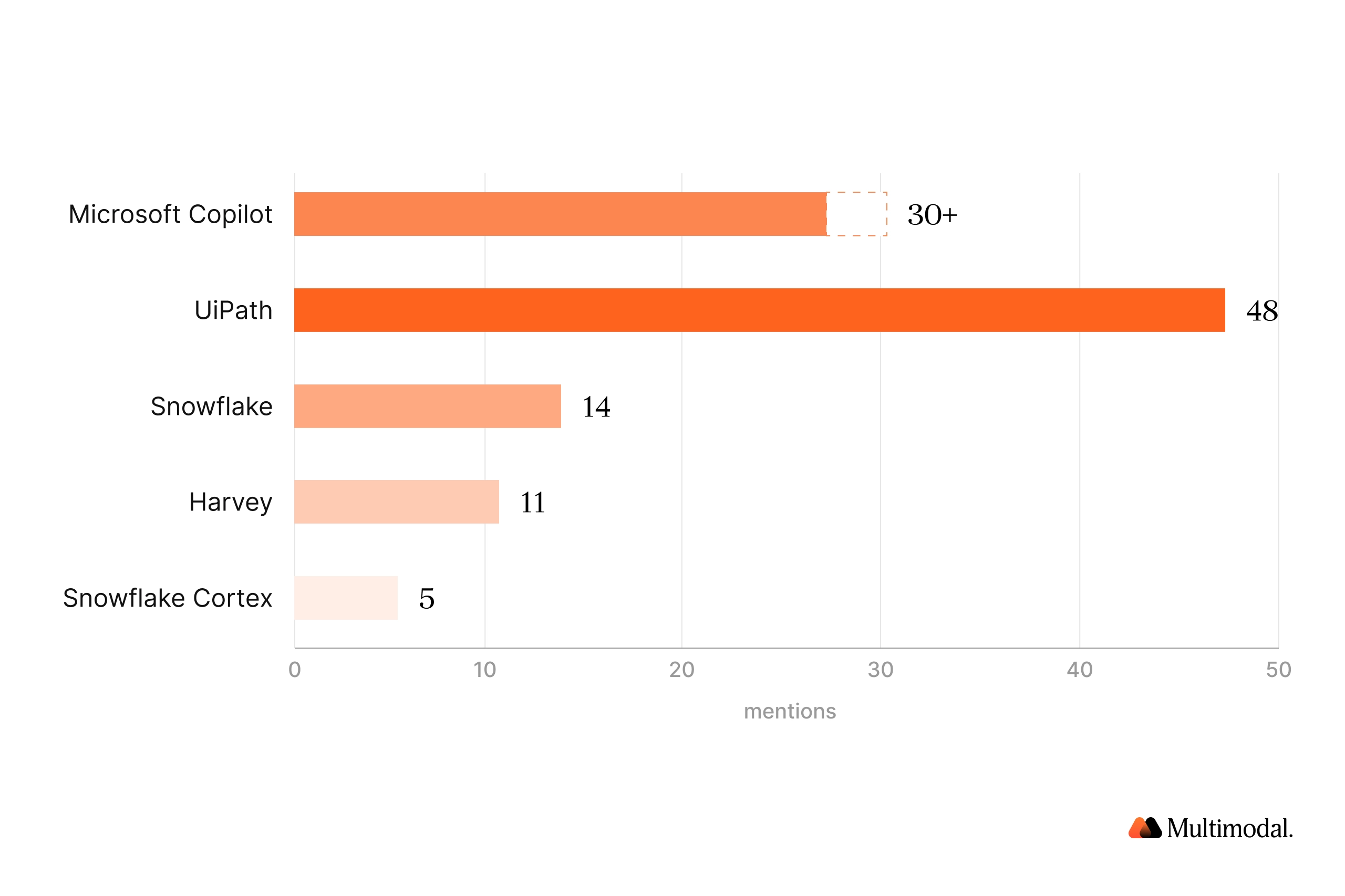
Mid-market financial institutions that have lived through a robotic process automation deployment describe failure in remarkably consistent terms. Automation handled 80% of the easy work and then collapsed on the long tail. UiPath alone surfaced in 48 of the 445 calls. Blue Prism, Automation Anywhere, Roots Automation, and "we built an internal bot" patterns add another 30-plus.

Vendor mentions across 445 calls: UiPath 48, Microsoft Copilot 30 plus, Snowflake 14, Harvey 11, Snowflake Cortex 5
Vendor mentions across 445 calls.

Anybody can fly above and talk about the easy 80 percent of the problem. It's the hard 20 percent that I need. 80 percent of that is going to take most of the time, and then the last four percent is going to take you an incredibly long time. Are you prepared for that?

CTO, mortgage technology platform

The "we already have RPA" objection actually argues for agentic AI rather than against it. Traditional automation collapses on exception handling. Unlike traditional AI workflows that follow predetermined rules, agentic AI systems plan around exceptions: they read unstructured data, query a knowledge base, escalate to a human analyst when confidence drops, and resume the workflow without rewriting the script. Gartner's work on AI in banking and investment services describes the broader shift from deterministic automation to goal-directed automation, and operations leaders consistently mapped that distinction to their own RPA scar tissue.

Framing matters. Selling agentic AI as "more automation" loses to RPA on familiarity. Selling agentic AI as the discipline of solving the long tail wins, because every operations leader in mid-market finance has lived through the long tail.

4

Auditability is becoming the new accuracy

Buyers in regulated financial services are explicitly transposing academic citation logic onto AI output. What they want is a citation-backed answer that survives a regulatory exam, and a confident generative response without sources no longer counts. This is a tonal shift from 2024's "is it accurate?" to 2026's "can you prove how you got the answer?"

I hearken it back to professors who are asking 'show me your sources.' Right now, you get a lot of responses from Claude or ChatGPT, you go through the laundry list, and people sort of take it as gospel. That doesn't work in an organization that relies on a deeper level of number-crunching and analysis. I don't trust the data until you can show me the trust of the data that's driving the AI engine. And that's going to be an issue.

EVP, mid-size community bank

The vendors that present AI as "intelligent" are losing to vendors that present AI as auditable. This tracks with the Federal Reserve's SR 11-7 framework on model risk management and the interagency model risk guidance, both of which weight transparency, traceability, and validated assumptions over headline accuracy metrics. Compliance monitoring used to be a separate function applied after the AI agent operates. Today it is a design constraint baked into the way agentic AI in financial services is built and sold.

The practical translation for product teams: every action an agent takes should produce a structured artifact that a human can review, a source citation that a model risk officer can trace, and a confidence score that an exception handler can act on. That is what "auditable" looks like in practice.

5

The hidden number: 97% of indirect auto loan packets arrive incomplete

The bottleneck in credit union indirect auto lending sits upstream of the underwriting decision. The documents arriving from dealers are functionally garbage. A head of indirect lending operations at a $4 billion credit union disclosed the number unprompted.

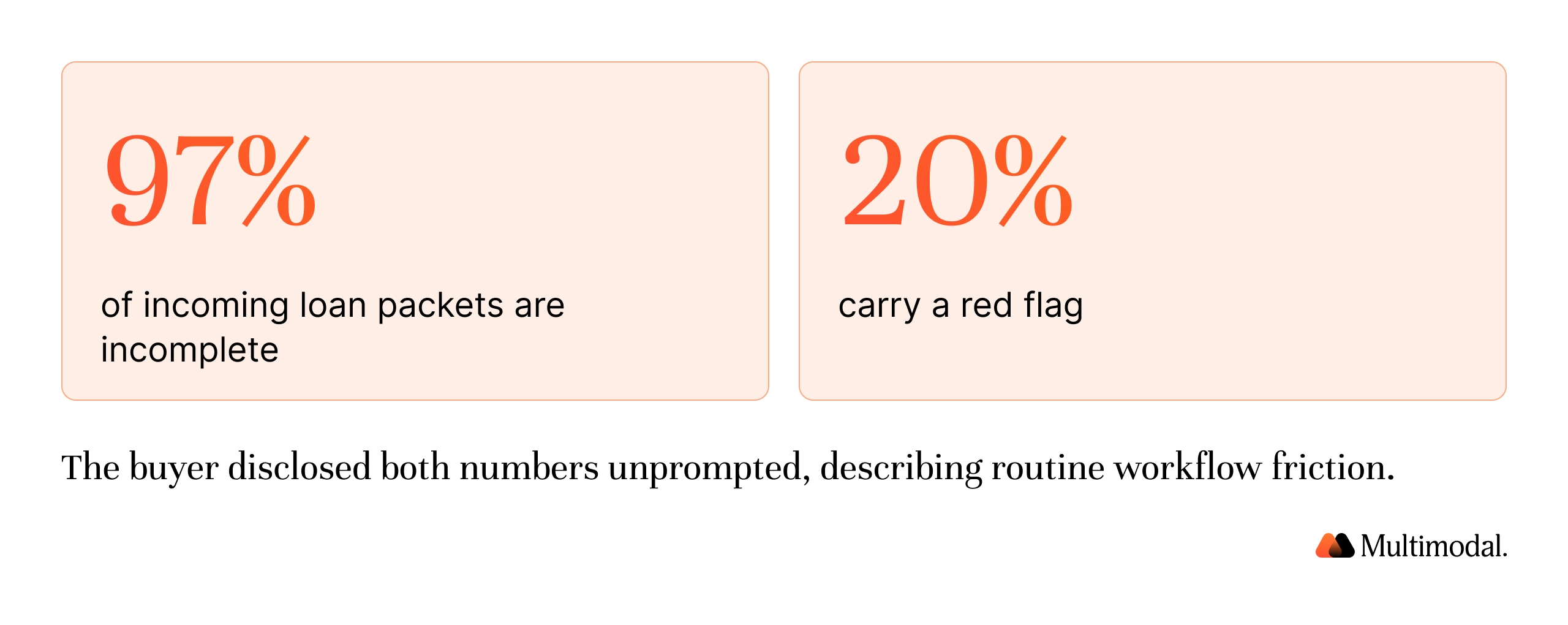
97% of incoming loan packets are incomplete; 20% carry a red flag
The buyer disclosed both numbers unprompted, describing routine workflow friction.

As far as friction, it's incomplete packets. 97 percent of our packets are incomplete, 20 percent have a red flag. So those are huge numbers. When 97 percent of our loans, even if you automated the work, they're not going to have what we need. That's a problem. Auditing has just always been completely manual. So that would be huge.

Head of indirect lending operations, $4 billion credit union

This reframes the AI value proposition entirely. Automating the underwriting decision without first solving completeness checking is solving the wrong problem. In this workflow, the real value of agentic AI lives upstream: ingesting unstructured data from dealer-side document packets, identifying gaps in customer income verification, flagging title and registration anomalies, and routing only complete packets to the credit-scoring model. That use case sits squarely in the operational layer most banking systems leave to manual effort.

It is also a useful example of how agentic AI banking use cases differ from those in algorithmic trading or fraud detection. The value sits in making the data clean enough to decide on, well before the decision itself. For credit unions, that is the most work and the most cost.

6

Human in the loop is non-negotiable, for regulators rather than buyers

Community banks and credit unions are designing AI workflows around what a regulator will accept, not around what an internal champion thinks the technology can handle.

The human-in-the-loop piece is critical. Critical. You can't reiterate that enough when it comes to the regulators. And the biggest difference is purely resources. If you look at the technology or the analytics team of a community bank, it's small.

Head of Operations, community bank

The vendors that frame human intervention as a sales objection are misreading the room. Human-in-the-loop is the regulator's design constraint, and the buyer is just the messenger. The competitive distinction worth fighting for is structured human oversight that does not slow the workflow down, rather than less human oversight. The real competitor in mid-market banking operations is rarely full automation. It is RPA plus ten human analysts clicking buttons on exception queues.

For chief technology officers and chief risk officers building governance frameworks around agentic AI, the practical question is where to position the human checkpoint. Routine tasks (data validation, document classification, format checks) can run with minimal human oversight. Decision moments that produce a customer-facing outcome (denial, pricing, escalation) should route to a human reviewer with full context, full source citations, and a one-click approve or reject.

7

"We already have Copilot" is the new "we already have RPA"

Microsoft Copilot has become the AI baseline in mid-market financial services. The choice mid-market buyers are making is between agentic platforms and the capabilities already bundled with their Microsoft enterprise agreement, rather than between agentic AI platforms and no AI at all. Twelve of 32 community bank calls reference Copilot as already deployed. More than 30 calls across the broader dataset do the same.

We generally have all of our employees on Copilot. But then I guess 20 percent of the company has ChatGPT Enterprise because they're the power users, the ones who couldn't really bear Copilot.

Head of digital, regional community bank

We have a license for Copilot. It can be agentic. I'm starting to get some things that aren't like the fancy document things you're seeing, but that kind of do other things. What can you guys offer that we couldn't already do?

Director of data analytics, $5 billion credit union

The most common buyer mental model is "we have Copilot for productivity, we need something else for workflows." That distinction is a positioning gift for agentic AI platforms that own the workflow layer. Copilot is a desktop assistant: it drafts an email, summarizes a meeting, answers a question. An agentic AI platform built for financial institutions operates across systems, executes tasks against banking systems of record, handles end-to-end processes, and produces audit trails that satisfy regulatory requirements. The two layers are complementary, not competitive, and buyers respond to vendors who articulate the boundary plainly rather than pretending Copilot is not in the room.

8

Snowflake plus Cortex is the silent in-house competitor

Snowflake surfaces in 14 of the 445 calls. Snowflake Cortex, the AI layer, is named in at least five. The pattern is consistent: a credit union or bank's internal data team has already stood up an in-house POC on Snowflake Cortex by the time external agentic AI vendors are in discovery. That internal POC is the competitor most external vendors never see on a slide.

We've had this data scientist standing up a POC through the Snowflake Cortex tool, setting up around our enterprise lending data set, and it's been pretty great so far. The challenges are really just in the work and rigor of the data catalog, data definitions, those sorts of things.

Head of data, $4 billion credit union

The honest framing wins this conversation. Yes, a Snowflake-native data team can build agentic AI workflows. Yes, machine learning and deep learning capabilities are accessible through Cortex without a separate platform. The constraints are the work and rigor of the data catalog, the cost of building exception handling for every workflow from scratch, and the time it takes to add governance frameworks an examiner accepts. McKinsey's 2024 Global Survey on the State of AI reported that the gap between high performers and the rest in scaling AI across enterprise workflows was widening, with data foundations and operating model gaps cited as the dominant blockers.

The right positioning for agentic AI vendors says: yes, you can build this. You should plan for it to take longer than your data scientist's slide deck implies, especially the data quality work and the model risk management work. Here is how a vendor platform compresses that path. That posture is more credible than dismissing the internal POC, which is often the most engaged buyer-side champion in the room.

9

Adding a vendor is a regulatory event, not a procurement event

Vendor rationalization is accelerating across mid-market financial services, driven by third-party risk management pressure rather than by budget pressure. Regulators have raised the cost of adding new vendors to the point where buyers prefer to consolidate agentic AI workflows within existing trusted relationships rather than sign a new SaaS contract.

Beyond just speed to value, it's more so a play for vendor rationalization to meet regulatory requirements on third party, or even to avoid regulatory scrutiny on why you have all these additional third parties. So by leveraging relationships you already have, you can sort of get away with adding new things to your ecosystem more easily than if you're just introducing a bunch of new partners.

Head of Operations, community bank

This is the operational reality of how financial institutions run procurement in 2026. Every new vendor triggers a third-party risk review, a vendor management policy update, a board reporting line item, and in many cases an examiner question at the next audit. The OCC's third-party risk management guidance (OCC Bulletin 2023-17) formalized expectations that boards and senior management actively oversee the full lifecycle of every third-party relationship, from due diligence through termination. For agentic AI vendors, the expansion path often runs through an existing trusted relationship rather than around it: integration with the core platform, white-label distribution through a CUSO, or a partnership with a system integrator the institution already engages.

The lesson for go-to-market leaders: build a partnership map alongside the direct sales map. Both can compound, but only one of them survives the regulator-driven procurement cycle that defines mid-market buying.

10

POCs stall on budget cycles, not on accuracy

This is the most under-discussed pattern in the dataset. When a POC stalls between "you've shown us something valuable" and contract signature, the blocker is almost always the budget calendar, not the technology.

I think this information is enough to understand what we can accomplish in each phase. And so I think the next step would probably be me looking at my budget, trying to figure out what makes sense here.

Head of data, $4 billion credit union, after a successful demo

Our business plan isn't fully finalized and approved until the end of January. So within the next couple of weeks, I should know more.

Innovation lead, $3 billion credit union

We tracked at least 30 deals in which the demo was a success, the technical fit was confirmed, the compliance review was clean, and the quarter-to-quarter slip was driven entirely by the institution's budget approval calendar. The marketing implication is straightforward. The educational content that lands hardest in mid-market financial services is a one-page ROI template the champion can walk into their CFO's office during budget season: estimated annual hours reclaimed, lower operating costs, a clear cost-to-deploy line, and a payback window that fits the institution's planning cycle. Another accuracy demo will not close the gap. A CFO-ready artifact will.

Agentic AI vendors who arm their champions with that artifact convert their stalled Q1 deals into Q2 wins. Vendors who keep sending case studies into the calendar gap watch the same deals slip again.

The negative space

What the data does not show

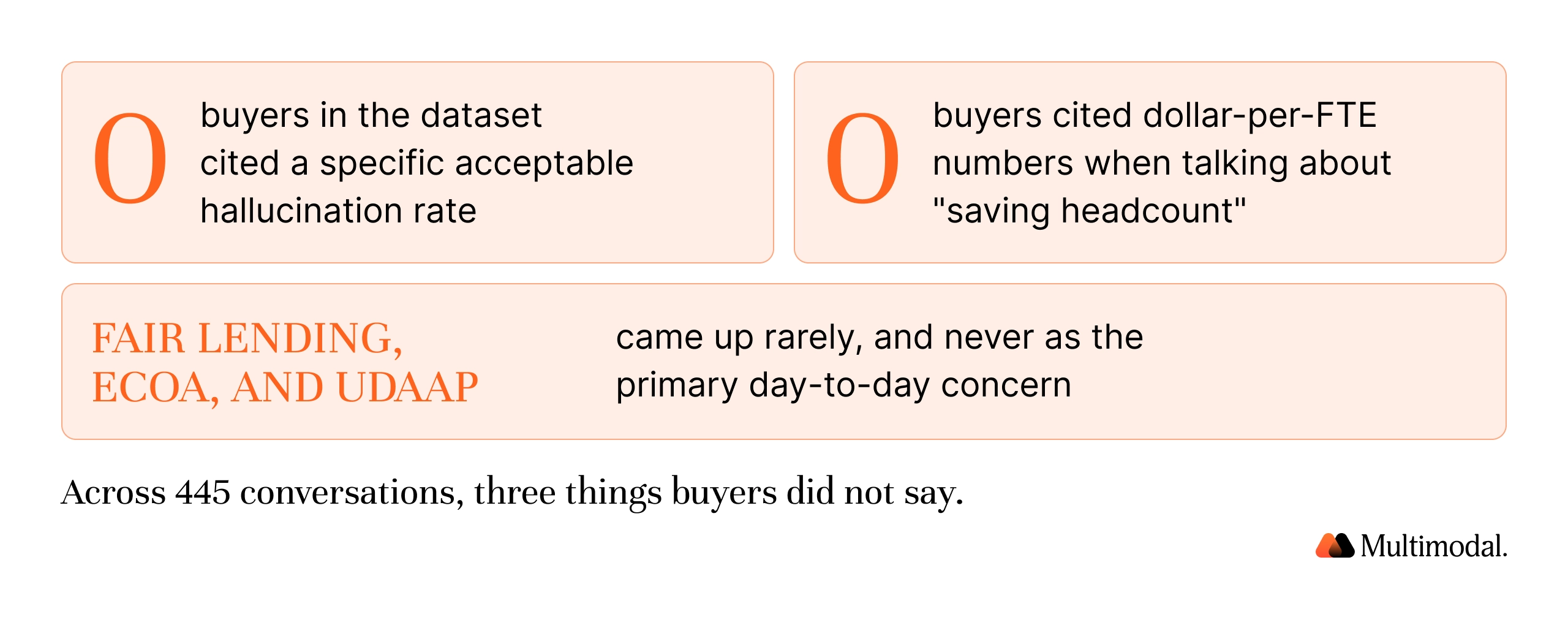
Cost-per-FTE figures are mostly absent. Buyers talk about "saving headcount" but rarely cite per-FTE dollar figures. That suggests mid-market financial institutions do not yet have a sharp ROI calculus for agentic AI. The institutions that develop one first will set the benchmark for the rest.

Hallucination is named as a concern but rarely benchmarked. No buyer in the dataset cites a specific acceptable hallucination rate. The implicit expectation is "zero" or "deterministic." That is unrealistic for any AI system handling unstructured data, and it leaves a useful conversation on the table: what false-positive rate can the operational workflow tolerate, and what review process closes the gap?

Fair lending, ECOA, and UDAAP appear in credit union and community bank conversations but rarely surface as the primary concern. The biggest day-to-day worry for operations leaders is throughput, not regulatory fairness. That is a gap worth watching, since the regulatory environment around AI fairness is tightening regardless of where buyers currently rank it.

Across 445 conversations, three things buyers did not say: a specific acceptable hallucination rate, dollar-per-FTE numbers, and fair lending as a primary concern
Across 445 conversations, three things buyers did not say.
The real story of 2026

The technology is no longer the moat

The technology is not what holds back agentic AI in mid-market financial services. What holds it back is peer proof, Q1 budget approval calendars, and the unglamorous work of cleaning dealer-supplied loan packets, claims documents, and customer onboarding files. The 2026 buyer is ready. The 2026 procurement cycle is the bottleneck.

That tension is the actual story. Across 223 hours of conversations with operations leaders at 144 institutions, the pattern repeats: a champion sees the value, the CIO confirms the platform, the compliance officer signs off on the model risk framework, and then the deal sits for two quarters waiting for next year's strategic planning to start. Vendors who win in this market treat the budget cycle as the deliverable. They build ROI templates the champion can present. They publish case studies that look like the buyer's peer. They invest in third-party education channels because vendor-led education is rejected on principle. And they design their agentic AI platforms so that the regulator sees auditability, the operations leader sees throughput, and the CFO sees a measurable line on the operating expense report.

That posture compounds. Vendors who pursue it consistently will own the next 24 months of agentic AI adoption in retail banking, commercial lending, insurance underwriting, and PE-portfolio enablement. The moat is the execution discipline around how agentic AI is sold, deployed, and proven inside compliance-sensitive financial institutions.

Two ways to go deeper

We are convening a closed-door peer roundtable for credit union and community bank operations leaders in August 2026. The next Field Report, with insurance and PE-portfolio cuts, ships Q4 2026.