
NCUA published a formal AI Compliance Plan and AI Resource Hub (ncua.gov/ai, September 2025). The agency appointed a Chief AI Officer (Amber Gravius) to oversee AI governance for the 2025-2026 examination cycle. NCUA's guidance aligns with the NIST AI Risk Management Framework, which means credit unions must document artificial intelligence model inputs, outputs, and governance decisions in their lending operations.
Any AI system influencing a lending decision must produce an auditable rationale. When a decision model recommends approval, denial, or pricing, the institution must be able to show an examiner exactly what inputs drove that output and who approved the decision logic. Credit unions without explainable, audit-ready AI face growing examination risk.
AgentFlow vs Automation Anywhere
AgentFlow is built for regulated finance. Automation Anywhere is a cross-industry RPA.
AgentFlow is an AI-native automation platform. Automation Anywhere is robotic process automation software with AI agents and agentic capabilities layered on top.
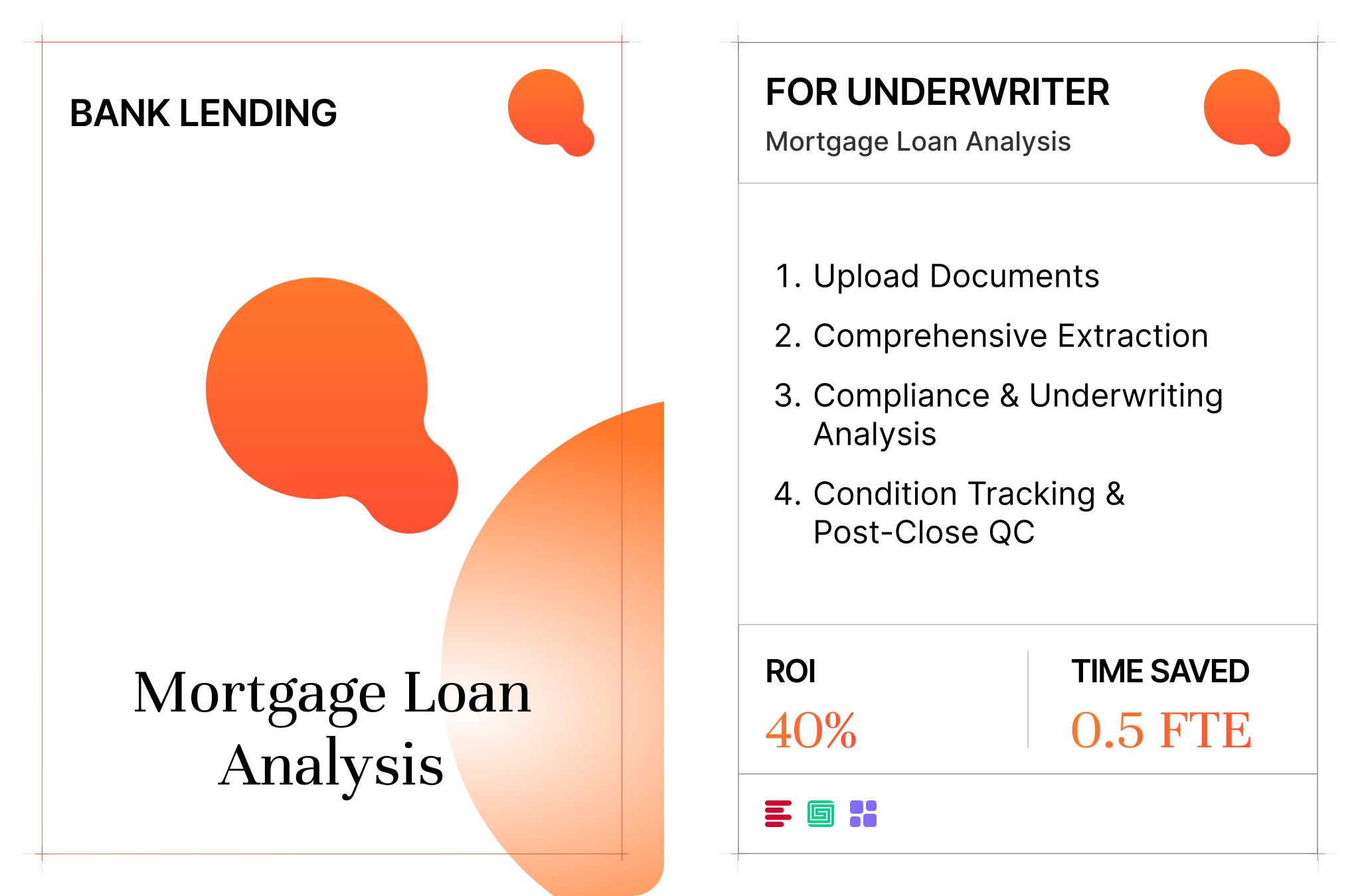
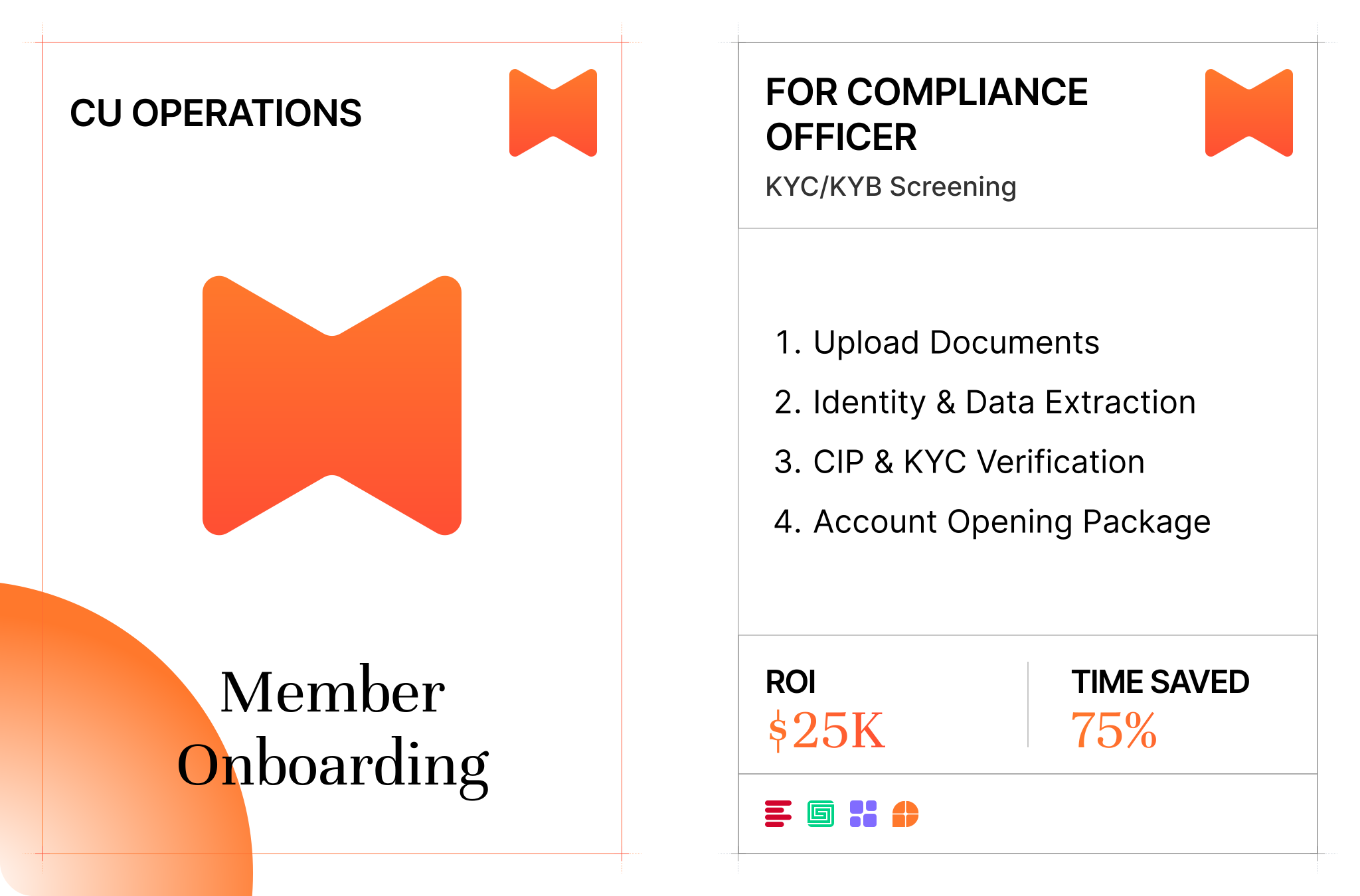
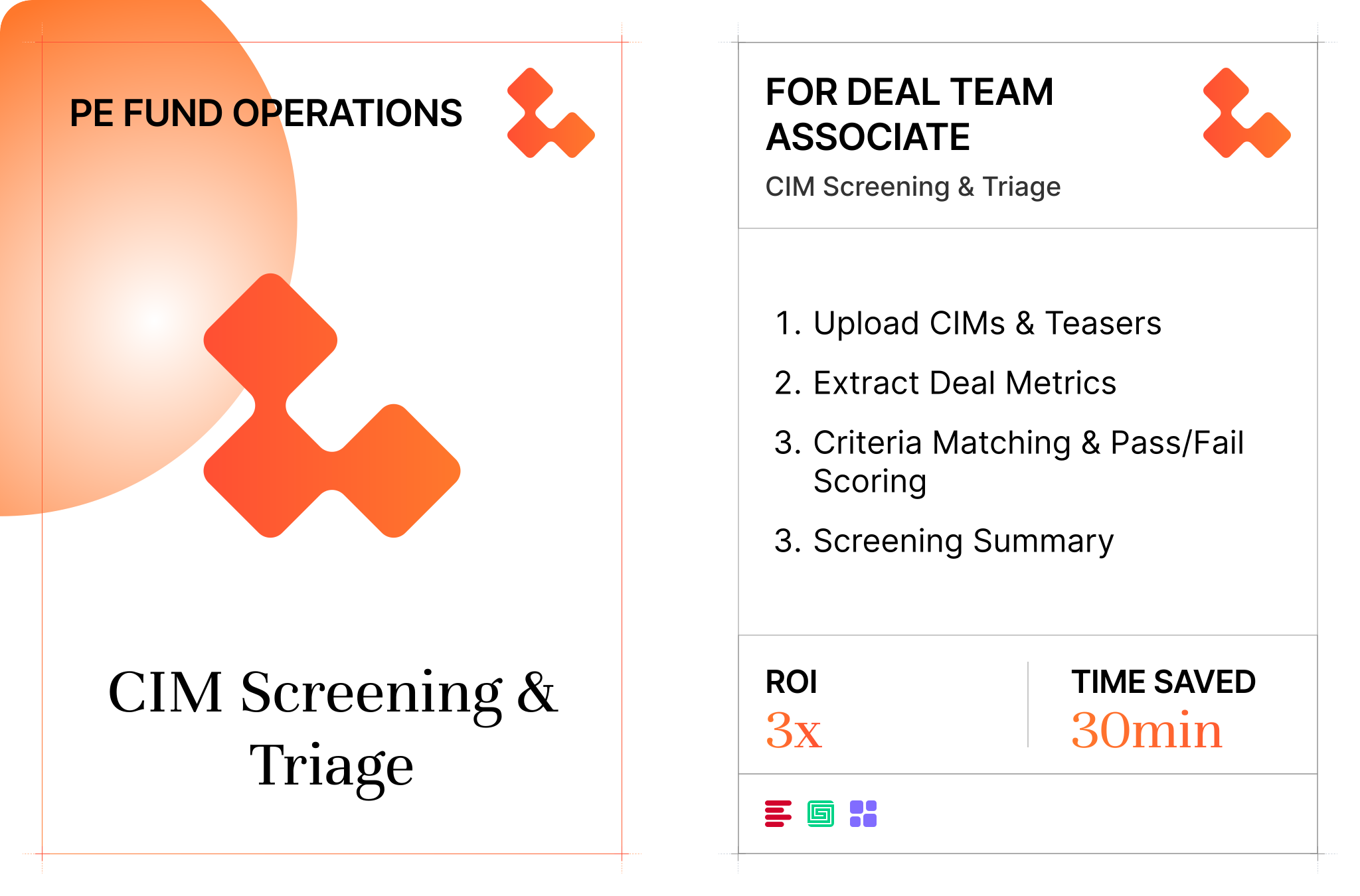
AgentFlow ships 100+ production-tested Playbooks that automate full business processes in lending, claims, customer onboarding, and M&A. Automation Anywhere's financial services depth is mostly partner-built, leaving most organizations to implement their own solutions.
AgentFlow reads complex financial documents at 99%+ field-level accuracy, including scanned and handwritten formats. Automation Anywhere needs an OCR or IDP tool on top of the base software to process the same inputs.
SEE AGENTFLOW in action

Automation Anywhere is one of the largest robotic process automation platforms in the market, with agentic capabilities added over the last 24 months. AgentFlow is an automation platform built as agentic process automation from day one, with automation technologies tuned for regulated finance.
Both let teams automate repetitive tasks and more complex processes — but the path to production, the maintenance burden, the process design effort, and the fit for different systems differ significantly.
Where this comparison is most useful. Process excellence leaders, CIOs, and automation center of excellence owners evaluating intelligent automation for lending, claims, servicing, or M&A processes will find the sharpest contrasts below. For high-volume horizontal tasks, Automation Anywhere stays strong. For regulated finance workflows, AgentFlow is the clearer fit.
01
Automation Anywhere is a cross-industry RPA. AgentFlow is purpose-built for financial services.
The core difference: AgentFlow is designed to automate the whole financial services process from intake to decision to system of record update. Automation Anywhere is designed to automate processes across virtually any industry or function.
Automation Anywhere
Cross-industry enterprise automation
- Cross-industry enterprise automation across IT, HR, finance, procurement, and 20+ other business processes. Financial services is one vertical among many.
- Financial services accelerators come mostly from partners and require configuration for each company's core systems, data, and policy engines.
- Strongest for high-volume, rule-based, repetitive tasks like AP, ITSM, and employee onboarding at large scale.
- Named a Leader for the seventh consecutive year in the 2025 Gartner Magic Quadrant for Robotic Process Automation, with agentic AI capabilities expanding across its platform.
AgentFlow
Purpose-built for regulated finance
- Purpose-built for banks, credit unions, insurance, and PE. Every product decision is made with regulated finance as the primary focus.
- 100+ prebuilt Playbooks — credit decisioning, KYC & onboarding, FNOL intake, loan servicing, M&A due diligence — with policy logic, data mappings, and integrations already wired for regulated organizations.
- Strongest for processes with variable inputs, exceptions, and regulatory review — where most organizations find that point solutions and legacy RPA break down.
- Positioned narrowly for regulated finance, where explainable AI and audit-ready agents are requirements, not nice-to-haves.
AgentFlow is the shorter path forward for lending, claims, servicing, and customer onboarding workflows. Automation Anywhere is a strong fit for horizontal back-office intelligent automation at enterprise scale, with a mature toolset for process discovery and process mining across different systems.
02
Automation Anywhere breaks on non-standard documents. AgentFlow treats them as the default input.
Roughly 80% of enterprise data is unstructured — consistently reported by both Gartner and IDC. Agentic process automation is built for that reality.
Automation Anywhere
Scripted bots on structured inputs
- Traditional RPA follows a script. When a document is scanned crookedly, a form field is missing, or an email replaces a PDF, the bot breaks or skips the record — triggering manual processes downstream.
- Handling variable documents requires stacking IDP, OCR, machine learning, and custom generative AI components on top of the base RPA software, increasing the integration surface.
- Only 20–30% of RPA projects are considered fully successful; 30–50% either stall, need rework, or are abandoned altogether (Nalashaa, 2026).
AgentFlow
AI reads the input, not the screen
- Scanned, handwritten, and multi-page document packages are parsed with the same accuracy as clean, structured PDFs. The platform normalizes structured and unstructured data into one pipeline.
- Document AI is native. Any document format — scanned PDFs, handwritten forms, multi-page packages — is supported out of the box, with zero separate tools to license, deploy, or implement.
- Artificio's 2025 study across 500,000 transactions found AI agents achieved accuracy rates 40% higher than RPA on variable-layout, unstructured documents (ERP Today, 2025).
RPA tools that depend on structured data at every step force banks to either transform data upstream, absorb the exception load downstream, or re-engineer the process in the middle. Agentic process automation absorbs that exception load natively and keeps the process moving.
03
Automation Anywhere treats compliance as an add-on. AgentFlow treats it as core.
Forrester has argued that agentic systems adapt to the dynamic, unpredictable reality of real-world processes in ways traditional RPA tools — which rely on brittle customization — cannot (Forrester, 2025).
Automation Anywhere
Compliance depends on how you build it
- Audit logging and governance exist across the platform, but compliance depth depends on how each automation is built. Explainability, reason codes, and model governance typically require custom support on top of the base RPA layer.
- Human intervention flows are custom-developed per process by the customer or a systems integrator.
AgentFlow
Compliance built into every decision
- Every decision carries a confidence score, its supporting evidence, and a full audit trail. SOC2 Type II, fair-lending alignment, and NCUA readiness are built-in platform capabilities.
- Built-in human-in-the-loop review automatically routes low-confidence cases, high-risk thresholds, and policy exceptions to a reviewer — with the context needed to act on each exception in a clean user interface.
For banks and credit unions, adaptability is where the cost-effective case lives — especially across portfolios of 10 to 50 production processes where rule changes, format drift, and policy updates drive most of the long-term maintenance bill.
Feature comparison
AgentFlow vs Automation Anywhere: platform capabilities
A full function-by-function breakdown across architecture, compliance, and fit for regulated finance.
Feature
AgentFlow
Automation Anywhere
AI-native agentic architecture
Yes
Partial — AI agents layered on RPA core
Purpose-built for financial services
Yes
No — cross-industry
100+ prebuilt Playbooks (lending, claims, KYC, BSA/AML, M&A)
Yes
No
Handles non-standard, scanned, handwritten documents at 99%+ accuracy
Yes
No — separate IDP/OCR tool required
Built-in human-in-the-loop review
Yes
Custom build
Explainable decisions with per-action audit trails
Yes
Partial
SOC2 Type II
Yes
Yes
NCUA and fair-lending alignment out of the box
Yes
No
Native core banking, LOS, GL, and claims connectors
Yes
Partial
Integrates with downstream digital systems (ERP, CRM, data warehouse)
Yes
Yes — broader connector library
Pricing model
Usage-based, tied to workflow outcomes
Cloud Starter ~$750/user/mo; enterprise ~$100K–$500K+ annually
Typical POC to production
5–6 weeks
3–6 months
Forward-deployed engineering from day one
Yes
No — partner-led support
User-friendly for business ops teams
Yes — low learning curve on Playbooks
Mixed — citizen-developer tools exist; complex RPA still needs developer support
Source for Automation Anywhere pricing: Automation Atlas, 2026.
Use case fit
Which platform wins by workflow type
AgentFlow and Automation Anywhere serve genuinely different workflow categories. The clearest signal for fit: regulated process or horizontal task?
Workflow
Best fit
Loan document processing and underwriting
AgentFlow
KYC, AML, and sanctions monitoring
AgentFlow
Insurance claims (FNOL to settlement)
AgentFlow
Loan servicing, collections, and member inquiry response times
AgentFlow
M&A due diligence and data room review
AgentFlow
Financial close and reporting
AgentFlow
IT helpdesk, ITSM, and L1 support ticket triage
Automation Anywhere
HR onboarding, procurement, and cross-industry ERP tasks
Automation Anywhere
High-volume data entry across legacy systems
Automation Anywhere
Blue Prism, UiPath, and Pega are the closest competitors to Automation Anywhere in the broader RPA market. Among RPA alternatives, AgentFlow is the one automation tool built specifically for regulated finance.
Integration & support
Systems, services, and time to value
Many organizations keep existing RPA bot fleets in place for horizontal processes and let AgentFlow automate the regulated process work those RPA deployments were never designed for.
AgentFlow integration
One intelligent automation fabric
AgentFlow integrates with the data and systems financial institutions already run: core banking, loan origination, claims, policy admin, GL, CRM, and data warehouse systems. API, event, and file-based integration patterns are supported. The platform sits across the data layer, the policy layer, and the integration layer as a single fabric. It works with the software your teams already rely on — including Automation Anywhere.
AgentFlow support model
Forward-deployed engineers on every deployment
AgentFlow assigns forward-deployed engineers to every deployment, compressing the onboarding ramp and the time from POC to production to a typical 5–6 weeks. The support team is built around process owners in regulated finance — not systems integrators serving cross-industry portfolios. For mid-market banks and credit unions without a large internal automation center of excellence, this difference often decides the total cost of ownership over three years.
For teams planning a migration from legacy RPA to agentic AI, the practical path is incremental: keep the RPA products that work, replace the ones that cost more in maintenance than they save in efficiency, and route new process use cases to the AI-native platform. This keeps the business on a cost-efficient path without a disruptive rip-and-replace.
Customer proof
What AgentFlow customers have achieved
Both organizations started with one workflow, hit the numbers, and expanded across more business processes — the clearest signal of durable automation in financial services.
FORUM Credit Union · $2.3B assets · Fishers, Indiana
99%
Document classification & extraction accuracy
70%
Lift in loan processing capacity
100%
Automated decisioning on 62 auto-loan packages
"There's a lot of easy decisions — so many easy decisions that we don't need to have a human look at it. It's kind of a win-win-win." — Andy Mattingly, COO, FORUM Credit Union
- 99% accuracy on both document classification and data extraction across 62 auto-loan packages (15–61 pages each)
- 70% lift in loan processing capacity (America's Credit Unions, 2025)
- 100% automated decisioning through AgentFlow integrated into Temenos core
80%
Reduction in per-document processing costs
20×
Faster loan approvals
"Nobody is doing what we're doing with Multimodal — not even close." — Jim Beech, CEO, Direct Mortgage Corp.
- Loan processing costs cut 80% and approvals moved from weeks to minutes
- Expanded from paystubs to 200+ document types after initial deployment
The new frontier
The future of finance automation is agentic, not scripted.
Intelligent automation and robotic process automation will keep automating the predictable, high-volume tasks they were designed for. Agentic process automation will absorb the business processes RPA was never built for: document-heavy, exception-heavy, regulated workflows that depend on judgment, structured data, and unstructured data in the same process.
For most organizations in banking and insurance, the practical question is not whether to adopt agentic AI — it is which platform owns the regulated process work, which tool stays in place, and which automation technologies to invest in next.
Frequently asked questions
Yes, for horizontal back-office automation (AP, ITSM, HR) and high-volume, rule-based tasks. For vertical lending, claims, and KYC processes that depend on non-standard documents and explainable decisions, most financial services buyers need to layer IDP, machine learning, and AI agents on top of Automation Anywhere — or choose a purpose-built platform like AgentFlow.
For the processes AgentFlow covers, yes. Teams typically run AgentFlow and their existing RPA software side by side and retire each RPA bot as the matching Playbook goes live. The migration is incremental, not a rip-and-replace, and it keeps support costs predictable during the transition.
For stable, rule-based tasks across structured data, legacy robotic process automation is usually cheaper per transaction once the bots are built. For workflows with variable inputs and exceptions, agentic process automation is cheaper in total cost of ownership because it cuts rule updates and maintenance hours. A 2025 Artificio study found organizations saw an 80% reduction in configuration and maintenance spend on unstructured-document workflows thanks to AI agents' self-learning capabilities.
UiPath, Blue Prism, and Pega Platform are broad enterprise automation platforms similar in profile to Automation Anywhere, each with their own agentic AI roadmap. AgentFlow's positioning against all of these competitors is the same: narrower industry focus, deeper out-of-the-box Playbook coverage for regulated finance, and an AI-native foundation rather than an add-on. Blue Prism leans toward process automation at enterprise scale; Pega leans toward case management and BPM.
No. The term most RPA vendors use is "digital workers" — rule-based bots that mimic a human performing tasks at a screen. AI agents pursue a goal, read context, choose tools, and hand off to humans when needed. The primary distinction: scripted bots execute a fixed path; AI agents reason across a business process and automate end-to-end, including the judgment steps that traditional robotic process automation cannot.
Compliance and Governance: What NCUA Examiners Now Expect

SOC 2 Type II
PCI DSS
ISO 27001
Complete Audit Trail
Model-Agnostic
Explainable AI
SSO & RBAC
Private Deployments
Human-in-the-Loop
Make agentic automation your competitive advantage
See AgentFlow automate your own lending, claims, or KYC process in a 30-minute session.
.svg)
.svg)