Agentic AI Playbooks: Pre-Built Workflows for Banks, Credit Unions, and PE Firms




Table of contents
Key Takeaways:
- Agentic AI Playbooks cut deployment times while boosting accuracy, efficiency, and compliance in financial operations.
- End-to-end automation beats fragmented tools on ROI by unifying intake, decisioning, and reporting.
- Compliance is built in from day one, audit trails, explainability, and human oversight included.
- Leading institutions are shifting teams from manual processing to smarter decision-making.
- Platform selection hinges on accuracy, integration depth, and deployment speed.
Get 1% smarter about AI in financial services every week.
Receive weekly micro lessons on agentic AI, our company updates, and tips from our team right in your inbox. Unsubscribe anytime.
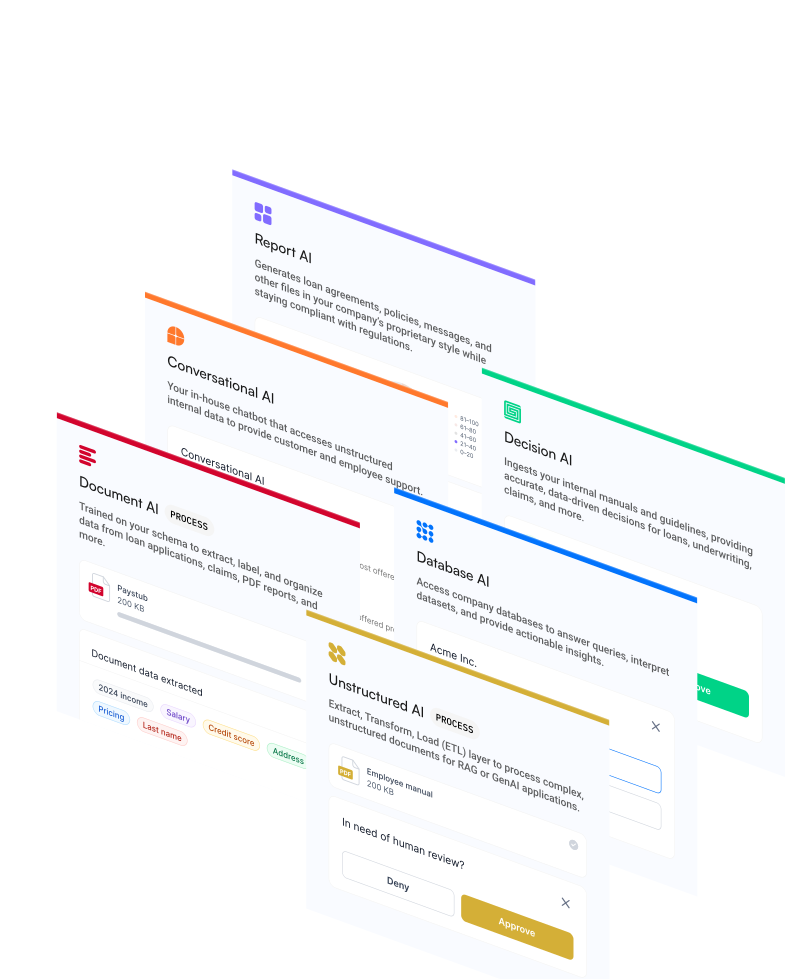
An agentic AI Playbook is a pre-built, governed workflow that bundles AI agents, integrations, schemas, and compliance rules for a specific business process. Each Playbook automates an end-to-end workflow, such as loan origination or claims intake, and can be tested and deployed in hours instead of weeks.
Agentic workflows have moved from concept to production across financial services faster than most institutions expected. According to Gartner, more than 60% of organizations plan to deploy agentic AI within the next two years, the most aggressive adoption curve of any emerging technology in their survey. The teams behind that demand are the same teams processing loan files, clearing compliance backlogs, and running due diligence on inbound deal flow. Playbooks are built for exactly that work.
What Is Agentic AI? (And What Makes a Playbook 'Agentic'?)
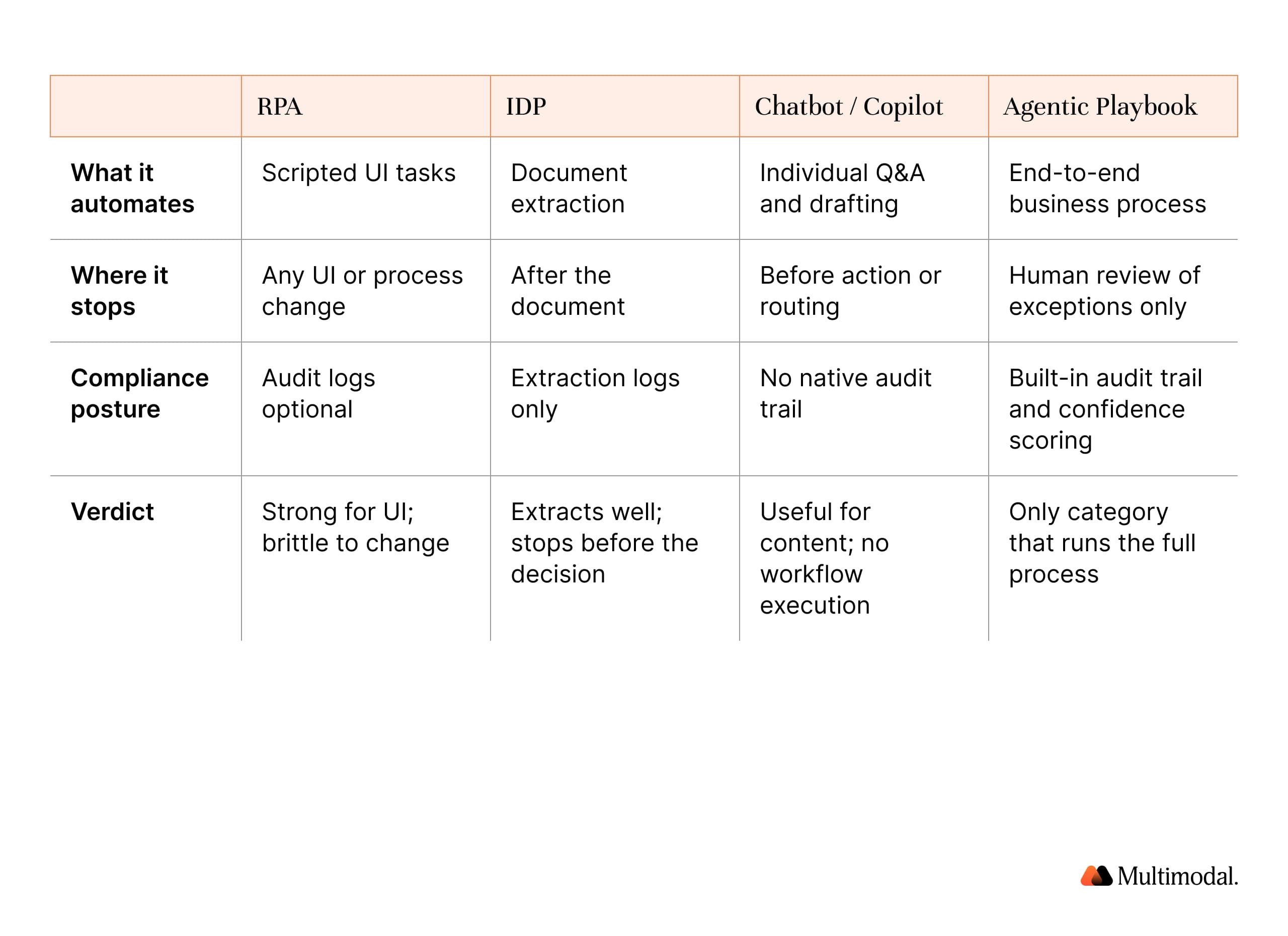
Agentic AI refers to systems that plan and execute multi-step AI workflows autonomously, taking action across connected data sources, applying business logic, and producing auditable outputs. Unlike a chatbot that responds to prompts or an RPA bot that follows scripted clicks, an agentic system perceives context, decides which steps to take, and routes exceptions to humans at the right moment. According to McKinsey, 23% of organizations are already scaling agentic AI systems, and in banking, early deployments are already reducing manual workloads by 30% to 50%.
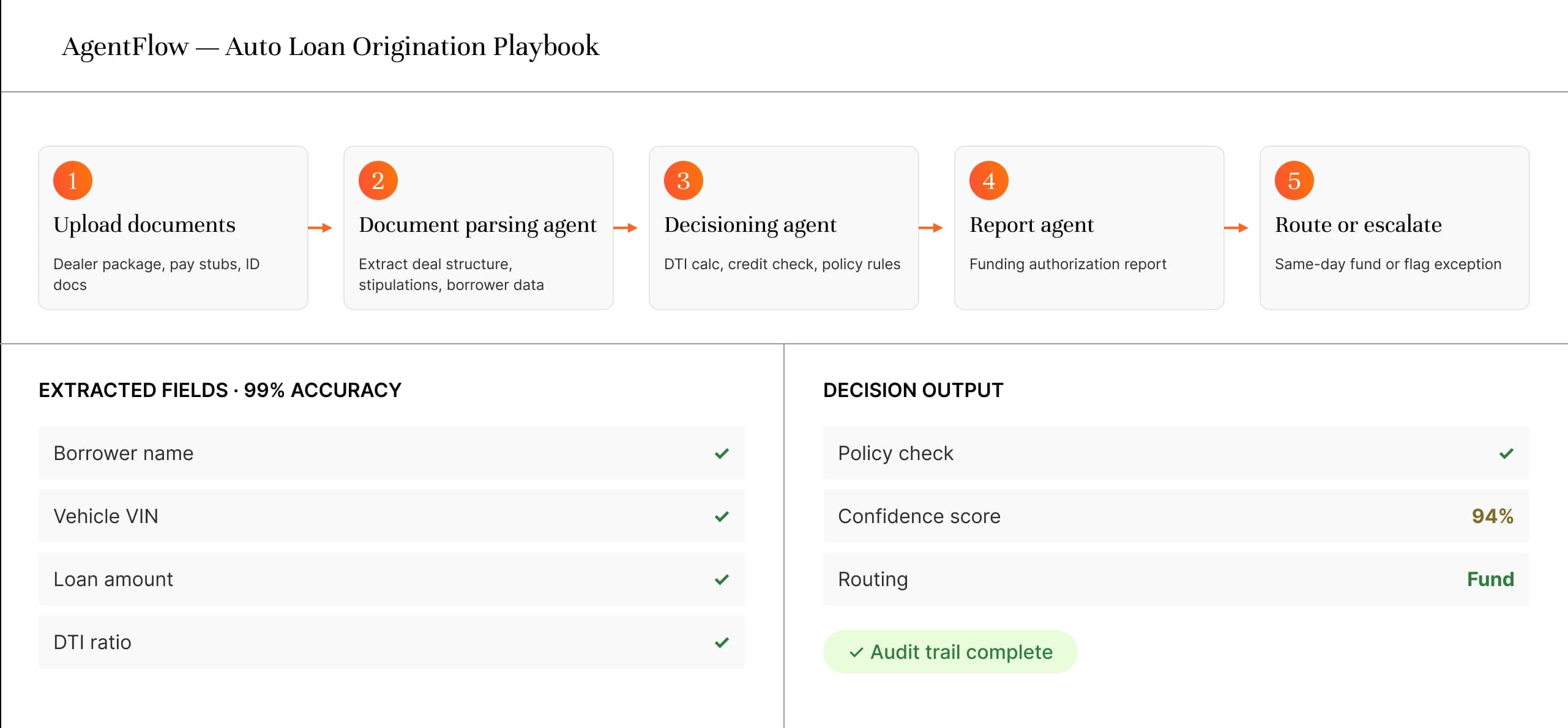
A Playbook is agentic because each step involves a specialized AI agent doing real work: a document parsing agent classifying and extracting data from uploaded files, a decisioning agent applying credit rules or investment criteria, a reporting agent generating structured outputs. The agents coordinate within a governed orchestration layer. No single large language model handles the full workflow on its own.
The table below separates the four automation categories that financial institutions typically evaluate.
How an Agentic AI Playbook Works, Step by Step
The walkthrough below uses the Auto Loan Origination Playbook: the workflow behind FORUM Credit Union's production deployment.
Step 1: Pick your industry and sub-vertical. Open AgentFlow and select Finance. Drill down to credit unions, then Auto and Vehicle Lending. The library filters to Playbooks built for that workflow context.
Step 2: Browse the Playbook library. Each Playbook is named after the process it automates. Clicking one opens a detail view with a workflow description, agent architecture diagram, editable parameters, and sample output previews. Schemas, decision thresholds, and output formats are all visible before you commit anything.
Step 3: Try it on real documents. The Try button runs the Playbook against sample or live documents. The system shows how each agent processes the input: which fields the document parsing agent extracted, what the decisioning agent calculated, and what the report agent drafted. Customers such as Direct Mortgage Corp. achieved 95%+ data extraction accuracy on agency-eligible loan packages after deploying this step in production.
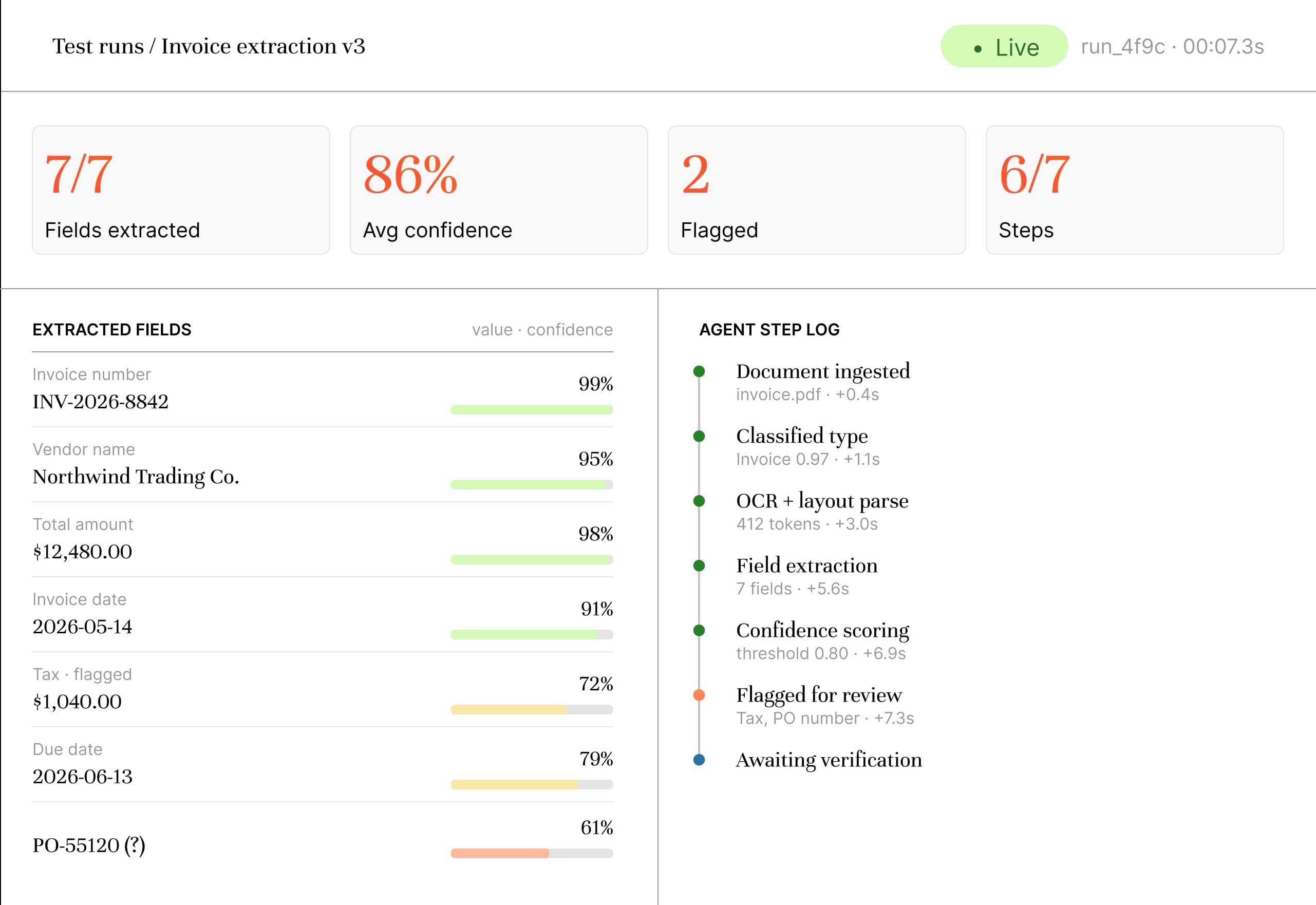
Step 4: Customize or deploy as-is. Teams can launch immediately or modify the Playbook first. Editable elements include schema fields, decision thresholds, output naming, and agent orchestration order. Cloning a Playbook and modifying the fork leaves the original intact.
Step 5: Connect to core systems. Forward-deployed engineers handle the integration between AgentFlow and your core banking system, LOS, or data room. Connections to Jack Henry, Fiserv, Symitar, and Corelation are pre-built. This is the step where a Playbook moves from prototype to production.
Playbooks for credit unions
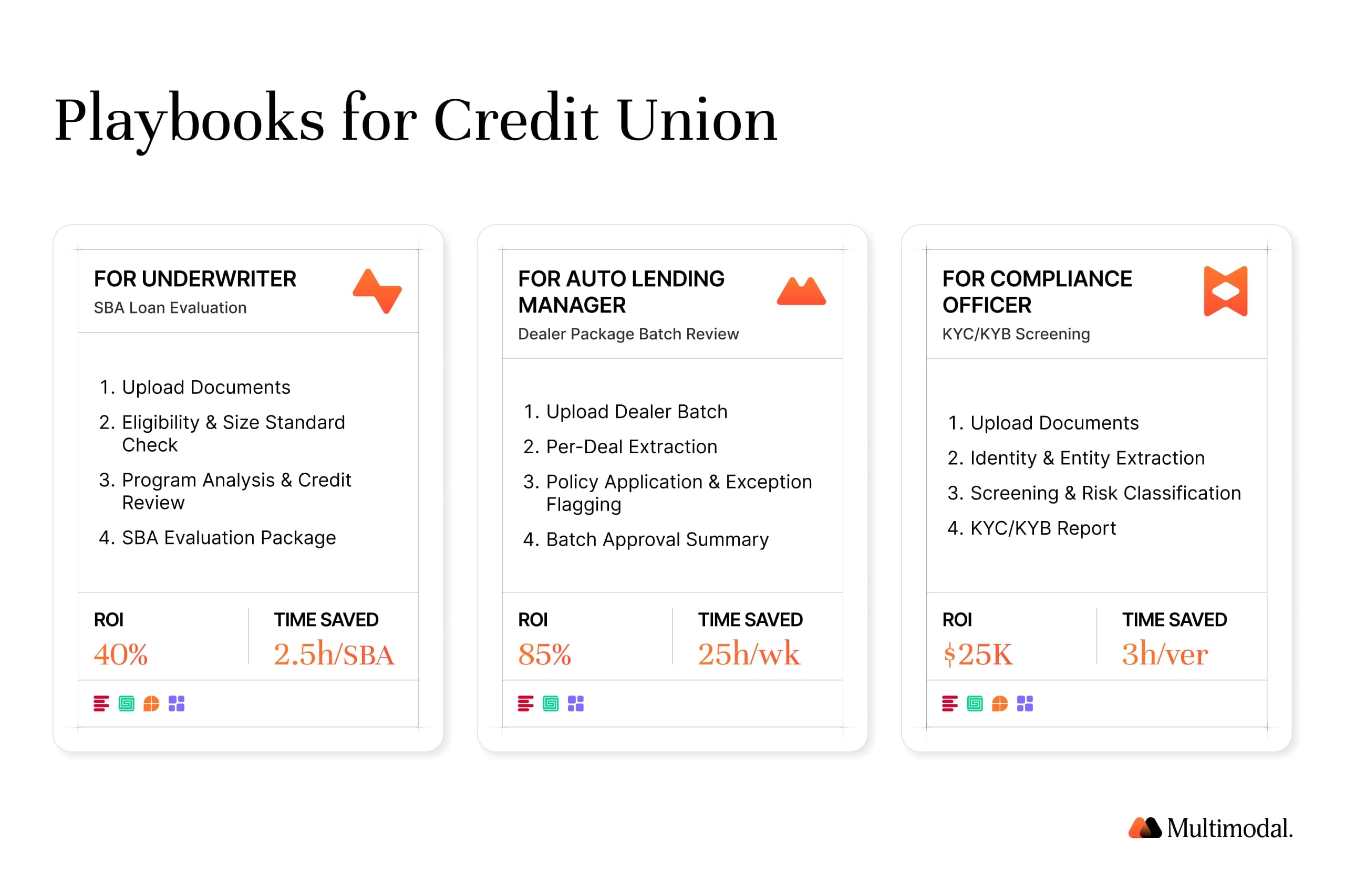
The credit union Playbook catalog covers 75 workflows across lending, operations, and compliance. Three workflows anchor the highest-volume use cases for AI for credit unions.
- Auto Loan Origination (indirect channel)
Extracts deal structure from dealer packages, reviews stipulations, and generates a funding authorization report. The decisioning agent applies your credit policy and flags exceptions. Every conclusion traces to its source document.
- Consumer Loan Origination
Automates intake, income verification, and pre-qualification for consumer loan applications. The decisioning agent calculates DTI ratios and assigns completeness scores with specific exception notes. Loan officers receive a structured review packet, not a raw document stack.
- Borrower Financial Assessment (C&I)
Spreads income statements, balance sheets, and cash flow data from member business financials. Calculates DSCR, leverage, and liquidity ratios across periods. Output is ready for loan committee review with full source traceability.
All credit union Playbooks are built to NCUA examination standards. Audit trails, confidence scoring, and human-in-the-loop checkpoints are defaults, not add-ons.
See AgentFlow Playbooks in action
Playbooks for banks
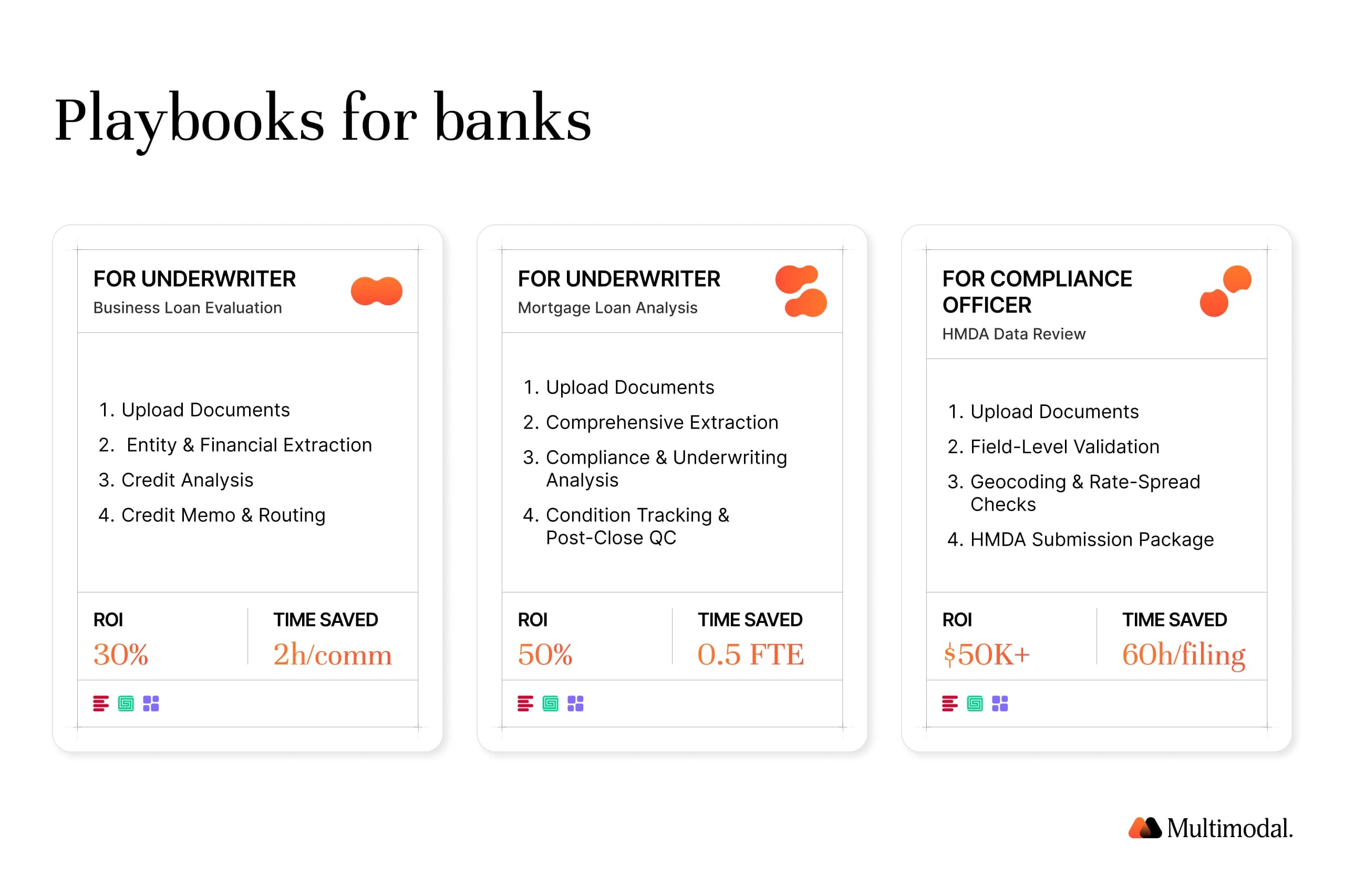
The bank Playbook catalog covers 75 workflows across commercial, consumer, mortgage, and operations. Three workflows are the highest-volume starting points for community and regional banks pursuing loan origination automation. See all AI for banks use cases.
- Business Loan Evaluation (C&I)
Handles entity extraction, financial spreading, DSCR and LTV calculation, collateral assessment, and credit memo generation. Routes the completed memo to the right approval authority with full policy citations.
- Mortgage Loan Analysis
Extracts and validates the complete mortgage package across 200+ document types: 1003 application data, appraisal, TRID timeline, HMDA fields, and income documentation. Processing time drops significantly for every file.
Direct Mortgage Corp. deployed AgentFlow and cut processing costs by 80%, achieved 20x faster approvals, and cut closing times from 10 weeks to 5 weeks across 200+ document types. Read the full mortgage application workflow story.
- HMDA Data Review
Validates every LAR field against source documents, recalculates rate-spread against current APOR tables, corrects geocoding errors, and produces an examiner-ready submission package.
Playbooks for private equity
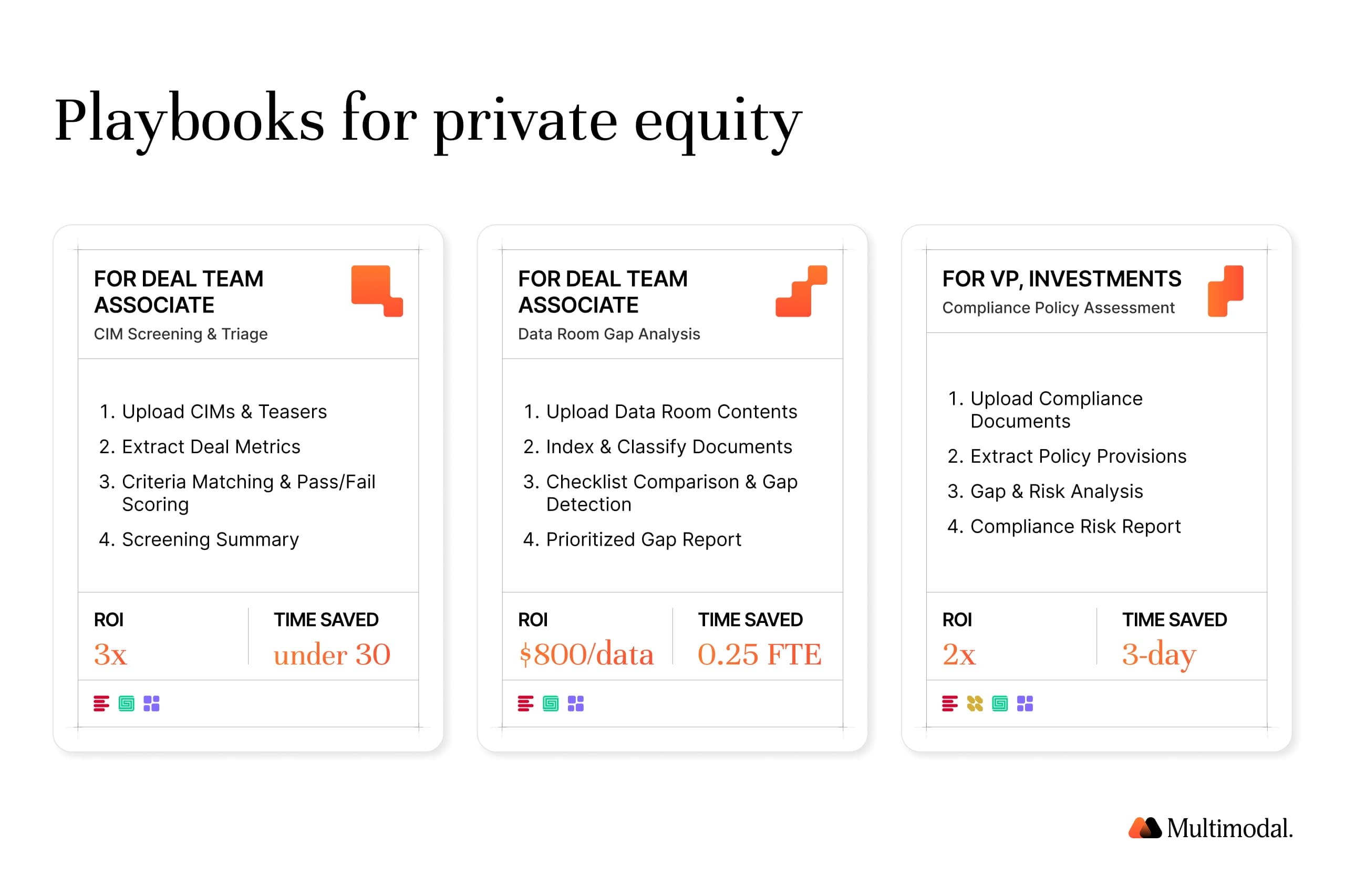
The PE Playbook catalog covers 29 workflows across deal sourcing, due diligence, exit preparation, investor reporting, portfolio monitoring, and value creation. Three workflows address the highest time-cost processes for AI for private equity operations.
- CIM Screening and Triage
Extracts revenue, EBITDA, margins, growth rates, and customer concentration from teasers and CIMs. Applies your investment criteria as hard filters, scores soft factors, and produces a pass/review/decline recommendation with every data point traced to its source.
- Data Room Gap Analysis
Indexes a virtual data room, classifies each document by category, compares contents against industry-standard DD checklists, and generates a prioritized gap report for the seller.
- Compliance Policy Assessment
Processes target company compliance policies, regulatory filings, and audit reports to identify policy gaps, regulatory non-compliance risks, and pending enforcement actions. Surfaces compliance risks before close that manual review consistently misses, including pending enforcement actions buried in regulatory filings.
Playbooks vs. building from scratch vs. Instant
AgentFlow supports three entry points for building agentic AI workflows. The right starting point depends on how well-defined the process is and how fast the team needs to move.
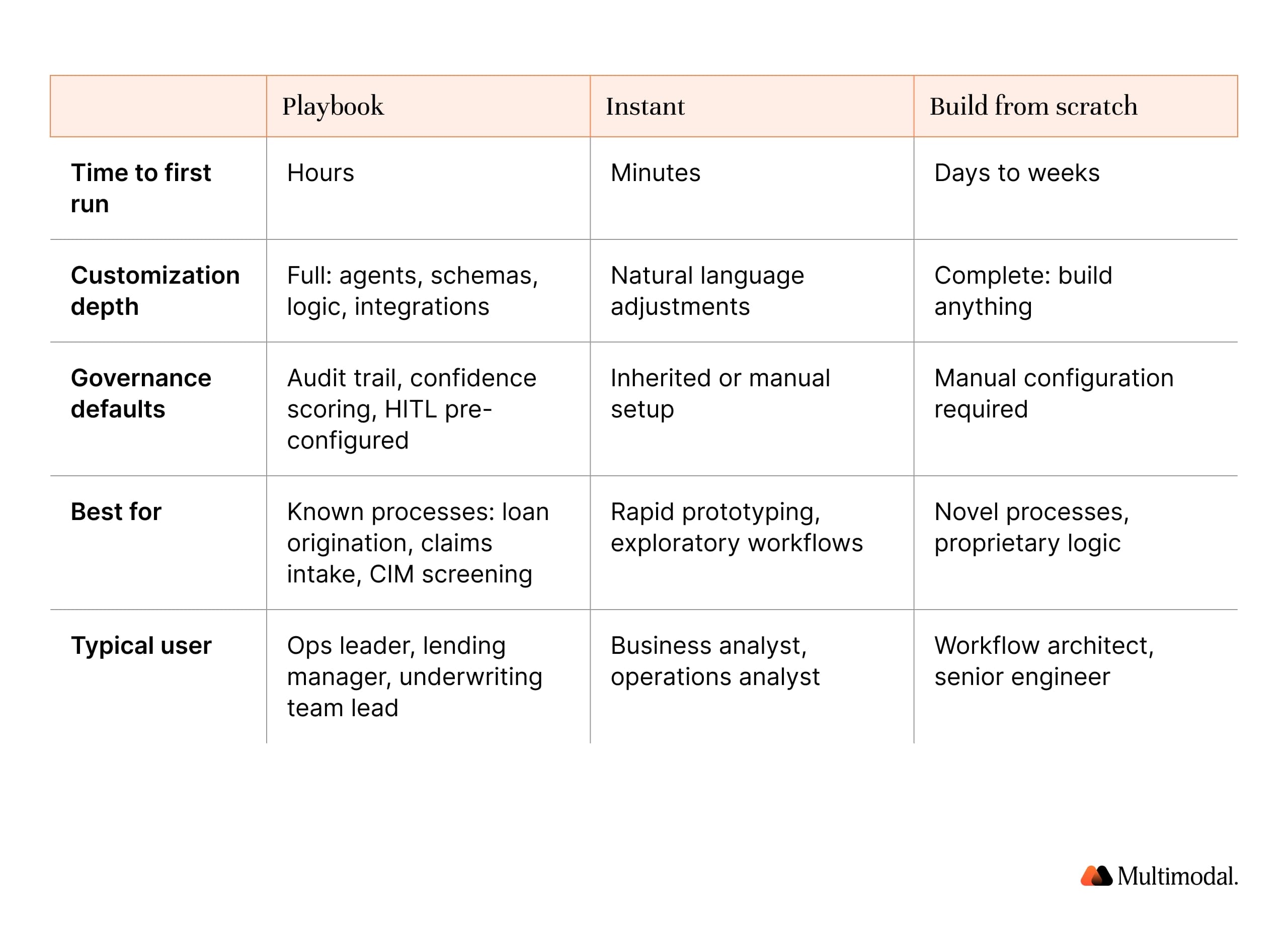
Building from scratch is the right choice when the workflow is genuinely novel or when proprietary decisioning logic cannot start from any templated point. Playbooks and Instant remain available regardless of which path a team starts with.
How agentic AI Playbooks compare to other platforms
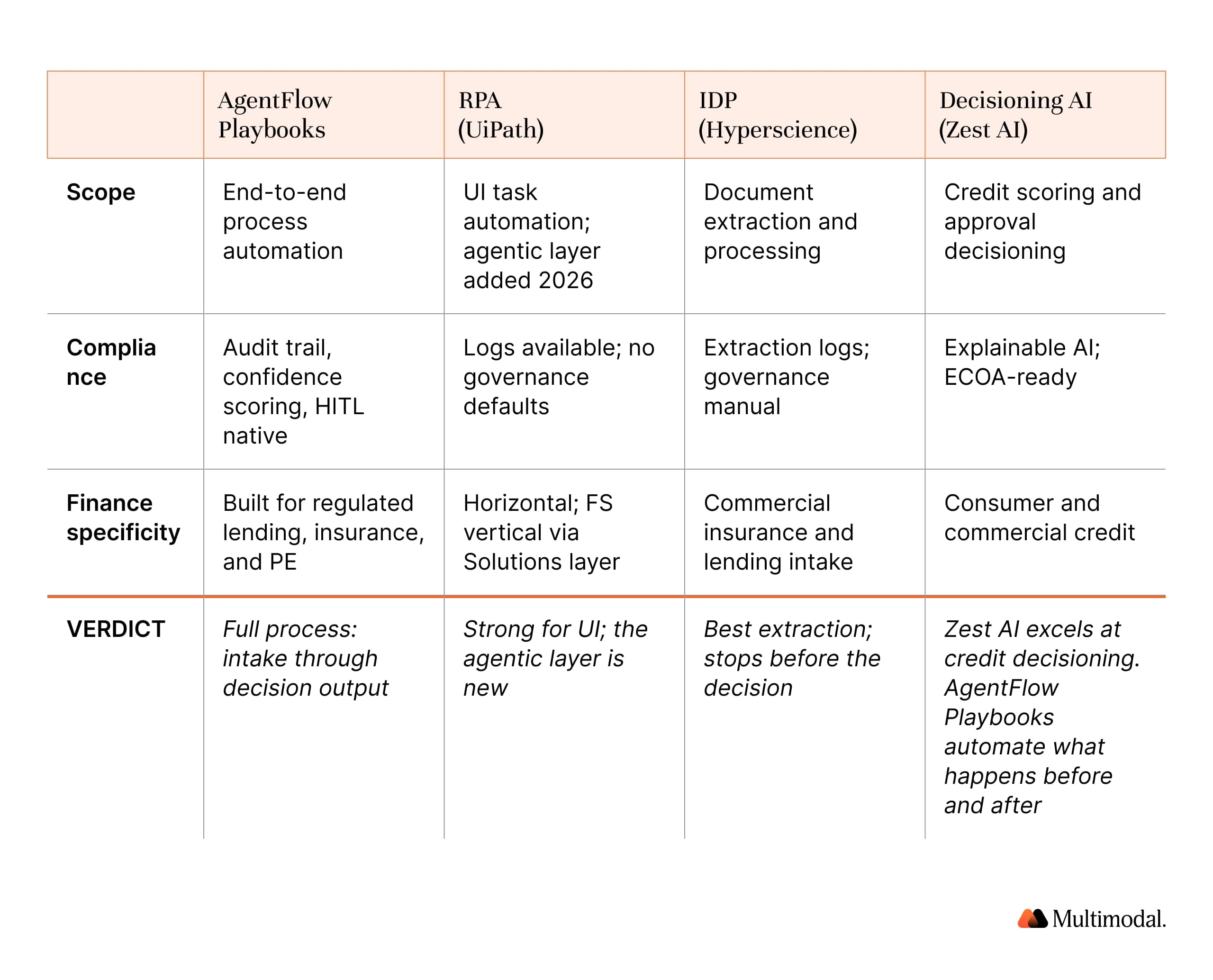
Governance, audit trails, and explainability
Every Playbook runs on AgentFlow's governance layer. Each agent step logs a timestamped record of the input received, the action taken, the confidence score assigned, and the output generated, formatted for examination review and available on demand.
Human-in-the-loop checkpoints are configurable per Playbook. When a decisioning agent's output falls below your confidence threshold, the case routes to a qualified reviewer with the full agent log and recommended action in context. The routing event, human decision, and any override rationale all write to the same audit trail as the automated steps.
Explainability scoring is built into the decisioning agent. Every credit recommendation or compliance finding cites the specific document fields and logic that drove the result, satisfying ECOA adverse action requirements without a separate layer.
AgentFlow is SOC 2 compliant and deploys within your security perimeter. Credit union Playbooks align with NCUA examination standards. Bank Playbooks support SR 11-7, when an examiner requests a decision record, AgentFlow surfaces the complete agent log on demand. No manual reconstruction required.
Frequently Asked Questions
Which Playbook should a credit union deploy first?
Pick the workflow with the highest document volume and the most consistent policy. Indirect auto loan origination and consumer loan origination are common starting points, because packages arrive in predictable formats and the review queue is easy to measure before and after the Playbook goes live.
What happens when an agent is unsure about a document or a decision?
Each Playbook carries a confidence threshold. When an agent's output falls below it, the case routes to a qualified reviewer with the full agent log and a recommended action in context. That reviewer's decision and any override rationale write into the same audit trail as the automated steps.
Will Playbooks connect to the core system we already run?
Connections to Jack Henry, Fiserv, Symitar, and Corelation are pre-built, and forward deployed engineers handle the work of linking AgentFlow to your core banking system, loan origination system, or data room. This integration step is what moves a Playbook from a tested prototype into production.
Who keeps a Playbook current when our credit policy changes?
Your team owns the parameters. Schema fields, decision thresholds, output formats, and agent orchestration order stay editable after launch, so a policy change is handled as a configuration update your own staff can make. Cloning a Playbook before editing lets you test a revision while the original runs.
What does a credit union need to prepare before deploying a Playbook?
Gather a representative sample of real documents, a written version of the credit policy the decisioning agent should apply, agreement on confidence thresholds, and a named reviewer for exceptions. Access to the core or loan origination system comes later, during the integration step with the engineering team.
How do we verify accuracy before trusting Playbook output?
Run the Playbook against files you have already processed and compare extracted fields and decisions against the known outcome. The detail view shows what each agent extracted, calculated, and drafted, so any disagreement traces back to a specific step and threshold before the workflow reaches live volume.