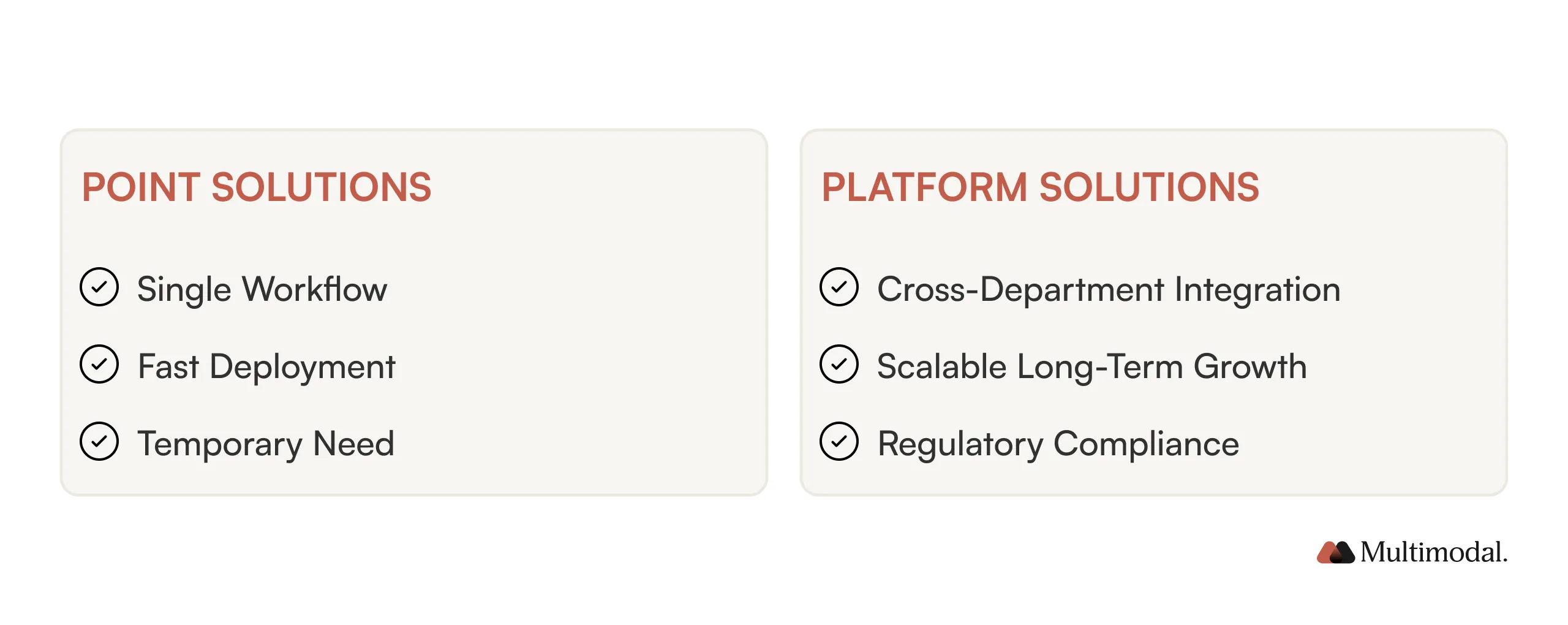
Platform solutions ensure a single source of truth and future-proof growth across workflows.
Point solutions excel in depth, but platforms provide broader, outcome-driven benefits.
Choose platform solutions for scalability, integration, and long-term success.
Get 1% smarter about AI in financial services every week.
Receive weekly micro lessons on agentic AI, our company updates, and tips from our team right in your inbox. Unsubscribe anytime.
Thank you! Your submission has been received!
Oops! Something went wrong while submitting the form.
How financial institutions adopt AI matters just as much as the tools they choose. Many teams still default to point solutions: narrow tools that solve a single problem, fast. While appealing in the short term, they often lead to tool sprawl, inconsistent results, and mounting overhead.
The alternative? Platform solutions that scale across departments, workflows, and long-term goals. These platforms rewire how organizations operate, helping teams manage multiple processes while maintaining a single source of truth.
This post outlines the key differences in the point solution vs platform debate, shows where each fits, and explains the critical platform vs. point solution trade-offs that will shape your AI strategy.
What Are Platforms?
Understanding the distinction between point solutions and platform solutions begins with a clear definition of what a platform truly is. Walter Thompson, a thought leader in enterprise software and an award-winning journalist, offered a useful definition in a recent LinkedIn post. According to him:
"A real platform is something an entire organization runs on. Think Salesforce. Zendesk. Shopify. If your customers don’t depend on you at that level, you’re a point solution—and that’s fine."
This definition emphasizes that a platform solution is the infrastructure that powers multiple workflows across an organization, not just a tool for solving a single problem. In contrast, point solutions are typically designed to address one use case or function, limiting their ability to scale across departments.
To help evaluate whether a solution qualifies as a platform, Walter Thompson posed three key questions:
How many people use it across your organization?
Does it power multiple workflows or just one?
Would work stop if it disappeared?
The answers to these questions reveal whether a solution can support multiple teams and processes and scale as the business grows.
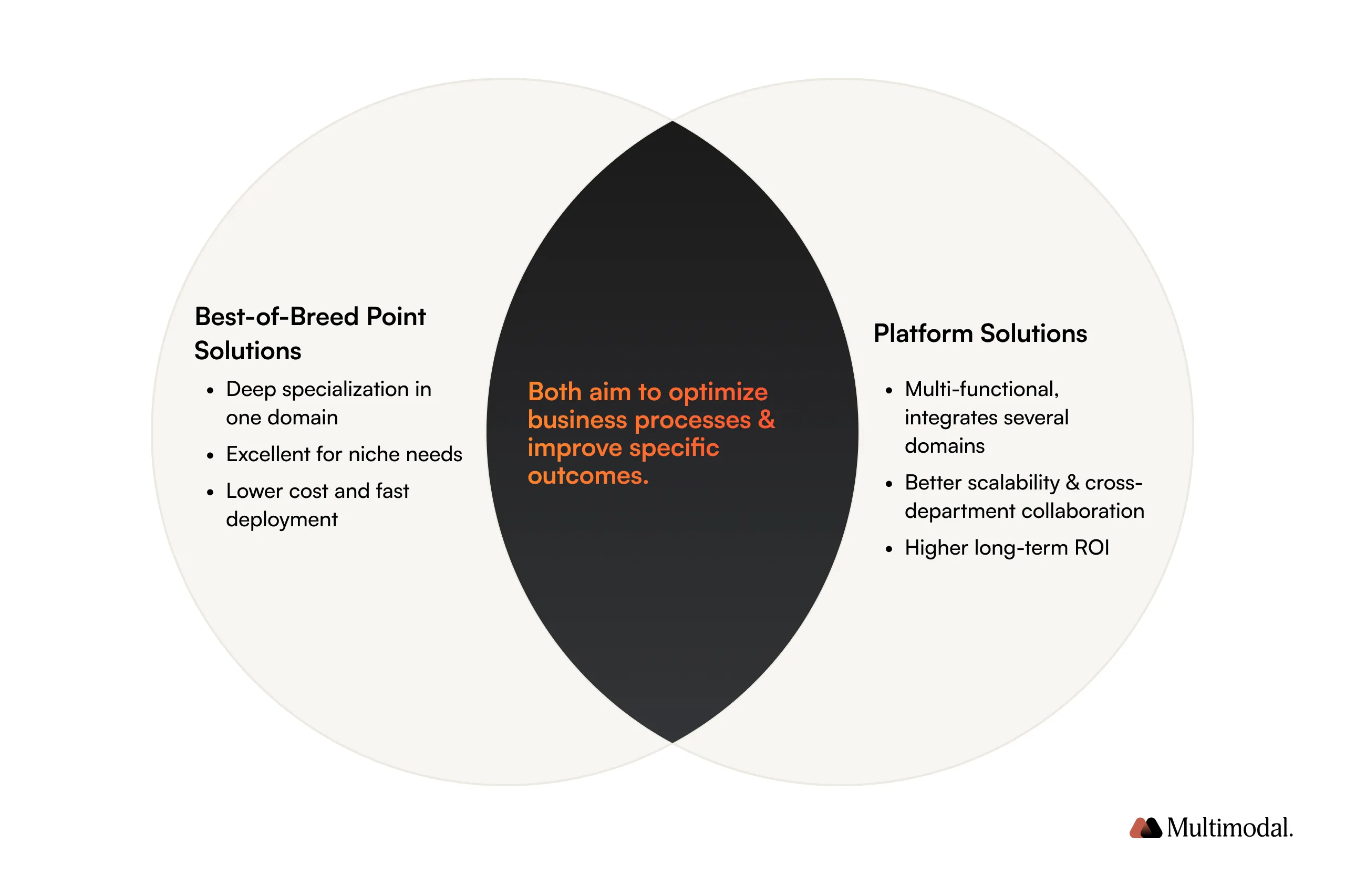
In short, a platform is defined by its ability to solve multiple problems in a coordinated way. It enables teams to manage and optimize various tools, departments, and workflows in an integrated approach. Platform solutions provide seamless integration across different business functions, reduce administrative costs, and deliver long-term efficiency—benefits that point solutions simply cannot match.
Example of a Platform: AgentFlow
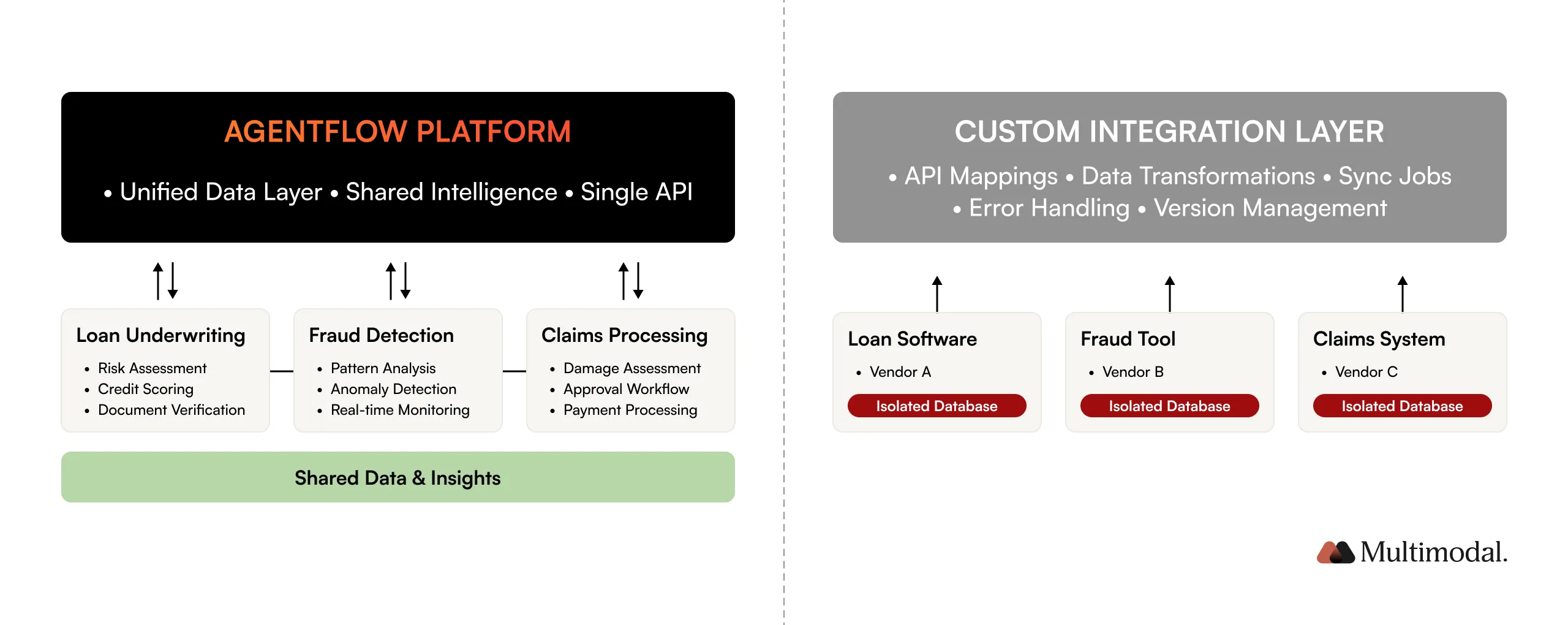
AgentFlow is a powerful example of a platform solution that supports multiple workflows across various departments. Unlike point solutions, which address single use cases, AgentFlow is designed to orchestrate AI agents for a variety of tasks, such as underwriting, risk scoring, claims adjudication, and anomaly detection, within one platform.
This platform provides a scalable, cross-functional solution, enabling multiple departments to automate and optimize their processes using a single, integrated interface. It allows for a seamless flow of data and tasks across business functions, ensuring a unified approach to automation rather than a fragmented, point-solution-based one.
It doesn't matter if you're improving document management in commercial lending or boosting customer satisfaction through better claims turnaround times. The same platform powers it all.
AgentFlow exemplifies what a platform should do: act as a solid foundation for scaling AI across departments, workflows, and long-term goals. Rather than managing multiple point solutions, organizations can implement a comprehensive system that addresses multiple business processes while reducing the expertise missing from fragmented approaches.
What Are Point Solutions?
Point solutions are software solutions designed to solve a specific problem or support a single use case. They typically offer deep functionality in one domain but fall short when it comes to cross-functional business applications, integration flexibility, or organizational scale.
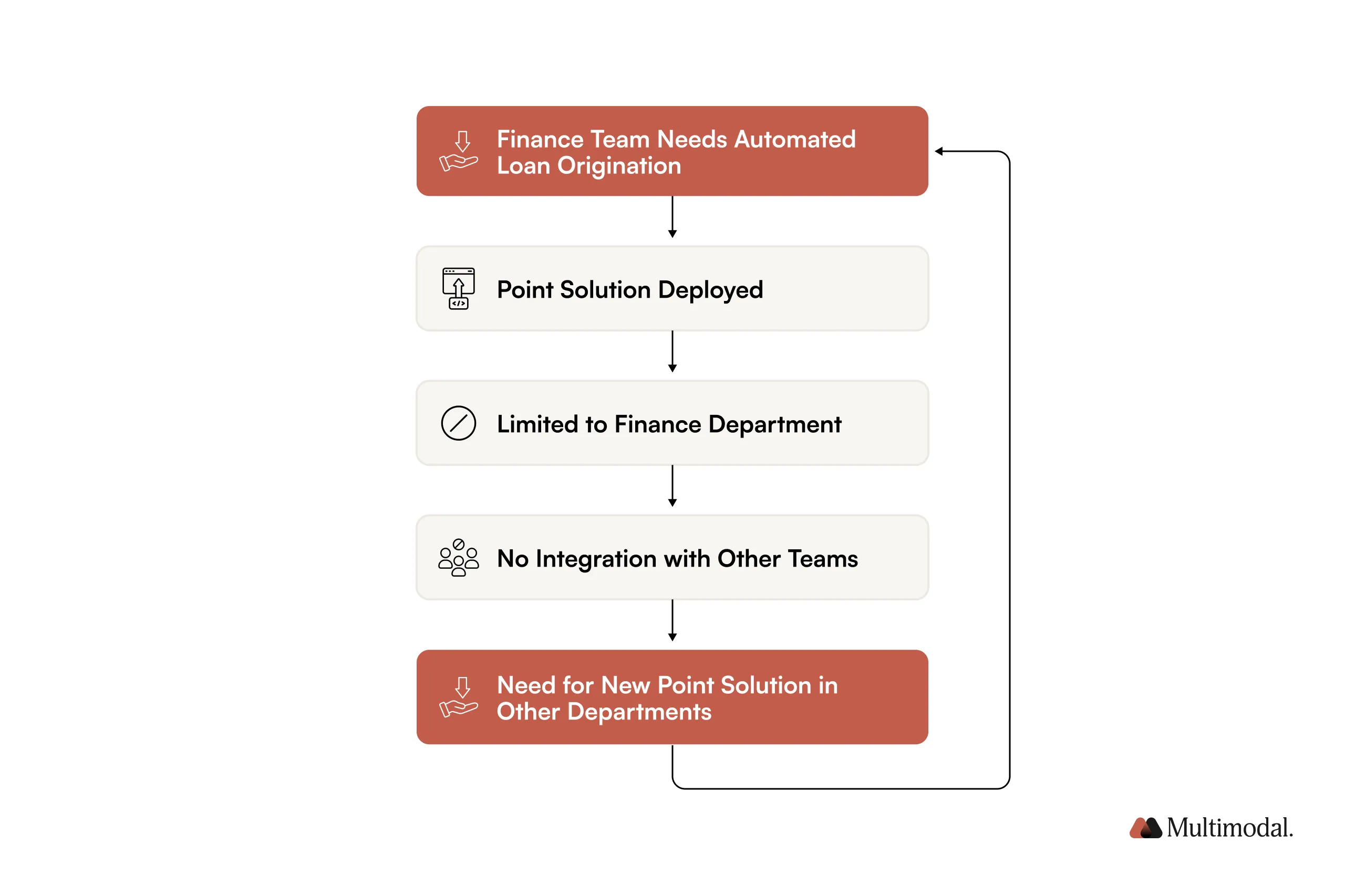
A point solution addresses immediate needs well. For example, a finance team might use one to automate part of the loan origination process, or underwriters might deploy one for credit risk scoring.
But once another department has a similar need, teams often realize the same solution can't stretch. This results in teams layering on multiple point solutions, each with its own data model, vendor contract, and training requirements.
Example of a Point Solution
Scienaptic brands itself as an "AI-powered credit decisioning platform." While it offers advanced features in credit risk modeling, it's designed to address a single problem: automating credit decisions. The product is not built to handle multiple processes across a company or to support workflows outside lending.
In a fast-changing environment where agility, security, and cross-functional intelligence are non-negotiable, relying solely on such narrowly-scoped tools can quickly become untenable. What starts as a focused solution for specific use cases often evolves into one piece of a growing collection of disconnected new tools that fail to integrate with your existing ecosystem.
Why Choose Platforms
Platform solutions offer several key advantages over point solutions, making them the right choice for organizations looking to scale and integrate their operations effectively. From simplifying vendor management to improving security and enabling future growth, platforms provide the solid foundation businesses need to thrive long-term.
1. Easier Vendor Management
Organizations quickly find themselves juggling vendors across various functions, each demanding attention and resources.
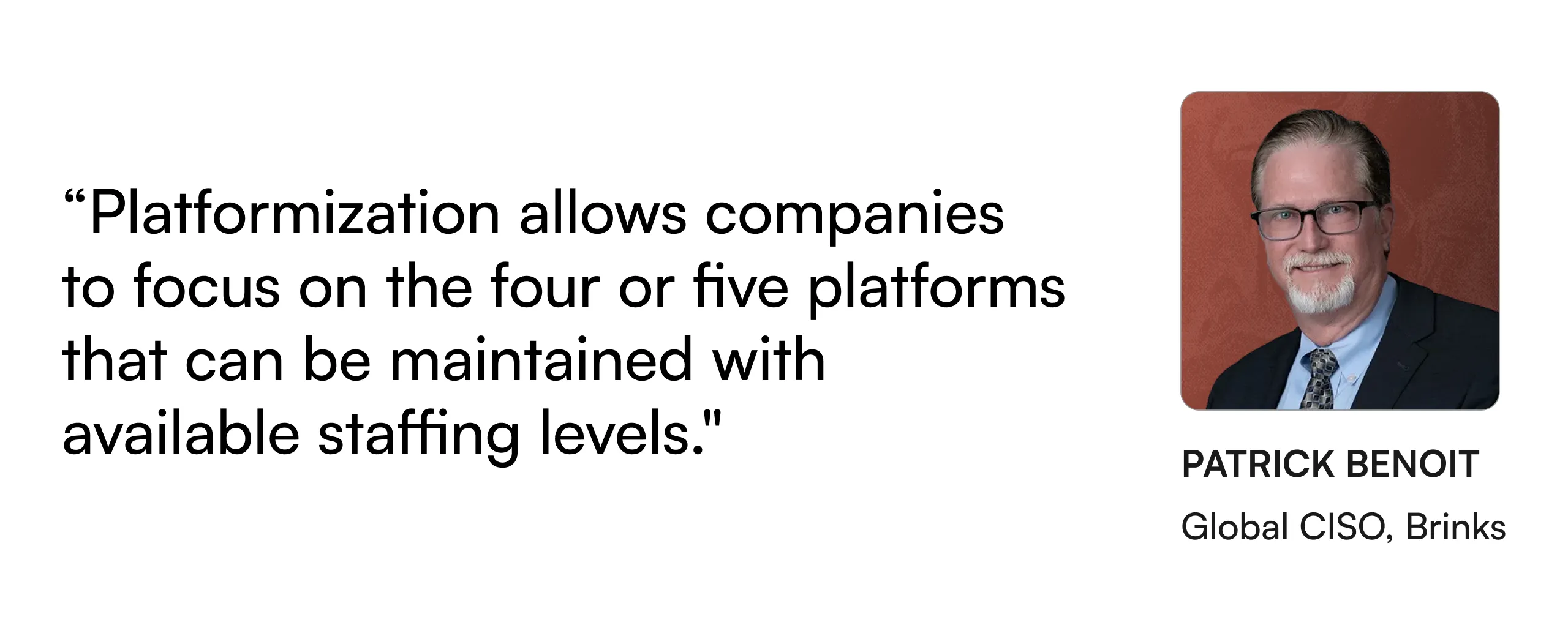
As Patrick Benoit, Global CISO at Brinks, explains, most companies can’t afford to deal with dozens of different products and vendors.
Working with a single vendor through a unified platform dramatically reduces overhead, saves time on coordination, and allows teams to focus on outcomes rather than vendor management.
2. Future-Proof Scale
A point solution might meet today's needs, but what happens when adjacent teams want automation? What if your company needs to scale operations across new markets or regulatory environments? Multiple point solutions create bottlenecks that slow growth.
"You don't future-proof your company by solving a single problem. You do it by building a foundation that can solve multiple." — Ishita Jaiswal, Head of Growth, Multimodal.
Platforms like AgentFlow support a growing collection of workflows across teams—all built on a shared architecture. Five years from now, most organizations will need AI across multiple workflows, not just one. The question becomes: do you want to manage dozens of vendors and new tools across departments, or work with a single platform that can scale across the organization?
This future-proof approach helps organizations drive growth without reinventing the wheel for each new use case or struggling with change management every time a new system is added.
3. Single Source of Truth
Data fragmentation creates operational risk. When underwriting data lives in one system and compliance data in another, decision-making slows and inconsistencies emerge. Data silos prevent effective data collection and analysis, making it harder to understand the full customer journey or maintain regulatory compliance.
"A platform doesn't just automate tasks. It orchestrates business processes end to end—and that's what drives real impact in finance and insurance." — Ishita Jaiswal.
Platform solutions unify data access and flow, establishing consistent documentation and metrics across workflows. This integrated approach ensures that when teams need to address challenges or implement new features, they're working from the same accurate information. The result is better productivity, improved customer satisfaction, and reduced risk.
4. Outcome-Driven Implementation
C-level leaders don't care about tools that extract text 3% more accurately. They care about outcomes: lower default rates, faster loan approvals, fewer errors in claims processing. Point solutions optimize individual steps. Platforms align automation around end-to-end business results.
"The risk with point solutions isn't just vendor sprawl—it's outcome sprawl. You end up optimizing steps, not results." — Ishita Jaiswal.
If your goal is real impact—closing more loans, better customer experience, operational excellence—you can't just optimize isolated steps. This requires end-to-end workflows where solutions integrate across multiple processes. Platform solutions offer this outcome-driven automation that fragmented improvements from multiple point solutions simply cannot match.
5. Improved Security
Adding multiple point solutions to your tech stack introduces new security challenges, as each tool requires its own security measures, assessments, and updates. Managing these tools individually can result in inconsistent security practices across the organization, leading to gaps in protection.
"Best-of-breed can foster a culture where security engineers flex their knowledge on what is best, by researching and running bake-offs between vendors. This can result in elevated overhead and limited security."
AgentFlow consolidates risk with:
Private, customer-controlled deployments
SOC 2 Type II certification
Per-agent audit trails, immutable logs, and confidence thresholds
Security and regulatory compliance become embedded features, not implementation headaches. Organizations can focus on innovation rather than managing security across multiple vendors and systems.
6. Expert Support
Today's software solutions are more complex to deploy than ever. As G2 research observes, "Gone are the days of the plug-and-play point solution, as tech stacks have become woven together into intricate systems."
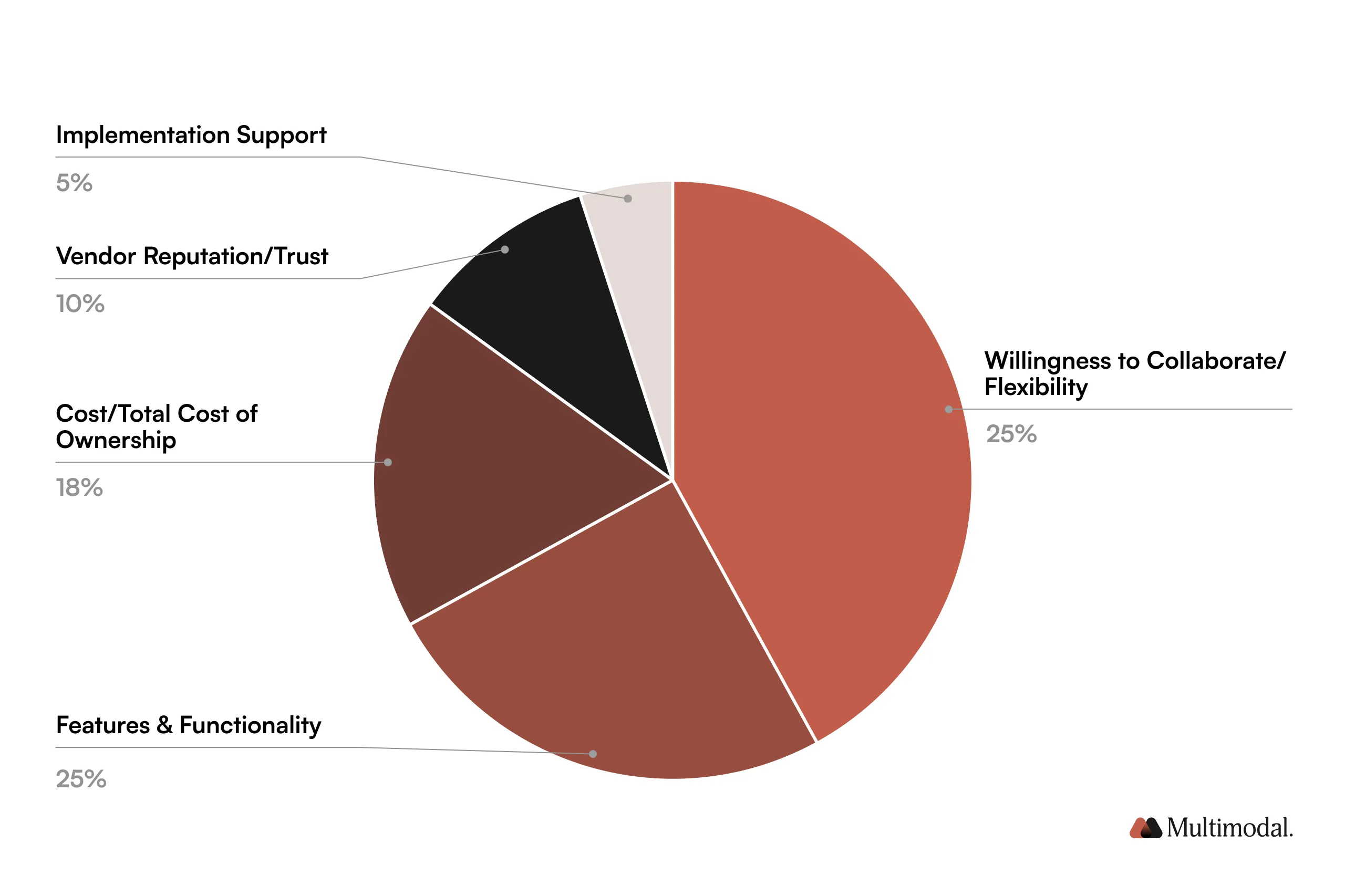
Buyers aren't just looking for great features—they want help implementing and evolving those features. According to Gartner Digital Markets, 42% of buyers rate "willingness to collaborate with us/flexibility" as one of the top considerations when selecting software.
Companies like Multimodal reflect that expectation by offering a full-service partnership model. They don’t just sell products, but rather embed teams with customers to co-design, configure, and continuously optimize AI workflows. This model ensures organizations get ongoing recommendations, change management support, and help achieve their long-term goals.
Why Choose Point Solutions
Despite their limitations, point solutions still have a place in the enterprise toolkit—especially when a team needs to address a specific problem with minimal disruption.
1. Best-of-Breed
Point solutions often excel in one domain, offering more specialized features than broader platforms. Wade Allen, president of Costa Vida Fresh Mexican Grill, put it this way during a panel at the 2024 Food Service Technology Conference:
"I believe in having the best solutions that I can afford [and that] own their respective sphere of influence, and then sew them together through integrations. That way, you are getting the best the industry has to offer."
In some highly regulated or technically nuanced areas, niche vendors may deliver exceptional value if integration overhead is manageable. These tools excel in their specific domain, providing depth that generalist platforms may not initially offer.
2. Complex Requirements
Most point solutions are deeply engineered for specific edge cases that general platforms can't easily accommodate. Organizations with highly complex requirements in niche areas may find that a point solution addresses their needs more directly.
However, that line is blurring. Modern platforms like AgentFlow now combine vertical specialization with enterprise scale, offering domain-specific features in lending, claims, and risk without limiting cross-functional orchestration. They can handle complex requirements while still providing the benefits of an integrated approach.
So while point solutions may appear to be the only choice for complex requirements, comprehensive platforms are rapidly closing that gap.
3. Ease of Deployment
In early-stage automation efforts, point solutions often win on speed. Their narrow scope means fewer integration points, simpler onboarding, and faster time to value. For example:
A claims team can deploy a document extraction tool in weeks
A risk team can test a new scoring engine without reworking infrastructure
Initial investment is typically lower, making it easier to get budget approval
That said, ease of deployment doesn't always equal ease of management. As workflows mature and organizations need to scale operations or implement new features, what was once simple becomes another silo to fix. The lower initial cost can quickly escalate into a higher total cost of ownership.
Point Solution vs. Platform: The Trade-Offs
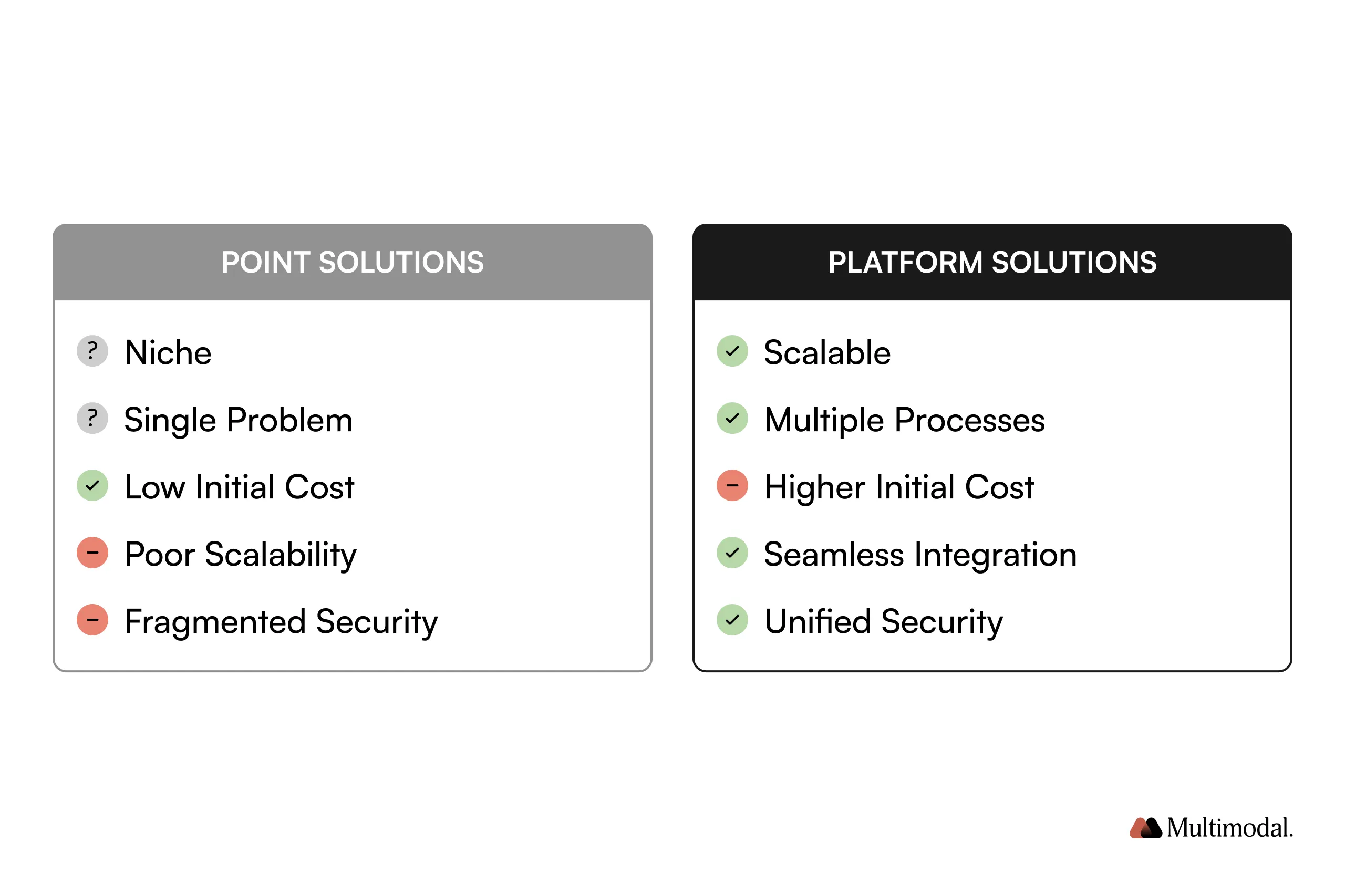
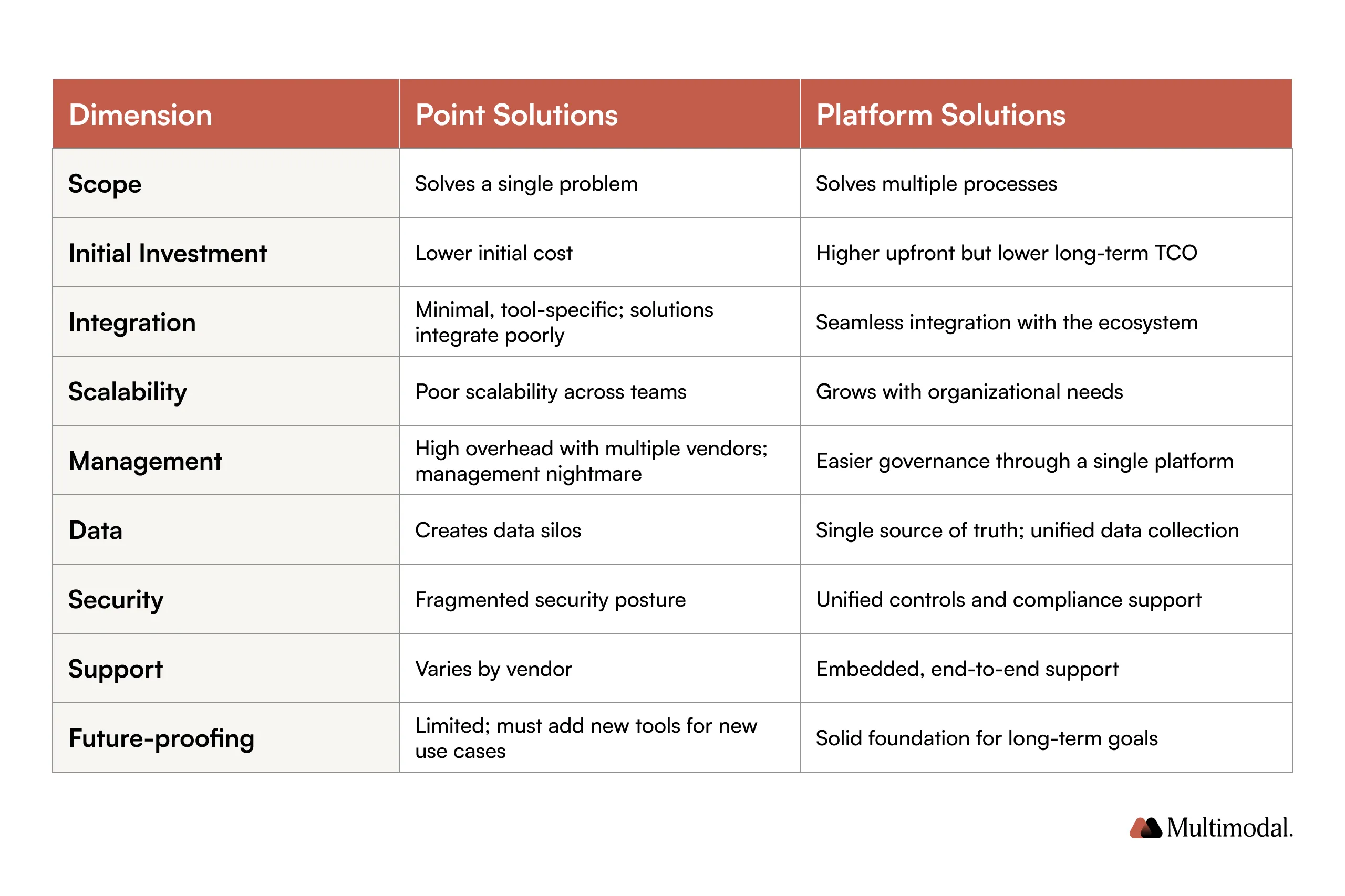
Choosing between a point solution and a platform is rarely black and white. Here are the key trade-offs to consider:
While point solutions may offer short-term wins or niche depth, platforms offer a sustainable path for AI deployment at scale.
When to Go Narrow and When to Go Wide
Joel Collin-Demers, in his post on procurement strategy, frames it well: narrow tools can make sense only if they plug into a broader system of record and don't disrupt your existing ecosystem.
If you're solving:
A single workflow pain point with no interdependencies
A high-stakes function where depth is paramount (e.g., fraud detection)
A temporary need that won't require long-term support
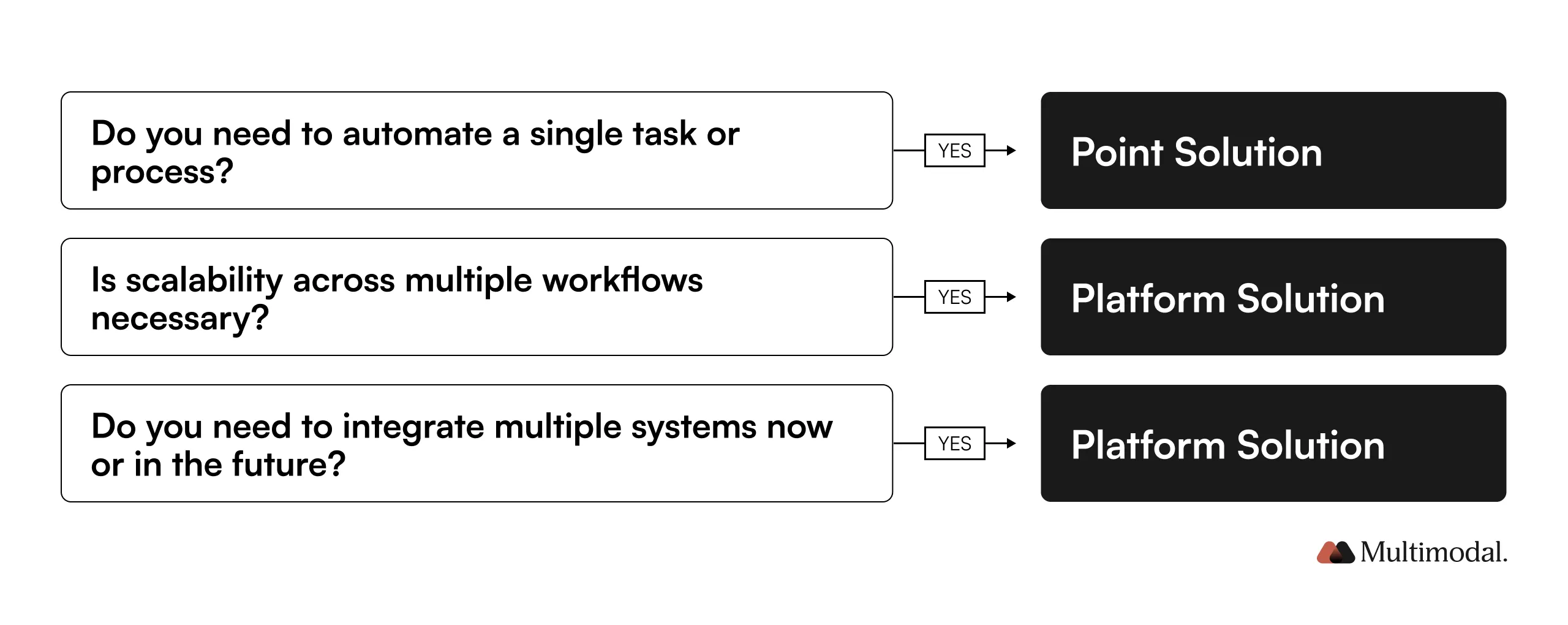
The decision is less about tools and more about your operating model. If your long-term vision involves cross-functional automation, integrated intelligence, and scalable deployment, go wide. Start with a platform that can grow with your organization.
Organizations that choose platforms position themselves to implement new capabilities faster, address emerging challenges more effectively, and maintain the productivity and customer satisfaction that drive competitive advantage.
Conclusion
When choosing between a point solution and a platform, you shouldn’t solely consider the technical abilities of each, but also their long-term, strategic impact.
How will they impact your company's ability to scale, compete, and drive growth?
Point solutions can address specific problems effectively, but they often come with hidden costs: data silos, poor scalability, administrative costs from managing multiple vendors, and a management nightmare when trying to coordinate across systems.
Platform solutions, on the other hand, offer seamless integration, a single source of truth, and a comprehensive integrated approach to solving multiple business processes. They provide the solid foundation organizations need to implement AI across various functions, maintain regulatory compliance, and achieve their long-term goals—all while working with a single vendor who provides expert support throughout the journey.
See AgentFlow Live
Book a demo to see how AgentFlow streamlines real-world finance workflows in real time.
For C-suite leaders in financial services, the question isn't just "What problem do we need to solve today?" It's "What foundation will help us solve multiple problems tomorrow, and save time, reduce costs, and drive growth along the way?"
Ready to make the right call for your organization? Explore how a platform like AgentFlow can help you streamline workflows, eliminate data silos, improve customer satisfaction, and scale with confidence.

.svg)
.svg)

.avif)
.png)