In regulated industries, financial reporting automation is a control strategy, not just a speed measure.
Most firms automate tasks, not outcomes, which creates exceptions, rework, and weak audit trails.
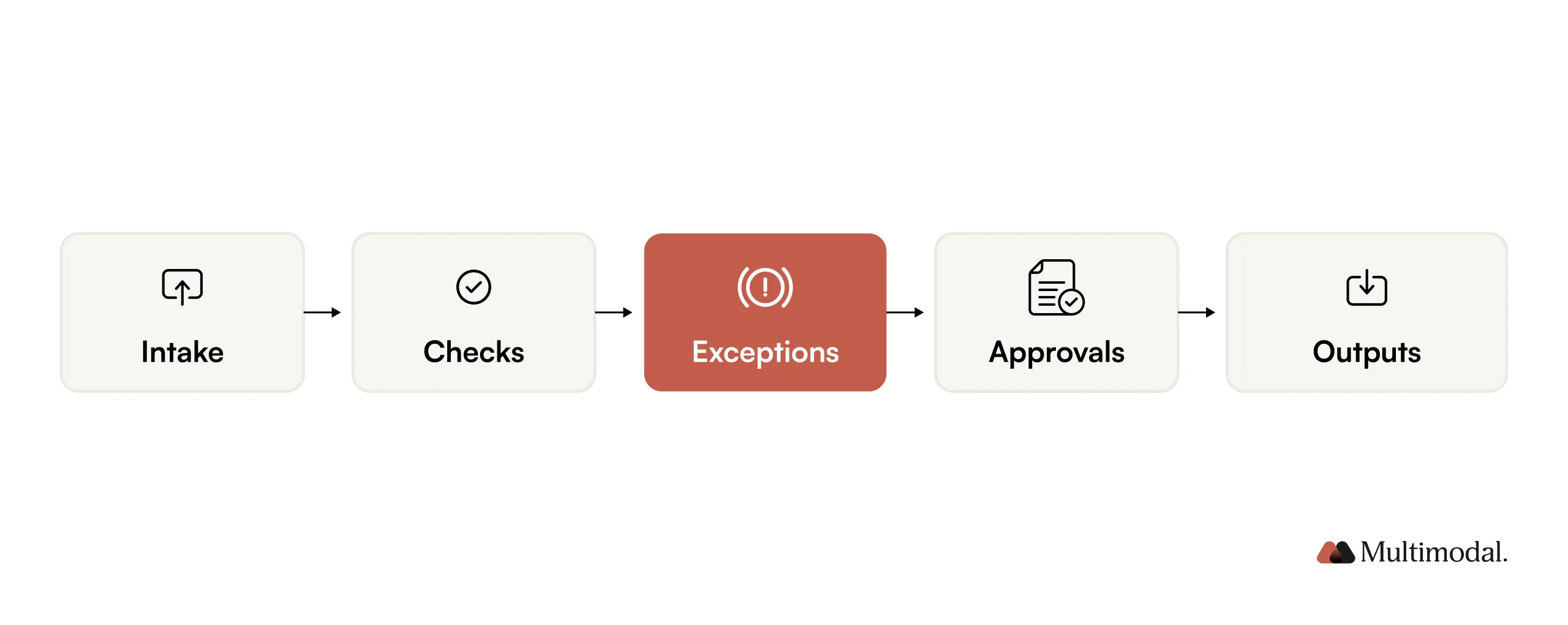
Governed workflows (intake → checks → exceptions → approvals → outputs) are what scale automated financial reporting.
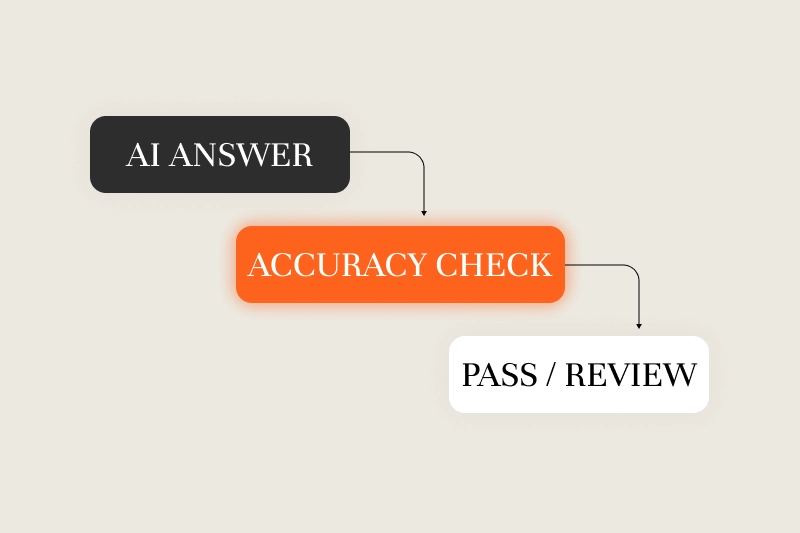
Use GenAI after validation for evidence-backed narrative, not for uncited numbers or conclusions.
Evaluate tools by defensibility: traceability, exception handling, access controls, retention, and repeatability.
Get 1% smarter about AI in financial services every week.
Receive weekly micro lessons on agentic AI, our company updates, and tips from our team right in your inbox. Unsubscribe anytime.
Thank you! Your submission has been received!
Oops! Something went wrong while submitting the form.
Reporting moved from a finance ops clean-up job to a strategic control surface.
In regulated industries, financial reporting automation determines how fast you can close, how confidently you can answer an examiner, and how consistently you can brief a board. The shift isn’t subtle. Reporting timelines keep tightening, stakeholder expectations keep rising, and the penalty for getting a number wrong keeps growing.
Most firms already have some level of reporting automation. The problem is that it’s often fragile: spreadsheet-led pipelines, rules that drift, brittle bots, and “GenAI in pockets” that don’t survive audit scrutiny. Automation works only when it becomes a governed workflow — not a set of disconnected tools.
This review covers the current state of automated financial reporting, what approaches are gaining traction, where gaps still break financial reporting processes, and how Private Equity, Banks, and Credit Unions are adapting.
What “Financial Reporting Automation” Means In Regulated Environments
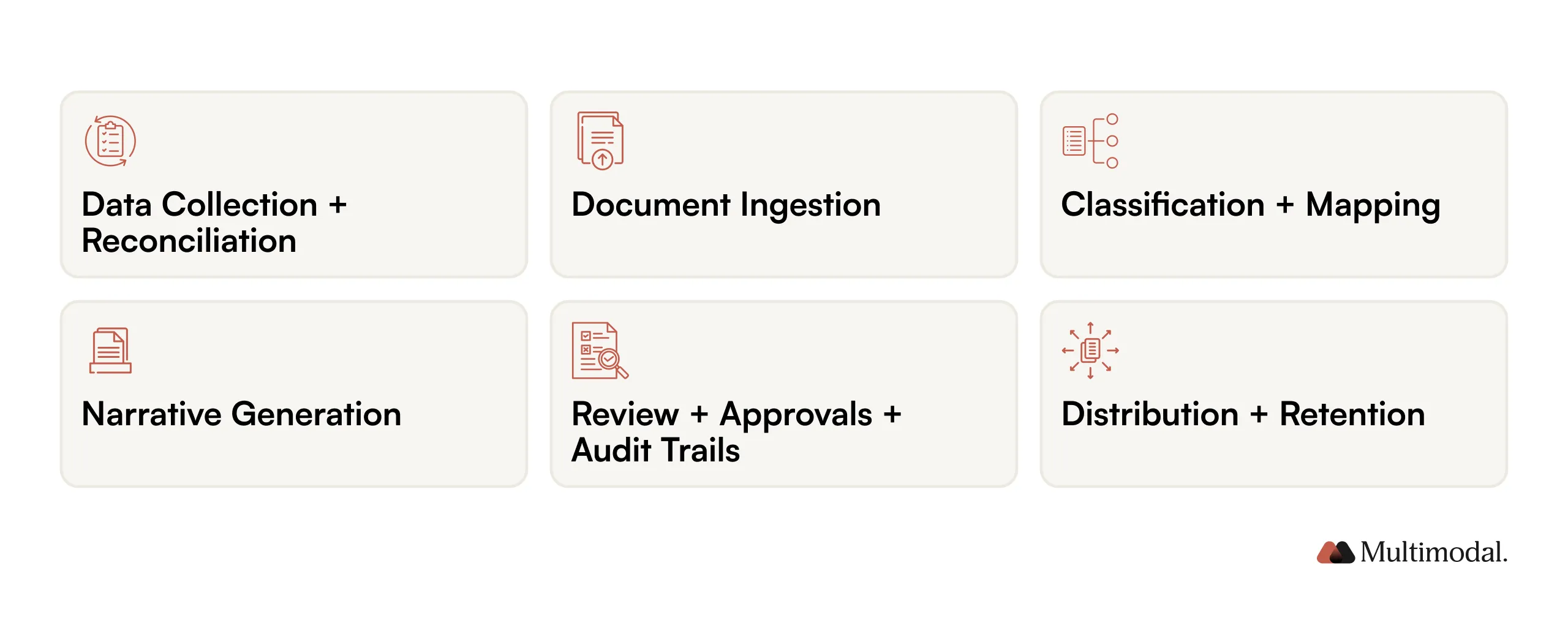
In regulated shops, “automation” goes beyond simple output creation and covers a reporting process that stays traceable, reviewable, and repeatable, including the human steps.
Distribution and retention (access controls, retention rules)
That “layer 5” is the regulated-industry difference. When a workflow can’t be reviewed and replayed, reporting automation turns into faster guesswork instead of dependable automated reporting.
The Current State Of Automation Practices
Here’s what’s actually happening in most finance teams today.
Spreadsheet-Led Pipelines Still Run The World
The common pattern looks like this:
Pull data from accounting software and integrated systems
Paste into spreadsheets
Do manual tie-outs and manual tasks
Build charts and narratives
Share drafts by email
Lose time to version chaos
This is where manual data entry and rework lead to human error and where data integrity becomes shaky. Teams “automate” via templates, but the reporting process still depends on tribal knowledge.
Rules-Based Templates And BI Dashboards Help — But Don’t Own Production
Rules-based systems work until definitions change. BI helps you analyze financial data and provides real-time insights, but dashboards are not the same as report generation for regulated outputs. They rarely cover approvals, retention, or end-to-end traceability across financial processes.
RPA Automates Steps, Not Outcomes
Bots can pull data, upload files, and automate routine tasks. But RPA breaks when portals change, formats drift, and exceptions appear. That’s the heart of complex financial reporting: exceptions.
“GenAI In Pockets” Is Real — And Usually Ungoverned
Plenty of teams use automated financial reporting tools to summarize variances or draft commentary. That can help with financial analysis and speed up writing. But without sourcing, evidence links, and review gates, it doesn’t become production-grade automated financial reporting software.
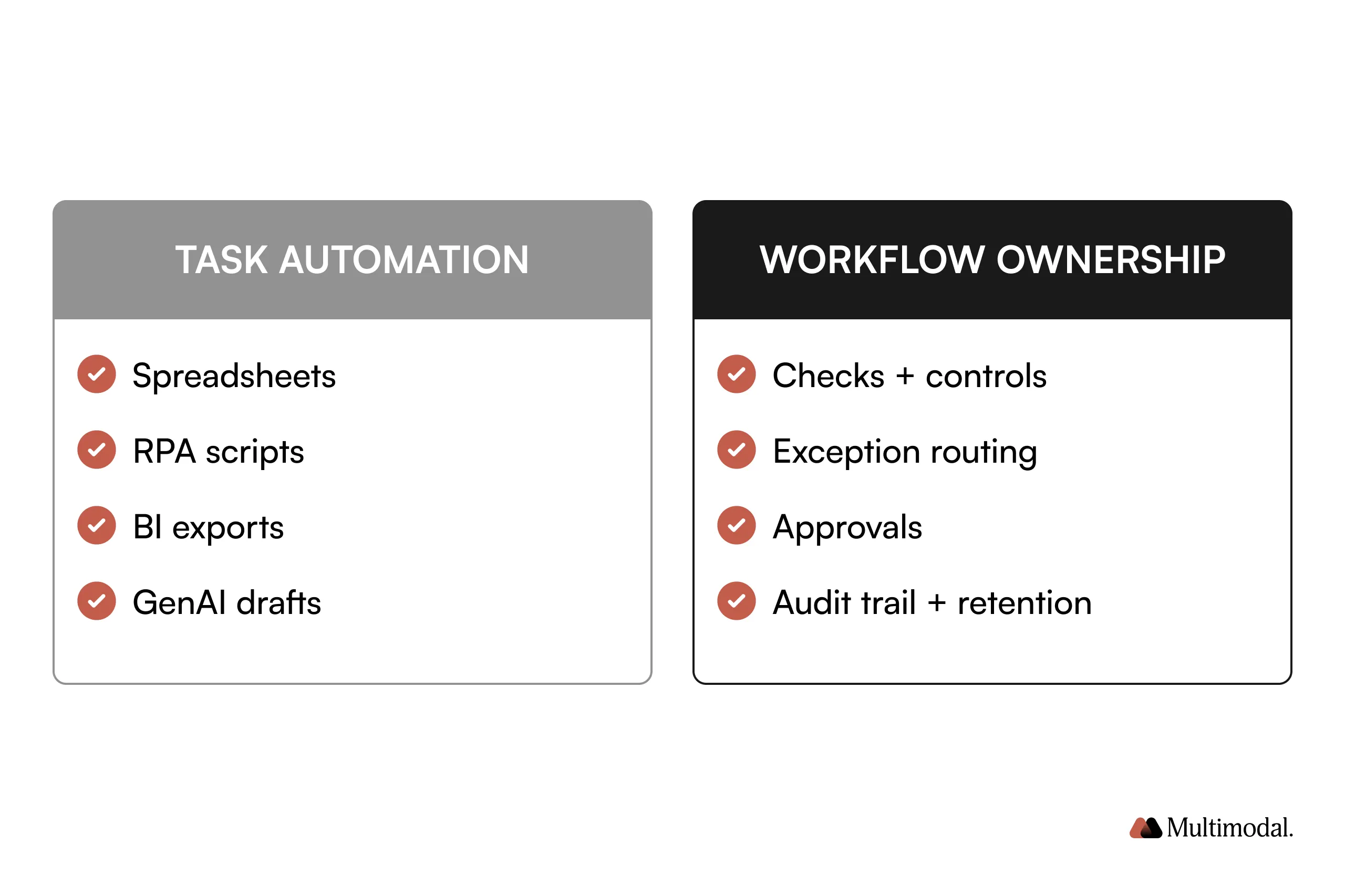
Pattern: lots of task automation, limited workflow ownership end-to-end.
Approaches Gaining Traction And Where They Break
Don’t evaluate financial reporting software by feature lists. Evaluate by where it fails under audit pressure.
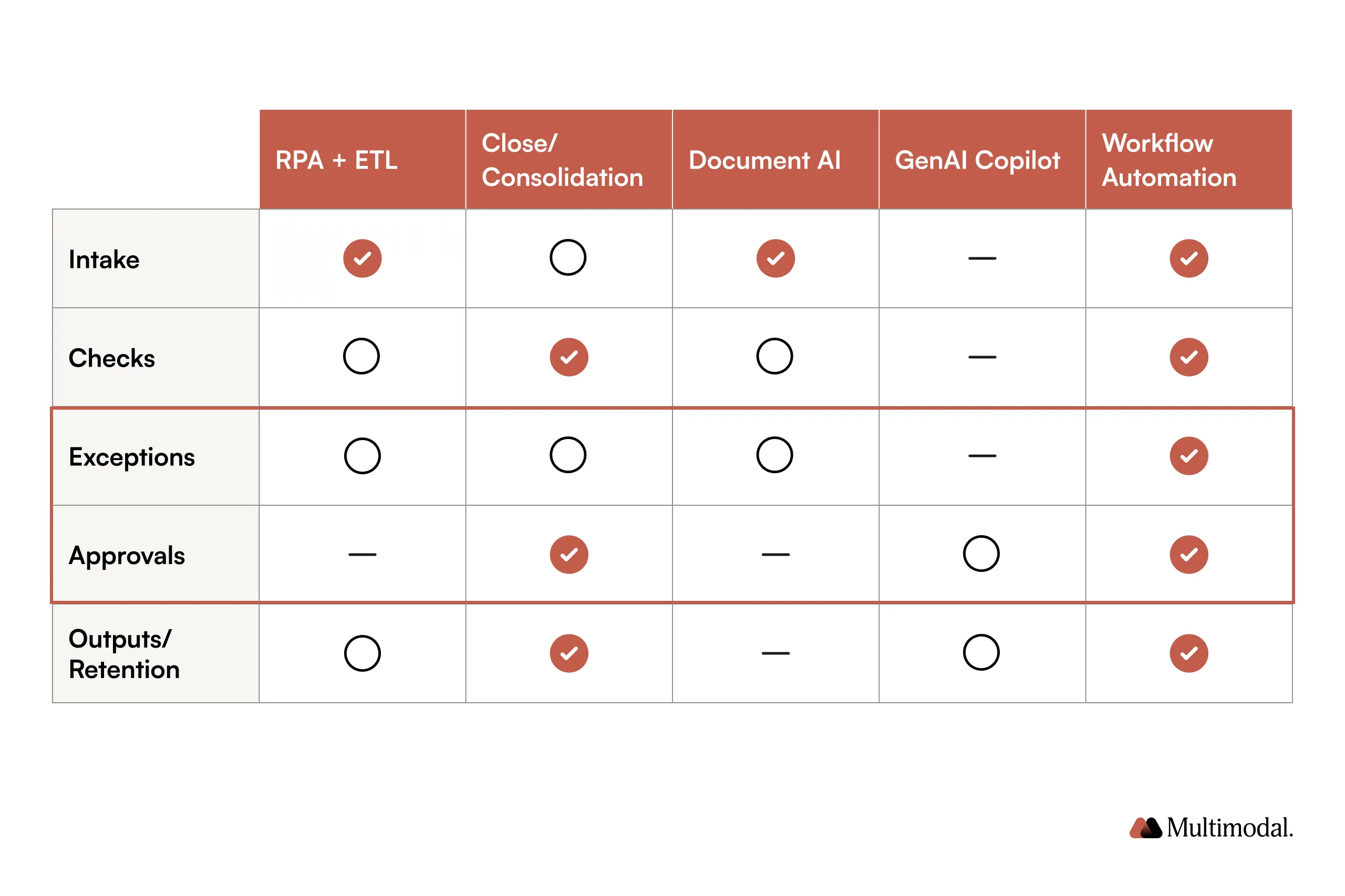
A) RPA + ETL Bolt-Ons
Best for: predictable pulls, deterministic steps, stable inputs.
Breaks on: exceptions, format drift, and weak end-to-end auditability.
RPA helps automate repetitive tasks, but it struggles to scale for automating financial reporting processes when you need approvals and traceable transformations.
B) Close / Consolidation Systems
Best for: structured close motions, standardized account reconciliation, and consolidation.
Breaks on: messy external inputs, unstructured docs, and narrative-heavy outputs.
They’re strong inside the accounting perimeter. The moment you need vendor reports, covenant docs, or portfolio normalization across multiple sources, you’re back to spreadsheet glue.
C) Document AI Layers (Extraction + Classification)
Best for: extracting financial data from statements and PDFs, classification, and mapping.
Breaks on: ownership of exception routing and approvals across the reporting process.
Document AI reduces data entry and improves throughput when working with financial statements, balance sheets, and cash flow statements that arrive in inconsistent formats.
D) GenAI Copilots (Narrative Assistance)
Best for: drafting variance explanations and summarizing movements in financial performance.
Breaks on: hallucinations, inconsistent sourcing, and lack of traceability.
Use GenAI after numbers are validated, where it can support drafting and summarization. Keep the system of record anchored in sourced data, checks, and approvals.
E) Workflow Automation Platforms (Where The Category Is Heading)
Human-in-the-loop review as a default, not a patch
The differentiator is simple: can it run in production and survive audit questions?
A Simple Comparison Table
How Firms Are Adapting And Where Gaps Remain
What Firms Are Doing Differently
Treat reporting automation like a control system
They design financial reporting automation around governance, not convenience.
Bring compliance in early
Instead of “build then review,” they define requirements first: approvals, retention, access, and what must be logged.
Standardize definitions
COA mapping rules, entity identifiers, and reporting logic stop being tribal knowledge. That’s how you protect data integrity across multiple data sources.
Operationalize review rhythms
They build review queues with clear ownership and escalation, so review isn’t a scramble at the end.
Persistent Blockers
Even strong teams hit the same walls:
Last-mile review: approvals still manual and opaque
Exceptions: edge cases force rework loops
Data fragmentation: inconsistent identifiers across financial systems
Auditability: weak lineage from input → transformation → output
Scaling: every new report becomes a new one-off build
This is why financial reporting automation becomes strategic: it’s one of the few areas where control and speed move together.
Use Cases By ICP
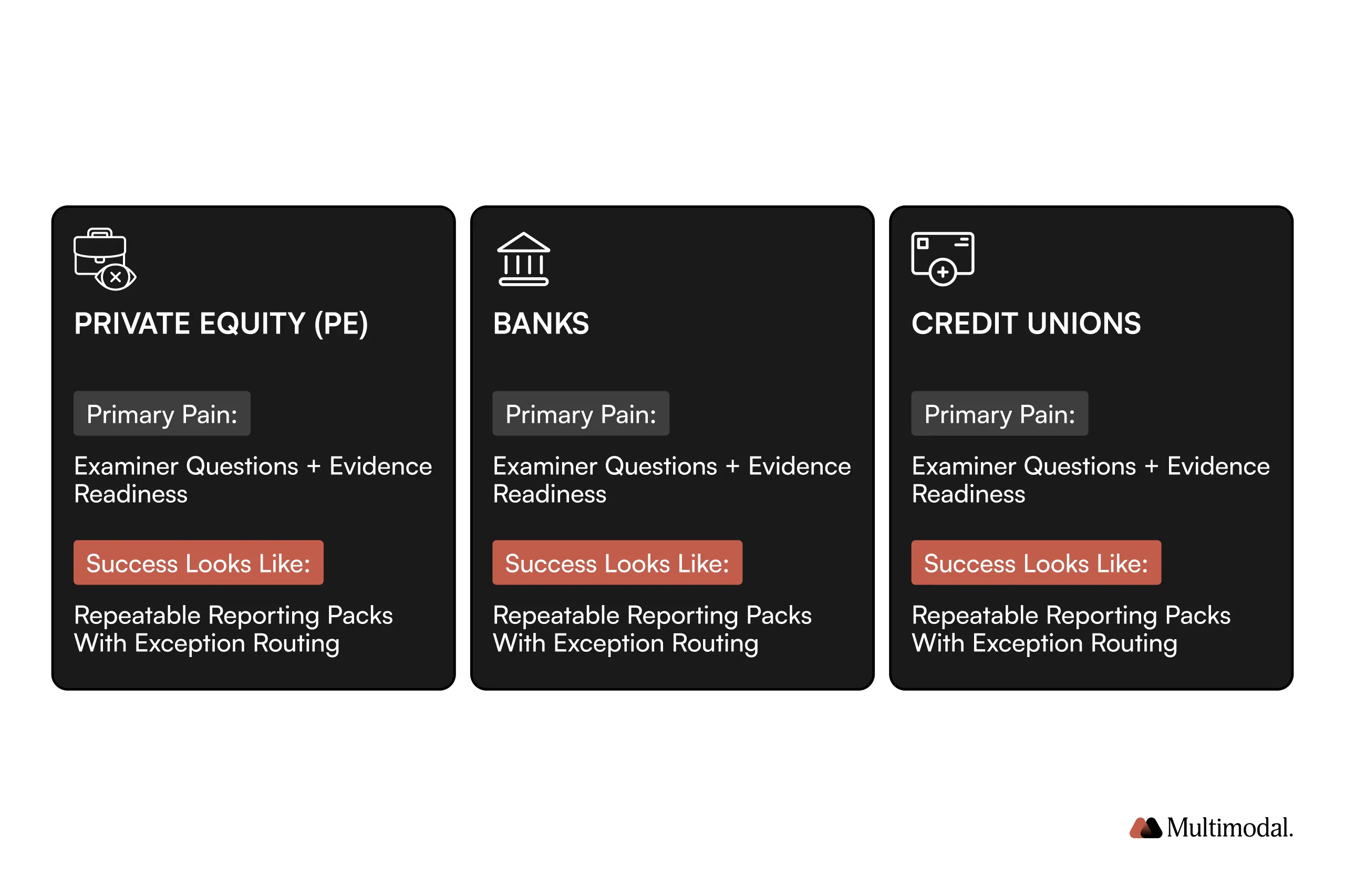
A) Private Equity And Portfolio Ops
PE teams live in portfolio reporting. They need consistent metrics across companies with different charts of accounts and different accounting software.
High-value use cases:
Portfolio KPI rollups + normalization across portfolio companies
Quarterly reporting packs with variance commentary (with sourcing)
Covenant monitoring and compliance reporting
Deal-team updates: comparable narratives across the portfolio
Standardized expense reports rollups for operational visibility
Success looks like: repeatable automated financial reporting via templates, with exception routing per company and per metric. That’s how a team protects a company’s financial health narrative across quarters.
B) Banks
Banks have heavy scrutiny and frequent examiner requests. They need automated reporting systems that can “show the work.”
High-value use cases:
Management reporting with evidence-backed variance explanations
Traceability: every number maps to sources, transformations, and reviewers
Exception handling: routing, escalation, and rework capture
Integration: reliably pull data and push outputs across integrated systems
Repeatability: templates for common financial reports and custom reports
Operational ownership: who maintains mappings when definitions change?
What To Ask In A Demo
Ask the vendor to walk through one report end-to-end:
“Show how you pull data from multiple sources.”
“Show the checks you run before humans approve.”
“Show what happens when an exception hits.”
“Show me the audit trail for one number in the balance sheets.”
“Show how you retain artifacts and approvals.”
If traceability isn’t demonstrable in the demo, you’re evaluating output formatting, not financial reporting automation.
Where The Category Is Going Next
The next wave centers on production maturity, with AI applied where it improves speed without weakening governance.
The winning stack will look like:
Workflow templates (playbooks) for the reporting process
System access that can pull data reliably
Built-in audit trails and approvals
Feedback loops that improve mapping and checks over time
This shift moves teams from fragmented automated reporting software toward governed financial automation that scales across reports and teams. It’s also how teams streamline financial processes without turning control into an afterthought.
Close the loop with the thesis:
If it can’t explain itself, it won’t scale.
See AgentFlow Live
Book a demo to see how AgentFlow streamlines real-world finance workflows in real time.
From Task Automation To Defensible Reporting Workflows
Financial reporting automation shapes how quickly you close and how confidently you defend results. In regulated industries, it supports speed without sacrificing control by keeping the reporting process traceable, reviewable, and repeatable.
The firms pulling ahead standardize workflows end-to-end: data collection from multiple sources, validation and account reconciliation, exception routing, human approvals, and audit trails that explain every number in the financial statements.
Automation scales when it can show its work. Build reporting automation as a control system, reduce human error, cut manual data entry, and deliver reporting that internal and external stakeholders can trust.
Ready to standardize one reporting workflow end-to-end and make it audit-defensible? Book a demo to walk through one reporting workflow end-to-end.
Frequently Asked Questions
Which report should we automate first?
Pick one recurring, high-frequency report with stable stakeholders, such as a monthly board pack or a portfolio rollup. Automate it end-to-end, from intake through checks, exceptions, approvals, and retention. A single defensible workflow teaches your team more than several partial builds, and it becomes the template for the next report.
Do we need to replace our accounting system or ERP first?
Usually no. Reporting automation sits above the systems of record, pulling data from accounting software, spreadsheets, and vendor documents, then applying checks and approvals. What matters is reliable system access and consistent identifiers across sources. A platform that cannot read your existing stack will push you back to manual glue.
Who should own an automated reporting workflow, finance or IT?
Finance should own the definitions, mappings, and review queues, since those change with policy and business structure. IT owns connectivity, access controls, and retention. Name an accountable owner for mapping maintenance before go-live, because unowned mappings drift quietly and surface as exceptions during the close.
How do we show an examiner that an automated number is correct?
Trace it. For any figure in the statements you should be able to show the source document, the transformation applied, the checks that ran, the exception path if one triggered, and the person who approved it. If a vendor cannot replay that chain in a demo, assume it will not hold up later.
Does reporting automation mean cutting finance headcount?
Headcount reduction is rarely the driver. The hours recovered come from manual data entry, tie-outs, and version chasing, which frees analysts for variance investigation, exception handling, and stakeholder questions. Lean teams, including many credit unions, tend to use automation to absorb rising reporting demand without adding staff.
How do we stop spreadsheets from creeping back in after automation?
Make the governed workflow the easiest path. Put templates, checks, and review queues where the work already happens, publish outputs from one place, and log every override so side spreadsheets become visible. Stale logic and slow exception handling are what send people back to Excel, so keep both under active ownership.

.svg)
.svg)

.avif)
.png)




.webp)