Workflow automation optimizes individual tasks, not end-to-end complex business processes.
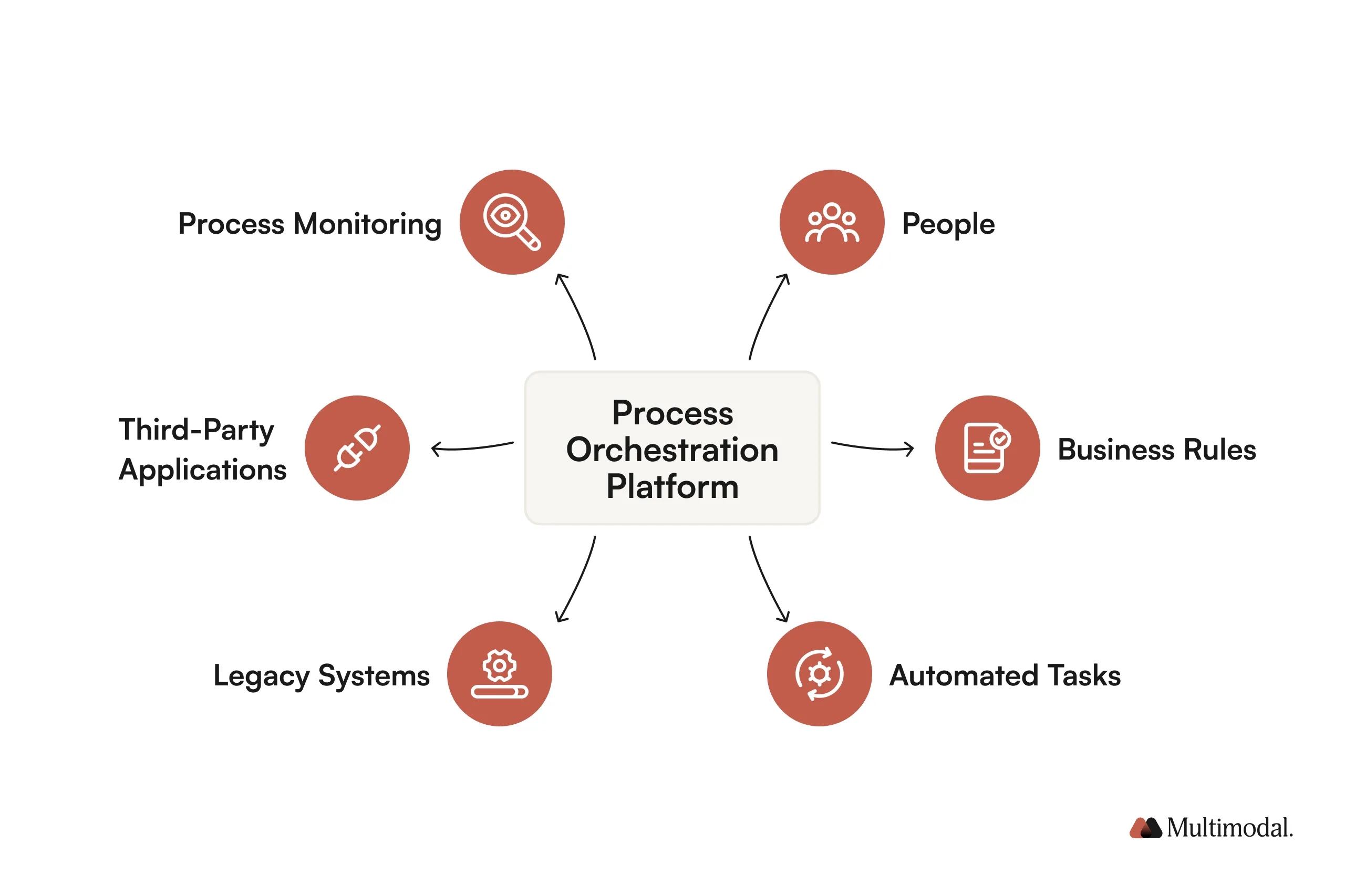
Process orchestration coordinates automated processes, business rules, and people across multiple systems.
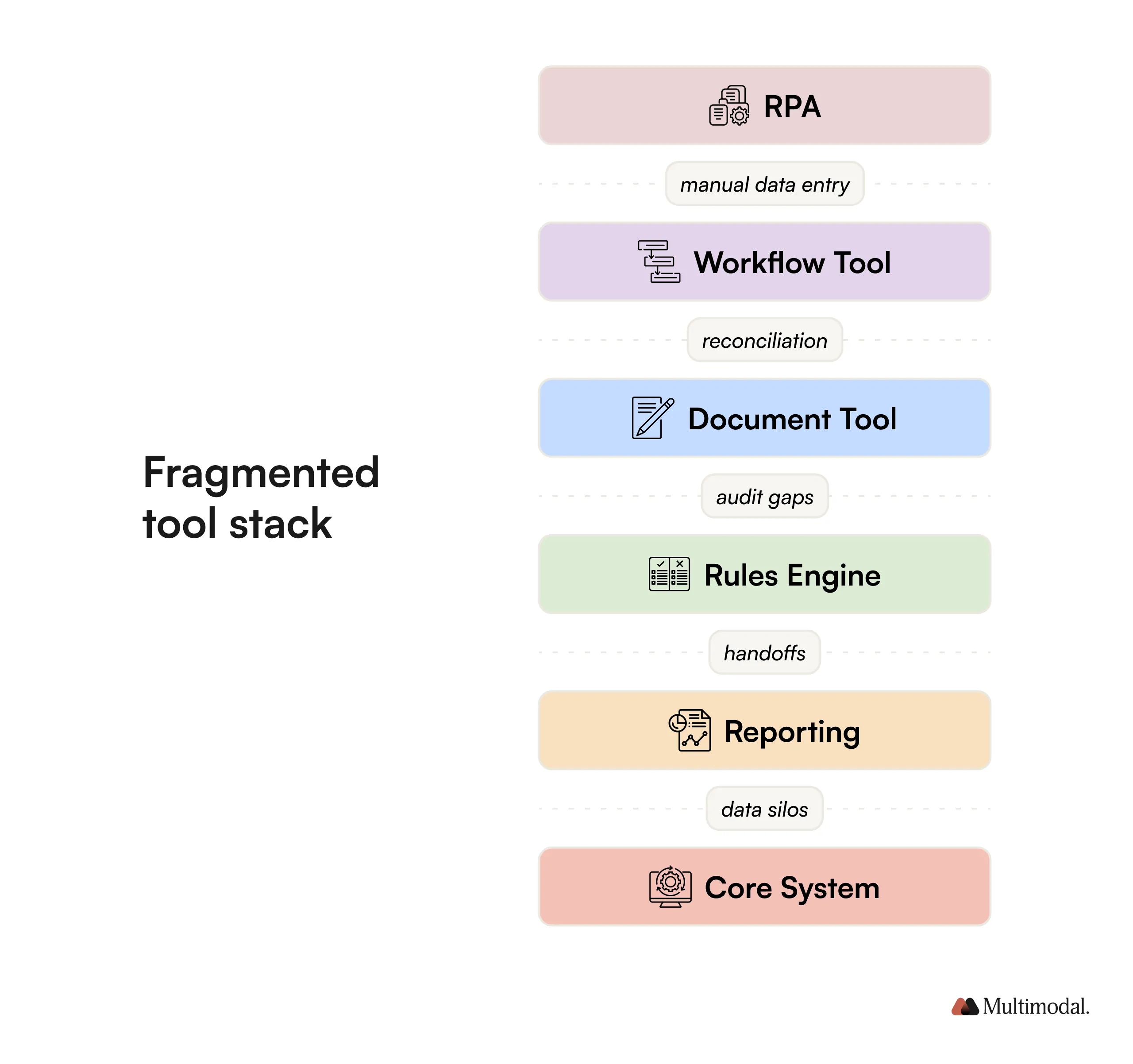
Siloed tools (workflow + RPA) drive sprawl, more manual data entry, and weaker process monitoring.
Business process orchestration uses process modeling to identify bottlenecks and improve process efficiency.
Strong process orchestration solutions embed governance to streamline operations and boost customer satisfaction.
Get 1% smarter about AI in financial services every week.
Receive weekly micro lessons on agentic AI, our company updates, and tips from our team right in your inbox. Unsubscribe anytime.
Thank you! Your submission has been received!
Oops! Something went wrong while submitting the form.
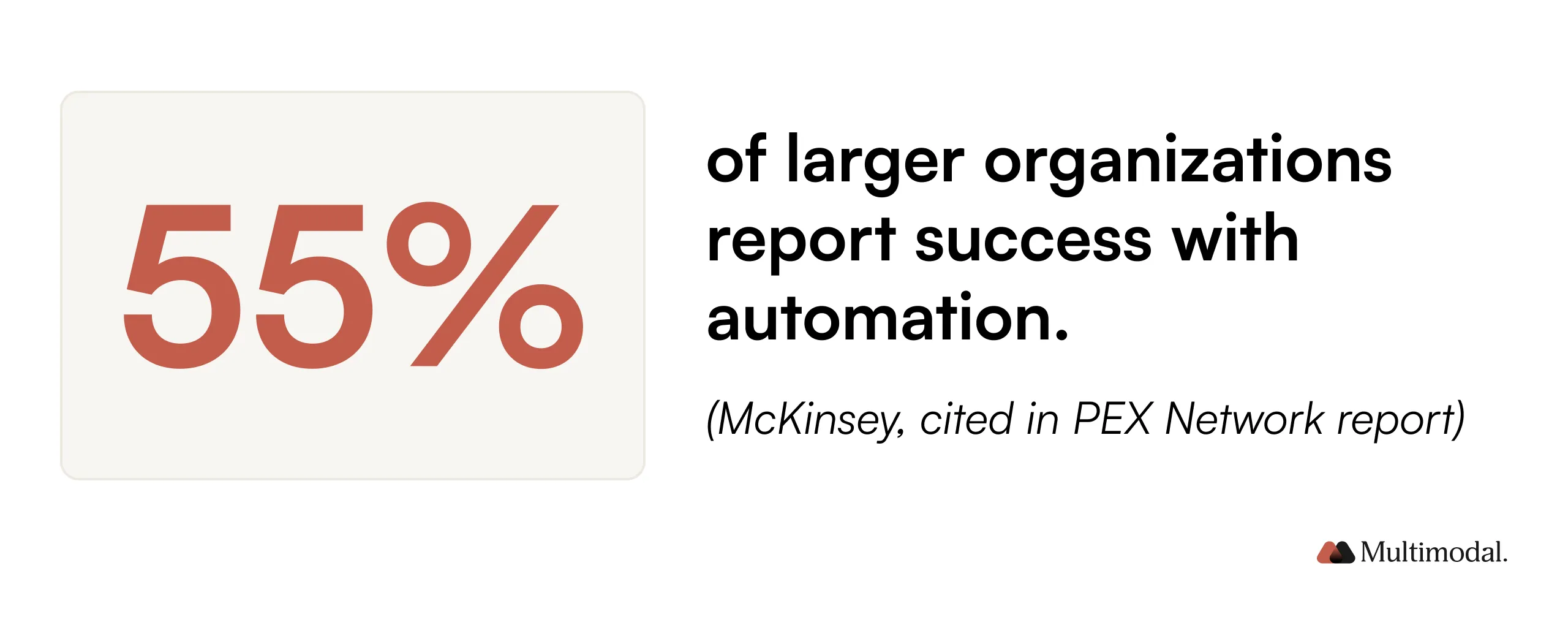
Financial services firms have spent years automating. RPA handles repetitive tasks. Workflow tools manage approvals. Point solutions serve individual teams. Yet cycle times stay long, compliance gaps persist, and data keeps falling between systems. Most firms already have plenty of automation platforms; the gap is that their automation is organized around workflow automation and isolated tasks rather than process orchestration across core business processes.
It can't coordinate across credit, risk, compliance, and operations simultaneously. That gap is where efficiency breaks down, and ROI disappears. Financial services actually need process orchestration: a platform-level capability that unifies people, systems, and automated processes across the entire business.
This post makes the case for why the distinction matters, what it looks like in practice, and how to evaluate whether a platform is genuinely built for it.
Why Workflow Orchestration Falls Short
Workflow automation is good at what it's designed for: reducing manual tasks, eliminating human errors from repetitive processes, and accelerating handoffs within a defined scope. A well-configured workflow tool can route a contract for approval, trigger notifications when a data entry field is updated, or kick off a downstream process when a condition is met. Within a single team or system, that creates real value.
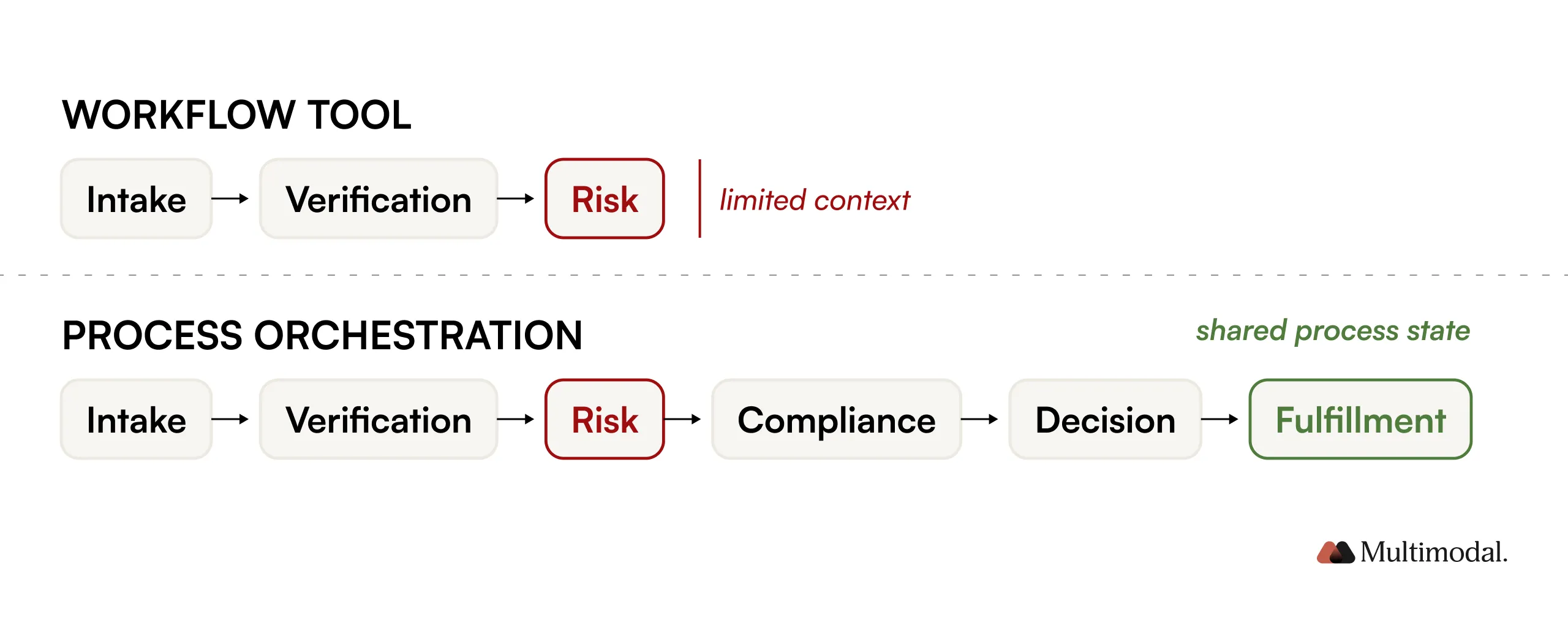
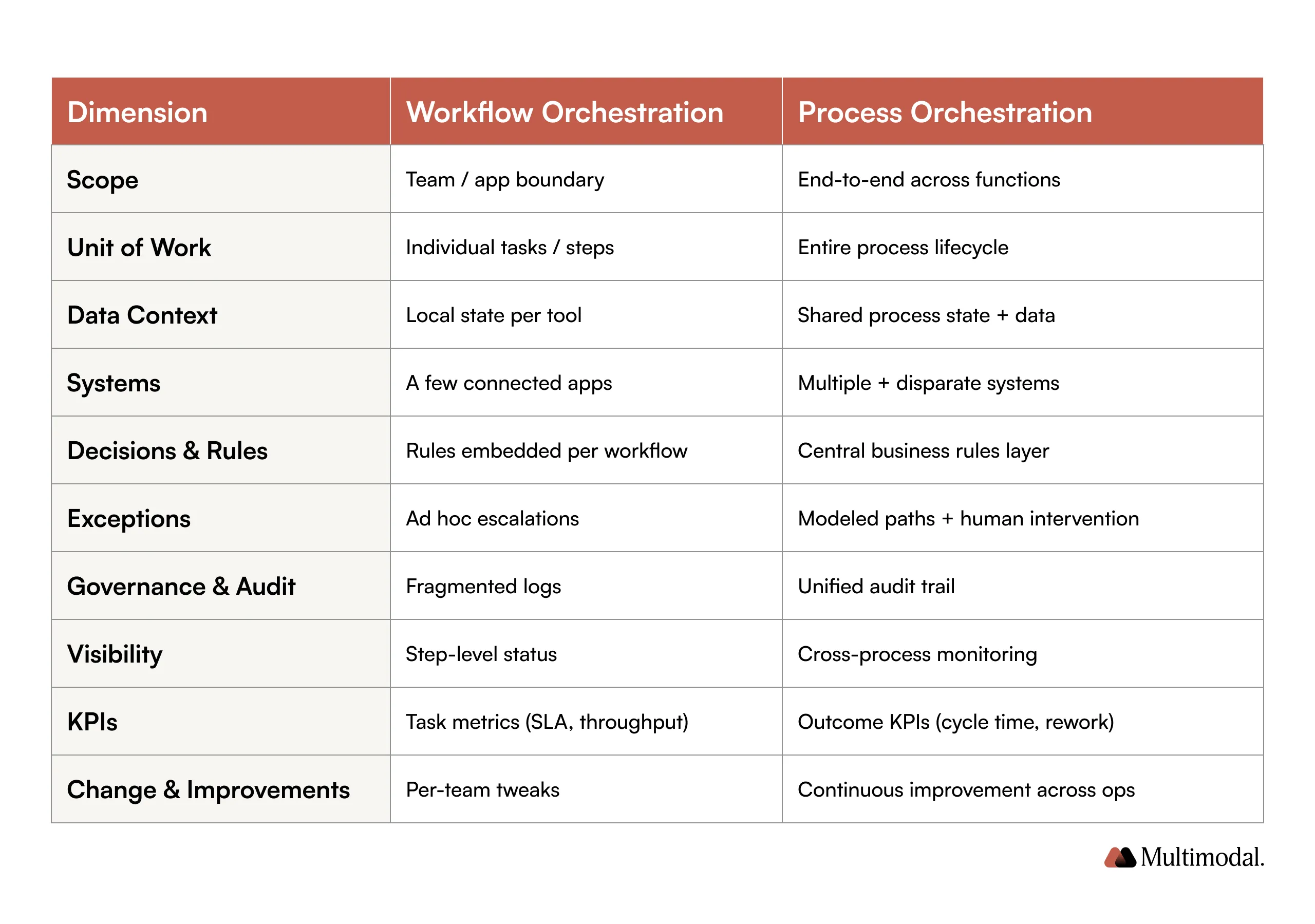
Scope is where workflow automation hits a ceiling: it optimizes local steps but rarely governs the entire process lifecycle across multiple systems and business stakeholders. Workflow orchestration tools are built around individual tasks and bounded processes. They don't maintain awareness of the broader business process they're a part of.
A workflow managing document collection for a loan application has no visibility into what's happening in credit scoring, compliance review, or portfolio risk, even when all four are working on the same deal. Each workflow operates on its own local context, in its own system, often with its own data.
In complex financial services environments, that isolation compounds into serious operational problems:
Fragmented data across disparate systems. When workflow automation tools don't share a common data layer, information gets duplicated across systems, grows inconsistent, and requires manual reconciliation to keep in sync. Manual data entry becomes the connective tissue between automated workflows, negating much of the efficiency gain.
Compliance gaps from siloed governance. Disparate systems with independent audit trails make it nearly impossible to produce a unified compliance record. Business rules enforced in one workflow tool may not carry into the next, creating inconsistencies that surface only during regulatory examination.
Automation sprawl and mounting technical debt. As individual teams solve their local problems with point solutions, an RPA tool here, a workflow platform there, a specialized automation tool for a specific use case, the organization accumulates a fragmented stack. Each new tool adds integration overhead, creates new failure points, and requires its own maintenance. The theoretical benefits of automation become buried under operational complexity.
No visibility into end-to-end process performance. When business processes are spread across multiple workflow tools, leaders have no way to monitor the entire process lifecycle in one place. They can see task completion rates within individual tools, but not cycle time across the full process, not where bottlenecks form between systems, and not how process efficiency trends over time.
Workflow orchestration keeps work moving inside an existing workflow; enterprise process orchestration connects the full set of business processes end-to-end, including automated processes, manual tasks, and human intervention across business teams. For financial services organizations running complex, cross-functional operations, the gap between what workflow tools can do and what enterprise processes require is structural; no amount of configuration can close it.
How Process Orchestration Is Different
Process orchestration operates at a different level than workflow automation. Where workflow tools manage sequences of individual tasks, process orchestration coordinates the people, technology, decisions, and data that make up an entire business process, from initiation through completion, across every system and team involved.
The difference shows up in execution: a process orchestration platform maintains process state, data context, and decision logic across complex workflows, while most workflow automation tools only manage steps inside existing workflows.
A process orchestration platform maintains a unified view of the process state at all times. It knows where a process is in its lifecycle, what data has been collected and validated, which automated tasks have completed and which require human intervention, and what business rules apply at each decision point. That persistent, cross-system awareness is what makes it possible to orchestrate complex processes rather than just automate individual tasks within them.
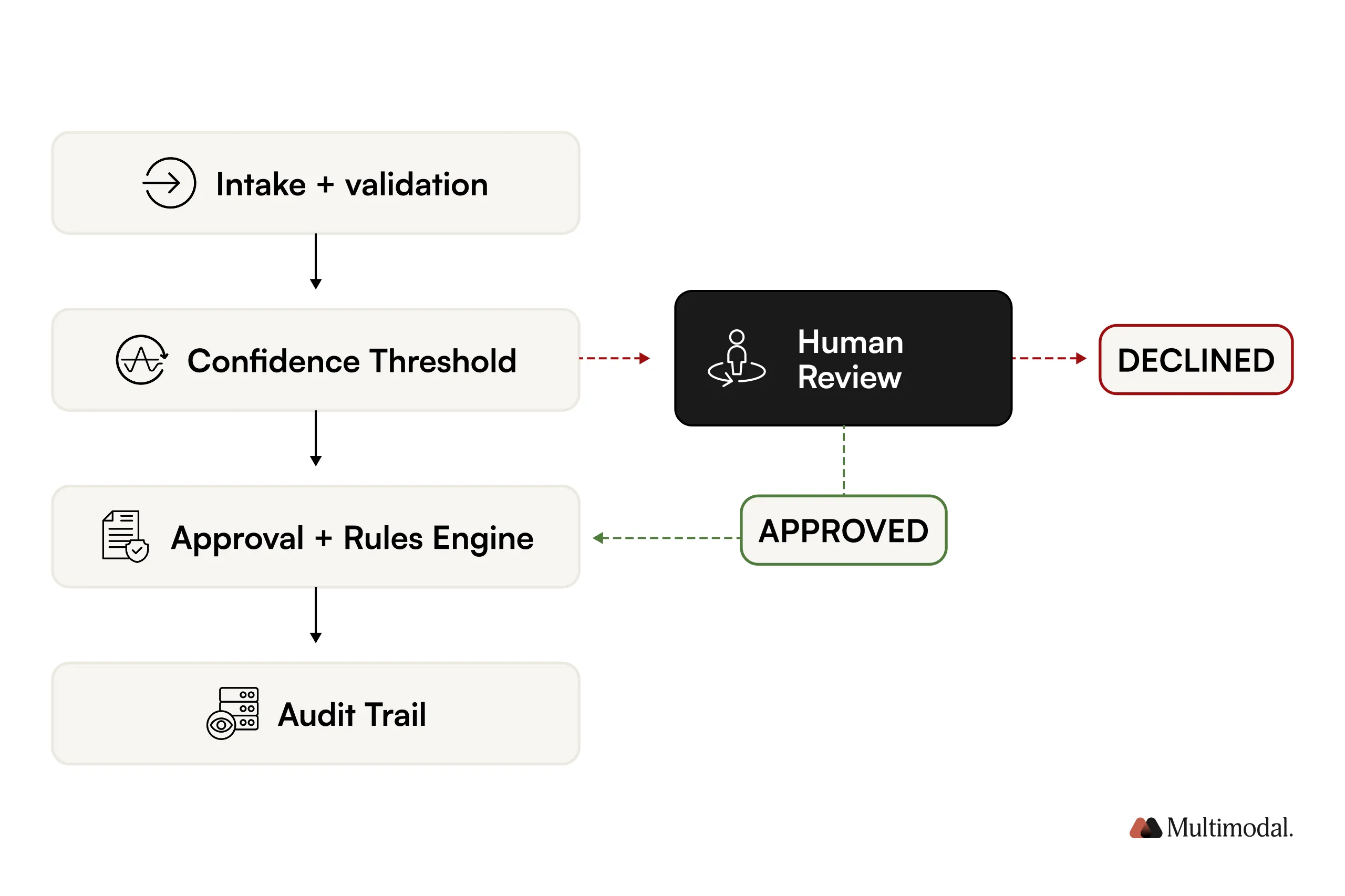
Business process orchestration also treats automated and manual tasks as equally first-class elements of a process. Human intervention, an analyst reviewing a model output, a compliance officer signing off on a regulatory filing, a credit committee approving an exception, is built into the orchestrated process alongside automated steps, not bolted on afterward. This means process modeling reflects how work actually happens, not just the parts a workflow tool can touch.
The 2024 Process Excellence Network report captures the practical implication clearly: “process orchestration goes beyond isolated or fragmented automation, tying together both automated and manual tasks as well as different business processes to help achieve end-to-end automation.”
The same research identifies a pattern that has become familiar in financial services: “organizations that invest heavily in automation point solutions instead of thinking holistically about their end-to-end processes create complexity faster than they resolve it.”
For financial services, the capabilities that follow from this architectural difference are consequential:
Unified data layer across existing systems. Process orchestration maintains a shared data context across the tools and systems involved in a process. Information doesn't need to be re-entered or reconciled at each handoff; it travels with the process.
Consistent enforcement of business rules. Rules, thresholds, and regulatory guardrails are embedded at the process level, not within individual workflow tools. They apply consistently across every step of the orchestrated process, regardless of which system is executing that step.
Complete auditability across the process lifecycle. Because the orchestration platform maintains awareness of every action, automated or manual, it produces a unified audit trail that spans the entire process. This is the kind of compliance record regulators expect, and that siloed workflow tools cannot produce.
Real-time process monitoring and continuous improvement. Leaders can see process health in real time, identify bottlenecks where they actually form, and use key performance indicators tied to process outcomes, not tool-level metrics, to drive continuous improvement.
A genuine process orchestration platform earns that label by coordinating everything a process touches: the data, the decisions, the systems, and the people.
Why Financial Services Can't Rely on Siloed Workflow Automation
Financial services processes are structurally unsuited to siloed automation. The core business processes: loan origination, counterparty onboarding, regulatory reporting, claims settlement, M&A due diligence, don't belong to a single department. They require coordinated action from credit, risk, compliance, legal, finance, and operations, often simultaneously, often against hard deadlines, and always under regulatory scrutiny.
McKinsey's research on AI in banking makes the broader point explicitly: institutions that achieve material results from automation resist the temptation to launch narrow point solutions in isolation. Isolated automation tools may be fast to deploy and low-risk individually, but they don't unlock enterprise value. The firms that win are those that coordinate transformation across functions, which is precisely what process orchestration enables and siloed workflow automation does not.
The operational consequences of relying on fragmented workflow automation in financial services are specific and serious:
Extended cycle times from inter-system gaps. When workflow tools don't coordinate, manual data entry and phone-and-email handoffs fill the space between automated steps. Loan origination processes that should close in days take weeks. Regulatory filings that should be straightforward require days of manual reconciliation. The automation is real, but the process efficiency isn't.
Compliance risk from inconsistent governance. Business rules enforced in one workflow tool may not carry over to the next system in the process. A compliance check in the origination workflow doesn't guarantee the same standards apply during servicing. Audit trails are fragmented across legacy systems and modern tools alike, making it difficult to demonstrate consistent control.
Compounding integration costs. Every point solution added to the stack requires integration work, both at deployment and ongoing as systems change. In organizations running legacy systems alongside modern platforms, this integration burden grows quickly. Technology teams spend cycles maintaining integrations rather than improving processes.
Reduced employee satisfaction from process friction. When employees must manually bridge the gaps between automated workflows, re-entering data, chasing approvals, and reconciling information across systems, the process friction undermines the productivity gains automation is supposed to deliver. Employee satisfaction suffers when automation creates new manual work rather than eliminating it.
Process Orchestration in Practice
AgentFlow is built specifically for the operational complexity of financial services. It's designed not as a workflow automation tool that handles one team's processes, but as a process orchestration and automation layer that coordinates complex, cross-functional business processes across the organization.
In loan origination, AgentFlow orchestrates the entire process lifecycle as a single coordinated process rather than a sequence of handoffs between disparate systems. That means document collection, borrower verification, fraud screening, compliance review, and credit decisioning all run in one place. Every step shares the same data context, including regulatory documentation at close.
But the more important point is what happens beyond lending. AgentFlow is designed for organizations that need to orchestrate multiple automated tasks across their entire business, not just streamline operations within one team:
M&A and due diligence: Coordinating document analysis, counterparty research, regulatory filings, and deal team workflows across legal, compliance, and finance, with full process monitoring and auditability throughout. AgentFlow connects the work that happens in data rooms to the decisions that happen in credit and risk committees, maintaining process context across every stage.
Regulatory reporting and financial reporting: Automating repetitive tasks in data collection, validation, and report generation while embedding approval gates and business rules that ensure accuracy and regulatory compliance. Instead of relying on manual data entry to bridge legacy systems and reporting platforms, AgentFlow orchestrates the entire reporting process from source data to submitted output.
KYC and client onboarding: Managing identity verification, sanctions screening, risk scoring, document collection, and relationship setup as a single orchestrated process, eliminating the manual coordination between compliance, operations, and relationship management that typically extends onboarding timelines by days or weeks.
Contract lifecycle management: Moving contracts through drafting, negotiation, legal review, and execution using cohesive workflows that span internal business teams and external counterparties. Intelligent automation handles routine steps; structured human intervention handles exceptions and approvals; all tracked within a unified process record.
The architectural difference matters here. AgentFlow gives organizations the ability to orchestrate processes that span the entire enterprise: a fundamentally different capability from speeding up the tasks that one team's workflow tool already handles.
The Strategic Benefits of Platform-Scale Orchestration
The business case for process orchestration over workflow automation is built on outcomes. What becomes possible when business processes are coordinated at the platform level, and what the cumulative effect of that coordination looks like across an organization's operations.
Fewer Vendors, a Simplified Stack
Consolidating around a process orchestration platform reduces the number of workflow automation tools, point solutions, and third-party applications that need to be integrated, governed, and maintained.
For financial services organizations that have accumulated automation tools over years of department-level purchasing decisions, this simplification has measurable value: fewer vendor relationships, lower integration costs, reduced security surface area, and dramatically simpler governance. Business rules enforced at the process orchestration layer apply consistently across the organization rather than being configured independently in each tool.
Cross-Department Visibility and Process Monitoring
When business processes run on a process orchestration platform, leaders gain visibility into process health across the organization. Real-time process monitoring means that a head of operations can see where deals are stalling, a chief risk officer can see how credit processes are performing against key performance indicators, and a compliance team can track regulatory filings without chasing status updates across multiple systems.
This cross-functional visibility supports faster decision-making and more effective management of complex processes.
Faster End-to-End Outcomes
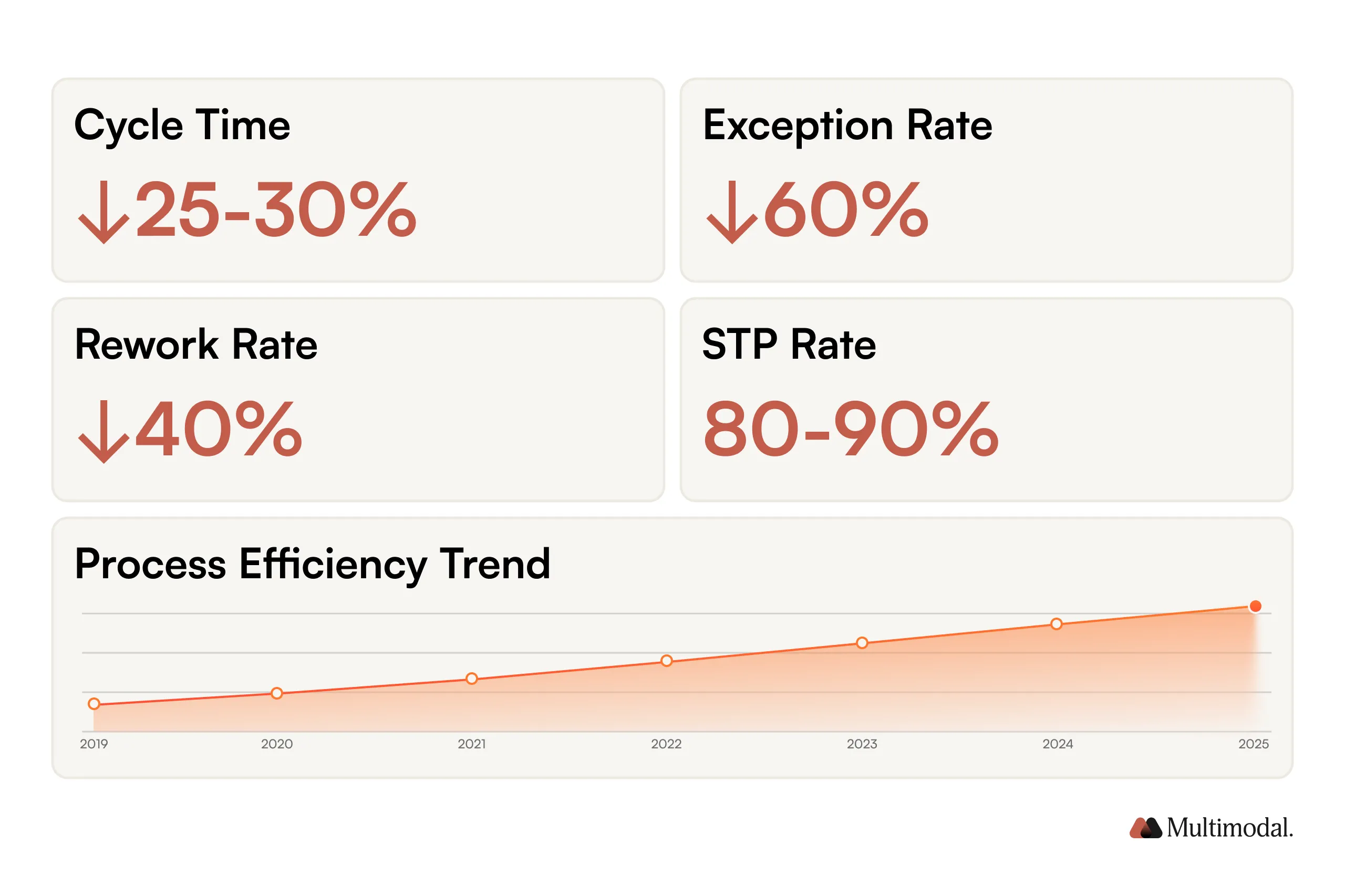
The efficiency gains from process orchestration compound across the process lifecycle. Eliminating manual data entry between systems removes one of the most common sources of delay and human errors. Automated tasks that previously required a handoff between workflow tools now execute within a single coordinated process.
Human intervention is triggered with the full process context already assembled, so reviewers spend time on decisions rather than on gathering information. Across high-volume processes like loan origination or regulatory reporting, these gains accumulate into meaningfully faster cycle times and measurably higher throughput.
Embedded Compliance and Auditability
Implementing process orchestration means compliance controls are built into how processes run, not applied after the fact. Business rules, approval thresholds, regulatory guardrails, and escalation triggers are embedded at the process level and enforced consistently across every execution of the process, whether it's the tenth deal of the week or the thousandth.
The audit trail is unified across the entire process lifecycle, not stitched together from logs across disparate systems. For regulated financial institutions, this transforms compliance from an operational burden into an architectural property of the business.
Higher ROI from Automation Investments
Perhaps the most important benefit is financial: process orchestration captures the value of automation investments that siloed workflow tools leave on the table. When automated processes are coordinated end-to-end, rather than running in parallel across disconnected tools, the efficiency gains compound rather than cancel each other out.
Organizations that have invested in robotic process automation, machine learning, artificial intelligence, and workflow automation tools but haven't seen enterprise-scale returns are often missing the orchestration layer that would make those investments work together. Process orchestration software provides that layer, aligning existing automation investments into a coherent operational capability.
Practical Evaluation Criteria for Financial Services Leaders
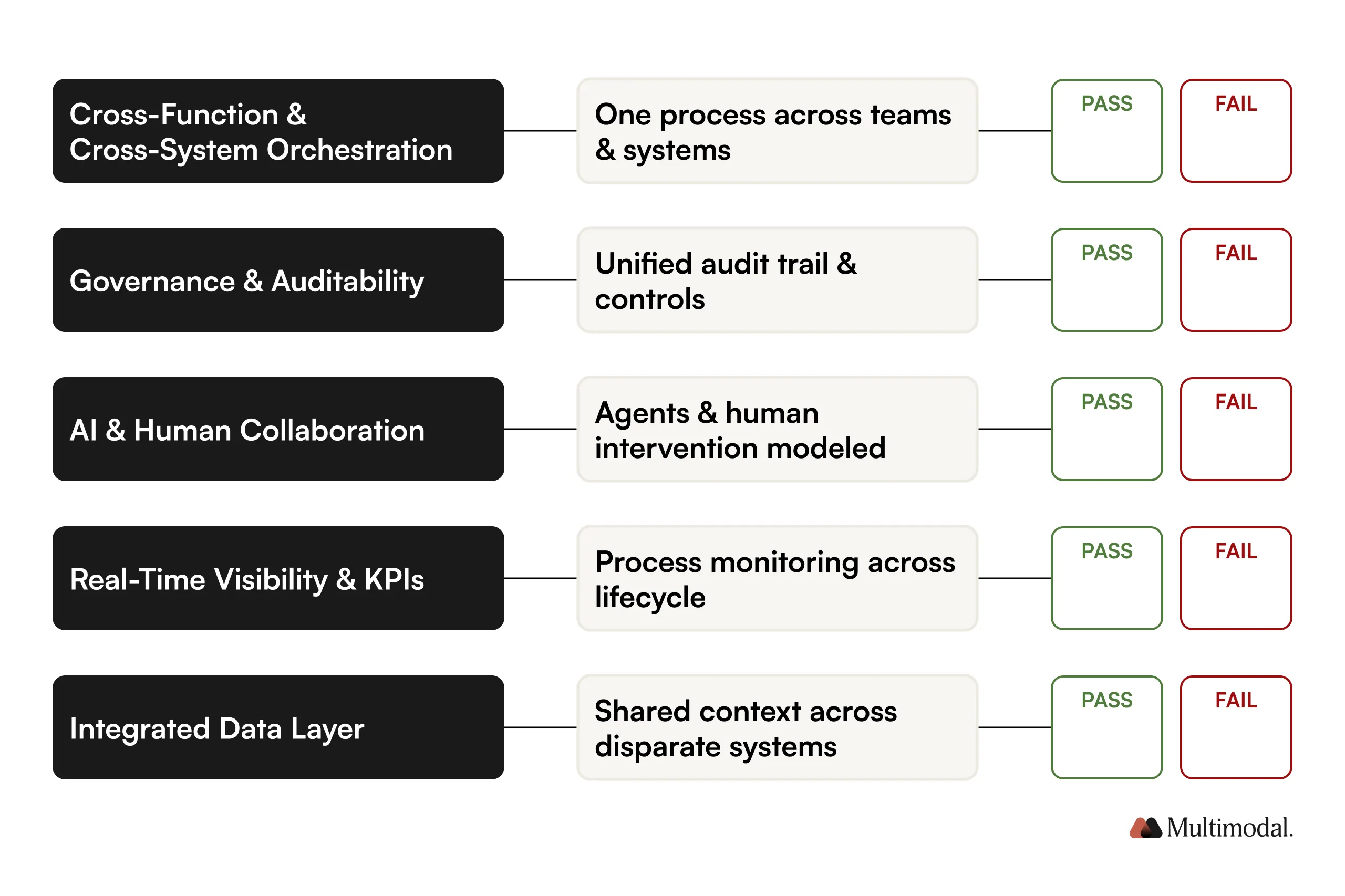
When evaluating process orchestration solutions, the criteria are fundamentally different from those that apply to workflow automation tools. Many platforms present themselves as process orchestration technology while remaining, in practice, sophisticated workflow tools with limited cross-functional reach. Here's how to tell the difference:
Ability to orchestrate across functions and systems: A genuine process orchestration platform coordinates processes that span multiple departments, business units, and systems, including legacy systems that weren't designed for modern integration. Ask whether the platform can manage a process that starts in origination, passes through compliance, triggers actions in risk, and produces outputs in finance, all as a single orchestrated process, not a sequence of separate automated workflows.
Governance, compliance, and audit support: Business rules and compliance controls should be embedded at the process level and enforced consistently across every execution. The platform should produce a unified audit trail that spans the entire process lifecycle, not fragmented logs from individual workflow tools. For regulated industries, this is non-negotiable.
Scalability with AI agents and human collaboration: As financial services organizations increase their use of artificial intelligence and intelligent automation, the orchestration platform needs to support AI agents working alongside human decision-makers within the same process, not as separate systems that need to be integrated. The platform should handle the full range from fully automated tasks to processes that require structured human intervention, and scale across both.
Real-time visibility and measurement: Effective process orchestration software provides real-time monitoring of process state across the organization, not just task completion metrics within individual tools. Leaders should be able to identify bottlenecks as they form, track process performance against key performance indicators tied to business outcomes, and use that visibility to drive continuous improvement.
Integrated data layer across existing systems: The platform needs to maintain shared data context across the disparate systems involved in a process, core banking platforms, risk engines, legacy systems, third-party applications, and modern cloud services. Without this integrated data layer, the platform is connecting workflow tools rather than orchestrating processes; a capability gap that becomes obvious the moment a process crosses a departmental boundary.
A practical test: describe your most complex cross-functional process; one that involves multiple teams, multiple systems, hard compliance requirements, and both automated and manual steps. Ask whether the platform can orchestrate that process end-to-end, produce a unified audit trail, and give you real-time visibility into its performance. The answer reveals quickly whether you're evaluating a process orchestration platform or a workflow automation tool with orchestration marketing.
For a deeper look at how to think through the broader platform vs. point solution trade-off in financial services automation, see our analysis here.
The Case for Process Orchestration in Financial Services
The typical failure mode is coordination: firms automate repetitive processes and individual tasks, but lack process orchestration software to connect those automated tasks across business operations, legacy systems, and third-party applications. Workflow tools speed up individual tasks but can't unify the complex, cross-functional processes that define how financial institutions actually operate.
Process orchestration closes that gap: aligning automation investments into a coherent operational system with real governance, real auditability, and real enterprise-scale efficiency. Top performers keep the toolchain simpler and put a business process management layer, process orchestration, and automation at the center, so complex processes run as cohesive workflows across disparate systems.
See AgentFlow Live
Book a demo to see how AgentFlow streamlines real-world finance workflows in real time.
AgentFlow functions as the process orchestration platform that coordinates process modeling, execution, and process monitoring across multiple systems, so teams can streamline operations without adding more point automation templates.
If you're ready to move from automating tasks to orchestrating outcomes, book a demo to see how AgentFlow works for financial services teams.

.svg)
.svg)

.avif)
.png)