Decision intelligence automates business decisions with clear, auditable outcomes.
Benefits include faster underwriting, fraud detection, compliance, and risk management.
Start small with quality data and strong AI integration to scale safely.
Ensure transparency with confidence scores, logs, and audit trails.
Use thresholds and escalation to balance automation with human oversight.
Get 1% smarter about AI in financial services every week.
Receive weekly micro lessons on agentic AI, our company updates, and tips from our team right in your inbox. Unsubscribe anytime.
Thank you! Your submission has been received!
Oops! Something went wrong while submitting the form.
Decision intelligence platforms are transforming how the financial services industry makes high-impact, data-driven decisions. Unlike analytics tools that simply report on historical performance, decision intelligence platforms help financial institutions turn data into decisions. They embed institutional knowledge, business rules, and statistical models directly into AI-powered workflows, enabling smarter decisions at scale.
In this guide, we explore how decision intelligence platforms apply to financial services and how to deploy them safely. We also explain how AgentFlow delivers real-time insights through unified data, governed decision flows, and modular decision intelligence software.
What Is a Decision Intelligence Platform?
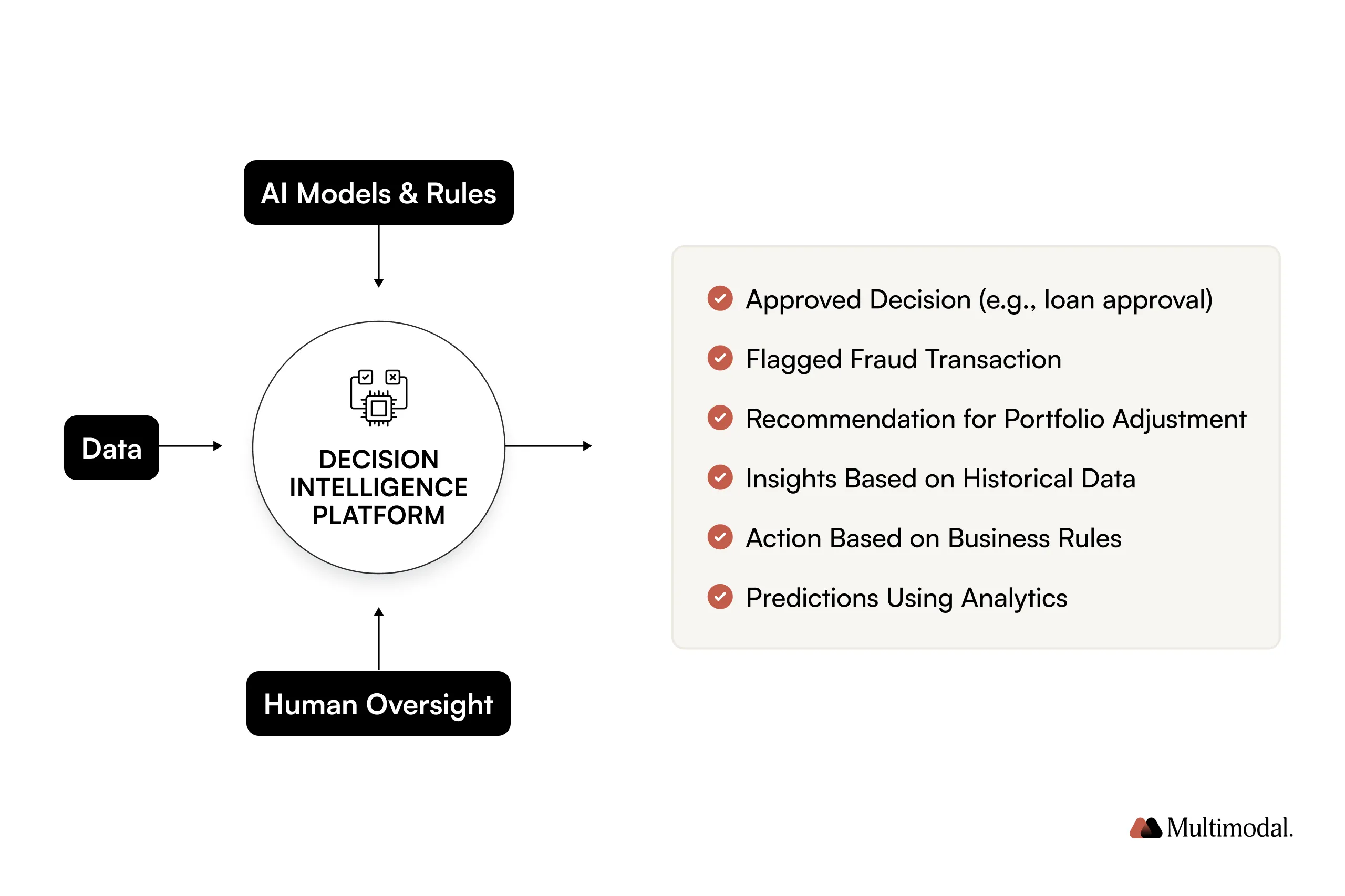
A decision intelligence platform combines data sources, AI models, rules engines, orchestration layers, and human oversight into a single intelligence platform that automates complex operational decisions.
Think of it as a control center for decision making, where unstructured data, financial data, and external signals are transformed into explainable decision outcomes.
Unlike traditional BI tools and legacy business intelligence systems that rely on dashboards and static reports, decision intelligence platforms:
Assess real-time analytics across internal data, market data, and third-party data providers
Apply decision logic using predictive analytics, historical data, and business logic
Explain reasoning through audit trails, confidence scores, and versioned logs
Improve decision outcomes over time using feedback from business users and data scientists
AgentFlow’s decision intelligence tools are purpose-built to support high-volume operational decisions in lending, compliance, fraud, and finance safely, transparently, and at enterprise scale.
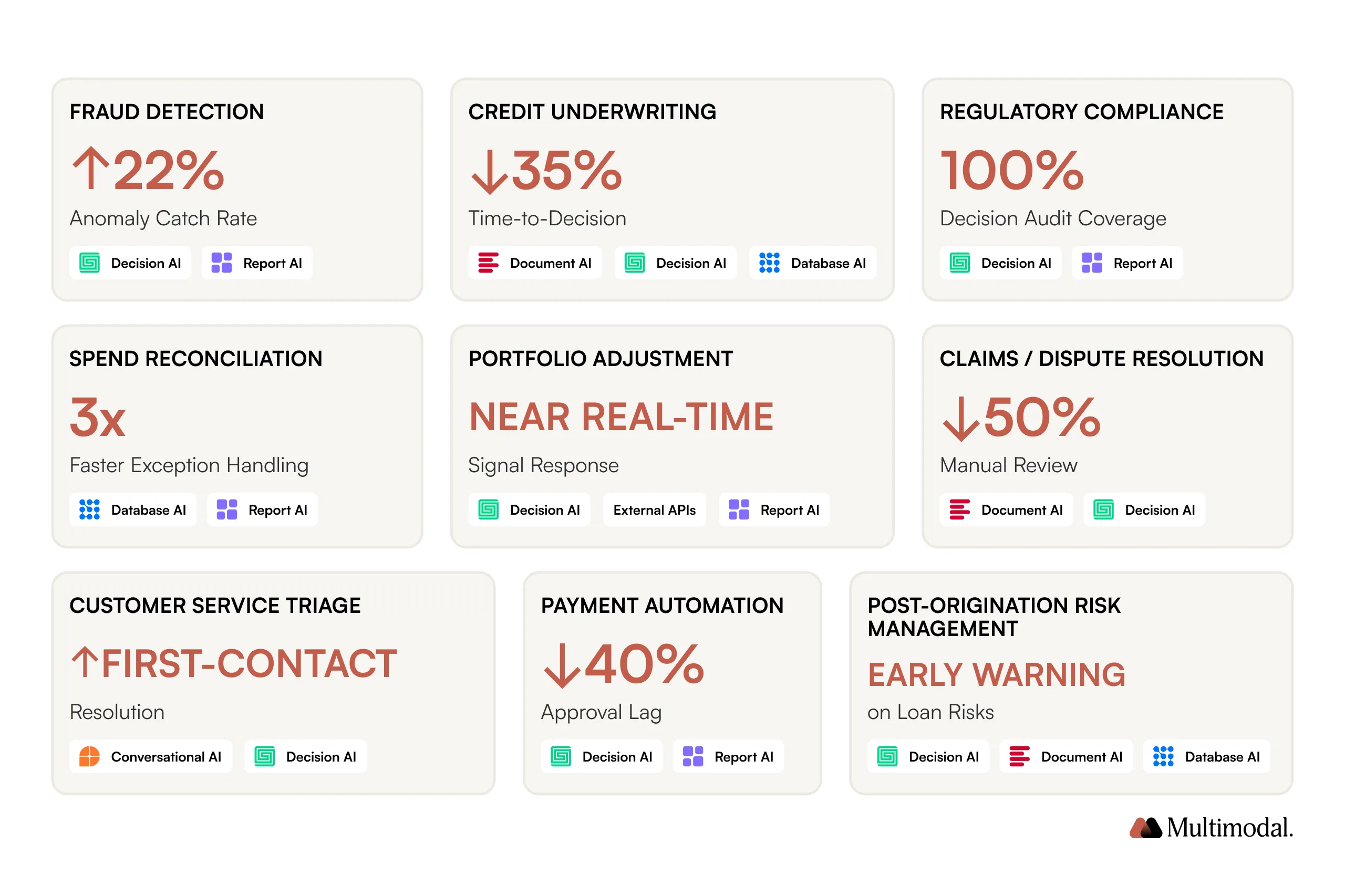
How Can You Use Decision Intelligence Platforms in Financial Services?
Decision intelligence enables financial institutions to automate and scale critical business decisions. These platforms unify complex data from multiple sources and apply advanced analytics, machine learning, and business rules. It helps organizations turn data into actionable insights, improving decision-making speed, consistency, and confidence while reducing operational risk and manual effort.
Below, we’ll highlight some of the most popular ways in which organizations can apply them in front-office workflows.
Credit Risk Modeling and Underwriting
Decision intelligence software supports credit risk assessment by analyzing financial data, including loan files, income documentation, credit reports, and unstructured data. By combining historical data, predictive modeling, and business logic, financial institutions can enhance the accuracy of underwriting decisions, reduce reliance on legacy systems, and support high-volume operational decisions with consistent, data-driven outcomes.
Fraud Detection
Real-time and predictive analytics enable organizations to continuously monitor transactions, payments, and account activity for suspicious activity. By learning from historical data and applying machine learning models, these systems improve fraud detection precision, reduce false positives, and accelerate decision execution across operational decisions.
Regulatory Compliance
Complex regulatory compliance requirements, such as SOC II, can be embedded directly into governed decision flows. Versioned decision logs, audit trails, and explainable decision outcomes help financial institutions reduce financial exposure. They allow you to confidently defend your decisions if any issues arise, whether with regulators or applicants.
Investment and Portfolio Decisions
For strategic planning and portfolio management, decision intelligence integrates internal, market, and third-party data to deliver real-time and predictive insights. Structured decision-making processes support smarter decisions by business users and investment committees, aligning portfolio actions with risk management objectives and long-term performance goals.
Post-Origination Risk Management
After origination, decision intelligence supports ongoing risk management by monitoring loan performance and market conditions. By analyzing payment behavior, borrower health, and market signals, organizations can identify early warning indicators and recommend actions, such as refinancing or portfolio adjustments, to mitigate losses and maintain compliance.
Customer Service Triage
Natural language search and customer intelligence enable finance teams to categorize, prioritize, and route inbound inquiries efficiently. Business rules guide resolution paths, improving customer satisfaction while reducing backlogs. These decision flows can be configured by non-technical users, empowering business users without requiring deep technical expertise.
Spend Intelligence and Reconciliation
By working with unified data from vendors, expense systems, and invoices, organizations can explore data to identify inconsistencies and cost-saving opportunities. Automated reconciliation improves data quality, reduces errors, and supports audit-ready reporting across enterprise teams.
Dispute Resolution
Dispute handling is streamlined by extracting relevant details from claims and chargeback documents, then applying policy rules and historical precedent to recommend outcomes. When confidence is low, cases are escalated for review, preserving traceability and ensuring consistent, confident decisions.
Payment Automation
Payment workflows benefit from automated verification, approval, and execution steps that enforce internal controls. By validating payees, detecting duplicates, and recording every decision outcome, finance teams reduce delays, minimize errors, and maintain transparency across critical business decisions.
How to Safely Use Decision Intelligence Platforms in Financial Services
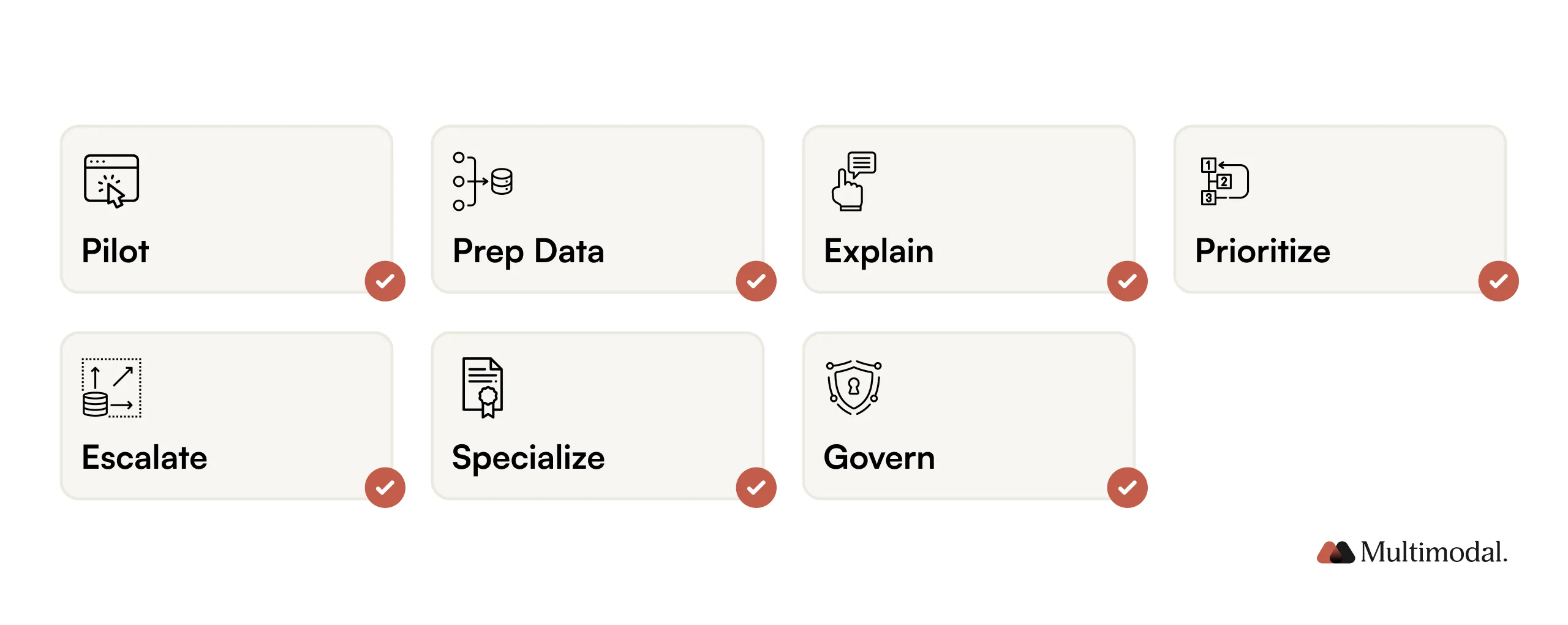
1. Use an Iterative Approach
Safely adopting decision intelligence requires starting with narrowly scoped, high-impact decisions rather than attempting end-to-end automation. Financial institutions that succeed typically begin with workflows where decision criteria are well understood, data quality is high, and outcomes can be clearly measured, such as underwriting reviews, compliance checks, or payment approvals. This limits operational risk while allowing teams to validate decision logic, governance controls, and auditability in production.
An iterative approach also enables continuous refinement as models, data pipelines, and business rules evolve. Early deployments surface gaps in data integration, edge cases in decision flows, and areas requiring human oversight. These insights inform expansion into adjacent use cases, ensuring decision intelligence scales with stronger controls, clearer accountability, and greater organizational trust.
2. Prepare Your Data for AI
Decision intelligence is only as effective as the data that powers it. Research from Celent shows that 60% of Tier 1 banks identify existing data architecture as a primary barrier to improving decision intelligence, highlighting how fragmented systems and inconsistent data structures limit the ability to scale intelligent decision-making. Without addressing these foundational issues, even the most advanced analytics and machine learning models struggle to deliver reliable outcomes.
Preparing data for AI requires more than basic integration. Financial institutions must standardize, structure, and contextualize both financial data and unstructured data so it can be consistently interpreted by decision systems. This includes improving data quality, resolving inconsistencies across internal and external data sources, and ensuring data is machine-readable, governed, and auditable. Institutions that invest early in AI-ready data architectures enable more accurate decisions, faster iteration, and greater confidence in automated decision flows.
3. Choose Only Explainable and Transparent Systems
In financial services, automated decisions must be understandable, defensible, and reviewable. Systems that rely on opaque models increase operational and regulatory risk by making it difficult to justify outcomes to auditors, regulators, and internal stakeholders. Explainable decision intelligence mitigates this risk by exposing how inputs, rules, and models contribute to each decision rather than producing black-box outputs.
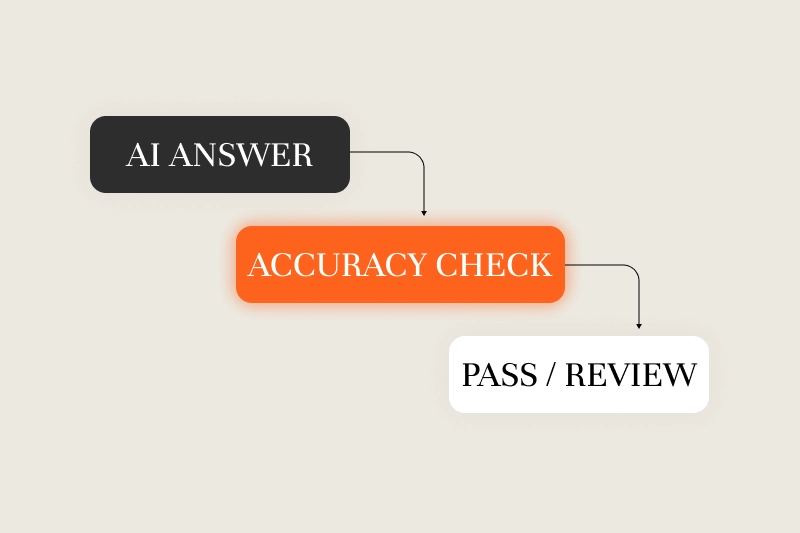
Confidence scoring adds an essential layer of control by quantifying the system's confidence in each decision. When confidence falls below defined thresholds, decisions can be automatically escalated for human review, ensuring high-risk or ambiguous cases receive appropriate oversight. This approach allows financial institutions to scale automation while maintaining accountability, reducing errors, and preserving trust in AI-driven decision-making.
4. Choose the Right Use Case
Not every workflow is a good candidate for decision intelligence. Successful deployments begin by identifying decisions that are frequent, repeatable, and rules-driven, with clear inputs and measurable outcomes. Use cases with well-defined success metrics, such as reducing time-to-decision, lowering error rates, or improving consistency, are more likely to deliver near-term value and justify further investment.
High-impact use cases also share strong data availability and clear ownership across business and technical teams. When decision criteria are ambiguous, data quality is poor, or accountability is unclear, automation can amplify risk rather than reduce it. Selecting the right starting point ensures that decision intelligence strengthens existing decision-making processes rather than introducing unnecessary complexity.
5. Prioritize Human Oversight
Human oversight is critical to safely scaling automated decision-making in financial services. While decision intelligence can handle high-volume operational decisions, certain scenarios, such as edge cases, ambiguous inputs, or high-risk outcomes, still require human judgment. Embedding structured review points ensures automation enhances decision-making rather than replacing accountability.
Human-in-the-loop frameworks allow systems to route decisions for review based on confidence thresholds, risk levels, or policy exceptions. This approach helps financial institutions maintain control, improve decision quality over time, build organizational trust in automated workflows, and ensure compliance with regulatory and governance expectations.
6. Work With Vertical Vendors
In financial services, technology choices directly affect risk, compliance, and operational resilience. Analyst firms such as McKinsey consistently note that industry-specific platforms outperform general-purpose tools in regulated environments because they are designed from the outset around domain workflows, regulatory constraints, and financial data structures.
Vertical vendors reduce the need for heavy customization, shorten implementation timelines, and lower the risk of misaligned decision logic across areas such as credit risk, fraud detection, and regulatory reporting.
Regulators and supervisory bodies increasingly expect financial institutions to demonstrate control, explainability, and governance across automated decision-making systems. Vendors that serve only financial services are better positioned to meet these expectations because their platforms embed compliance requirements, auditability, and risk controls as core capabilities rather than add-ons.
For financial institutions, partnering with a vertical provider means faster time to value, stronger alignment with regulatory standards, and greater confidence that decision intelligence can scale safely across high-impact, high-volume operational decisions.
7. Ensure Proper Governance
Effective decision intelligence requires clear governance structures to oversee the design, deployment, and maintenance of automated decisions. Financial institutions should establish cross-functional governance committees that bring together risk, compliance, IT, data science, and business leaders to define accountability, approve use cases, and set guardrails for automated decision-making.
Strong governance also includes ongoing model lifecycle management, regular retraining and validation, continuous risk monitoring, and comprehensive auditability. These controls ensure decisions remain accurate, compliant, and aligned with regulatory expectations as data, policies, and market conditions change. Platforms that support formal controls and recognized security standards provide a stronger foundation for scaling decision intelligence safely and responsibly.
What Sets AgentFlow Apart
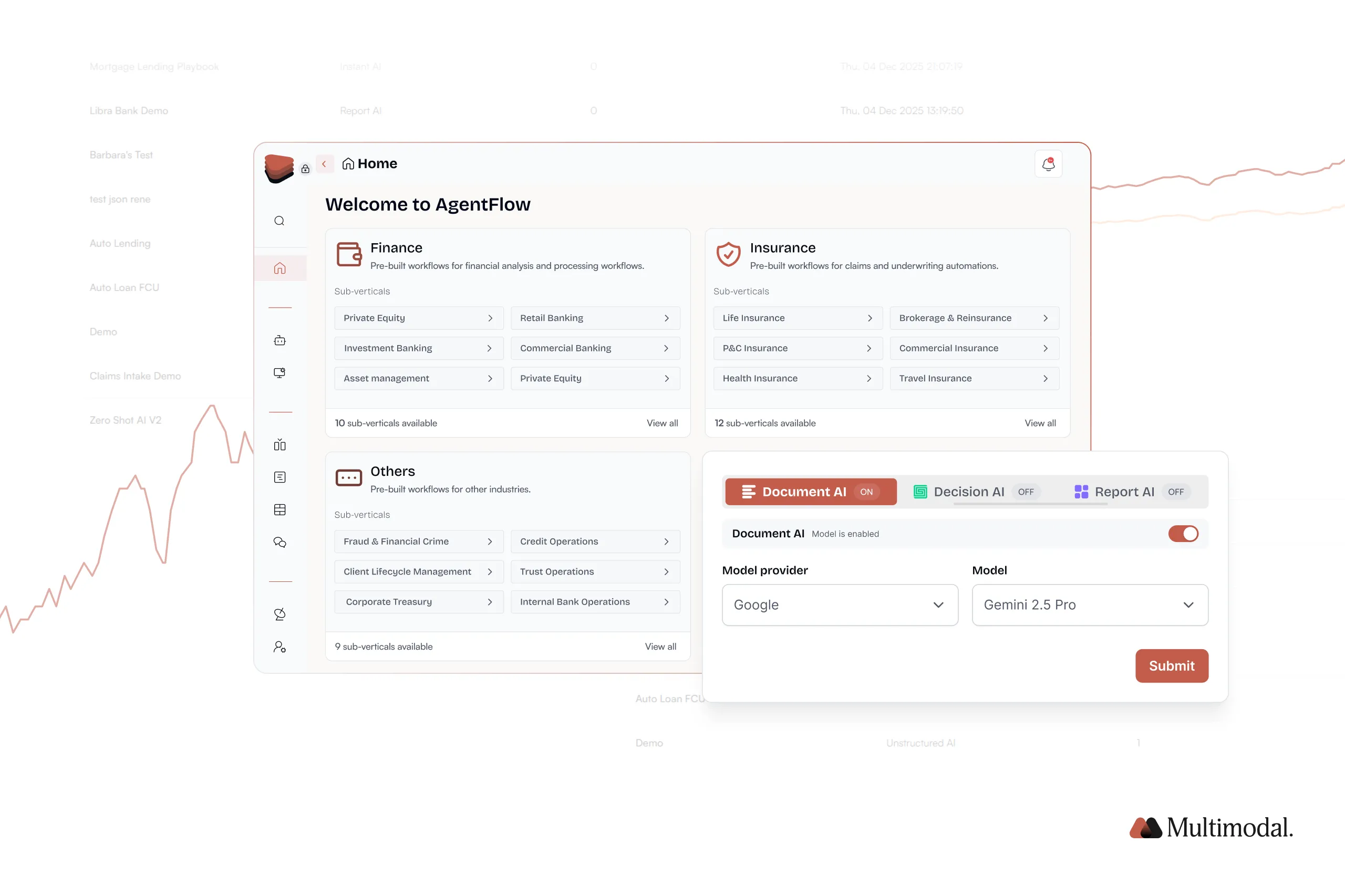
Private deployments on AWS, Azure, or on-prem
Model and GPU choice with full customer data ownership
100+ finance-specific templates to accelerate decision automation
Self-learning AI agents that improve over time via business feedback
Multi-agent orchestration to span unstructured processing, decisioning, and reporting
AgentFlow is more than a toolkit. It's a production-grade platform for turning tribal knowledge into governed decision intelligence, trusted by compliance teams, IT departments, and front-line staff alike.
Want to see how this works in a real decision flow? Book a demo, and we’ll show you how customers are using AgentFlow to scale automation across high-value financial workflows safely.
See AgentFlow Live
Book a demo to see how AgentFlow streamlines real-world finance workflows in real time.

.svg)
.svg)

.avif)
.png)