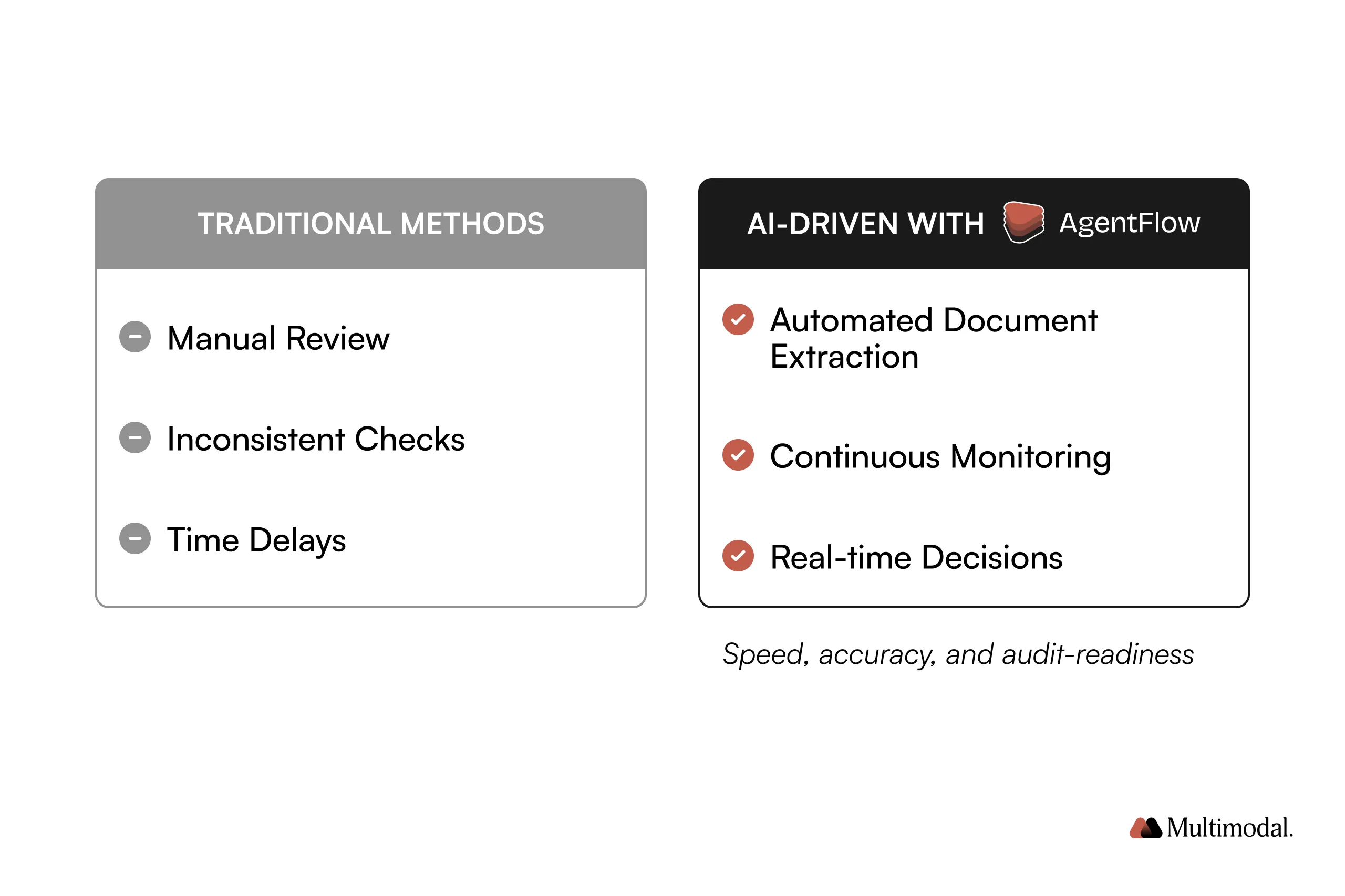
A single codified workflow eliminates fraud gaps from manual, inconsistent processes.
Agentic AI automates intake-to-payout checks with explainable, auditable decisions.
Confidence-based step-up routing reduces false positives while escalating real risk.
Structured logs and decision packs cut audit turnaround from days to minutes.
Phased rollout delivers fast intake gains, then scales insights and payout controls.
Get 1% smarter about AI in financial services every week.
Receive weekly micro lessons on agentic AI, our company updates, and tips from our team right in your inbox. Unsubscribe anytime.
Thank you! Your submission has been received!
Oops! Something went wrong while submitting the form.
Commercial lending fraud doesn’t thrive because banks lack tools. It thrives because fraud detection isn’t a single model; it’s a sequence of decisions embedded in disconnected workflows. When documents live in PDFs and emails, decisions live in people’s heads, and monitoring lives on someone’s checklist (if at all), gaps appear. And fraud hides in the gaps.
What’s missing isn’t software. It’s a shared, enforceable decision process. Without one, different analysts apply different thresholds. Exceptions become one-offs instead of policy. And explaining outcomes to audit, compliance, or leadership takes weeks.
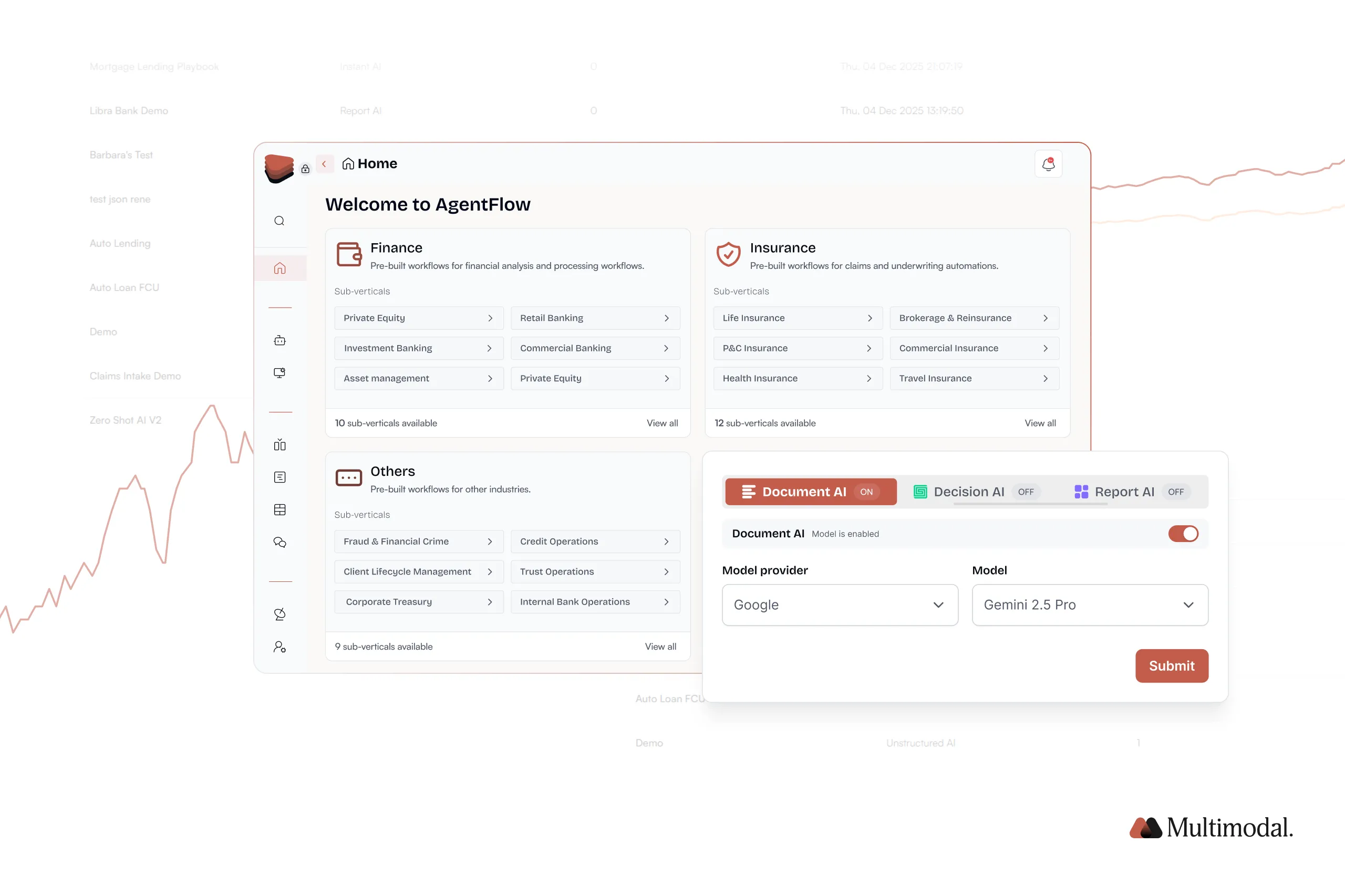
AgentFlow changes that. It doesn’t give you another fraud tool. It codifies your fraud playbook and executes it end-to-end with agentic AI.
Agentic Fraud Detection: What It Means in Practice
AgentFlow lets banks run their own fraud detection workflow as an agentic system. Agents execute each step of the fraud playbook. Decision AI orchestrates those steps and generates auditable outcomes. Every decision includes the evidence used, a confidence score, a clear audit trail, and a defined escalation path.
The platform’s building blocks are tightly integrated: Document AI extracts and normalizes document content; Unstructured AI reads messy text such as broker emails; Database AI links identities and reconciles across systems; Conversational AI structures human interactions; Report AI assembles audit-ready summaries; and Decision AI routes, scores, explains, and governs decisions.
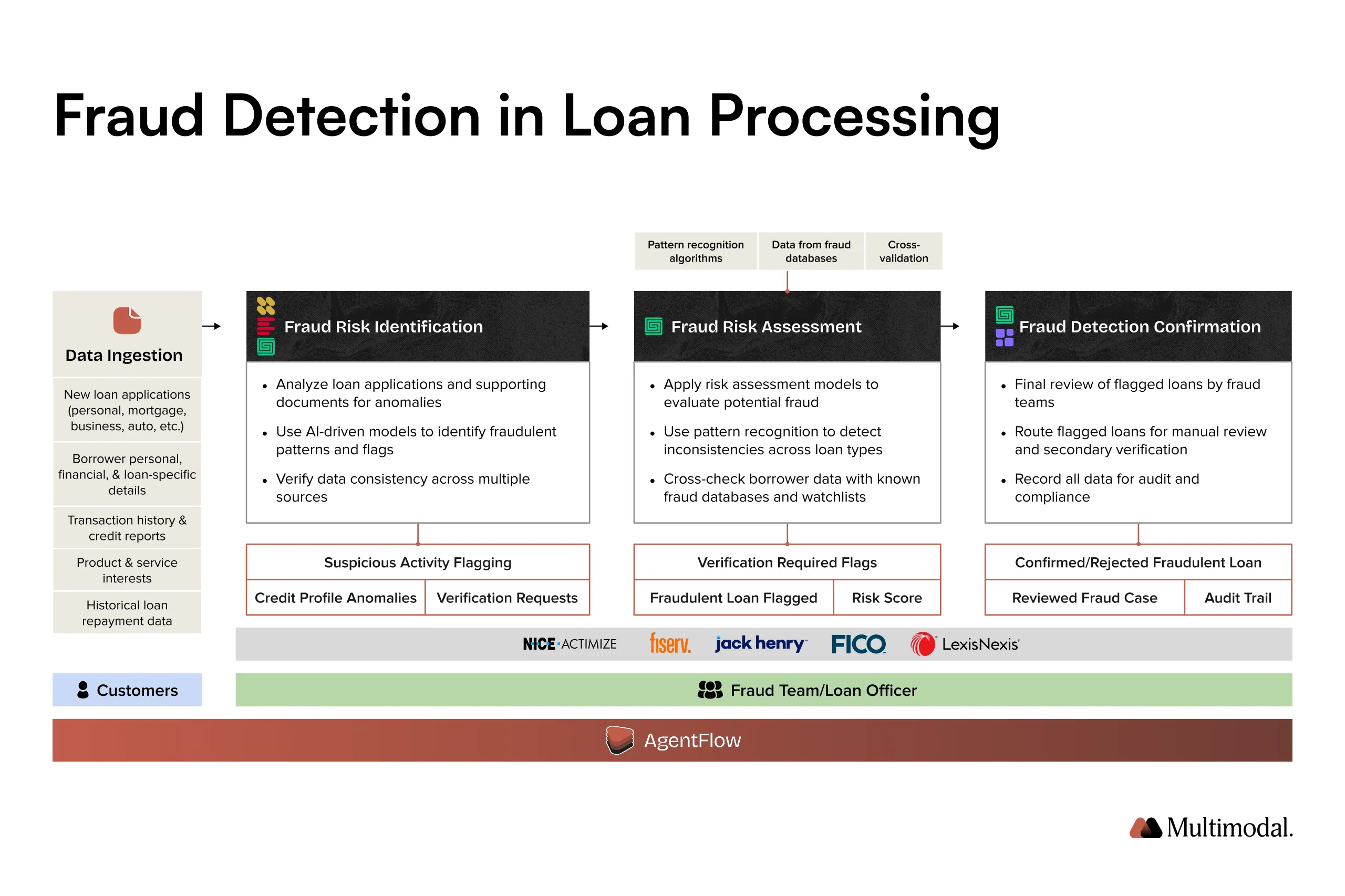
The Workflow: Fraud Detection & Monitoring Across the Loan Lifecycle
Step 1: Prove the Borrower and the Paper (Intake)
Before AgentFlow, analysts manually reviewed IDs, financials, and tax returns. Cross-checks were inconsistent, and the results rarely led to repeatable policy. With AgentFlow, Document AI extracts data from identity documents, financial statements, and tax returns, while Unstructured AI processes the context layer, emails, borrower notes, and explanations.
Decision AI then runs the intake checks as codified policy: mismatch detection (name, EIN, address), continuity checks (date ranges, statement gaps), internal logic validation (math, anomalies), and “what changed” deltas between document uploads.
The output includes a trust score reflecting identity and document integrity, a KYC/KYB decision (pass, step-up, or escalate), and evidence-backed rationale explaining the result.
Step 2: Defend Every Session (Application to Underwriting)
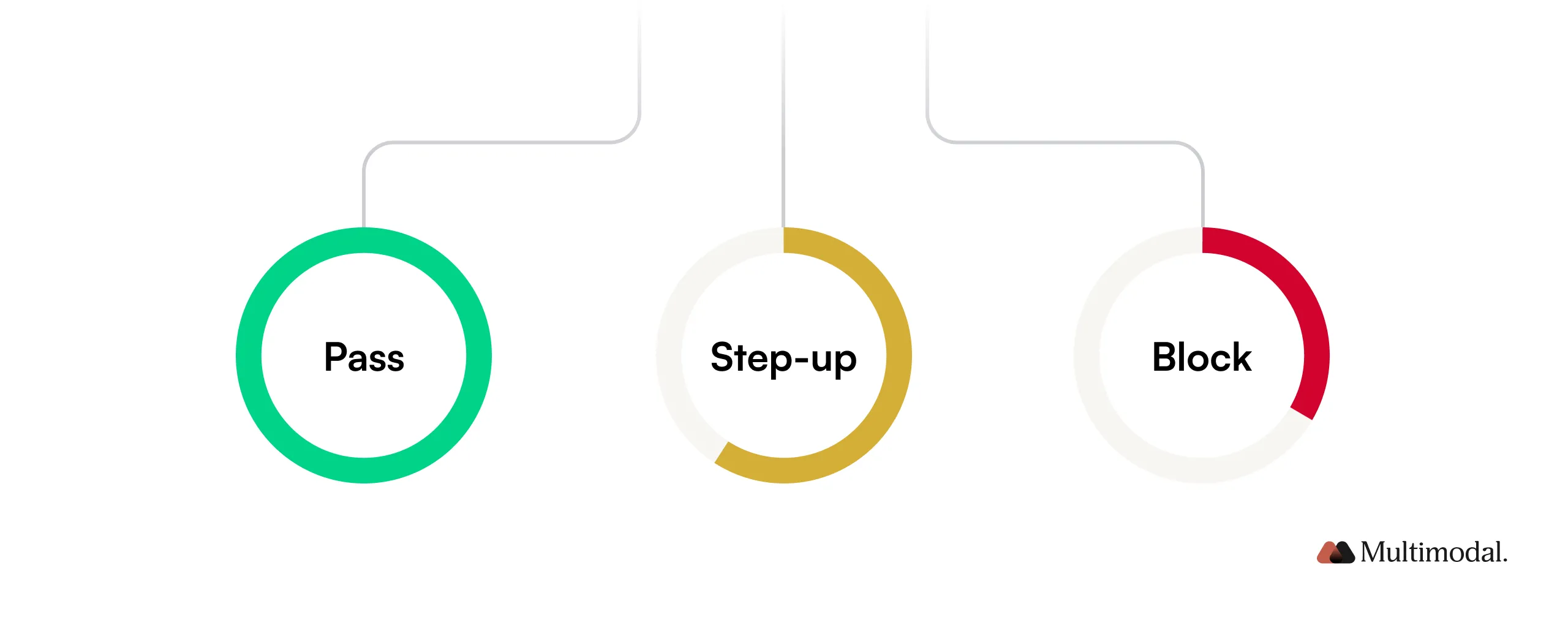
Fraud doesn’t just live in documents; it lives in behavior. Before AgentFlow, borrower or broker communications via portal or email were disconnected from risk decisioning. AgentFlow changes that. Conversational AI captures and structures all interactions, while Decision AI evaluates session-level trust: whether to allow, step-up, or block the process. “Step-up” can trigger additional verification, callbacks, or requests for more documents.
The result is a clear, logged decision for every session, paired with a rationale trail that records what was said, what changed, and what action was taken.
Step 3: Catch Synthetics + Early Patterns (Underwriting Checks)
The third stage is where fraud detection evolves into fraud intelligence. Historically, underwriting teams couldn’t reliably cross-reference prior applications, shared entities, or internal systems. With AgentFlow, Database AI links borrower and entity attributes, EINs, addresses, bank accounts, and devices across systems. Decision AI uses this data to flag risky overlaps, repeat anomalies, and influences from prior decisions, such as declined or escalated cases.
Crucially, the fraud score generated is explainable, not just a number. It feeds into a referral queue prioritized by risk, with a transparent rationale for review.
Step 4: Secure Disbursement (Funding)
Disbursement is where fraud becomes irreversible. Traditionally, payout changes are communicated via email, and audit documentation is compiled after the fact. AgentFlow’s Decision AI enforces payout controls: identity and payment instructions are re-verified before funding, and any changes trigger step-up approvals. Report AI automatically compiles a decision pack detailing the inputs, checks, decisions, confidence scores, and any human overrides.
The final output includes a release or hold decision, a full audit log, and reviewer notes for compliance or audit teams.
What Makes AgentFlow Safe to Deploy
AgentFlow is engineered for regulatory-grade oversight and enterprise audit readiness. Its deployment model supports complete isolation through private VPC or on-prem setups, ensuring customer control over infrastructure, data, and model behavior.
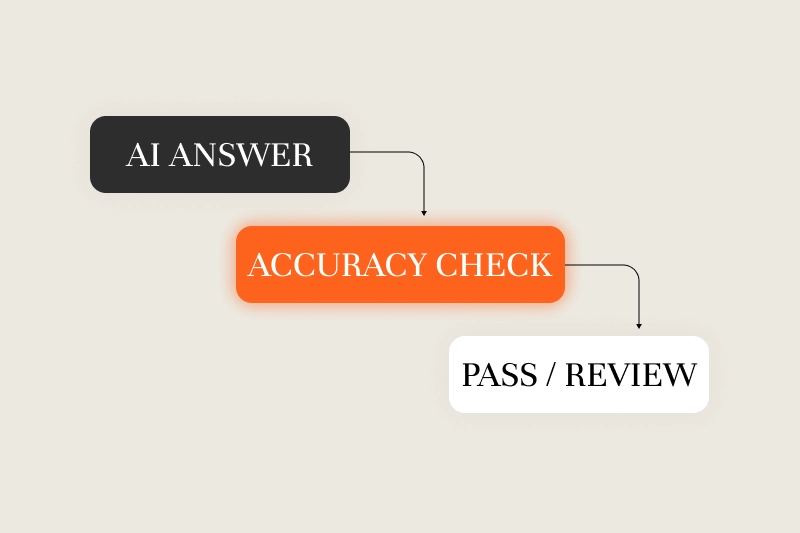
Role-Based Access Control (RBAC) governs every user interaction, with permissions tied to organizational roles and approval chains. Human-in-the-loop governance allows companies to tier escalation paths by both confidence scores and business risk. For example, decisions with confidence below 70% are routed to manual review, while those above 99% can be auto-approved, with sampled audits triggered after the decision.
Policy versioning ensures traceability by documenting which rules were applied to every decision and when. Each agentic workflow run is logged as a JSON-formatted execution trace with time-stamped inputs, outputs, model versions, and override notes. This forms the backbone of AgentFlow’s immutable audit trail, fully aligned with CECL, IFRS 9, and other regulatory requirements.
Confidence scoring and per-execution rationale are embedded by default, making every output explainable and defensible to internal risk, audit, and compliance teams.
How to Roll It Out: 3-Phase Implementation
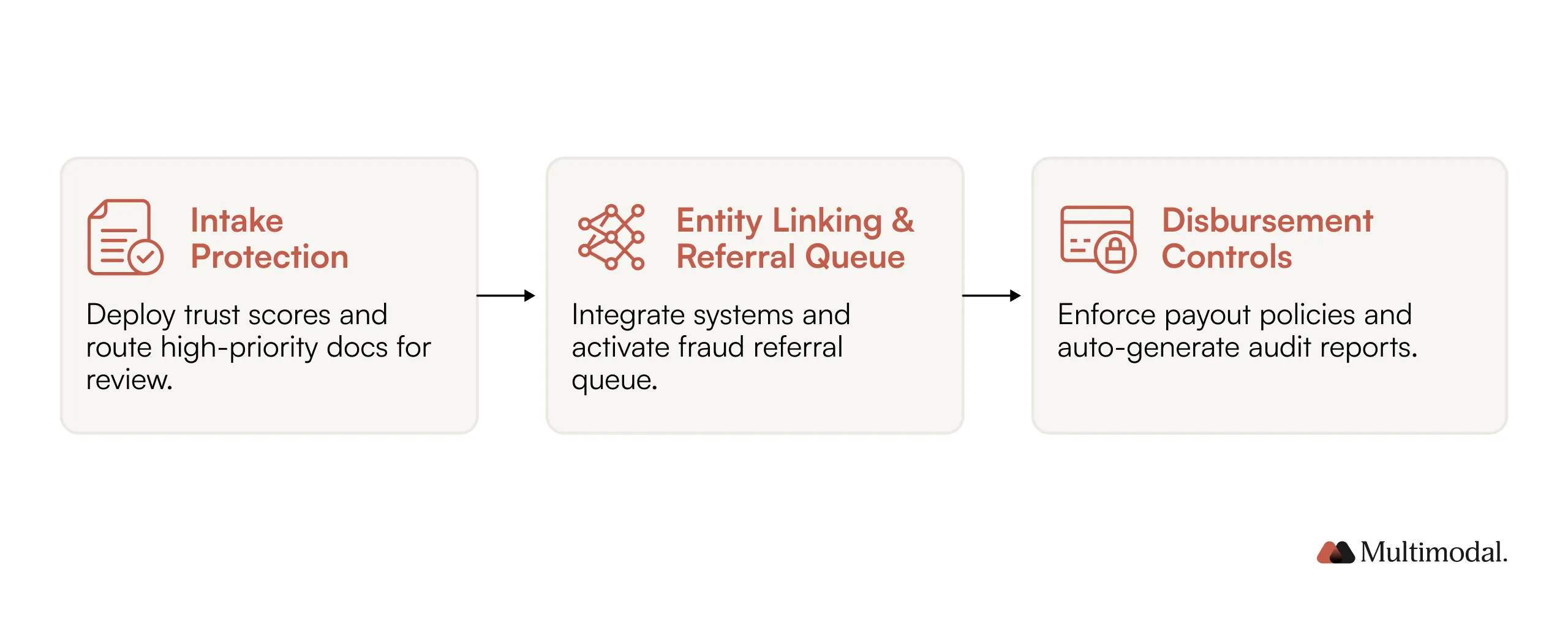
Implementation doesn’t require boiling the ocean. Most financial institutions follow a structured three-phase rollout.
In Phase 1, teams target the intake stage, where risk is first assessed. Deploying trust scores and step-up routing for top-priority document types (such as IDs, tax returns, and financial statements) yields an immediate lift in fraud catch rate and standardizes intake decisioning. This phase typically includes 10–15 document templates and runs in parallel to human review before being promoted to production.
Phase 2 focuses on entity-level insights. By connecting LOS, CRM, and core banking systems, AgentFlow activates Database AI to link identity and activity across applications. The result is an explainable referral queue that allows fraud and risk operations to focus on high-signal cases, reducing manual screening overhead while increasing capture of synthetic and repeat offenders.
Phase 3 locks down payout operations. Teams activate Decision AI to enforce disbursement policies, including re-verification workflows, wire change detection, and approval escalation. At the same time, Report AI auto-generates decision packs for every loan funded, enabling 48-hour audit turnaround and executive-ready reporting.
What to Measure
The right metrics measure operational efficiency and fraud intelligence, not vanity KPIs. Start with the time to first fraud decision at intake; this sets the baseline for end-to-end responsiveness. Track review load and escalation rate to assess how effectively the system filters low- and high-risk sessions. Override rate, especially in early phases, is a key indicator of both model precision and policy calibration.
Over time, monitor the confirmed-fraud capture rate by cross-referencing referrals or holds with cases later validated as fraud by internal teams. Lastly, measure audit readiness: how long it takes to retrieve the rationale and supporting evidence for a decision when auditors or compliance request them. With AgentFlow’s structured logs and explainability-first architecture, that window compresses from days to minutes.
Build AI Your Industry Can Trust
Deploy custom multimodal agents that automate decisions, interpret documents, and reduce operational waste.
AgentFlow shifts fraud detection from ad hoc judgment to repeatable, explainable policy execution. No more scattered decisioning. Just clear outcomes that teams can audit, explain, and improve.
If you want to map this onto your current systems, we can walk through the build together. Schedule a 30-minute call to see how AgentFlow automates each step of your fraud playbook, from intake to payout, with auditable precision.

.svg)
.svg)

.avif)
.png)