

.svg)
.svg)

.svg)
This is a summary of an episode of Main Street AI, an educational podcast on AI led by our founder. Join 3,700+ business leaders and AI enthusiasts and be the first to know when new episodes go live. Subscribe to our newsletter here.
TL;DR:
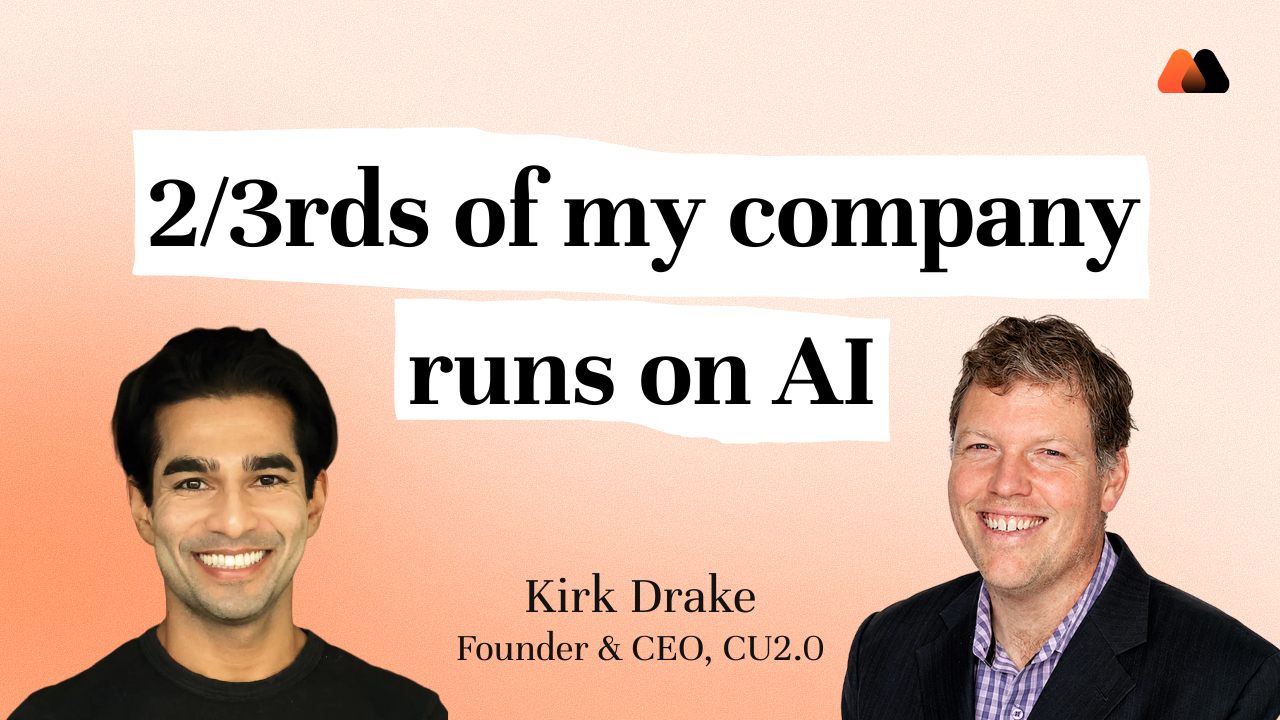
- Kirk Drake: founder and CEO of CU 2.0, started as a teller, later ran IT at a handful of credit unions
- Wrote FinAncIal: Helping Financial Services Executives Prepare for an Artificial World in 2020, before most of the industry had heard of ChatGPT
- His claim: 30 years of hard-won PowerPoint and spreadsheet skills are now worth zero
- "We can't put our data near these models" is mostly an excuse, not a real blocker anymore
- orsa credit union built and deployed an AI fee-scanning tool, live with online account opening, in 48 hours
- Adoption starts with 5 to 7 percent of a team opting in, not a company-wide mandate
- The real AI strategy every credit union is chasing is just learning to move more quickly
Before we dive into the key takeaways from this episode, be sure to catch the full episode here:
Why Do 30 Years of Skills Suddenly Count for Zero?
Drake puts himself in the frame first. He's good at PowerPoint, good at spreadsheets, can build a pivot table and a self-updating table of contents with footnotes in Word. He wrote two books that way.
"That entire set of skills that I probably spent twenty, thirty years getting better at, upgrading each time a new version of PowerPoint or whatever, just flat out doesn't matter anymore. That sucks. It's a sense of loss." — Kirk Drake
He treats that grief as real rather than something to push past quickly. The instinct to protect decades of skill-building is the same sunk cost fallacy that stalls institutions, and naming the loss honestly, rather than skipping it, is what lets a person or a credit union actually move to the next stage.
Is AI Data Privacy Really a Risk for Credit Unions, or a Perception Gap?
Drake's answer is direct: it's a perception gap, not a live risk.
"This fear of people doing things with AI in the credit union, that fear only exists because I actually don't have the right architecture. I don't have a zero trust environment. I don't have role-based access on every single system. I don't have a modern core that can support API ingestion in a half hour."
He points to hosting patterns like Microsoft Foundry, paired with zero trust environments, role-based access, and PII scrubbers, as solutions that already exist today. The technical blocker most credit unions cite has largely been closed. What's left is comfort with an old excuse.
"It's like trying to retrofit a gas car with batteries."
What Should an AI Governance Framework for Credit Unions Actually Include?
Drake is specific that governance does not mean a policy document sitting in a shared drive.
"I don't mean like an AI policy. I mean really beginning to have risk and business process around the process of managing agentic stuff."
His framework has four working parts: a skills catalog built from existing job descriptions, documented workflows captured through a retrieval-based feedback loop with subject matter experts, AI-ready infrastructure with zero trust and role-based access, and real governance covering models and evals rather than a static policy. He's worked with $7 billion credit unions carrying 10,000-page SOP manuals every employee will privately tell you are obsolete. Turning that into a living, queryable system, using a platform like Senso or a comparable RAG tool, is what actually counts as governance in his framework.
What Does an AI Implementation Roadmap Look Like in Practice?
Inside his own company, the roadmap took 18 months: an hour a week of shared practice, one to two hours of daily time savings within six months, four to five hours a day within a year, and two-thirds of the company on forward-looking AI work by month 18. With credit union clients, Drake compresses that same roadmap to 30 to 60 days, because his team has already paid the tuition and hands over prebuilt skills and evals.
The proof point that ends most planning meetings: a credit union wanted to win members away from a bank charging heavy fees. Drake's team prototyped a tool, similar to what became orsa credit union's FeeNuff™, that scans an uploaded bank statement, calculates the savings, and routes straight into account opening.
"My core would have told me that was going to take three years. You just did this in two days. How is that even possible?"
Should a Credit Union Run an AI Readiness Assessment Before Hiring a VP of AI?
Drake's answer is to skip the hire, not run a formal assessment first.
"One of the mistakes people make early on is we're going to hire a VP of AI. You don't need to hire a VP of AI. This is an organization-wide strategy."
The better readiness signal, in his framework, is participation, not a title. He sends an open invitation for volunteers across the organization, expects 5 to 7 percent to opt in first, and treats that early group's visible results as the real readiness test. The narrow exception to the no-hire rule is a genuine change agent whose job is making people comfortable trying and failing, not owning the technology roadmap.
How Do You Close the AI Skills Gap Without a Company-Wide Mandate?
The mandate is the trap, according to Drake. A traditional training plan struggles to survive the pace of change, since what's taught today may not be relevant in 90 days. Instead, momentum spreads through visible results: within six to twelve weeks, an opted-in group is getting noticeably more done, and the next wave asks to join on their own.
"If you get 10 out of 100 people doing AI-first work, that is awesome, but the rest of the organization can't keep up with it. That causes way more friction and organizational change than anything else in this equation."
The same math hits IT hardest. A fully enabled IT team can produce 10 to 50 times its historical output, and tellers, the call center, and the branches aren't built to absorb a change rate that fast. Drake's fix is governance, playbooks, and hackathons aimed at capacity everywhere else, not more tooling for IT alone.
How This Works in Practice
Drake's four-part framework, skills, workflows, infrastructure, and governance, maps closely onto how Multimodal builds AgentFlow for credit union partners. The workflow piece is the clearest overlap: a RAG loop surfaces where an SOP manual has gone stale, but turning that into something an agent can act on, with an audit trail a regulator can follow, is what Document AI and Decision AI are built to do. The zero trust and role-based access Drake describes as a prerequisite aren't a separate project bolted onto AI in AgentFlow, they're built into how the platform handles a credit union's data from the start.
Want more on financial services and AI? Check other episodes here.
Frequently Asked Questions
1. What is an AI governance framework for a credit union, and how is it different from an AI policy?
An AI governance framework covers ongoing risk and business process for managing models, agents, and evals as they run. An AI policy is a static document. Kirk Drake argues most credit unions have the second and mistake it for the first.
2. What should an AI implementation roadmap for a credit union include in the first 90 days?
A skills catalog built from existing job descriptions, a documented workflow system replacing outdated SOP manuals, and an open call for staff volunteers rather than a mandated rollout. Drake compresses what took his own company 18 months into 30 to 60 days for credit union clients.
3. Is AI data privacy a real concern for credit unions, or mostly a perception problem?
Mostly perception, according to Drake. Zero trust environments, role-based access, PII scrubbers, and hosting patterns like Microsoft Foundry already solve the technical risk. Platforms like AgentFlow build that architecture in rather than treating it as a separate project.
4. Should a credit union hire a VP of AI or run an AI readiness assessment first?
Neither, in Drake's view. Skip the dedicated hire, since AI adoption works better as an organization-wide strategy than a department. Instead, send an open invitation for volunteers and treat the 5 to 7 percent who opt in first as the real readiness signal.
5. How do you close an AI skills gap without a company-wide mandate?
Let visible results do the recruiting. An opted-in group of early volunteers typically shows measurably more output within six to twelve weeks, which pulls the next wave in voluntarily rather than through a top-down training requirement.
6. Why does Kirk Drake say 30 years of skills now count for zero?
Because the specific tool proficiencies, PowerPoint, spreadsheets, pivot tables, that people built careers on have been commoditized by AI. Drake's point isn't that experience is worthless, but that treating the loss as sunk cost is what keeps institutions from moving forward.

%20(1).png)
%20(1).png)