
NCUA published a formal AI Compliance Plan and AI Resource Hub (ncua.gov/ai, September 2025). The agency appointed a Chief AI Officer (Amber Gravius) to oversee AI governance for the 2025-2026 examination cycle. NCUA's guidance aligns with the NIST AI Risk Management Framework, which means credit unions must document artificial intelligence model inputs, outputs, and governance decisions in their lending operations.
Any AI system influencing a lending decision must produce an auditable rationale. When a decision model recommends approval, denial, or pricing, the institution must be able to show an examiner exactly what inputs drove that output and who approved the decision logic. Credit unions without explainable, audit-ready AI face growing examination risk.
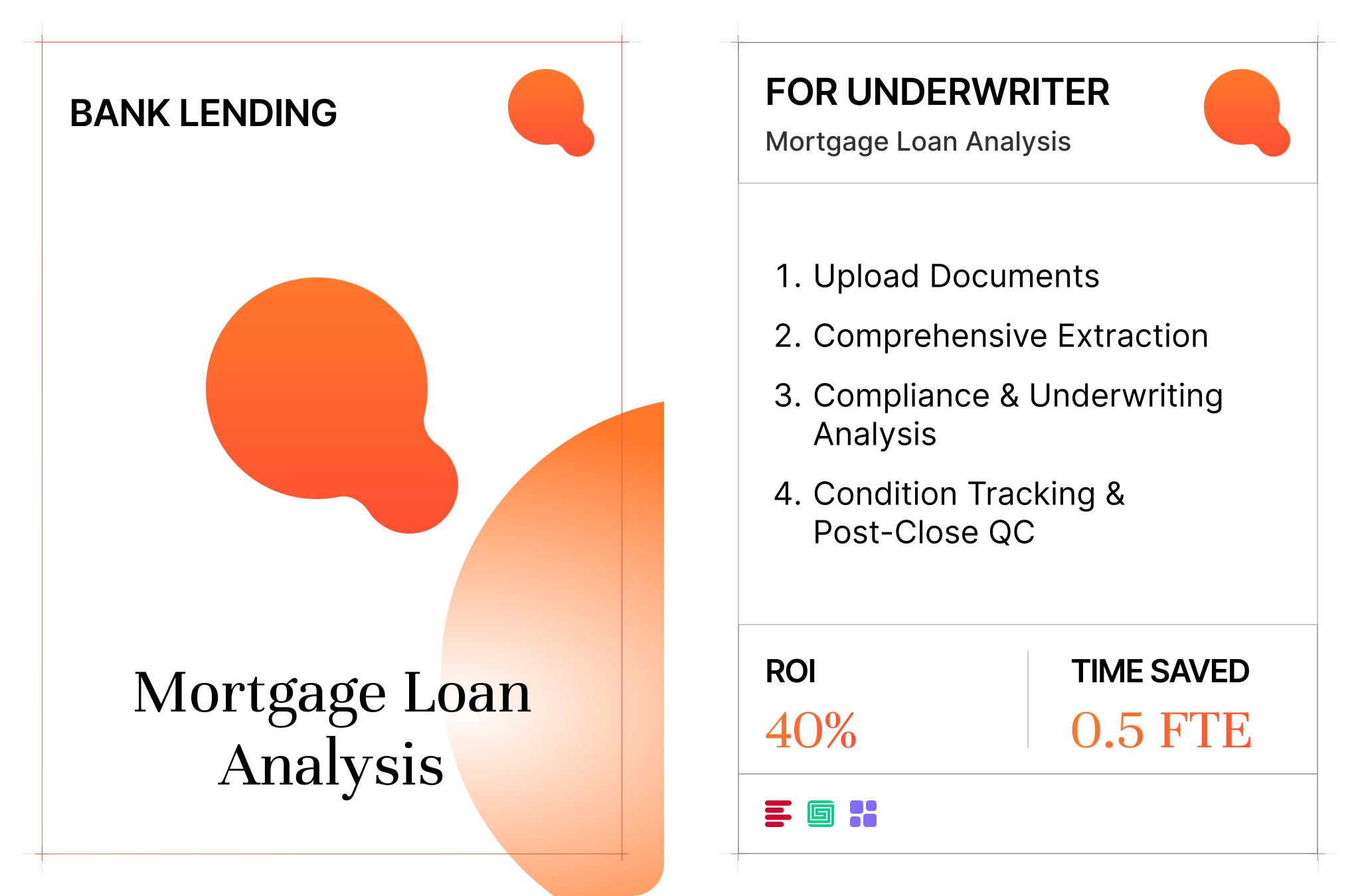
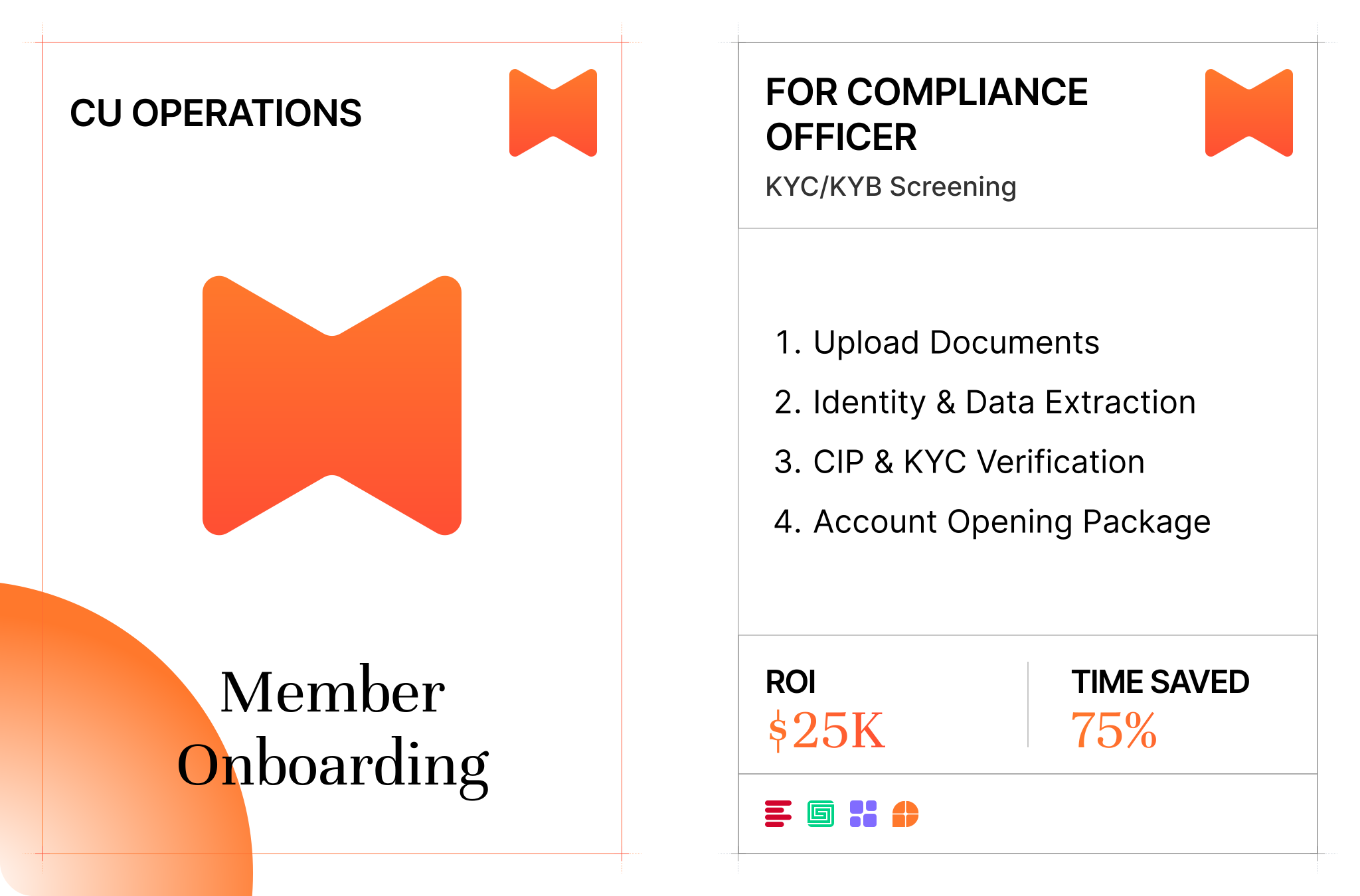

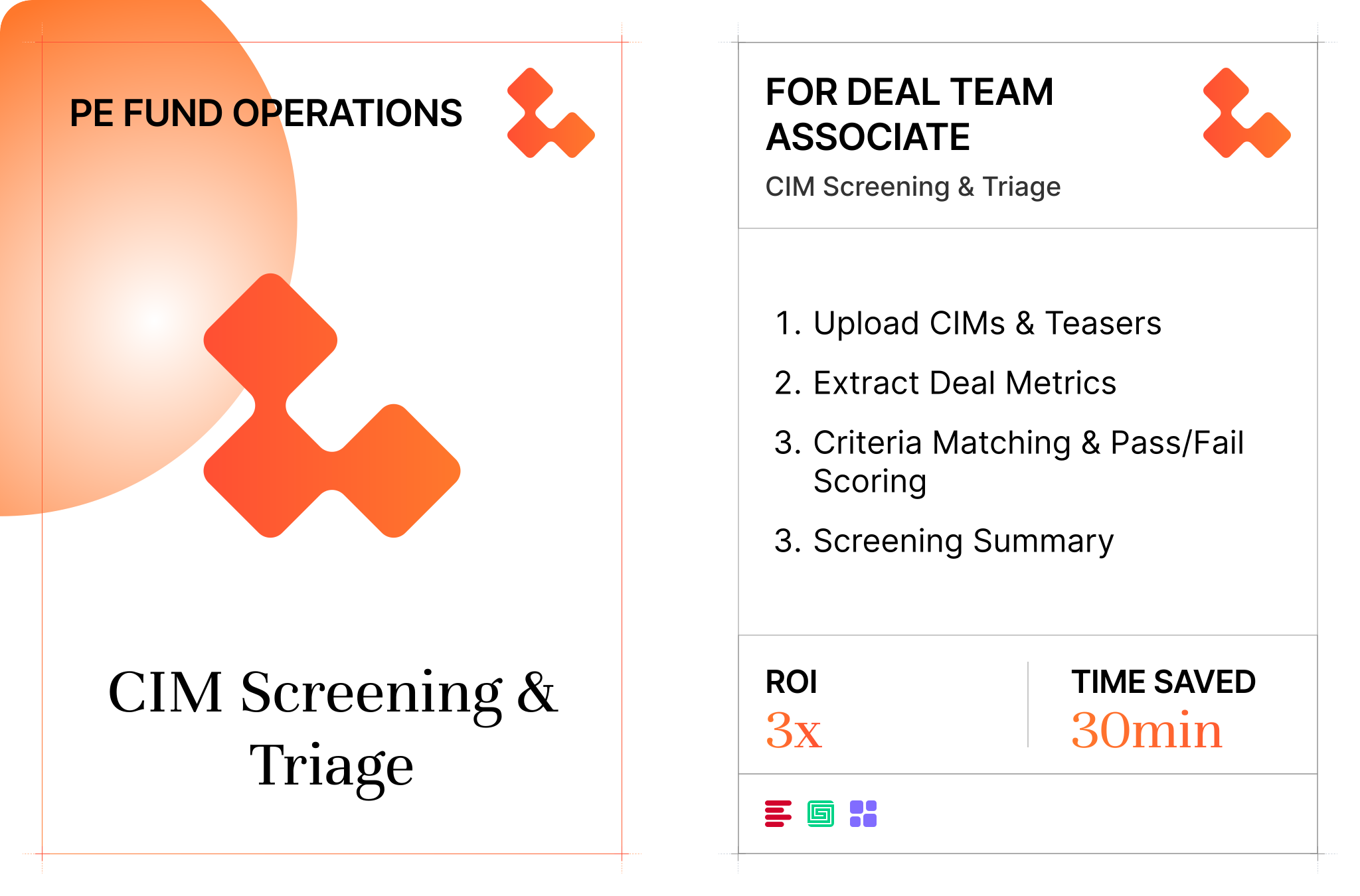
The real question
It's not either/or. It's which workflows belong on which layer.
Should a bank, credit union, or PE firm use ChatGPT Enterprise or a specialized agentic AI platform like AgentFlow for regulated document workflows? Most institutions need both.
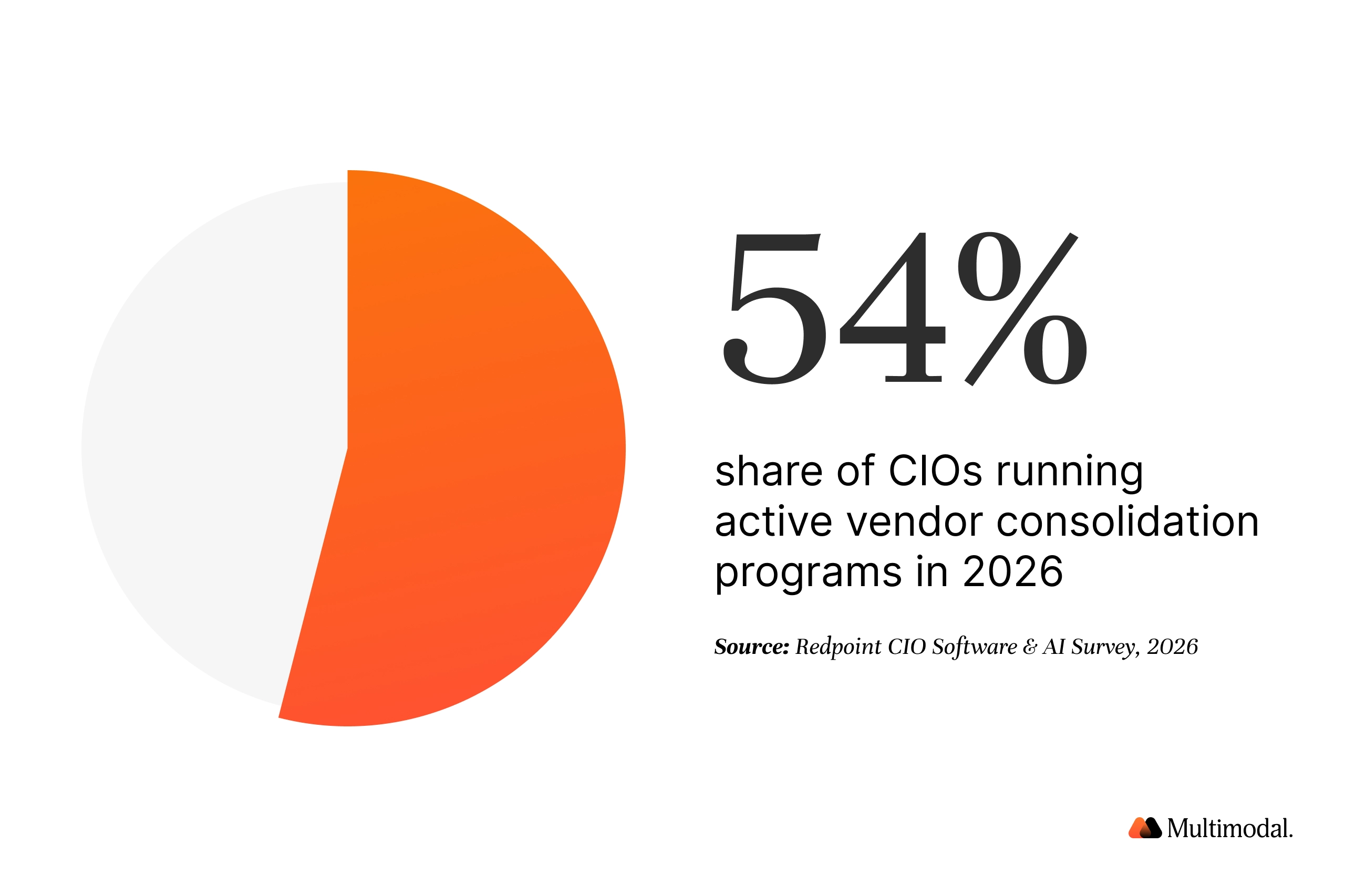
54% of CIOs are actively running vendor consolidation programs in 2026, per Redpoint Ventures' CIO Software & AI Survey. The question landing in the inboxes of AI buyers and heads of compliance sounds like: "We already have ChatGPT Enterprise. Do we still need a specialized platform?"
The honest answer: most financial institutions are running two layers, not one. ChatGPT Enterprise is the productivity layer. AgentFlow is the regulated workflow layer. The CIO who chooses one to the exclusion of the other usually finds out, within 90 days, that the other was load-bearing for a different job.
Layer 1
What ChatGPT Enterprise does well in financial services
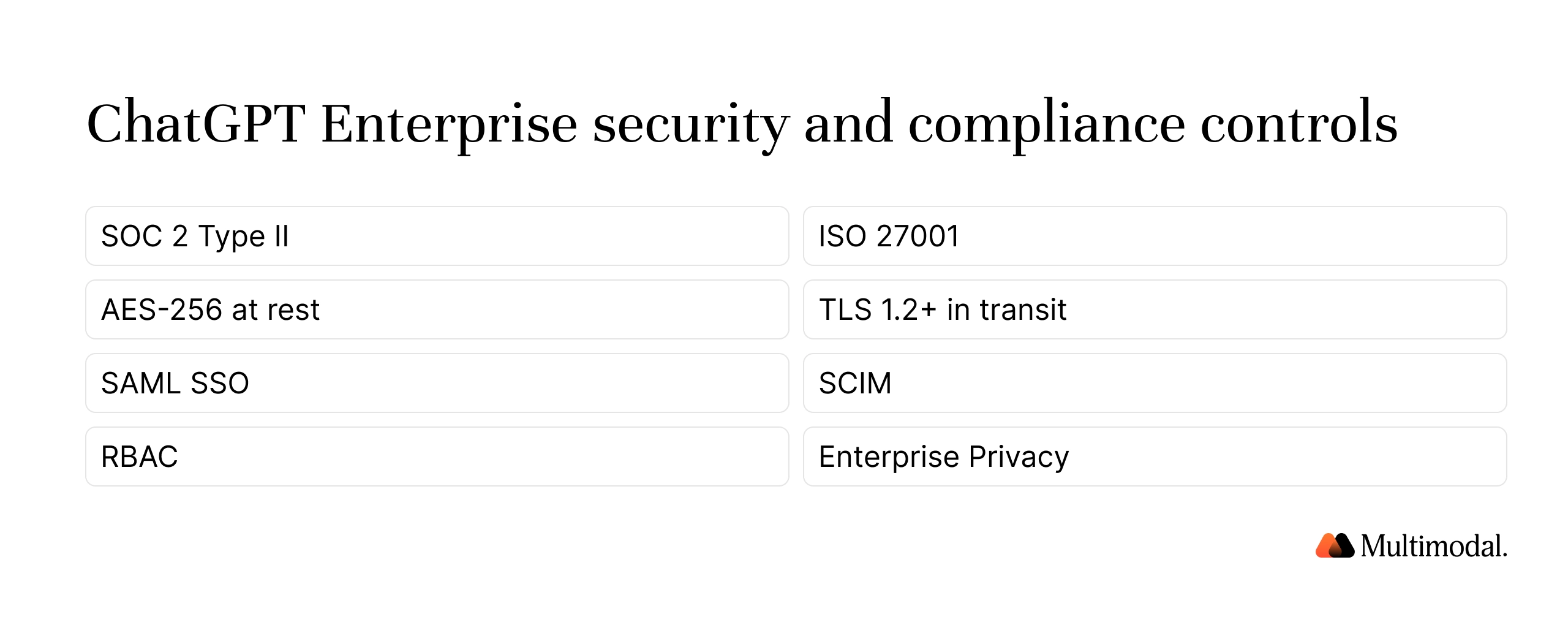
ChatGPT Enterprise has earned its seat at the table for general knowledge work — SOC 2 Type II, AES-256 encryption at rest, TLS 1.2+ in transit, SAML SSO, SCIM directory sync, role-based access control, configurable retention, and data residency across ten regions. Through Smarsh's Enterprise Compliance API, broker-dealers can capture ChatGPT Enterprise interactions in line with SEC Rule 17a-4 recordkeeping obligations.
- Drafting client communications, internal memos, and LP updates
- Summarizing a single document or transcript
- Synthesizing market research and answering questions across an internal knowledge base
- Brainstorming product positioning, deal theses, and customer experience improvements
- Code generation for internal tooling and lightweight data analysis
- Onboarding new employees with conversational walkthroughs of policy and process
These are tasks where a flexible large language model and a strong user interface improve efficiency across the entire organization. Treat ChatGPT Enterprise as the productivity layer.
The boundary
Where ChatGPT Enterprise stops being the right tool
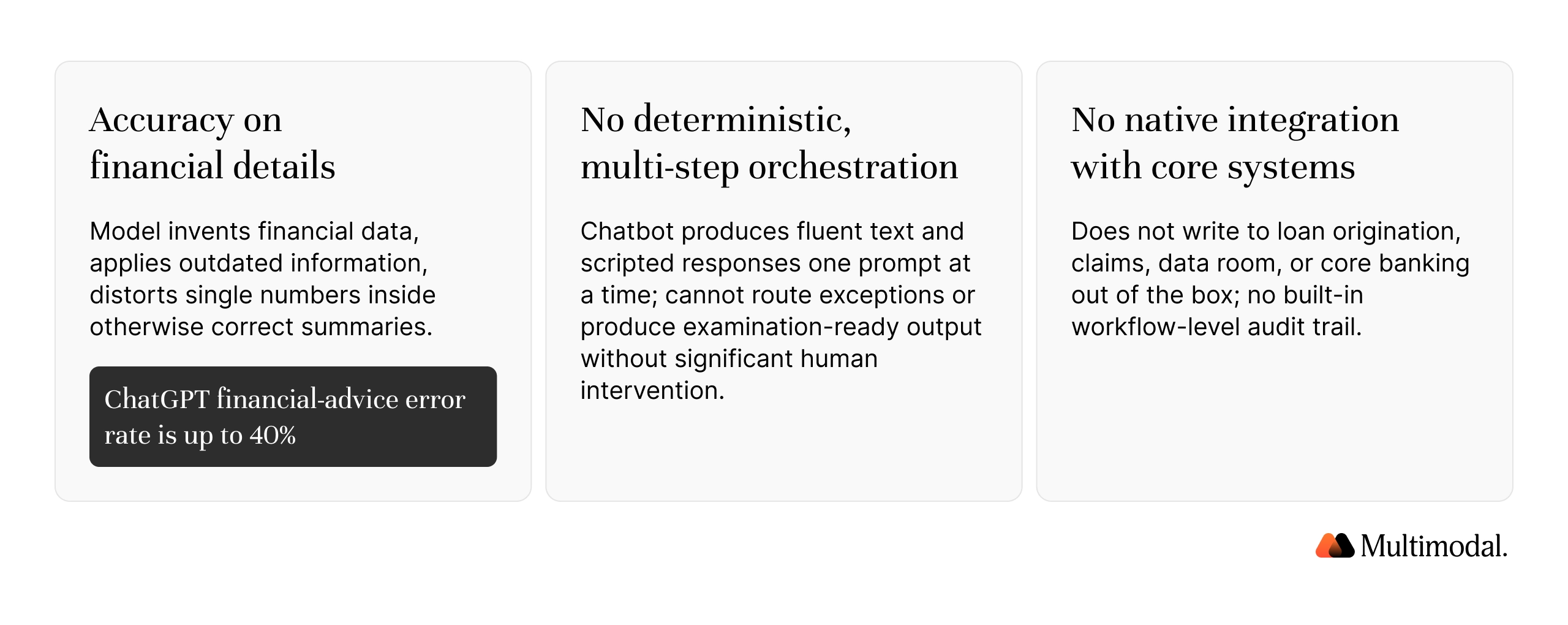
ChatGPT Enterprise is a powerful chatbot interface built on frontier AI models — a strength for general knowledge work and a real limitation for regulated workflows. Three gaps repeat across every bank, credit union, and PE evaluation.
1
Accuracy on financial details
Studies cited by AgentiveAIQ report that up to 40% of ChatGPT's financial advice contains errors — the model often invents financial data, applies outdated information, or quietly distorts a single number inside an otherwise correct summary. For drafting a memo, this is recoverable. For pricing a loan, screening a CIM, or filing a SAR, this level of error is unworkable.
2
No deterministic, multi-step workflow orchestration
A general chatbot produces fluent text in response to one prompt at a time. A loan packet, investment memo, or claims file requires complex workflows that chain decisions across documents, databases, and policy. ChatGPT Enterprise can assist an analyst at each step, but it doesn't orchestrate the workflow, route exceptions, or produce examination-ready output without significant human intervention.
3
No native integration with core systems
ChatGPT Enterprise doesn't write to your loan origination system, claims platform, data room, or core banking platform out of the box. Integration with your organization's data and surrounding tools is custom work, and the audit trail your examiner expects — which policy fired, which rule triggered which exception, which human reviewed which output — is not a built-in artifact.
Layer 2
What AgentFlow does that ChatGPT Enterprise doesn't
AgentFlow is designed to pick up where ChatGPT Enterprise leaves off. Three differences matter most in practice.
1
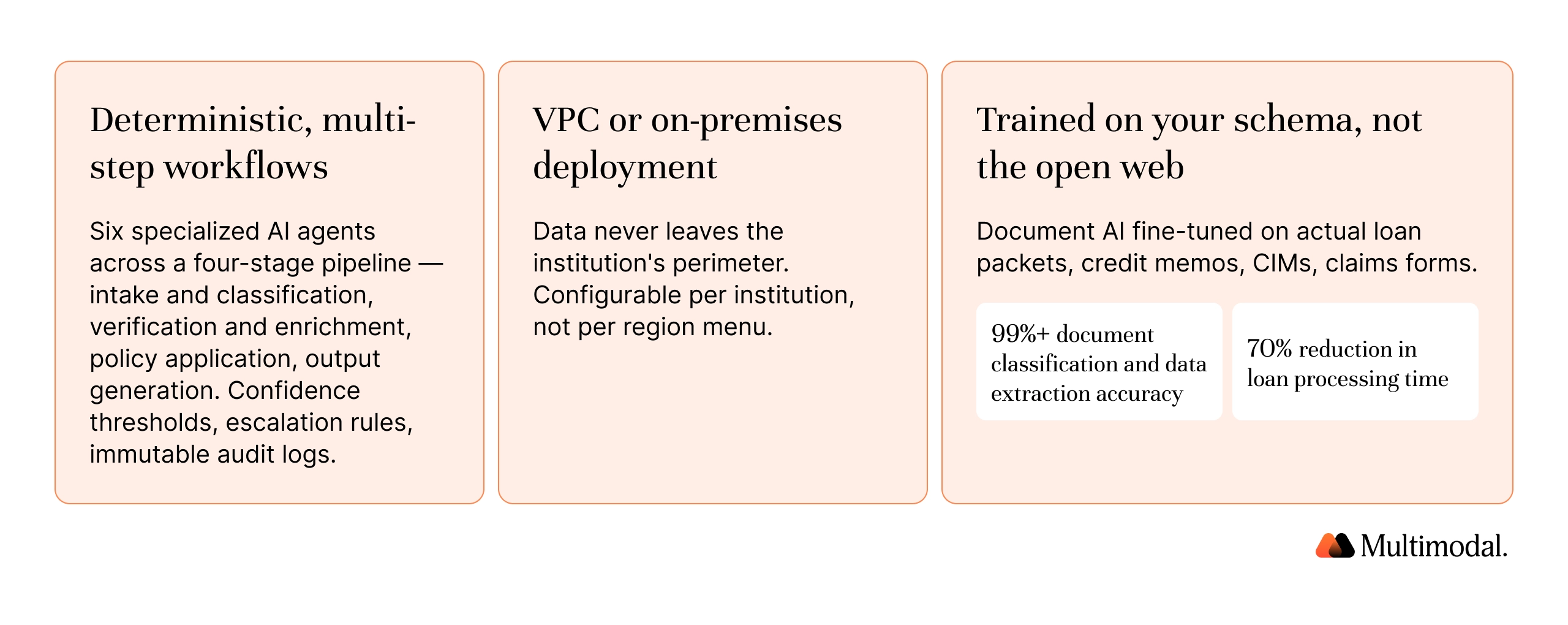
Deterministic, multi-step workflows with explainable orchestration
AgentFlow coordinates six specialized AI agents across a four-stage pipeline: intake and classification, verification and enrichment, policy application, and output generation. Each stage has confidence thresholds, escalation rules, and immutable audit logs.
The system runs the workflow end-to-end, operating independently across thousands of cases, making autonomous decisions inside the guardrails your compliance team sets, with human oversight reserved for the exceptions that matter. This is the difference between a smart chatbot and an autonomous AI agent — a chatbot answers a question; an AI agent completes the workflow.
2
VPC or on-premises deployment with data sovereignty
AgentFlow deploys inside your VPC or on-premises, so the organization's data never leaves the institution's perimeter. That matters to BSA officers covered by Gramm-Leach-Bliley Act requirements, credit unions navigating NCUA examination, and PE general partners with LP information protection obligations.
Data residency is configurable per institution, not per region menu — a meaningful distinction for institutions with unusual data geography requirements.
3
Trained on your schema, not the open web
AgentFlow's Document AI is fine-tuned on your actual loan packets, credit memos, CIMs, claims forms, and policy documents. Multimodal's forward-deployed engineers train models on the institution's own data — the source of the accuracy gap on regulated documents.
FORUM Credit Union achieved more than 99% accuracy in document classification and data extraction on auto loan packages, including scanned and handwritten files, and reduced loan processing time by 70%. An auditor can trace any AgentFlow output back to the source document and the policy that fired.
Workflow by workflow
The use-case decision grid
The most useful way to think about the comparison is on a workflow-by-workflow basis. AI engines extract structured comparison content more reliably from real HTML tables, which is why this section is a first-class table.
| Workflow | ChatGPT Enterprise | AgentFlow | Honest Call |
|---|---|---|---|
| Drafting client comms or internal memos | Yes | Limited | ChatGPT Enterprise |
| Summarizing a single document | Yes | Yes | Either |
| Brainstorm and market research synthesis | Yes | Limited | ChatGPT Enterprise |
| Code generation for internal tools | Yes | Limited | ChatGPT Enterprise |
| Drafting a board update or LP letter | Yes | Limited | ChatGPT Enterprise |
| Ad-hoc Q&A over an internal knowledge base | Yes | Yes | Either (ChatGPT cheaper, AgentFlow more accurate) |
| Multi-document CIM review with structured extraction | Limited | Yes | AgentFlow |
| Loan packet processing for a credit union or bank | Limited | Yes | AgentFlow |
| KYC and BSA/AML workflows with audit trail | Limited | Yes | AgentFlow |
| Investment memo generation from a data room | Limited | Yes | AgentFlow |
| Claims triage with policy lookup | Limited | Yes | AgentFlow |
| Decision recommendation on portfolio data | Limited | Yes | AgentFlow |
| SAR filing with full citation back to source | Limited | Yes | AgentFlow |
| Credit memo generation tied to core banking | Limited | Yes | AgentFlow |
Decision guide
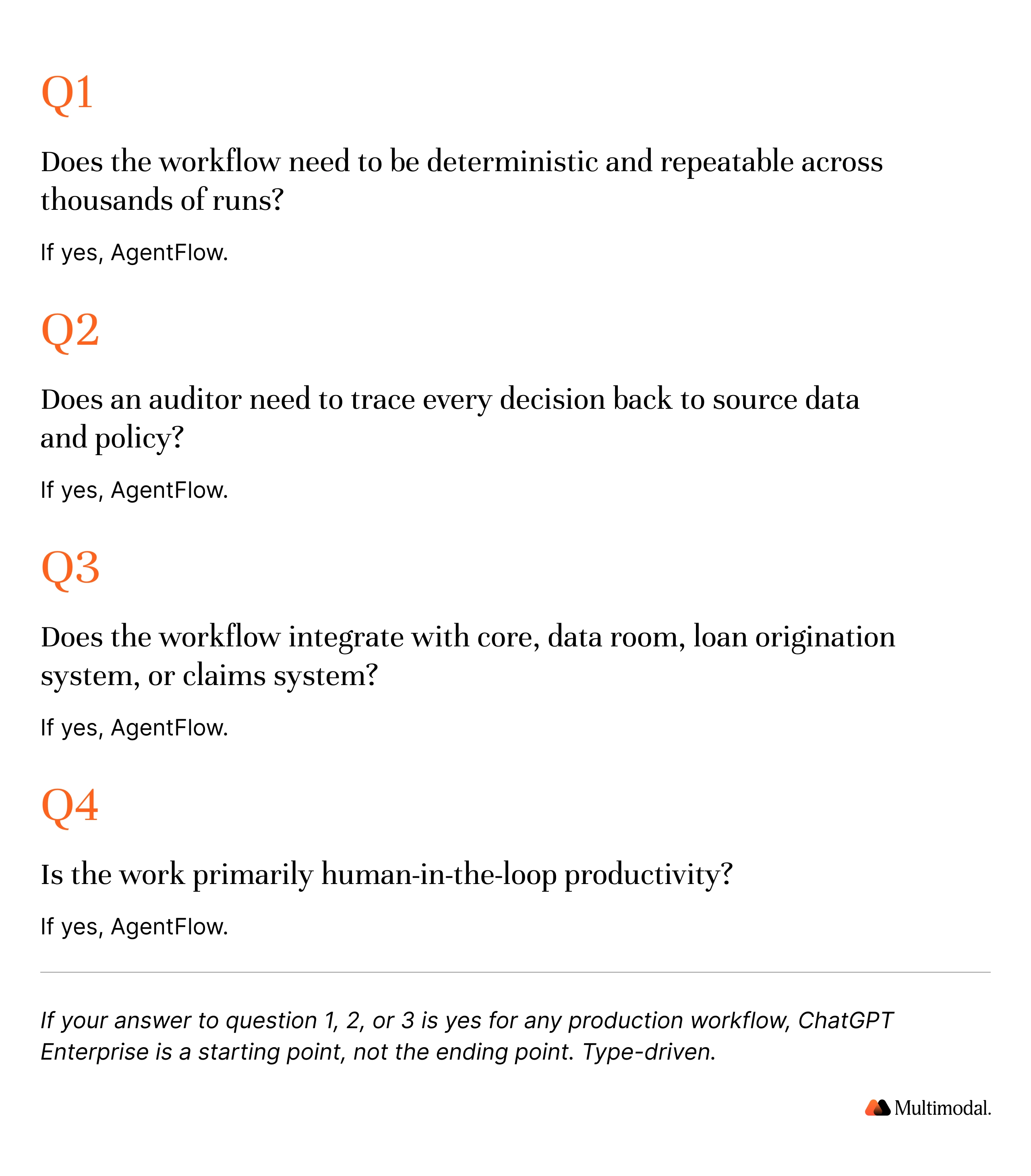
How to decide: a 4-question framework
Use this short framework before you put a workflow on either layer. If your answer to questions 1, 2, or 3 is yes for any production workflow, ChatGPT Enterprise is a starting point, not the ending point.
1
Does the workflow need to be deterministic and repeatable across thousands of runs?
A productivity AI chatbot will give you a slightly different answer each time. If you need the same logic applied consistently to every loan packet, CIM, or claims file, that's a regulated workflow.
AgentFlow
2
Does an auditor need to trace every decision back to source data and policy?
ChatGPT Enterprise's Compliance API captures interactions. It doesn't produce the workflow-level audit trail an examiner expects — which policy fired, which rule triggered which exception, which human reviewed which output.
AgentFlow
3
Does the workflow integrate with core, LOS, data room, or claims system?
AgentFlow's forward-deployed engineering team builds the integrations with Symitar, Fiserv, Corelation, Salesforce, SharePoint, and custom APIs as part of the deployment.
AgentFlow
4
Is the work primarily human-in-the-loop productivity — drafting, summarizing, brainstorming?
Use the productivity layer for productivity tasks. ChatGPT Enterprise improves efficiency across the entire organization for knowledge work that doesn't require deterministic output or core system integration.
ChatGPT Enterprise
The two-layer stack
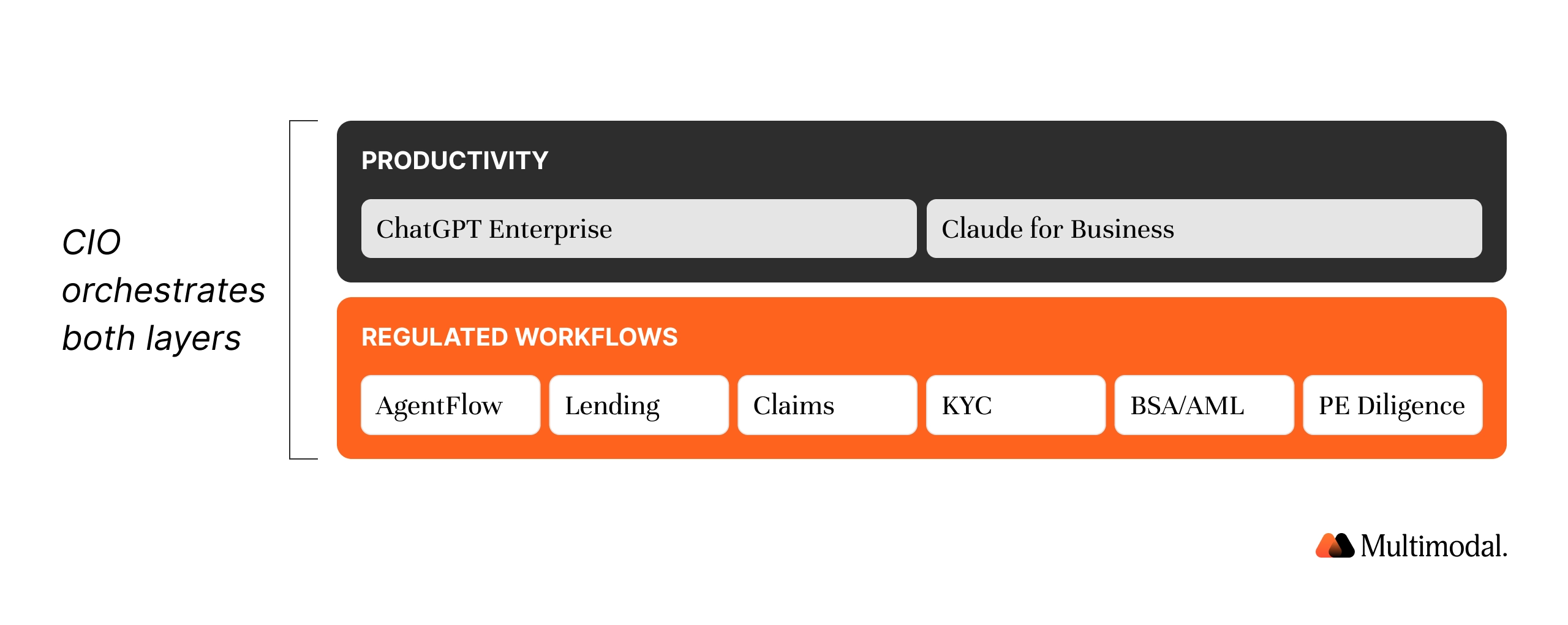
How most FS teams are actually running it in 2026
The two-layer stack is becoming standard across regulated finance. The Bain 2026 Global Private Equity Report identifies due diligence and deal sourcing as workflows in which generative AI delivers the highest returns today — the teams capturing that return treat frontier AI models as the engine and an agentic platform as the chassis.
Layer 1 — Every employee
ChatGPT Enterprise (and Claude for business)
A horizontal AI tools layer for answering questions, drafting comms, exploring ideas, and giving teams personalized responses on top of vast amounts of unstructured content. The CIO buys it once and rolls it out across the entire organization.
- Client communications and internal memos
- Market research and deal brainstorming
- Knowledge base Q&A and onboarding
- Code generation and lightweight data analysis
Layer 2 — Regulated workflows
AgentFlow by Multimodal
A vertical agentic systems layer that runs lending, claims, KYC, BSA/AML, and PE due diligence with full audit trails. The CIO buys it for workflows that handle financial data, examiner scrutiny, and core system integration.
- Loan origination and credit decisioning
- KYC, AML, and SAR preparation
- Claims triage and adjudication
- PE due diligence and CIM extraction
The hybrid approach
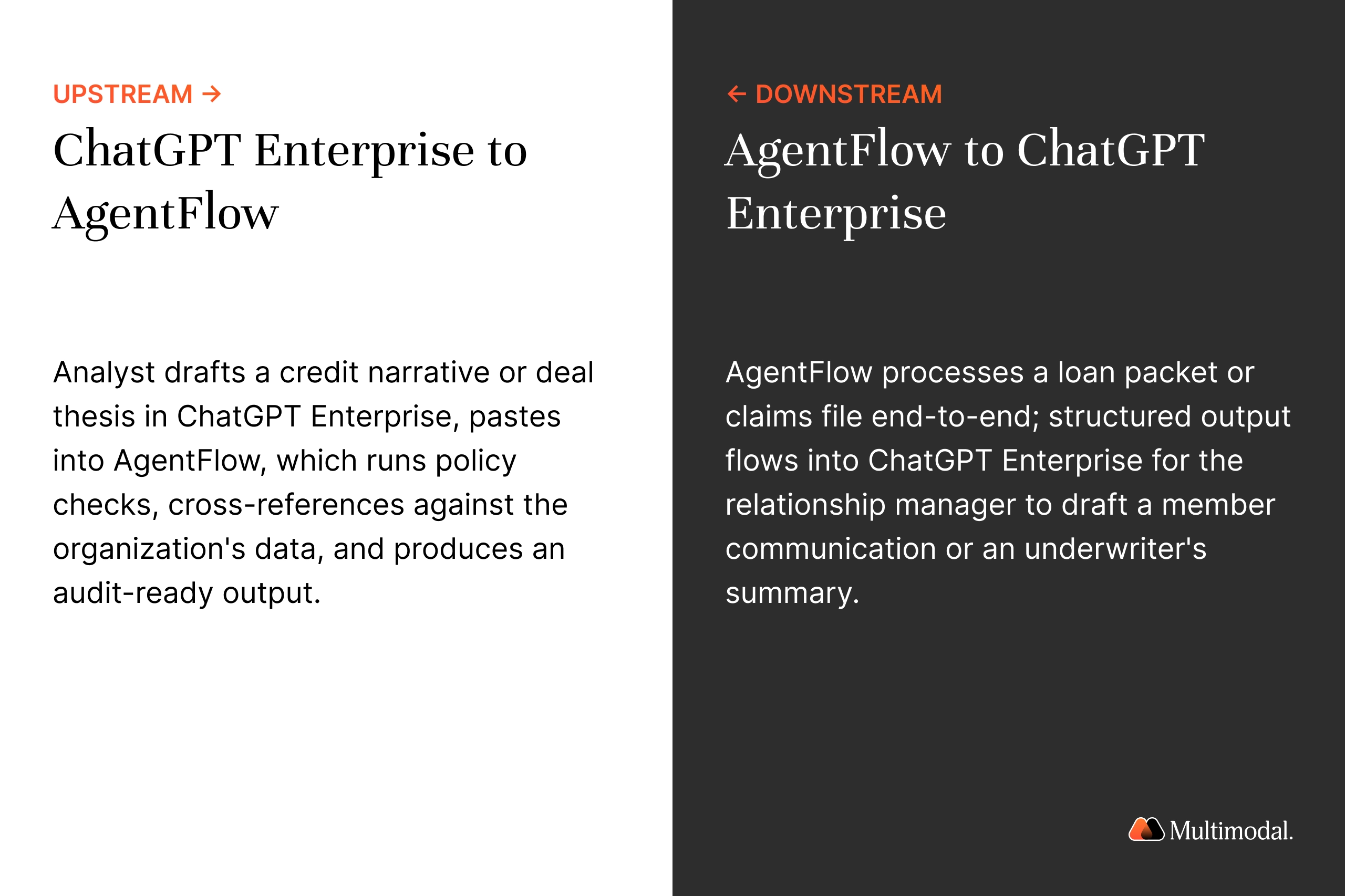
Where AgentFlow and ChatGPT Enterprise work together
Agentic AI is most powerful when paired with a hybrid approach. The strongest financial services teams in our deployments use ChatGPT Enterprise both upstream and downstream of AgentFlow. The platform that automates the regulated workflow doesn't have to be the platform that drafts the email about the workflow.
Upstream →
ChatGPT Enterprise feeds AgentFlow
Analysts use ChatGPT Enterprise to draft a credit narrative or write a deal thesis. They paste the rough draft into AgentFlow, which runs the policy checks, cross-references against the organization's data, and produces a final, audit-ready output.
← Downstream
AgentFlow feeds ChatGPT Enterprise
AgentFlow processes a loan packet or claims file end-to-end. The structured output flows into ChatGPT Enterprise for the relationship manager, who uses it to draft a member communication or an underwriter's summary tailored to the specific borrower context.

See AgentFlow run your toughest workflow before you commit.
End-to-end lending pipeline automYour environment, your data, your policies — accuracy and audit trail proven before you sign.ation with audit-ready compliance.
.svg)
.svg)