
AI Agent for Loan Origination
- AI agents automate document intake, data verification, income checks, and risk scoring.
- The bottleneck occurs after approval: the funding review takes up to 3.5 hours.
- Document classification drops from 15 minutes to under 20 seconds per file.
- Complete audit trails give compliance officers uniform, timestamped logs of every action.
- Human oversight remains: agents prepare analyses; loan officers make credit decisions.
An AI agent for loan origination is software that reads, verifies, and completes the loan file between application and funding. It handles document intake, income verification, cross-document checks, and exception flagging, so loan officers spend their time on high-value cases rather than manual review. Decisioning engines approve or deny; origination agents process the documents that turn an approval into a funded loan.

What is an AI agent for loan origination?
An AI agent for loan origination is agentic AI that manages tasks across the lending lifecycle: collecting loan applications, extracting borrower data from unstructured documents, validating completeness against compliance rules, and routing exceptions to a human specialist. It orchestrates these tasks across the loan origination system, core, and imaging platforms most lenders already run.
Three distinct layers of technology touch a loan before it funds, and each does a different job. Understanding the split matters because financial institutions often buy decisioning tools expecting them to fix document-handling problems they were never designed to solve.
The first two layers are mature markets. The third is where most manual processes still live, and it is the layer this page covers.
What does an AI agent actually do in the loan origination process?
An AI agent works the file the way a skilled processor would, in a fixed sequence, with a log of every step.
1. Document intake and classification. The agent ingests every document in the packet — bank statements, tax returns, pay stubs, IDs, insurance, title records — whether they arrive by portal, email, or mobile app. AI document agents handle this multimodal input more reliably than legacy OCR, using document understanding rather than fixed templates. Document classification drops from 10 to 15 minutes to under 20 seconds. 2. Completeness check. The agent compares the packet against a configurable checklist built on the lender's internal policies rather than a one-size-fits-all rule set, flagging anything missing before a processor touches the file. 3. Cross-document validation. Names, addresses, VINs, and amounts are checked across documents, flagging the inconsistencies and potential fraud that manual data entry routinely misses. 4. Income verification. Extraction pulls income data from bank statements and tax returns and reconciles it against stated income — the single verification step lenders most often name as their bottleneck. 5. Fund-ready output. The agent produces a fund-ready summary or an exception list with citations back to the source documents, so manual intervention happens only where judgment is required.
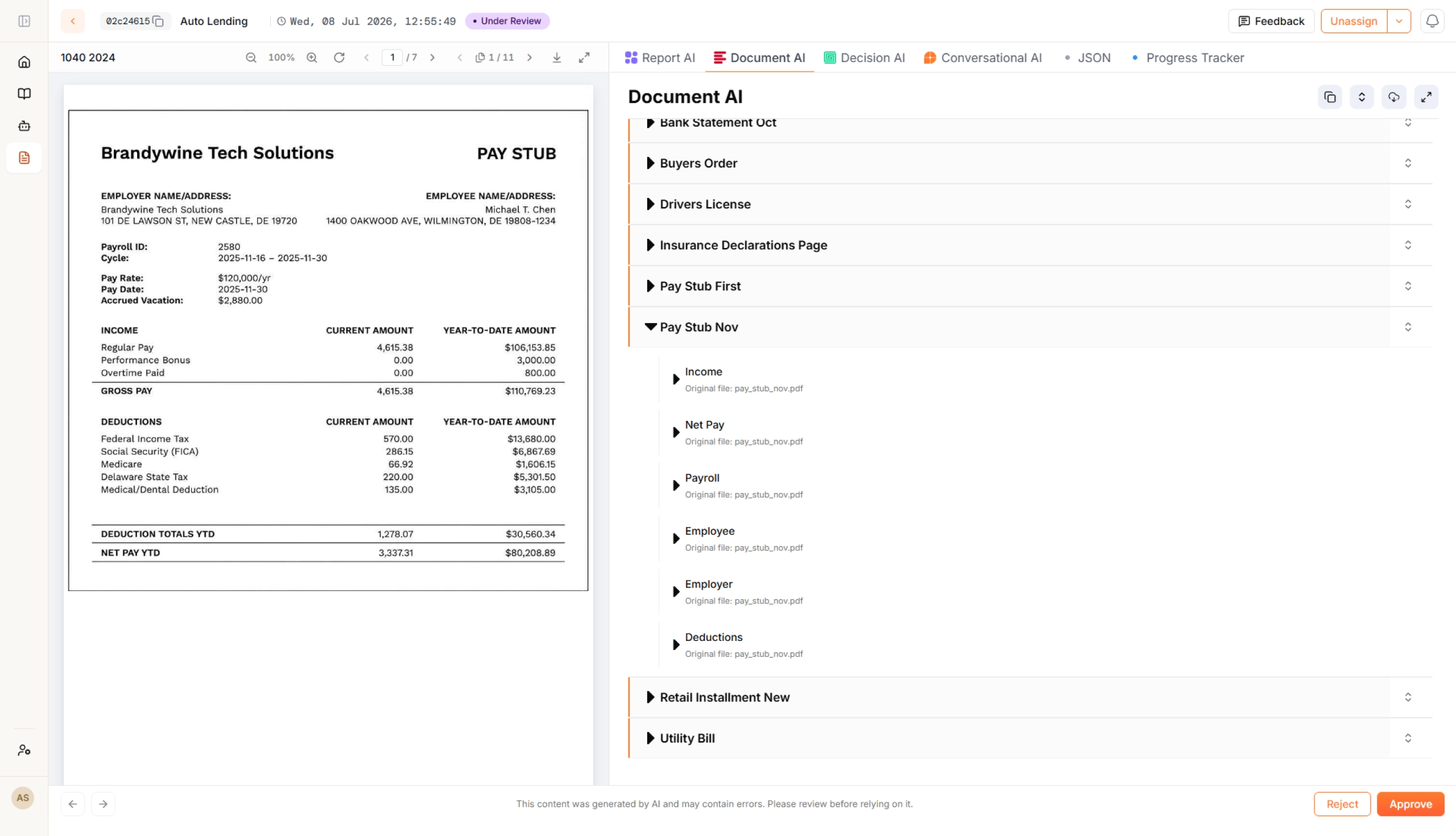
Intelligent document processing enables automatic data extraction from unstructured documents at each step, reducing manual data entry and the human errors that come with it. Because agents handle complex multi-step tasks without manual triggering, the same pattern extends beyond origination into loan servicing: continuous monitoring for automatic risk reviews, proactive outreach when a missed-payment risk appears, and borrower engagement that does not depend on staffing.
Why doesn't decisioning AI fix loan origination bottlenecks?
Because the approval process is no longer the slow part. Credit decisions on standard consumer loans are near-instant at most lenders. The delay sits between approved and funded, where a submitted packet has to become a complete, verified, fundable file — and the packet rarely arrives complete.
At credit unions participating in a 2026 industry research committee, manual review of a funding packet runs 40 minutes to 3.5 hours per application. In Multimodal's Field Report 2026, drawn from 445 sales conversations with financial institutions, lenders consistently reported that traditional automation handles the structured steps but stalls on the final stretch of document work, which still falls to people. A decisioning model can score risk in milliseconds and still leave a processor reconciling pay stubs by hand. Fixing the decision layer twice does not fix the file.
"Everyone sells lenders a faster yes. Nobody funds on a yes; they fund on a complete, verified file. The delay was never in the decision. It sits in the documents, and that is the work agents take on."
 Ankur PatelFounder & CEO, Multimodal
How do credit unions use AI agents for loan origination?
Credit unions feel the file-processing gap most acutely in indirect auto lending, where the dealer, not the member, chooses which lender gets the next deal. Dealers route business to whichever institution funds fastest. Every incomplete packet means a callback, a day of contract-in-transit aging, and a dealer weighing a faster competitor.
One credit union in the research committee works with 560 dealers, while a single processor caps out near 150 loans a month. At that ratio, funding capacity — not the approval process — sets the growth ceiling.
AI agents change the math by preparing the fundable file in minutes, instantly validating documents, and keeping loan officers focused on relationship-building rather than repetitive checks. The same document-processing pattern applies across credit union lending operations: consumer loans, mortgage files, and member business lending.
AI agent vs. RPA vs. LOS automation: what's the difference?
Traditional automation moves data between screens. Lending AI agents understand the content they move. The distinction determines what each can carry in a lending workflow.
RPA still earns its keep on stable, repetitive tasks. The difference shows up in the messy middle of document handling, where formats vary and content matters. For a deeper comparison, see our guide to loan origination and servicing automation.
What results can lenders expect?
Reported outcomes across the industry cluster around four themes: speed, accuracy, cost, and compliance.
Speed. AI-powered systems process loan applications in seconds rather than days, loan closings complete significantly faster, and document validation compresses into minutes. Accuracy. Agents reduce human error in data entry and validate each document against the same checklist every time. Cost. Operational costs fall as repetitive tasks move off processors' desks, and existing teams absorb higher volume without added headcount. Compliance and customer experience. Uniform, timestamped logs give compliance officers a complete record, and borrowers get 24/7 assistance during the application process, leading to faster, more transparent decisions that improve customer satisfaction.
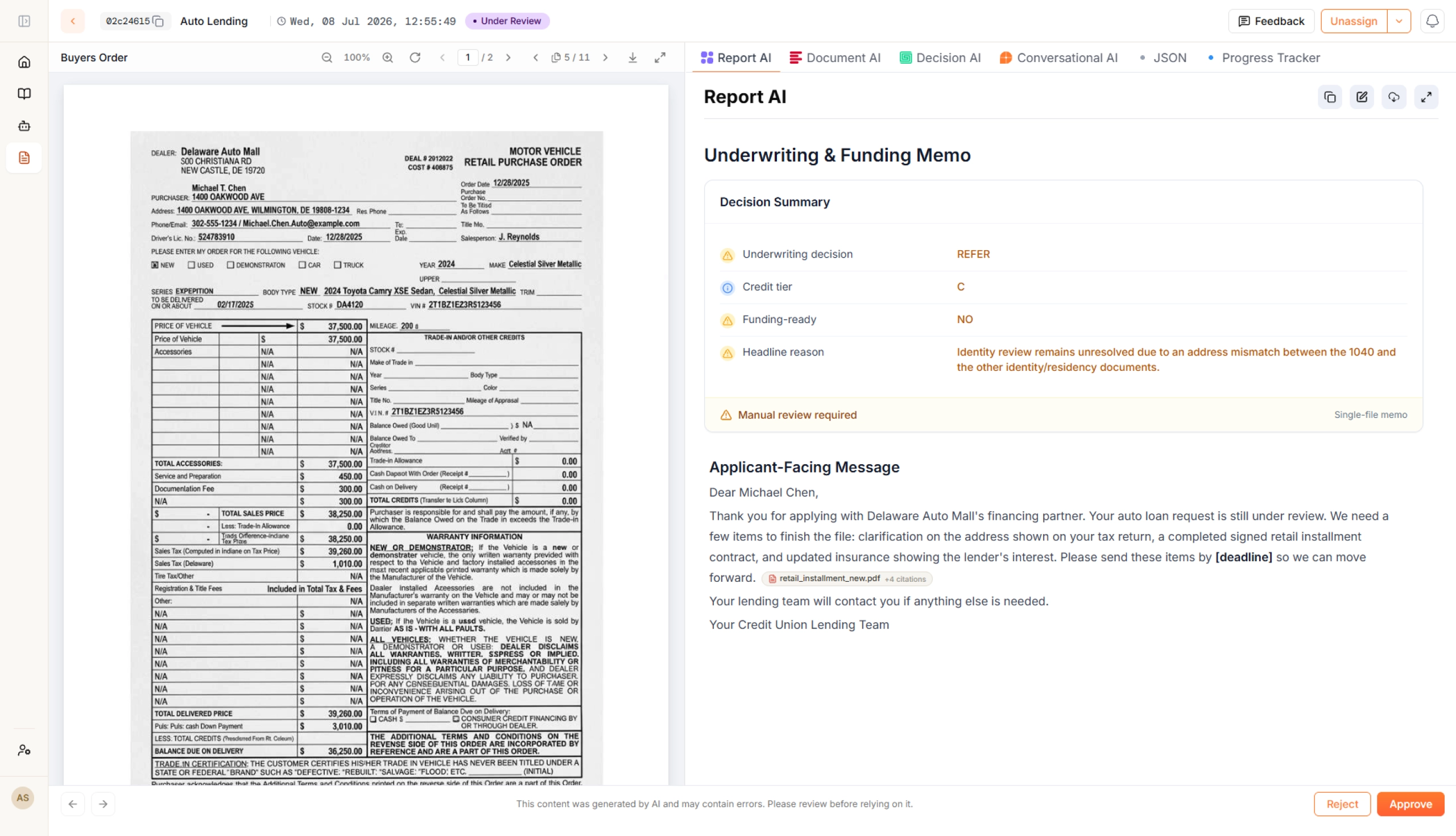
FORUM Credit Union, which processes loan files on AgentFlow, reports 99 percent extraction accuracy with 60 percent of applications auto-underwritten. At the servicing end of the lifecycle, deployments elsewhere in the market have scaled to 33,000 collection calls per month handled by agents, indicating how far autonomous workflows extend once the file layer is reliable. Results depend on integration: AI solutions require connections to the loan origination system, core, and imaging platforms already in place, because agents that cannot reach those systems cannot complete work in them.
How do you evaluate an AI agent for loan origination?
The market splits into the three layers described above, and the honest starting point is to decide which layer your bottleneck lives in.
Compliance guardrails
The agent should evaluate every application against internal policies and regulations, screen outbound borrower communications for prohibited language, and maintain audit trails, full stop.
Human oversight
Agents should prepare the analytical foundation for human review, not replace it. Ask where the escalation points are.
Document depth
Test on your real packets, including the worst ones. Accuracy on clean PDFs tells you little about handwritten stips.
Integration
Confirm the agent reads from and writes to your LOS and loan management systems rather than creating a parallel queue.
Configurability
Your funding checklist, your exception matrix, your compliance rules. A fixed rule set imported from another lender will misfire on yours.
AI agent for loan origination FAQs
An AI agent for loan origination is software that autonomously reads, verifies, and completes loan files. It classifies documents, extracts borrower data, verifies income against bank statements and tax returns, checks completeness against compliance rules, and flags exceptions for human review, all while working within the lender's existing loan origination system.
No. Agents handle repetitive checks, document processing, and preliminary analysis, then hand humans a complete analytical foundation. Loan officers, underwriters, and risk teams keep authority over credit decisions and complex cases. In regulated lending, human oversight is a standing requirement, and well-designed agents are built around it.
A loan origination system routes applications, stores documents, and manages the workflow. An AI agent works inside that workflow, reading the documents, verifying the data, and completing the file. Most lenders run both together, with the agent integrated into the LOS they already own rather than replacing it.
Yes. Agents extract income data from bank statements, tax returns, and pay stubs, reconcile it against stated income, and cross-check names, addresses, and amounts across the packet. Document verification that takes 10 to 15 minutes manually is completed in under 20 seconds, with every check logged.
Agents strengthen regulatory compliance when properly governed. They apply the same internal policies to every file, maintain complete audit trails, and produce uniform, timestamped logs for every action taken. Compliance officers get a fuller record than manual processes leave behind. Governance, fair-lending review, and human escalation paths remain the lender's responsibility.
Yes. Agents integrate with the loan origination system, core, and imaging platforms credit unions already run, reading from and writing to those systems rather than replacing them. Integration scope is the primary implementation variable, so confirm which systems are supported early in the evaluation.
Pricing varies by document volume, workflow count, and deployment model, and most vendors quote per implementation. The relevant comparison is against the fully loaded cost of manual review, which takes 3.5 to 40 minutes per application, multiplied by the annual funded loan volume.
.svg)


See an origination agent run on your own documents
.svg)
.svg)