
Agentic Mortgage: How AI Agents Automate the Mortgage Process in 2026
- Agentic mortgage refers to autonomous AI agents performing multi-step mortgage file work.
- Agents handle documents, data, and verification; humans keep decision authority.
- The real bottleneck is the loan file, not the approval decision.
- Lenders report faster processing, fewer errors, and lower operational costs.
- TD Bank cut one application step from 15 hours to minutes.
- Compliance still requires human oversight of every lending decision.
- Start with one document-heavy workflow, measure accuracy, then expand.
Agentic mortgage refers to the use of autonomous AI agents that read, verify, and act on mortgage documents and application data across loan origination, underwriting support, and funding. Unlike traditional automation that follows fixed scripts, agentic AI plans multi-step work, extracts data from unstructured documents, flags exceptions for human review, and moves each file toward a decision with minimal human intervention.

What is agentic mortgage AI?
"Everyone demos an agent that talks about the mortgage. The test is whether it processes the file: reads the pay stub, catches the missing document, and moves the application forward without a person pushing it."
 Ankur PatelFounder & CEO, Multimodal
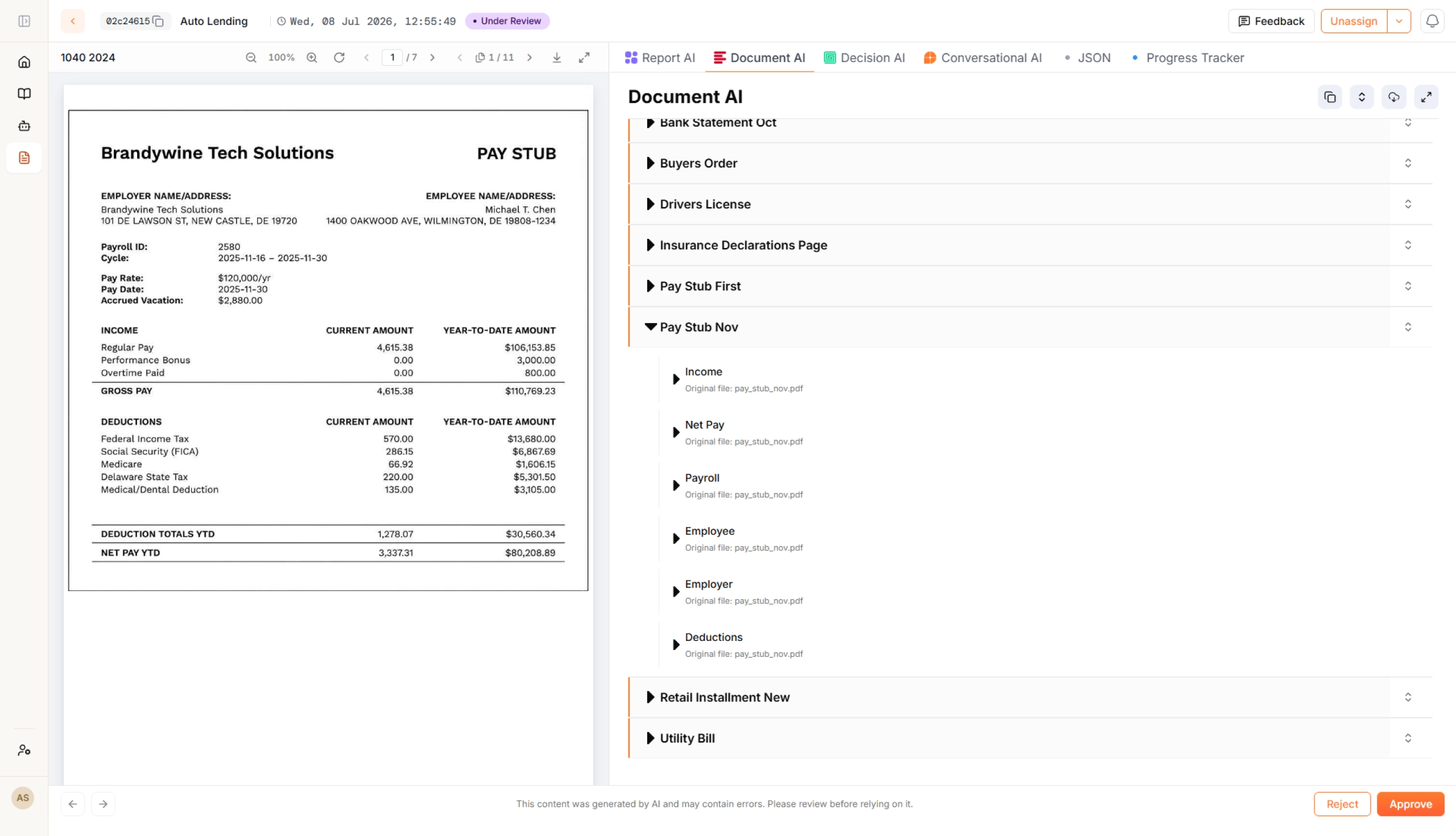
Agentic mortgage AI is the application of autonomous AI agents to the mortgage process. These agents combine large language models, natural language processing, and business rules to perform work that previously required manual effort: reading pay stubs, tax returns, income statements, and credit reports; extracting data into structured formats; verifying it across sources; and preparing files for loan underwriting.
The distinction from earlier tools is autonomy. A chatbot answers questions when asked. An OCR system extracts text when fed a document. An autonomous AI agent monitors a queue of mortgage applications, identifies what each file is missing, requests the missing documents, validates what arrives, and escalates only the exceptions that need human expertise.
The term entered mainstream mortgage vocabulary in 2025 and 2026 as major institutions moved agents into production. TD Bank launched agentic AI to automate the processing of mortgage and HELOC applications. ING piloted an agentic assistant that analyzes mortgage applications requiring manual assessment, with an employee remaining responsible for every final decision.
How is agentic AI different from traditional mortgage automation?
Traditional methods automate individual steps. Agentic AI coordinates the steps in between, where most processing time accumulates. RPA breaks when a form changes. OCR extracts text but cannot judge whether a document satisfies a condition. Agentic systems understand document content, adapt to variation, and decide what to do next within defined guardrails.
Generative AI on its own summarizes and drafts. Agentic AI acts on the output: it enters verified application data into the system of record, updates application status, and triggers the next task. Industry analyses of early deployments report 30 to 50 percent reductions in intake time when data collection is automated this way.
What can AI agents do across the mortgage lifecycle?
AI agents apply to every document-heavy stage of mortgage lending. Decisioning engines and loan origination systems keep their role; agents handle the file work that surrounds them.
Two patterns hold across all stages. First, agents work with both structured data and unstructured documents, which is what earlier automation could not do. Second, continuous learning from exception outcomes improves accuracy over time, so the share of files needing manual review declines rather than staying flat.
Why is the loan file, rather than the decision, the real bottleneck?
Decision engines made approvals fast years ago. The remaining delay in mortgage applications occurs between application and funding, when a submitted packet must become a complete, verified, fundable file. Packets rarely arrive complete. Documents arrive as scans, photos, and mixed PDFs. Names, addresses, and figures have to match across every document, and each mismatch today means manual review, a callback, and a delay the borrower feels.
The scale of that manual work is measurable. In research conducted with a credit union research committee in 2026, manual funding-file review ran 40 minutes to 3.5 hours per application. That time is spent on data entry, cross-document checking, and follow-up, none of which requires human judgment, all of which are prone to human error at volume.
This is why lenders that automate document processing report the largest gains. When agents handle collection, extraction, and verification, published implementations report document processing time reductions of up to 88 percent, compressing processing that took weeks into days or minutes for standard files. Faster file completion is also what borrowers experience directly: fewer document requests, visible application status, and faster approvals, which improve borrower satisfaction and customer trust.
What results are lenders seeing from agentic mortgage AI?
Reported outcomes fall into four categories: speed, accuracy and risk, cost, and experience. The figures below are labeled by source type and worth validating against your own portfolio.
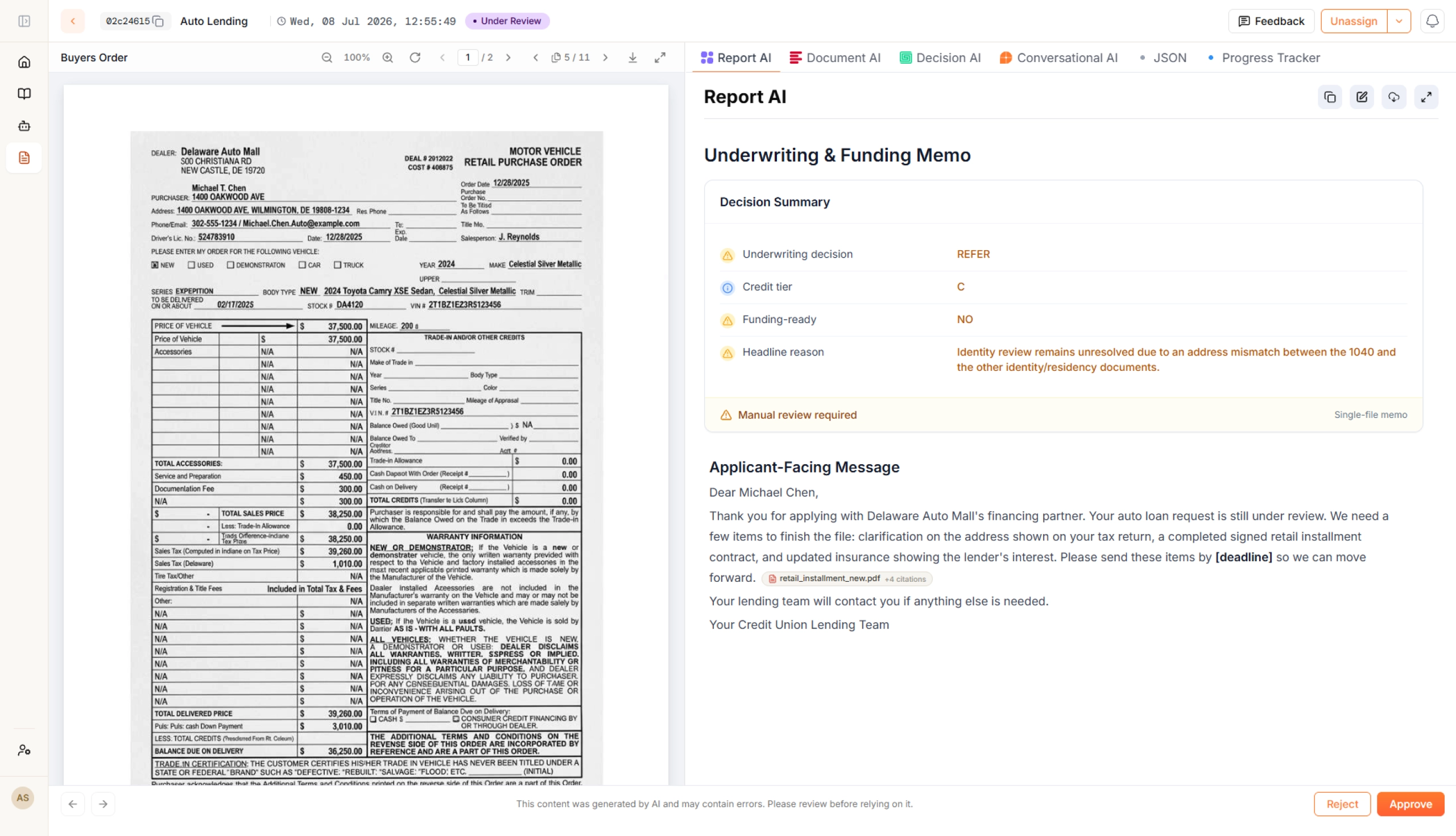
Speed. TD Bank reports its first agentic AI deployment cut one mortgage application-processing step from 15 hours to under 3 minutes, and industry reports cite loan processing time reductions of around 60 percent and intake-time reductions of 30 to 50 percent from automated data collection. Accuracy and risk. Customer-attributed results from Multimodal deployments include FORUM Credit Union reaching 99 percent extraction accuracy and 60 percent auto-underwriting on eligible files, and Direct Mortgage Corp. automating document-heavy origination steps; industry analysis reports compliance exceptions falling to single-digit percentages and credit-risk reductions of up to 50 percent where verification is automated. Cost. Automating repetitive file work lowers operational costs by removing manual work from every file rather than through staff reduction, shifting capacity to exceptions. Experience. Borrowers get around-the-clock responsiveness on status and document requests, and institutions deploying AI-driven borrower communication report higher satisfaction.
Based on 445 sales conversations with financial institutions, the workflows lenders most frequently ask to automate are document intake, income verification, and underwriting file preparation.
How should mid-size lenders and credit unions get started?
Start with one document-heavy workflow, not an end-to-end transformation. Income verification and application intake are common first choices because volume is high, the documents (pay stubs, tax returns, bank statements) are predictable, and accuracy is easy to measure against current manual review.
Baseline the current process
Measure touch time per file, error rates, and processing times for one workflow. This is the number every result gets compared against.
Define the human review boundary
Decide which confidence levels and exception types route to people. Regulators expect decision authority to stay with the institution.
Run agents in parallel
Compare outputs on live files for accuracy before removing the manual step. Watch the known weakness: unusual financial situations still need human expertise.
Address data and privacy upfront
Agents handle sensitive financial data and may connect to external payroll and bank sources. Security review, GLBA alignment, and model-risk documentation belong in the first conversation.
Expand by adjacency
Once one workflow holds accuracy in production, extend it to the next stage that shares the same documents.
For credit unions specifically, examination readiness shapes the rollout: NCUA-aligned governance, member-data controls, and audit trails for every automated action. Multimodal's AgentFlow follows the coexistence pattern above: decision engines and origination systems retain their roles, while agents handle document processing, verification, and file preparation. The same pattern applies across platforms, and it is the architecture most mid-size lenders land on.
Agentic mortgage FAQs
Agentic mortgage AI is the use of autonomous AI agents to execute multi-step mortgage work: classifying documents, extracting and verifying data, preparing underwriting files, and routing exceptions to people. It differs from chatbots and RPA in that it plans its next steps within guardrails rather than following a fixed script.
For standard files, yes. Agents classify, extract, cross-check, and produce verified structured data from pay stubs, tax returns, and bank statements. Unusual financial situations that fall outside standard parameters still route to human review, so end-to-end automation in practice means full automation for the majority of files plus managed exceptions.
RPA repeats scripted actions and breaks when documents or interfaces change. Agentic AI understands document content, adapts to variation, and decides the next step itself. RPA suits stable, structured tasks; agentic AI handles the unstructured document work that makes up most of the mortgage process.
No. Agents prepare complete, verified files and flag exceptions, which removes data entry and manual review from the underwriter's day. Credit decisions, judgment calls, and accountability stay with people. Institutions deploying agentic AI, including TD and ING, keep a human responsible for every lending decision.
Pricing varies by platform and volume, so evaluate cost per processed file against current fully loaded touch time. ROI is driven by three levers: hours removed per file (measured as 3.5 to 40 minutes of manual funding review per application), error reduction, and capacity gained without added headcount.
Yes, when deployed with human oversight, audit trails, and clear decision boundaries. Agents improve compliance evidence by logging every extraction and check. Institutions remain responsible for fair lending, GLBA, and examiner expectations, so governance documentation and a human decision layer are requirements, not options.
Accuracy on their own document mix, exception handling that routes to staff, NCUA-examination-ready audit trails, member-data controls, and integration with the existing LOS and decision engine rather than replacement of them. A pilot on real member files against a manual baseline is the fastest way to validate all five.
.svg)


See how agentic mortgage works on your own files
.svg)
.svg)