
NCUA published a formal AI Compliance Plan and AI Resource Hub (ncua.gov/ai, September 2025). The agency appointed a Chief AI Officer (Amber Gravius) to oversee AI governance for the 2025-2026 examination cycle. NCUA's guidance aligns with the NIST AI Risk Management Framework, which means credit unions must document artificial intelligence model inputs, outputs, and governance decisions in their lending operations.
Any AI system influencing a lending decision must produce an auditable rationale. When a decision model recommends approval, denial, or pricing, the institution must be able to show an examiner exactly what inputs drove that output and who approved the decision logic. Credit unions without explainable, audit-ready AI face growing examination risk.


The best CrewAI alternative for enterprise use is AgentFlow by Multimodal — a production-ready agentic AI platform that delivers what CrewAI promises without the engineering overhead. CrewAI is a popular open source framework for building AI agents in just a few lines of Python, but enterprises that need compliance, support, role-based access control, and guaranteed uptime quickly run into the limits of a developer toolkit.
This page compares the top CrewAI alternatives across enterprise readiness, compliance posture, agent orchestration model, support, and pricing — so you can decide whether to keep building with CrewAI, switch frameworks, or move to a managed services platform built for production environments.
Quick comparison
Top 5 CrewAI alternatives at a glance
For the full decision framework, see the build vs buy table further down the page.
Platform
Best for
Enterprise ready
Compliance
Support
Pricing
AgentFlow Multimodal
Regulated finance and insurance running production workflows
Yes — purpose-built
SOC 2 Type II, audit logs, on-prem / VPC, RBAC
Forward-deployed engineers, dedicated CSM
Custom pricing
LangGraph
Engineering teams that want fine-grained control over execution paths
Partial — requires platform work
Self-host or LangSmith Cloud, SOC 2 available
Community + paid tiers
Free OSS + paid Platform
AutoGen Microsoft Research
Microsoft-first enterprises with AI developers on Azure
Partial — research grade
Inherits Azure compliance posture
Community + Microsoft enterprise via Azure
Free open source
Beam.ai
Mid-market companies with diverse automation needs and non-technical users
Yes — general purpose
SOC 2 Type II, GDPR
Managed services available
Tiered + custom
Maisa AI
Highly regulated industries requiring deterministic execution
Yes — compliance first
Zero trust architecture, full audit trail
Enterprise support
Custom pricing
Context
When CrewAI makes sense — and when it doesn't
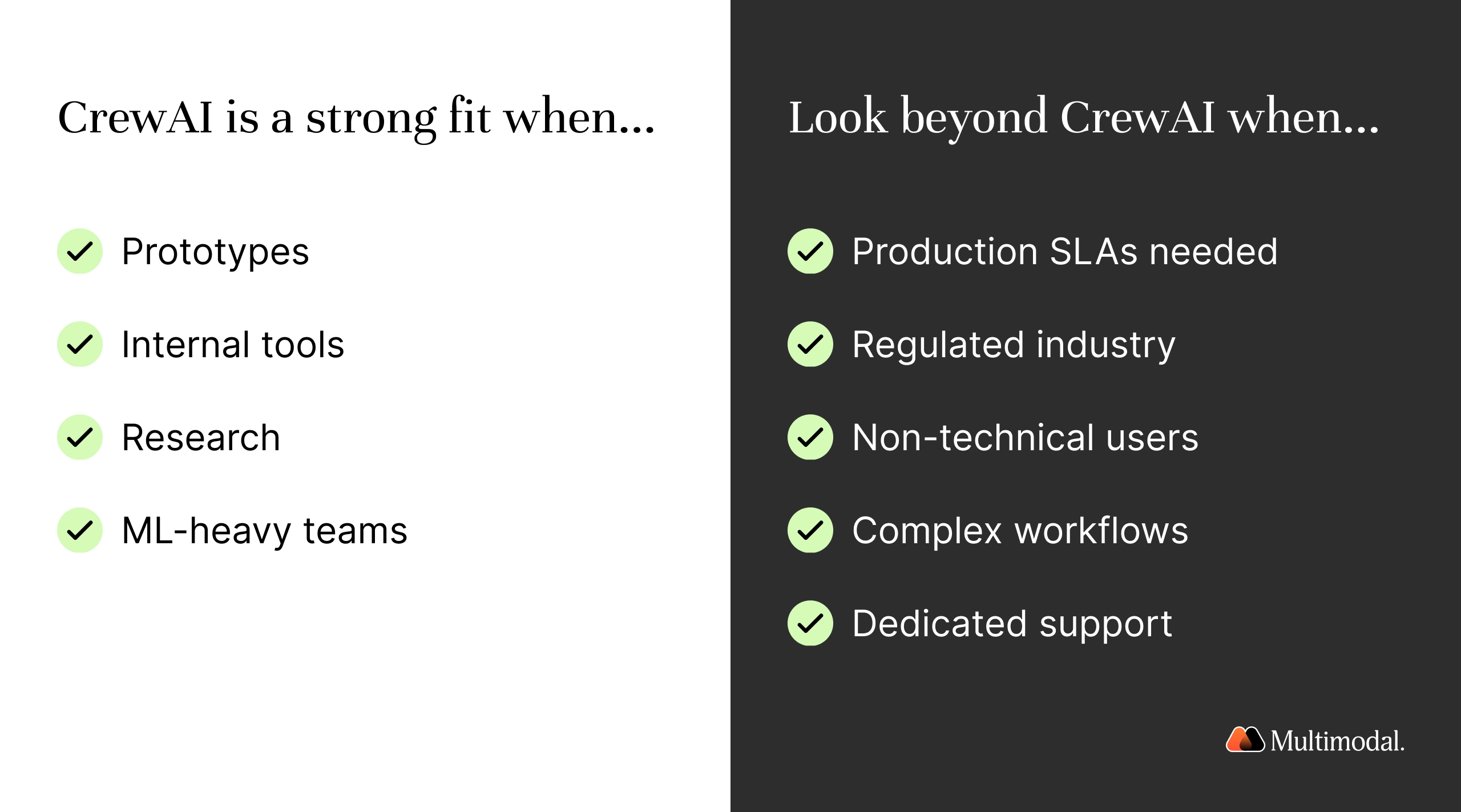
CrewAI earned its position as one of the most downloaded agent frameworks in 2025 by making it easy to spin up role-based agents that collaborate on complex tasks. For experimentation and prototyping, that simplicity is a real advantage.
Where CrewAI fits
- Prototypes and proofs of concept. Teams can stand up multiple specialized agents and create agents that delegate to each other in just a few lines of Python, then validate whether multi-agent orchestration is the right pattern for their problem.
- Internal tools for technical teams. Engineering, data science, and AI developers who already work in Python can wire CrewAI into existing pipelines and run simple agents against internal data sources.
- Research projects and demos. The role-based abstraction is well-suited to academic and research settings where the goal is to study agent behavior, not run production agents at scale.
- Teams with strong ML engineering bench strength that already operate model serving, observability, and deployment pipelines can layer CrewAI on top.
Where CrewAI falls short for enterprise
- Production deployment overhead. Self-host means standing up servers, queues, monitoring, secret management, and version control yourself.
- Compliance gaps in the open source tier. No SOC 2 evidence, audit logs, or RBAC out of the box. The paid Enterprise tier adds these, but that's a buy decision.
- No visual editor for non-technical users. Every change requires writing code — no drag-and-drop builder, no no-code interface.
- Steep learning curve for complex workflows with conditional logic, branching, retries, and human-in-the-loop checkpoints. The framework feels thin compared to graph-based alternatives like LangGraph.
- Production SLAs only on paid tiers. No guaranteed uptime, no incident response, and no roadmap influence on the open source path.

Alternative 1
Recommended
AgentFlow by Multimodal
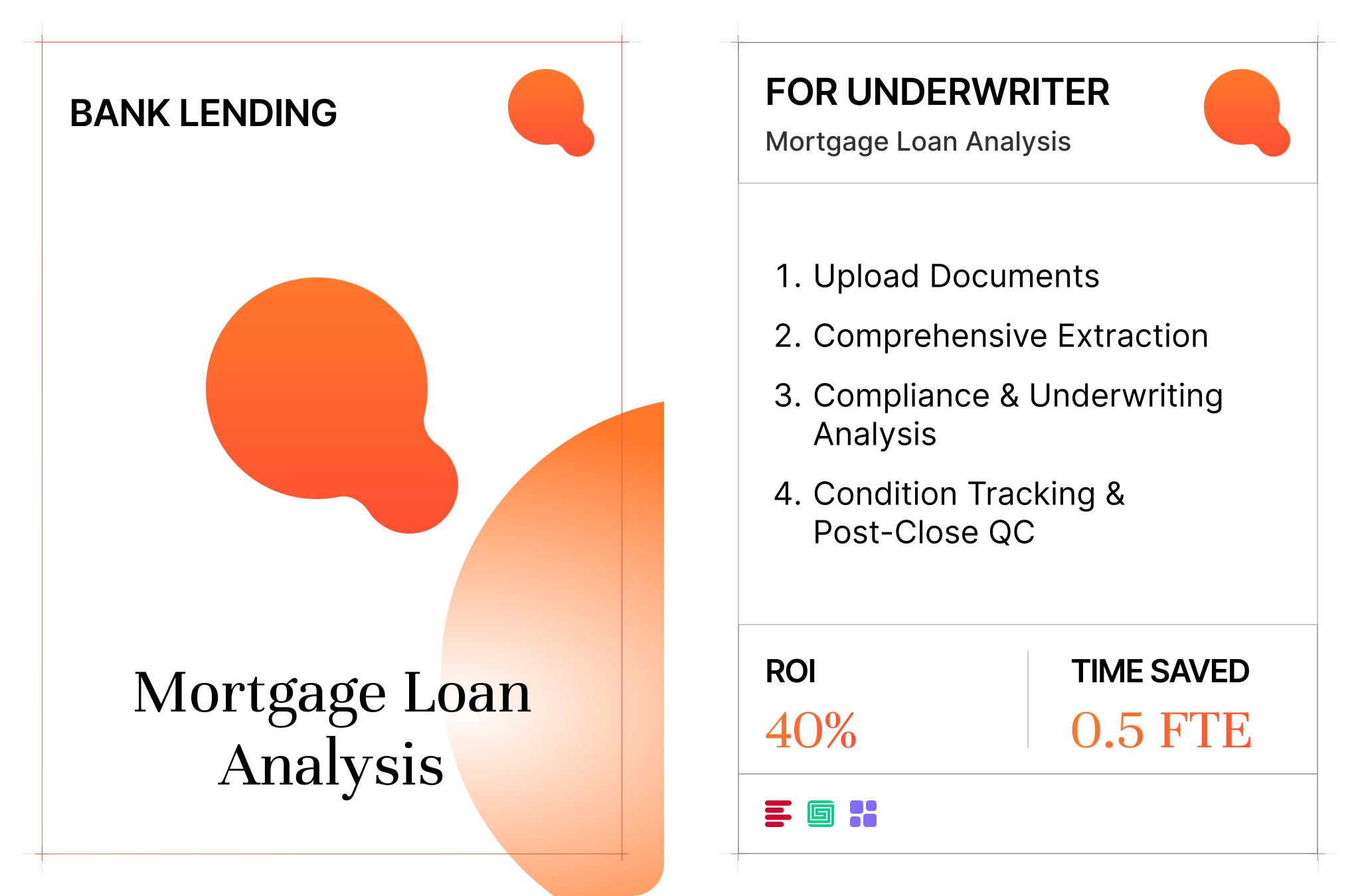
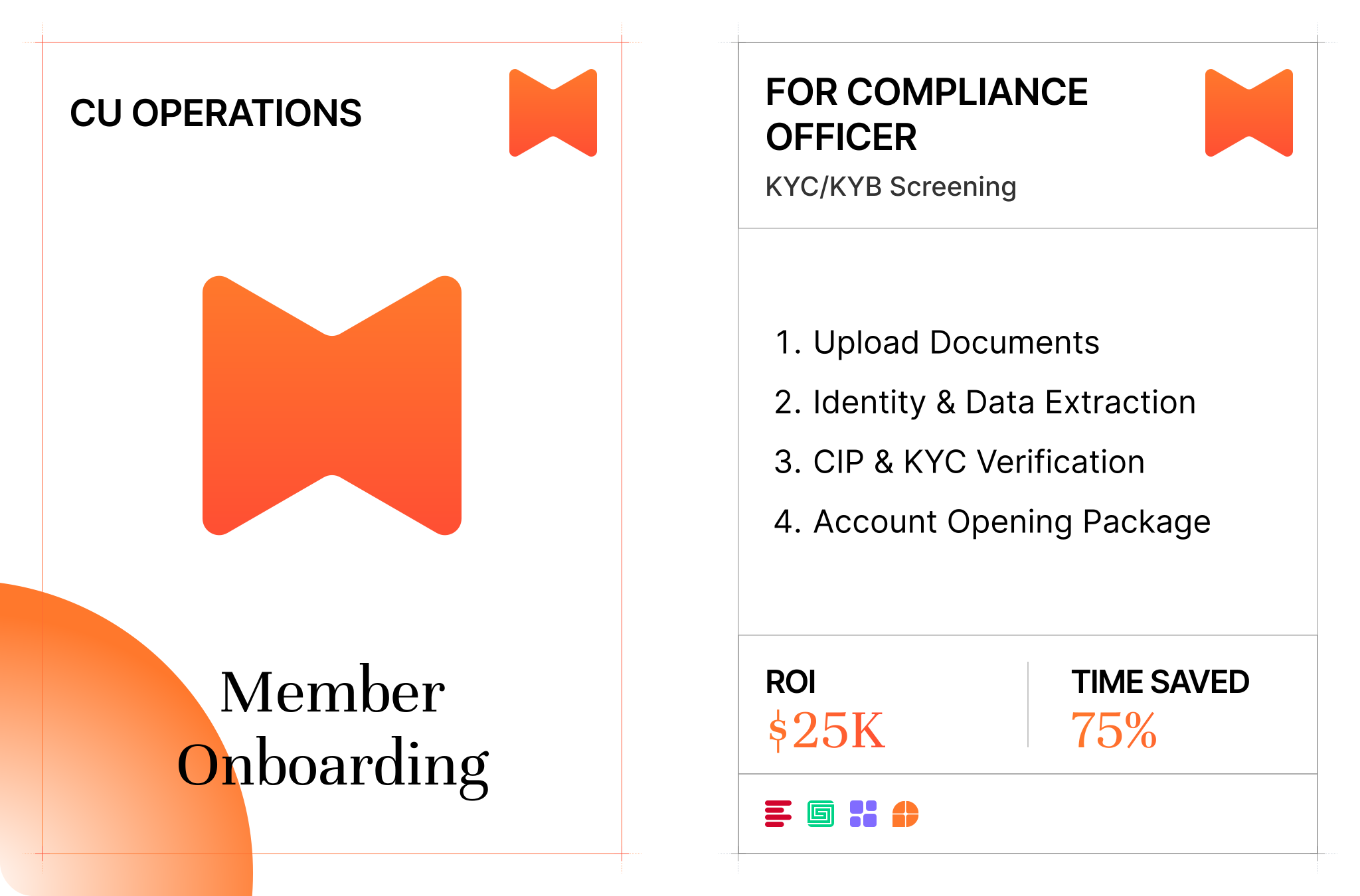
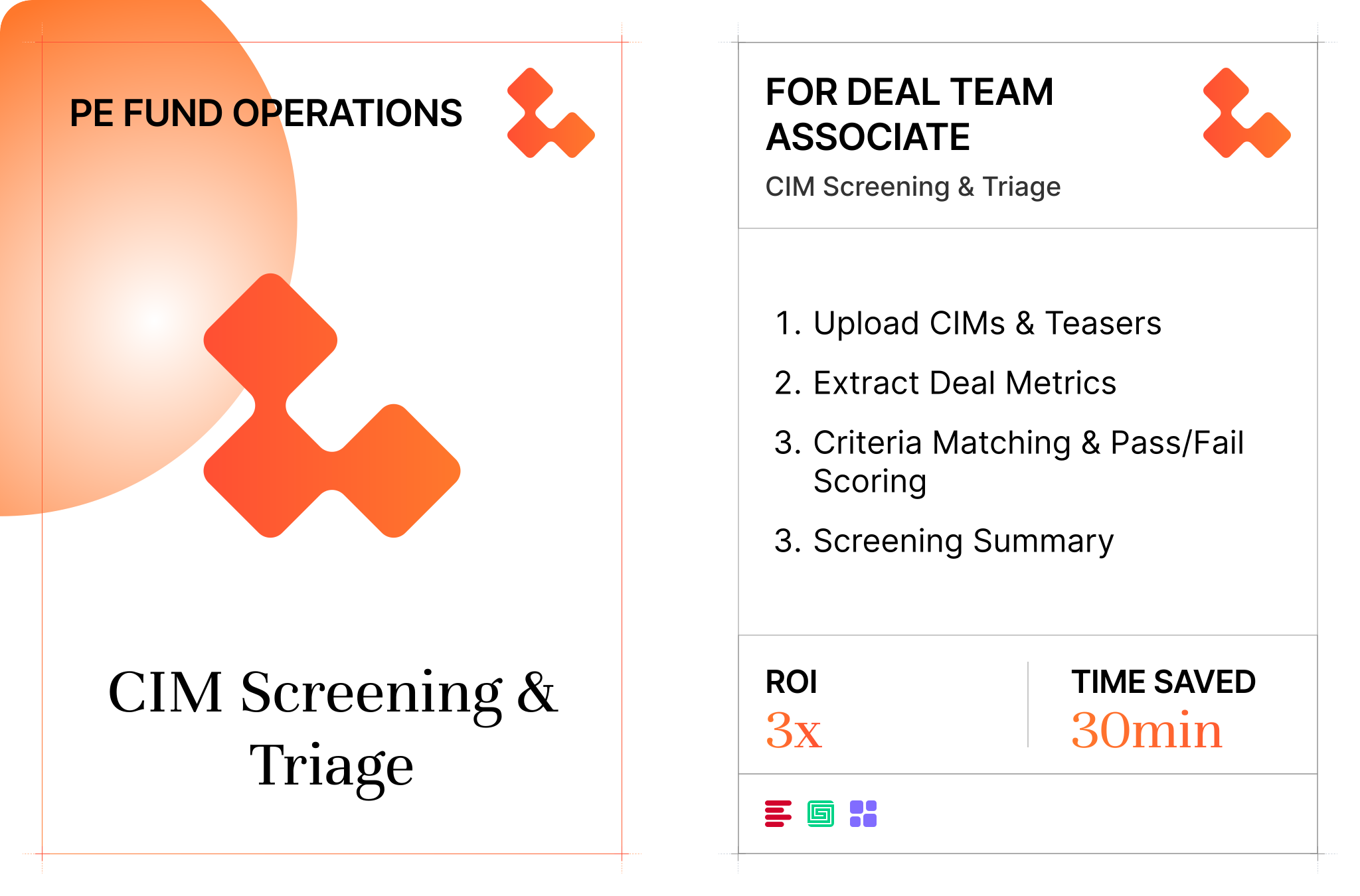
AgentFlow is the agentic AI platform from Multimodal, purpose-built for financial services, insurance, and other regulated industries that need to deploy agents in production. Where CrewAI gives you a Python library, AgentFlow gives you a full platform: a visual interface for building multi-agent workflows, 100+ prebuilt playbooks, an orchestrator agent that coordinates specialized agents and human reviewers, and the compliance scaffolding that regulated buyers require.
Why enterprises choose AgentFlow over CrewAI
- Production agents, not just simple agents. AgentFlow ships with playbooks covering lending, operations, BSA/AML, and private equity workflows. Each playbook is a tested multi-step workflow connecting agents to external data sources, core systems, and document pipelines.
- Built for non-technical users and AI developers. The visual editor lets risk, ops, and compliance leaders configure agent logic and execution paths without writing code. AI developers still get fine-grained control through configuration files and SDK extensions.
- Compliance as a feature. SOC 2 Type II, role-based access controls, and comprehensive audit trails. AgentFlow deploys in your VPC, on premises, or in air-gapped environments to match your internal risk profile.
- Forward-deployed engineering. Multimodal partners with customer teams on go-live outcomes, with deployment timelines that have produced production results in 30 to 90 days.
- Proven outcomes in regulated finance. FORUM Credit Union automated ~60% of consumer loans and boosted loan processing volume by 70%, with 99% accuracy across 62 document packages. Direct Mortgage Corp. cut processing costs by 80% and reduced approval time from weeks to minutes after expanding to 200+ document types.
Best for
CTOs, VP Engineering, and risk leaders at credit unions, banks, insurers, and PE firms who need production workflows with audit logs, dedicated support, and a managed services posture — not a developer toolkit.
Trade-offs to consider
- Custom pricing tied to scope and volume — heavier than spinning up an open-source framework on a laptop
- Opinionated toward financial services; teams needing horizontal AI for marketing automation will get more value from a general-purpose tool

Alternative 2
LangGraph
LangGraph, from the team behind LangChain, is the most popular graph-based agent framework for building multi-agent workflows that need to survive contact with production. Where CrewAI models work as a team of role-playing agents, LangGraph models it as a directed graph: nodes are steps, edges are transitions, and state is persisted at every checkpoint — giving technical teams fine-grained control over agent interactions and execution paths.
Why teams pick LangGraph
- State management is built in. Every step writes a checkpoint you can rewind, branch from, or replay — essential for long-running multi-step workflows that pause for human-in-the-loop input.
- Production-grade orchestration tools. Klarna built its AI assistant for 85 million active users on LangGraph and reported 80% reduction in query resolution time. AppFolio's Realm-X copilot reported 2× higher response accuracy after switching.
- First-class observability. Pairs naturally with LangSmith for tracing, evaluation, and version control of agent prompts and graphs.
- Conditional logic and dynamic workflows. The graph model handles branching, parallel execution, retries, and error recovery in ways that role-based agent frameworks struggle with.
Where LangGraph still has gaps
- Still a framework, not a platform — you self-host the runtime, build the UI, manage secrets, and handle production deployment yourself
- Steeper learning curve than CrewAI's; modeling agents as graphs requires more upfront design work
- Compliance is your problem — no built-in RBAC or audit logs at the framework layer
- No no-code interface — engineering teams required for any non-trivial change
Best for
Engineering organizations with mature platform teams and existing LangChain expertise that want production workflows with explicit state and execution paths, but are willing to operate the platform themselves.

Alternative 3
AutoGen (Microsoft Research)
AutoGen is an open-source framework from Microsoft Research for building conversational multi-agent systems. Where LangGraph uses graphs, AutoGen models multi-agent orchestration as structured conversations: agents exchange messages, with a GroupChat manager coordinating the dialogue. In early 2025, Microsoft shipped AutoGen v0.4, a rewrite around an asynchronous, event-driven actor model with a layered API.
Why teams pick AutoGen
- Strong fit for Microsoft-first enterprises. Native integration with Azure OpenAI, Azure AI Search, and the broader Microsoft ecosystem makes it the path of least resistance for shops already on Azure.
- Conversational agent orchestration. When the workflow really is a back-and-forth between specialized agents — coder agent + critic agent — AutoGen feels natural and the pattern is well documented.
- Event-driven v0.4 core. The rewrite added asynchronous messaging, improved observability, streaming, and the ability to save, restore, and resume agent tasks for more robust production agents.
- Active research community. Originated at Microsoft Research, with ongoing contributions from academic and industry teams.
Where AutoGen falls short
- Framework, not a managed platform — you still build the UI, manage state, deploy, and operate agents yourself
- Conversational pattern is less efficient than graph-based execution for deterministic complex workflows — token usage and latency can balloon
- Out-of-the-box compliance inherits whatever Azure provides; RBAC and approval flows must be layered on for regulated workloads
- The split between Microsoft's AutoGen v0.4 and the AG2 community fork has fragmented documentation and raised the learning curve
Best for
Microsoft-first enterprises with AI research teams or AI developers who want to experiment with multi-agent systems on Azure infrastructure and have the engineering bandwidth to harden the result for production.

Alternative 4
Beam.ai
Beam.ai is a no-code interface for building and deploying AI agents that automate operational workflows. Where CrewAI requires writing code in Python, Beam.ai gives operators a drag-and-drop visual editor to compose agent workflows, connect agents to external tools, and ship them without an engineering project.
Why teams pick Beam.ai
- No-code agent development. Beam Studio is a visual interface where business users can build multi-agent workflows, monitor agent action, and manage deployments with no Python required.
- 1,000+ integrations out of the box. Connectors for SAP, Salesforce, Asana, and most major SaaS systems make it easy to connect agents to existing data sources without custom code.
- Self-learning agents. Beam.ai applies prompt optimization and human feedback loops to push agent accuracy toward 98% over time — useful when edge cases evolve at high volume.
- Enterprise compliance baseline. SOC 2 Type II and GDPR, with self-host, managed services, and SaaS deployment options.
- Throughput at scale. Beam.ai reports scaling from 50 to 5,000 tasks per minute.
Where Beam.ai falls short for regulated finance
- General-purpose by design — no prebuilt playbooks for loan origination, KYC, or claims adjudication
- No built-in support for NCUA examiner walkthroughs, Reg Z disclosures, or model risk management documentation
- Audit trail granularity is lighter than what regulated buyers typically require for explainable AI defenses
Best for
Mid-market enterprises with diverse automation needs across operations, sales, and back office, where non-technical users own the agent development lifecycle.

Alternative 5
Maisa AI
Maisa AI takes a different angle from every other entry on this list. Where CrewAI and LangGraph give you flexibility to build whatever multi-agent systems you can imagine, Maisa AI doubles down on deterministic execution with full traceability, built around its proprietary Knowledge Processing Unit (KPU) reasoning engine.
Why teams pick Maisa AI
- Deterministic agent behavior. The KPU turns LLM agents into more predictable executors by translating reasoning into deterministic code execution, with a full chain of work traceability for every agent action.
- Compliance-first design. Zero trust architecture, encryption, and GRC controls aimed at the highest assurance use cases. Auditable and regulator-ready from day one.
- Citizen developer model. Business experts without an IT background can train digital workers in natural language — similar to a no-code interface but with a stronger guarantee of reproducibility.
- Analyst recognition. Named in Gartner's Hype Cycle for AI and Future of Work reports as a leading agentic AI vendor. Closed a $25M seed round led by Creandum with participation from Forgepoint Capital, NFX, and Village Global.
- 300+ integrations. Digital workers connect to APIs, cloud platforms, and legacy systems without disrupting existing software development workflows.
Where Maisa AI falls short
- Newer than the other alternatives, with a smaller community support base and fewer published reference deployments
- Deterministic execution adds engineering rigor but can add friction for use cases that genuinely benefit from the flexibility of probabilistic LLM agents
- Custom pricing oriented toward large enterprise pilots — not designed for small team experimentation
Best for
Organizations in banking, insurance, energy, and manufacturing where compliance, traceability, and deterministic outcomes outweigh flexibility — and where the cost of a wrong agent action is high.
Decision framework
Should you build with CrewAI or buy a platform?
Most enterprise teams evaluating CrewAI eventually face the same question: keep building, or buy a platform that already solved production problems? Score yourself across these six criteria.
| Criterion | Build with CrewAI / LangGraph | Buy AgentFlow / Beam / Maisa |
|---|---|---|
| Engineering team size | 5+ dedicated AI developers and platform engineers available | Fewer than 5, or AI is not the team's primary focus |
| Time to production | 6 to 12 months acceptable | Production deployment in under 90 days required |
| Compliance needs | Light — internal tools, low risk | SOC 2, audit logs, RBAC, and explainability required |
| Document processing volume | Low or experimental | Thousands of documents and complex tasks per day |
| Budget | Strong preference for open source + internal cost | Comfortable with custom pricing in exchange for managed services |
| Customization needs | Extreme — every workflow is one of one | Mostly recognizable patterns (loan origination, claims, KYC) where playbooks accelerate go-live |
How to read this scorecard: If four or more rows lean to the right, a managed agentic AI platform like AgentFlow will reach production faster and at a lower total cost than a CrewAI build. If four or more lean to the left, building on an open source framework (CrewAI for simple agents, LangGraph for complex agents) is the right call.
Make the right call for your team
Which platform wins and when
CrewAI is a strong open-source framework for prototyping multi-agent systems and building simple agents fast. For enterprise production environments, especially in regulated finance, the gap between framework and platform is the gap between a working demo and a system you can defend to a regulator.
If you are evaluating CrewAI alternatives, the honest summary is:
AgentFlow
wins for regulated finance and insurance, where compliance, audit logs, and forward-deployed engineering matter more than maximum framework flexibility.
LangGraph
wins for engineering-led teams that want production workflows with fine-grained control and are willing to operate the platform.
AutoGen
wins for Microsoft-first shops that already live on Azure and want a research-grade base for software development of multi-agent systems.
Beam.ai
wins for mid-market companies with diverse automation needs and non-technical users in the driver's seat.
Maisa AI
wins for organizations where deterministic execution and traceability are non-negotiable.
Frequently asked questions
CrewAI is a capable open-source framework for building AI agents and prototyping multi-agent systems. But on the open-source path, production deployment requires self-hosted infrastructure, audit logs, and role-based access control you build yourself. The paid Enterprise tier closes some gaps. Regulated production environments that handle sensitive data still benefit from a managed agentic AI platform.
Yes. AgentFlow covers the same multi-agent orchestration patterns CrewAI offers, including specialized agents, an orchestrator agent, human-in-the-loop checkpoints, and agents interacting with external tools. It adds a visual editor, audit logs, SOC 2 Type II posture, and 100+ playbooks, with production deployment typically in 30 to 90 days.
A CrewAI build for regulated workflows typically requires 3 to 5 AI developers for 6 to 12 months, plus infrastructure and compliance work. McKinsey found that over 80% of enterprises see no EBIT impact from gen AI yet — often because the integration and governance burden isn't accounted for. A managed platform consolidates integration, governance, and workflow redesign into predictable custom pricing.
CrewAI is faster to start, with role-based agents created in just a few lines of Python. LangGraph offers fine-grained control over execution paths with explicit state. For production workflows needing durability, observability, and human-in-the-loop checkpoints, LangGraph or a managed AI agent framework like AgentFlow is the safer choice.
If non-technical users own agent logic, a no-code interface or visual editor is essential. AgentFlow, Beam.ai, and Maisa AI offer visual interfaces. CrewAI, LangGraph, and AutoGen require writing code. Most enterprises eventually need both: a visual editor for operators and an SDK for AI developers building complex agents.
Google's Agent Development Kit, OpenAI Agents SDK, and Lyzr Agent Studio are credible CrewAI alternatives for technical teams — all open source frameworks or developer-first studios with similar trade-offs to LangGraph and AutoGen. None match AgentFlow's depth in regulated finance playbooks, audit logs, and forward-deployed support.
Every AgentFlow playbook supports human-in-the-loop checkpoints by default. The orchestrator agent routes routine work to specialized agents and escalates complex tasks to named human reviewers with full context. Every agent action is logged and explainable — essential for regulated multi-step workflows facing examiners and auditors.

Make the Right Call for Your Team
CrewAI is a strong open-source framework for prototyping multi-agent systems and building simple agents fast. For enterprise production environments, especially in regulated finance, the gap between framework and platform is the gap between a working demo and a system you can defend to a regulator.
.svg)
.svg)