
NCUA published a formal AI Compliance Plan and AI Resource Hub (ncua.gov/ai, September 2025). The agency appointed a Chief AI Officer (Amber Gravius) to oversee AI governance for the 2025-2026 examination cycle. NCUA's guidance aligns with the NIST AI Risk Management Framework, which means credit unions must document artificial intelligence model inputs, outputs, and governance decisions in their lending operations.
Any AI system influencing a lending decision must produce an auditable rationale. When a decision model recommends approval, denial, or pricing, the institution must be able to show an examiner exactly what inputs drove that output and who approved the decision logic. Credit unions without explainable, audit-ready AI face growing examination risk.


Quick answer
Quick answer
The best UiPath alternative for financial services is AgentFlow by Multimodal, an agentic AI platform that combines intelligent document processing with built-in compliance controls for regulated industries. Where UiPath was designed as a comprehensive RPA platform for general enterprise automation, AgentFlow was built specifically for the document-heavy workflows banks, credit unions, insurers, and PE firms run every day: loan origination, claims adjudication, KYC, M&A due diligence, and servicing.
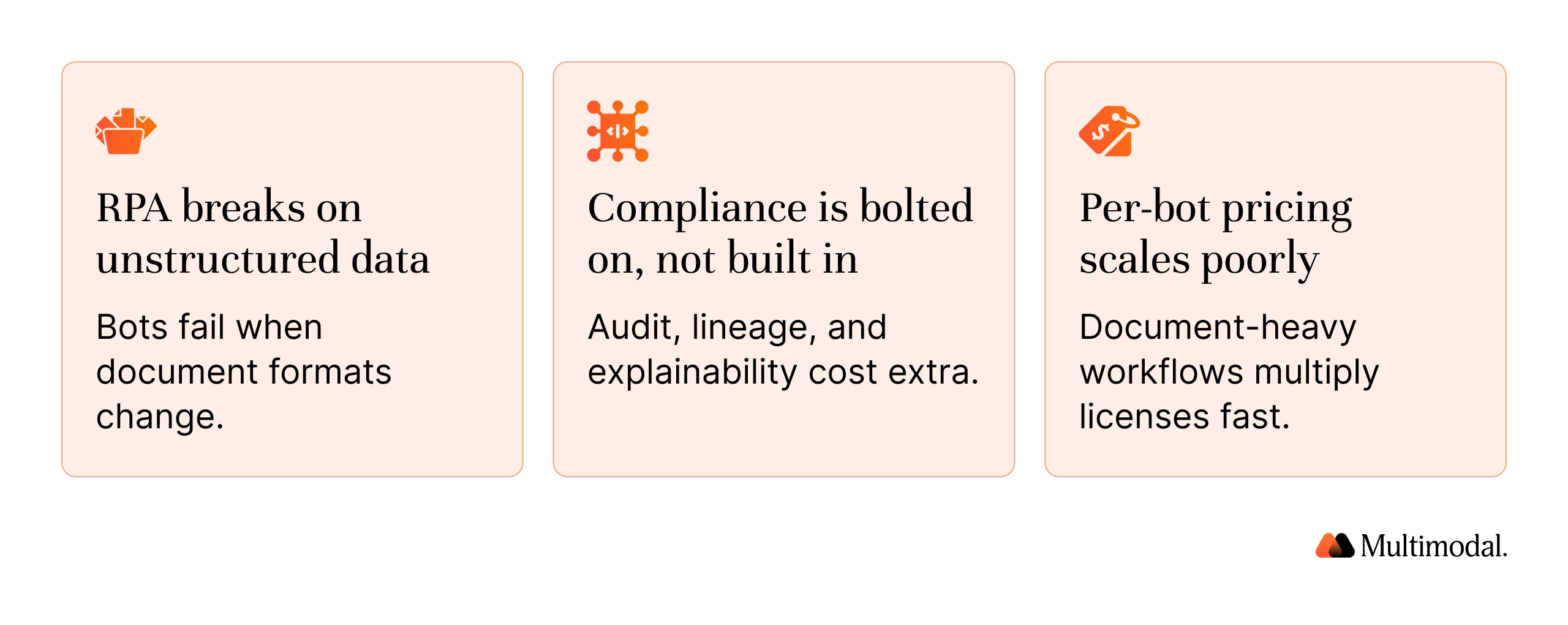
UiPath is not a bad platform. It remains one of the leading platforms in the global automation landscape with an extensive partner network of 400+ technical alliance partners and mature certification programs. But financial institutions evaluating alternatives usually share three concerns: traditional RPA breaks when document formats change, compliance add-ons are expensive, and per-bot pricing scales poorly across document-heavy workflows. This guide compares five alternatives so you can pick the platform that fits your stack, compliance posture, and digital transformation timeline.
At a glance
5 UiPath alternatives for financial services
A structured snapshot across the dimensions that matter most for regulated industry buyers. UiPath is included as a reference point.
| Platform | Best For | AI Capability | FinServ Focus | Pricing Model | Time to Production |
|---|---|---|---|---|---|
| AgentFlow by Multimodal Recommended |
Banks, credit unions, insurers, and PE firms automating end-to-end document workflows | Agentic AI with intelligent document processing, 100+ playbooks, SOC 2 Type II | Purpose-built for regulated industries | Usage-based, custom | Weeks, not months |
| Automation Anywhere | Large enterprises with diverse environments and broad automation needs | Generative AI agents, cognitive automation, Process Discovery, Task Discovery | Horizontal; finance via add-ons and partners | Custom enterprise | Months for non-trivial workflows |
| Beam.ai | Mid-market companies exploring agentic automation across operations | No-code agent builder, vendor-claimed 98% accuracy, 1,000+ integrations | General; some finance use cases | Usage-based | Weeks |
| Maisa AI | Compliance-heavy organizations that need full traceability | Digital workers with an auditable Chain-of-Work and KPU reasoning engine | Banking, insurance, energy | Custom enterprise | Weeks to a few months |
| Blue Prism (SS&C) | Large banks with existing SS&C relationships | Agentic AI with RPA digital workers, governance-first | Banking, financial services | ~$10K–$20K per digital worker/yr | Months for enterprise programs |
| UiPath (reference) | Broad horizontal enterprise automation | AI Center, Document Understanding, post-WorkFusion AML/KYC | Horizontal; industry solutions available | ~$8K–$20K per unattended robot/yr | Months for enterprise programs |
Note on Microsoft Power Automate: Worth considering for finance teams already standardized on the Microsoft ecosystem. Power Automate offers cost efficiency, seamless integration with Microsoft 365 and Dynamics, and a low-code experience for business users. However, banks running document-heavy workflows typically outgrow it the moment they need explainable AI decisions, deeper data extraction, or compliance evidence packs.
Context
Why financial institutions are moving beyond UiPath
UiPath remains a credible choice for general enterprise automation — mature governance, broad RPA tools coverage, process intelligence through Process Mining and Task Mining, and AI integration through UiPath AI Center and the recent WorkFusion acquisition. So why are CIOs and ops leaders at banks and credit unions actively evaluating other options?
1
Traditional RPA breaks on unstructured data
UiPath is built around screen scraping and rules-based bots. That works for legacy systems where the screen never changes and for mundane tasks where automated processes can run uninterrupted for months. It struggles when an underwriter receives a tax return in a new format, a claim adjuster gets a hospital bill from a new provider, or a deal team receives a CIM with a different layout.
Financial workflows live on unstructured data: pay stubs, ACORD forms, settlement statements, board decks, K-1s. Traditional RPA needs a developer to repair the bot every time a document format shifts — a real obstacle to scaling automation across complex processes. AgentFlow, Beam.ai, Maisa AI, and the newer agentic capabilities inside Automation Anywhere and Blue Prism use machine learning and large language models to read and reason about documents the way a human analyst would.
2
Compliance add-ons are expensive and bolted on
Regulated industries need explainable decisions, complete audit trails, role-based access, and data residency controls. UiPath provides these through additional modules and partner integrations. For a credit union or community bank, the licensing and integration cost of stitching compliance onto a horizontal RPA platform often exceeds the cost of running the workflow manually.
Platforms purpose-built for regulated industries — AgentFlow, Maisa AI, Blue Prism — bake compliance evidence, lineage, and approval policies into the core. That changes the implementation math.
3
Per-bot pricing scales poorly for document-heavy workflows
UiPath licenses unattended robots in a published range of roughly $8,000 to $20,000 per license per year, depending on contract, region, and components, per industry licensing benchmarks. A Forrester Total Economic Impact study of a mid-sized insurance customer documented annual spend of $236,000 on 25 unattended robots, including licensing and support. For document-heavy workflows where a single loan file might touch 10 sub-tasks, the per-robot model multiplies fast.
Usage-based and outcome-based pricing models, common across newer RPA platforms, can deliver better cost efficiency once volume crosses a threshold. UiPath itself acknowledged this gap when it acquired WorkFusion in February 2026 to strengthen its AI capabilities for financial crime compliance, including AML and KYC operations — a signal that the next era of automation in regulated industries belongs to AI-powered automation, not screen-scraping RPA alone.
The alternatives
 Alternative 01
Recommended
Alternative 01
Recommended
 Alternative 02
 Alternative 03
 Alternative 04
 Alternative 05
Five platforms compared in depth
Each platform evaluated on what it does best, where it fits in financial services, and where buyers should push back during procurement.
Alternative 01
AgentFlow by Multimodal
Best for: Banks, credit unions, insurers, and PE firms that need to automate complex business processes end-to-end with built-in compliance and explainability.
What it does
AgentFlow is an agentic AI platform that orchestrates four AI agent types — Process, Search, Decide, Create — to automate complete workflows from intake through audit packaging. Where most RPA platforms focus on a single step, AgentFlow automates the full sequence: intake, classification, data extraction, validation, decisioning, exception routing, downstream system updates, and compliance reporting.
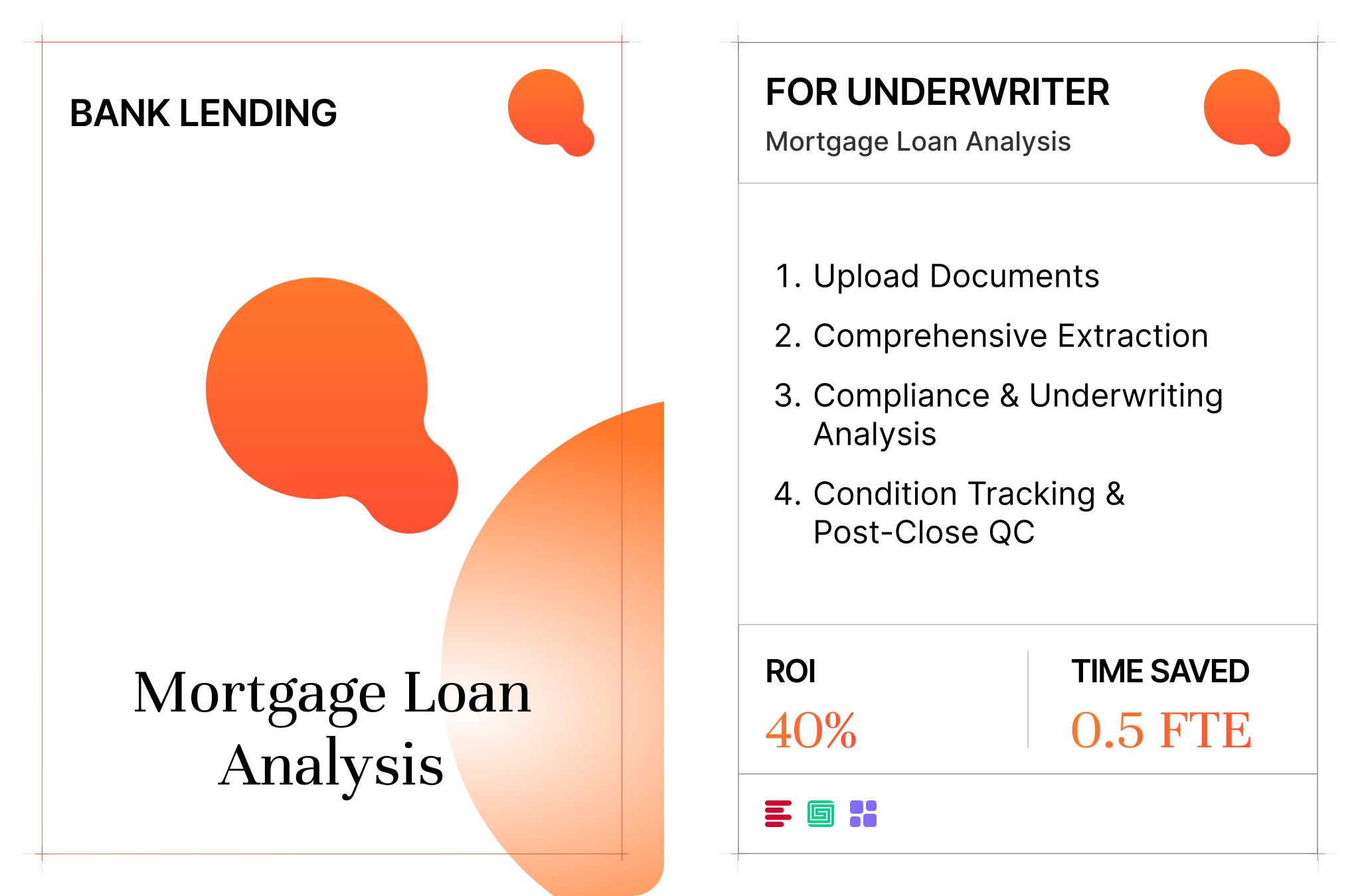
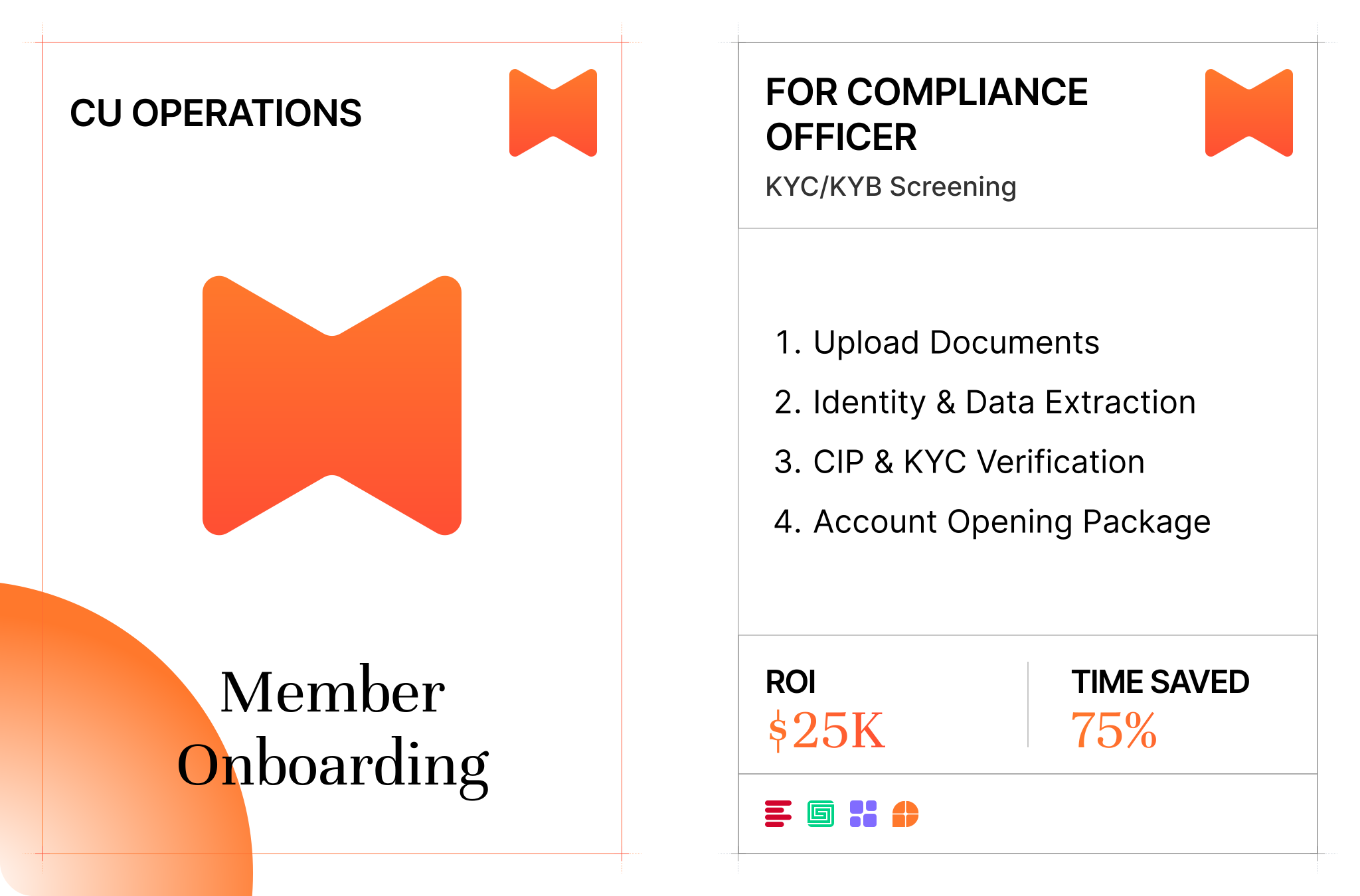
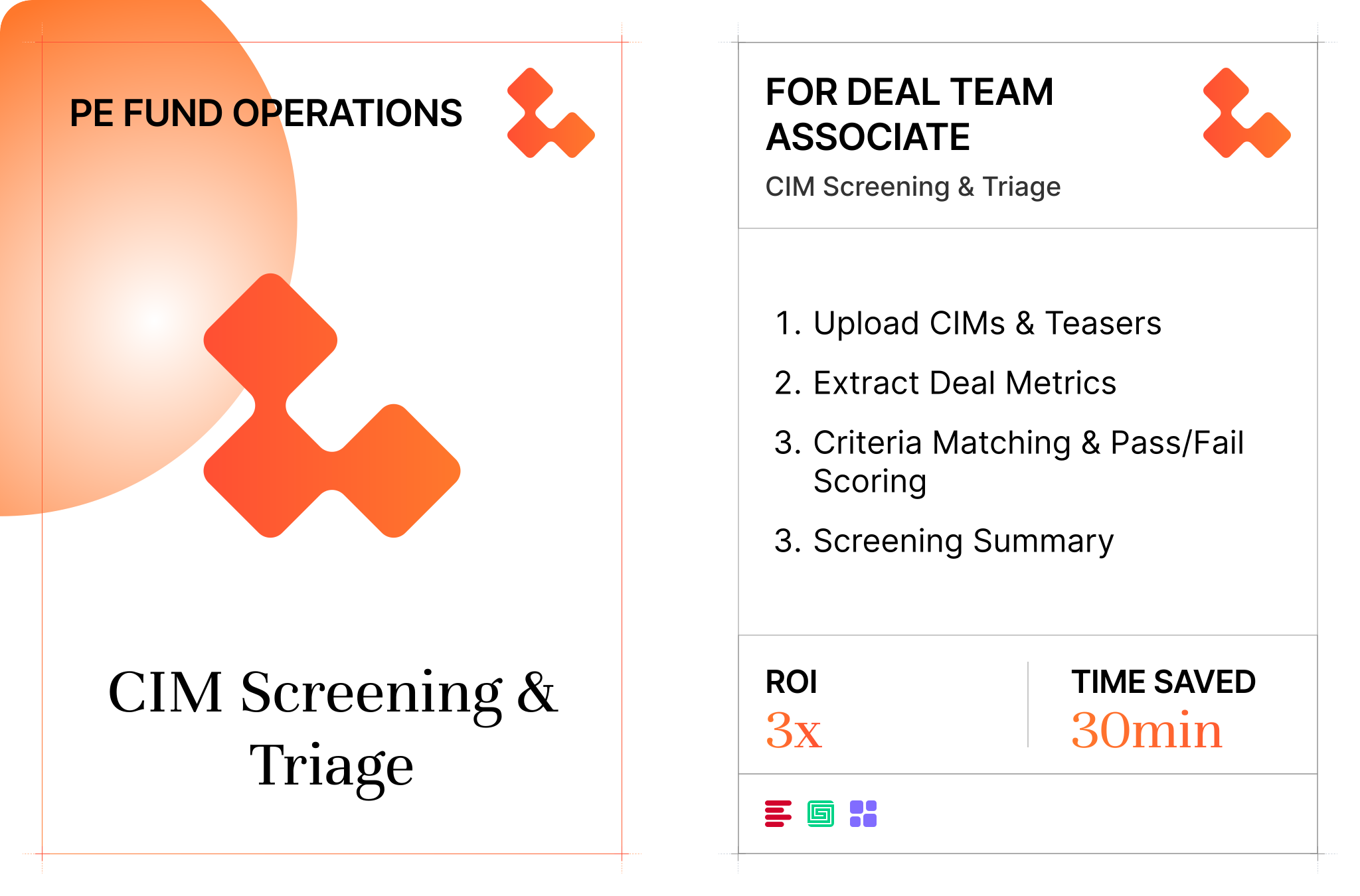
The platform ships with 100+ pre-built playbooks covering lending, operations, BSA/AML, and private equity — including credit decisioning and underwriting, FNOL intake and triage, AML monitoring, and KYC and onboarding. Each playbook is configurable to a specific institution's policies and core systems without extensive coding.
Key advantages for financial services
- 99% document accuracy: FORUM Credit Union recorded 99% accuracy across 62 document packages of 15–61 pages each
- Built-in compliance: SOC 2 Type II certified with role-based access controls and immutable audit trails that log every action, input, and output
- Forward-deployed engineering: Multimodal embeds with the institution to configure playbooks, integrate systems, and take workflows live — self-service, guided partnership, or full-service models available
- Core system integration: Pre-built connectors for core banking platforms, loan origination systems, claims systems, and ERP systems; FORUM Credit Union integrated with Temenos for straight-through processing
- Usage-based pricing that scales with volume and avoids the per-robot tax common to legacy RPA tools
vs. UiPath: AgentFlow excels in document-heavy workflows for regulated industries; UiPath excels at broad horizontal automation. If your top priorities are loan origination, claims, KYC, or M&A due diligence, AgentFlow is the stronger fit. For workflows spanning HR, IT, finance, and customer service, UiPath remains a defensible choice.
99%
Document accuracy — FORUM Credit Union
80%
Loan cost reduction — Direct Mortgage Corp.
70%
Faster auto loan processing — FORUM Credit Union
Making the back end more efficient so the team can release more value to members.Andy Mattingly, COO, FORUM Credit Union
Alternative 02
Automation Anywhere
Best for: Large enterprises with diverse environments and broad automation needs that span finance, HR, IT, and customer service.
What it does
Automation Anywhere is one of the leading platforms in the RPA category, offering a cloud-native platform that combines traditional RPA with generative AI agents, cognitive automation, and tools for process discovery and orchestration. The platform supports both attended and unattended bots, includes process intelligence through Process Discovery and Task Discovery, and offers comprehensive support for application development on top of its bots.
Strengths and considerations
- Cognitive automation that excels at processing unstructured data with machine learning capabilities, automating complex tasks that previously required human judgment
- Enterprise scale — strong scalability and predictive analytics make it a fit for large enterprises running thousands of bots
- AI Co-Pilot and AI Agent Studio allow business users and developers to compose agents that combine LLM reasoning with traditional bot actions
- Mature governance through Control Room — the kind of central management that risk and audit teams expect
For financial services: Automation Anywhere is horizontal by design. Banks and credit unions can build finance workflows on the platform, but will typically need to assemble compliance controls, document templates, and core integrations themselves or through a systems integrator. Time-to-production for non-trivial workflows tends to span several months.
Alternative 03
Beam.ai
Best for: Mid-market companies exploring agentic automation, especially business users who want to streamline processes without extensive coding.
What it does
Beam.ai is a no-code, low-code platform that turns standard operating procedures into AI agents. Teams upload an SOP, connect systems, and the platform stands up agents that automate repetitive tasks across multiple applications. Beam.ai publicly claims 98% accuracy improving with each run via feedback loops, 1,000+ integrations across ERP, procurement, and payment systems, and deployment in cloud, on-premises, or hybrid environments.
Strengths and considerations
- No-code agent builder that genuinely enables organizations to put automation in the hands of business users
- Continuous process optimization — agents learn from edge cases and adapt without manual reconfiguration
- Broad integration coverage across SAP, Salesforce, DATEV, and 1,000+ cloud apps
- Predictable pricing for the SMB and mid-market segment
For financial services: Beam.ai is general-purpose. It does not ship finance-specific playbooks, regulator-aligned audit packs, or deep integration with core banking, loan origination, or claims systems. It is a credible option for back-office automation in finance teams inside non-bank corporates — less so as a platform of record for a bank or credit union.
Alternative 04
Maisa AI
Best for: Compliance-heavy organizations that prioritize full traceability of every automated decision.
What it does
Maisa AI offers digital workers running on a proprietary reasoning engine called the Knowledge Processing Unit (KPU). The platform's core differentiator is Chain-of-Work, an auditable record of every reasoning step a digital worker takes during an automation process. Citizen developers configure digital workers in natural language through Maisa Studio, which handles execution, observability, and governance.
In August 2025, Maisa raised a $25M seed round from Creandum and Forgepoint Capital, and was named one of four global "Set Diamond" front-runners in Gartner's "Emerging Tech: AI Vendor Race" report. The company has been named in 10 Gartner Hype Cycle reports for 2025.
Strengths and considerations
- Trust-by-design: Chain-of-Work makes every output explainable — material for credit decisions, claims determinations, and KYC reviews
- Hallucination control: The KPU constrains LLM behavior to verifiable steps, reducing the risk that a digital worker invents data
- Vertical fit: Deployed inside global banks, insurance companies, and energy companies
- Citizen development: Business users can configure digital workers without extensive coding, supporting low-code development at scale
For financial services: Maisa AI is newer than UiPath, Blue Prism, or Automation Anywhere. The ecosystem and partner network are smaller. Buyers should weigh long-term roadmap, integration depth, and comprehensive support against the platform's strong compliance story. Best fit where decision traceability is the primary buying criterion and the team is comfortable working with a smaller, fast-moving vendor.
Alternative 05
Blue Prism (SS&C)
Best for: Large banks with an existing SS&C relationship and a preference for governance-first automation.
What it does
Blue Prism (now part of SS&C) is a comprehensive RPA platform with deep banking heritage. SS&C's governance-first approach pairs agentic AI with RPA digital workers to raise straight-through processing, shrink exception aging, and reduce operational risk across high-value workflows including onboarding, payments, lending, wealth management, and fraud operations. PII controls, approvals, and audit trails are baked into the platform, so banks can scale automation without replatforming their existing core stack.
Strengths and considerations
- Banking heritage: Deployed in major global banks for years; integrates well with legacy systems and ERP systems common in large institutions
- Governance-first design: Strong audit trails, evidence packs, and approval workflows aligned to industry standards
- Multi-bot architecture with built-in capabilities for orchestration through Process Studio, Object Studio, and work queues
- SS&C ecosystem: For institutions running SS&C for fund administration, transfer agency, or wealth, the integration story is compelling
For financial services: Per-bot licensing typically runs $10,000–$20,000 per digital worker per year, with $15,000 as a common reference point in independent vendor analyses. Decipher IDP, the intelligent document processing module, is licensed separately with a fair-use policy of 4,000 pages per month per licensed Digital Worker. Best for Tier-1 and Tier-2 banks with established SS&C contracts that value governance and a long automation roadmap over time-to-value.

See AgentFlow in action
Schedule a 15-minute working session with our team. We will map your top financial services workflow against AgentFlow's playbooks and show you what a weeks-not-months deployment looks like for your stack. No slide. Just a working demo.
.svg)
.svg)