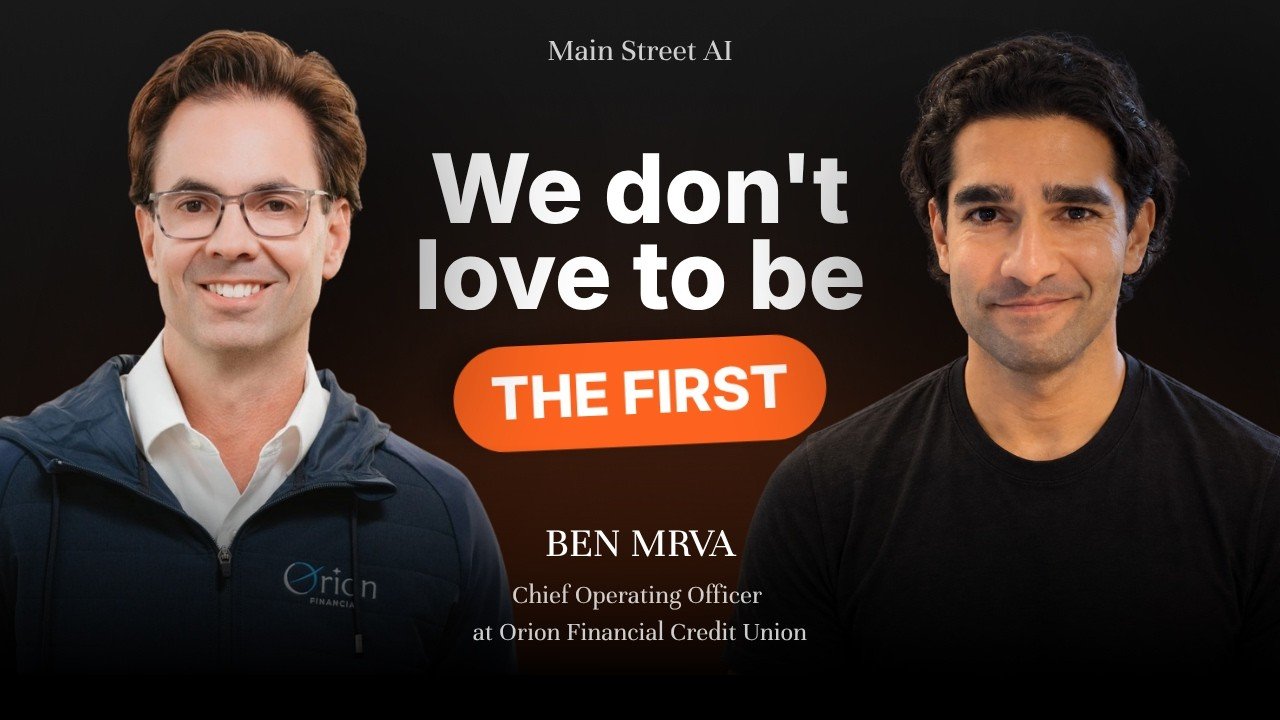


This is a summary of an episode of Main Street AI, an educational podcast on AI led by our founder. Join 3,700+ business leaders and AI enthusiasts and be the first to know when new episodes go live. Subscribe to our newsletter here.
TL;DR:
- Orion's AI work so far is internal: underwriting, lending and operations processes that members mostly notice as faster turnaround
- Data readiness sets the pace. Orion is building a data lake and only deploys AI where its data is already clean
- Every vendor faces two filters first: IT and data risk, then integration burden. Failing either is a hard stop
- AI let Orion bring fraud and mortgage servicing in-house and lean far less on consultants, producing significant savings
- Ben expects a minimal net increase in AI budget, since spend is moving from outsourced work into AI tools
- AI hasn't reduced headcount at Orion. It means staffing doesn't need to grow as fast as the credit union does
Before we dive into the key takeaways from this episode, be sure to catch the full episode here:

What Does AI Readiness Look Like at a Credit Union?
At Orion, it starts with the data. Ben's team learned this while measuring the results of recent branch renovations and workflow changes. People pulling branch transaction counts from different systems kept getting different answers.
“If the data's not tight, not only can our humans not solve it, but any AI application that we're applying to that same problem is going to get confused by the data.”
Ben Mrva
That's why Orion is building a data lake, expected to wrap up around the first quarter. Until then, AI only goes where the data is already clean. Ben is candid that this is the main reason Orion isn't as far along as leadership would like.
Why Isn't Credit Union Data Ready for AI Yet?
Ben points to two causes. The first is caution: in a heavily regulated industry, data security and risk had to be settled before anyone would connect new AI tools to core systems. The second is how credit union technology was bought. Each platform did one job, and nobody needed its data anywhere else.
AI use cases change that. Digital banking data now feeds marketing and member outreach, then gets written back to the core. Industry research lines up with what Ben describes: PYMNTS reports that data quality, governance and system connectivity are the main constraints keeping credit union AI pilots from becoming enterprise capabilities.
The Two Filters Every AI Vendor Has to Clear
Every new solution at Orion goes through IT and data risk review first, including how data moves in and out. The second filter is integration effort, because Orion's IT team is already split between strategic projects and daily fires.
“Those are the two filters we run everything through first, and if you can't make it past those, it's a hard stop.”
Ben Mrva
Ben saw the same priority at a recent Filene event where 27 fintechs pitched over two days. By his count every one was AI-driven, and the audience's most common question was which cores and digital platforms each one integrated with. If setup is a heavy lift, he says, the cost of getting a vendor in can cancel out the economic benefit.
Orion also checks references with credit unions running the same core and digital stack. “We don't love to be the first to do anything,” Ben says. Its core partner, Corelation, has supported Orion's innovation projects since Orion became one of KeyStone's earliest installs.
How AI Brought Fraud and Mortgage Servicing In-House
Orion's clearest return so far has come from insourcing work it used to pay others for.
“We've brought fraud in house, we brought mortgage servicing in house. We don't use nearly as many consultants as we used to because we can just use AI tools to do a lot of what third party consultants were doing for us.”
Ben Mrva
Ben says these moves have already produced significant savings. They've also won over staff who were hesitant about AI. Once one team gets a win, other departments start asking how to get involved.
How Should Credit Unions Budget for AI in 2027?
Ben starts with the problems Orion wants to solve for members and internally, then builds the budget around them. He doesn't expect a large net increase in technology spend, because money is moving from outsourced services and consultants into AI tools.
“We're just taking it from one pocket and putting it into the other.”
Ben Mrva
He expects a minimal short-term increase for AI and significant value over the long term. Headcount isn't the funding source either. Orion hasn't cut staff because of AI, though it may not need to add people as fast as it grows.
How Can Credit Unions Compete With Big Banks and Fintechs?
Orion can't match JPMorgan Chase's technology budget, and Ben doesn't try. Its edge is local knowledge and member data.
“We know Memphis, Tennessee better than any of the big banks out there ever possibly could.”
Ben Mrva
Where scale matters, credit unions solve problems together through groups like Filene. Ben calls fintech pressure from players like SoFi real and treats it as a lesson: remove friction, use data to put the right product in front of the right member at the right time, and raise products per member. Culture shapes the rest. Orion's hospitality push in branches is led by people, and AI's job is to give staff a full view of the member relationship before the conversation starts.
How This Works in Practice
Ben's closing advice is to lean on peers before building from scratch.
“If anyone's out there and you've got a problem you're trying to solve, you're not the first one trying to solve it.”
Ben Mrva
Orion's pattern of starting with internal workflows where the data is clean, then expanding after a proven win, is the path AgentFlow is built for. Multimodal deploys AI agents for lending, underwriting and document-heavy operations, with Document AI handling extraction and Decision AI supporting the decisions that follow. See how it works for credit unions.
Want more? Read how Adrian Rodriguez of American Heritage Credit Union treats AI as a data problem first, and why SECU's Phil Caputo stays deliberately conservative on AI.
Frequently Asked Questions
What is AI readiness for a credit union?
AI readiness for credit unions is mostly data readiness: clean, consistent data that returns the same answer no matter who asks or which system they query. Orion only deploys AI where its data meets that bar and is building a data lake to expand from there.
Why do credit unions struggle with data readiness?
Regulatory caution around data security and platform-centric technology both slowed progress. Each system kept its data to itself, and AI use cases now require connecting them.
Can AI help a credit union bring outsourced work in-house?
Yes. Orion used AI tools to bring fraud and mortgage servicing in-house and to replace much of its consulting spend, producing significant savings.
Does AI reduce staff at credit unions?
Not at Orion. Ben has seen no decline in personnel from AI, though the credit union may not need to hire as quickly as it grows.
How should a credit union budget for AI?
Start with the member and internal problems you want to solve, then fund AI largely by shifting spend away from outsourced services and consultants. Orion expects a minimal net budget increase in the short term and significant long-term value, the model AgentFlow deployments are designed around.
What should credit unions look for in an AI vendor?
Start with IT and data security, then the integration effort with your core and digital platforms. At Orion, failing either check is a hard stop, and references from credit unions on the same stack carry real weight.
 Continue exploring