

.svg)
.svg)

.svg)
This is a summary of an episode of Main Street AI, an educational podcast on AI led by our founder. Join 3,700+ business leaders and AI enthusiasts and be the first to know when new episodes go live. Subscribe to our newsletter here.
TL;DR:
- SECU: second largest credit union in the US, $56.8 billion in assets, 2.94 million members, one in four North Carolina residents.
- Conservative on AI by design: every tool passes legal review, inherent risk assessment, model risk, and third-party risk before deployment.
- AI that decides alone is classified as high risk: human oversight is non-negotiable./
- The burn-the-boat position clears legal fastest but is not a long-term vision.
- Biggest cost of going slow: losing younger members who want Zelle, mobile-first experiences, and no branch visit.
- First AI use case in the project office is governance, not planning or execution.
Before we dive into the key takeaways from this episode, be sure to catch the full episode here:
What Phil Caputo Walked Into
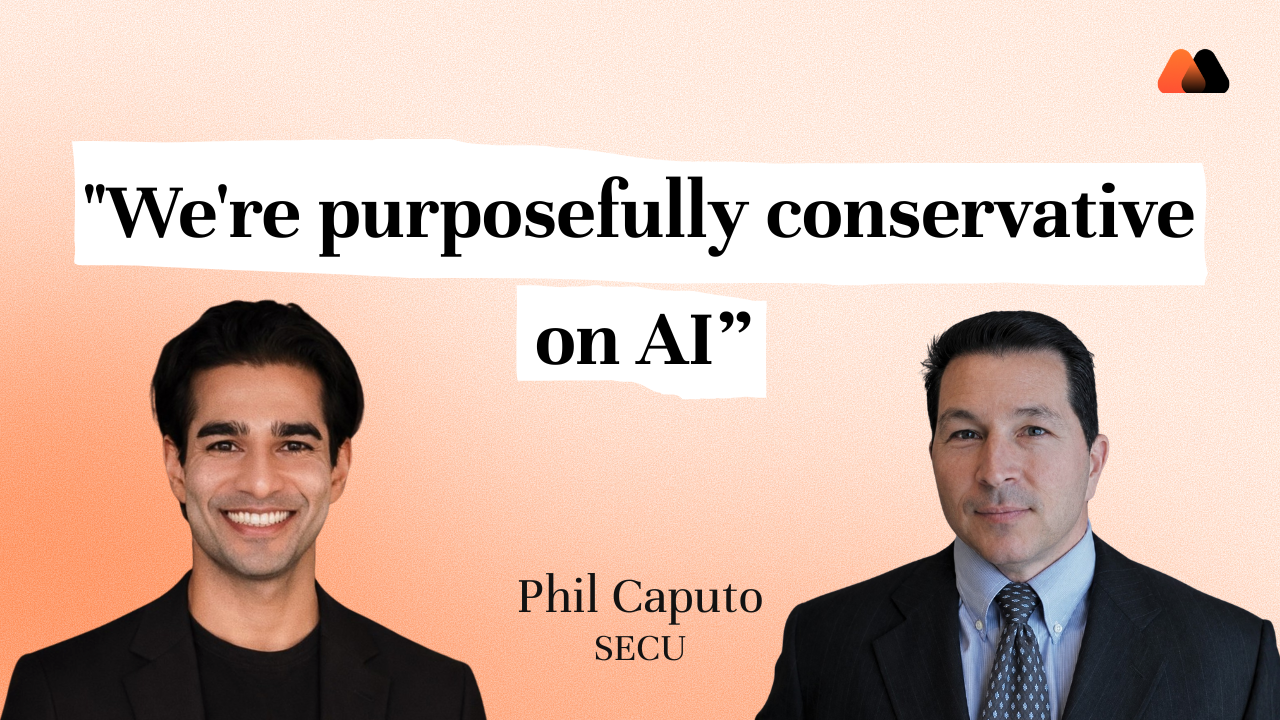
When Phil Caputo took over the Enterprise Project Management Office at State Employees' Credit Union, the gap between institutional scale and project discipline was striking. SECU had been operating for nearly 90 years, held almost $60 billion in assets, and served nearly three million members. The project governance framework was barely there.
"When I first walked in there, there was very little project governance. The project got approved, it got tossed over the wall to a project manager and a sponsor and they said, good luck."
The framework Caputo built is deliberately flexible on artifacts and rigid on outcomes. Do you have a plan? How are you managing it? Are you testing? The bar is not process for its own sake. It is whether the work connects to a result.
The tool he uses to reset expectations about resource allocation is a simple metaphor.
"You've got a five gallon bucket and you can only get five gallons in that five gallon bucket. You can't get 10 in there."
That picture forces the real conversation: which work is most valuable, and why. His answer is always anchored in strategy. And strategy, he argues, is the layer most organizations skip entirely. "A lot of organizations will come up with goals. A lot of organizations have a lot of projects, but they typically miss the real strategy piece in the middle." SECU is in a strategic renaissance right now, building the layer that connects board-level goals to the projects that execute them.
Conservative on AI, On Purpose
Caputo does not hedge on where SECU sits.
"We are conservative on AI. Purposefully conservative on AI. We're a credit union. We don't consider ourselves cutting edge. We want to make sure that we're making good, solid decisions for the membership."
That conservatism is operationalized, not vague. Every AI tool passes through legal review, inherent risk assessment, model risk review, and third-party risk review before purchase. The hardest line in the risk position is on autonomy: AI that decides alone is classified as high risk. That is a non-negotiable constraint at SECU, not a preference.
There is one position Caputo explicitly rejects: the burn-the-boat approach of turning AI off entirely and sharing no data.
"I will tell you, it is a faster and easier way to get through legal and risk, but it's probably not a very long-term vision. Eighteen months from now, I think you're going to see AI just baked into everything. So you've got to figure out how to work with it."
The conservative path and the hiding path are not the same thing. One is a deliberate order of operations. The other is avoidance dressed up as caution.
Buy, Not Build, and What Off-the-Shelf Actually Costs
SECU is a buy shop, and the reason is scar tissue. More than five years ago, build and customization decisions were made without adequate documentation. Nobody knew exactly what a custom tool did or why a particular change had been made. Now the institution leans toward limited customization and off-the-shelf products.
But Caputo is direct about what buying does and does not solve.
"The biggest myth about off-the-shelf is that it's easier. You're trading one set of problems for another set of problems. It really is up to us to identify what our process is, what works best for our goals, what works best for our membership, and then decide how we want to implement it."
Vendors build for a broad range of customers. The work of fitting the tool to the institution does not disappear just because you did not build it. And AI sharpens the build vs buy question rather than settling it.
"If I purchase a tool from vendor A and it makes a certain set of decisions, and I purchase another tool from vendor B that rationalizes decisions differently, and you put those together, you're going to see struggles. You're going to see conflict there."
That is why Caputo wants a broader AI strategy, one that does not set SECU up for future integration failures as AI gets baked into every vendor contract regardless of whether the institution asked for it.
What Going Slow Actually Costs
Caputo is candid that the conservative stance has a real cost, and it is generational.
"The older the generation is, the more loyal they are. The younger the generation is, the less loyal they are. Younger folks are looking for easier ways to do business. They don't love the idea of talking to people. They want to be able to do it all from their phones."
The concrete gap is Zelle. Members have been asking for it for years. The reason for the delay is not indifference: Zelle carries significant fraud exposure and SECU has not yet stood up the fraud detection and digital identification infrastructure to manage it safely.
"The plan is, let's get our fraud figured out, let's get our digital identification figured out, and then you move forward to those features that members want."
The digital platform itself has been addressed. SECU's new Member Access platform, launched in Q1 2026, unified the mobile and desktop experience on the same foundation for the first time. The two anchor projects now are completing the digital rollout and the Corelation core transformation. SECU's last core upgrade was in the early 1980s, meaning its current core system is older than many of its members.
Where AI Earns a Place First
For all the caution, Caputo is specific about where AI fits inside his own office. The first use cases in the project management space are not about planning or executing projects. They are about governance.
"Are your projects on track? Or are you approaching a milestone and maybe your percent completeness isn't where it needs to be?"
"It's less of a replacement for the project manager, but it's more augmenting their capability, and keeping them on track, so they can really focus on solving the problem for the organization."
The framing matches the rest of his philosophy: AI handles the tracking and flagging work so humans can concentrate on judgment. Member-service chatbots are on the roadmap, with SECU beginning to test them, but the discipline is the same everywhere. Tie it to an outcome, gate it through risk, and let it augment rather than decide alone.
How This Works in Practice
"What you can't do is hide from AI. You need to have some strategy around it, whether it's moving quickly or moving a little bit later, but deliberately."
— Phil Caputo, State Employees' Credit Union
Multimodal builds purpose-built AI agents for credit unions on Jack Henry, Fiserv, and Symitar, designed with the audit trail and human-in-the-loop controls that institutions like SECU require before any AI-assisted decision reaches a member. If your institution is thinking through the order of operations for AI deployment, the platform comparison is a practical starting point.
Want more on financial services and AI? Check other episodes here.
Frequently Asked Questions
1. Why is SECU deliberately conservative on AI?
Because it is a member-service institution dealing with people's money, not a technology company. Every AI tool at SECU passes through legal review, inherent risk assessment, model risk review, and third-party risk review. AI that decides without human oversight is classified as high risk and is not deployed.
2. How big is State Employees' Credit Union?
SECU is the second largest credit union in the United States with $56.8 billion in assets and 2.94 million members as of late 2025. Roughly one in four North Carolina residents is a member. The institution was founded in 1937 and operates 275 branches across all 100 counties in the state.
3. Should a credit union build or buy its AI tools?
SECU buys rather than builds, after getting burned by undocumented customization in earlier years. Caputo cautions that off-the-shelf is not actually easier: the institution still has to define its own processes rather than letting the vendor's logic dictate them. With AI now embedded in most vendor contracts regardless of whether the institution asked for it, having a broader AI strategy before purchasing multiple tools is essential to avoid future integration conflicts.
4. What does a credit union lose by moving slowly on AI?
Primarily younger members. Millennials and Gen Z want mobile-first experiences, peer-to-peer payments like Zelle, and the ability to complete transactions without a branch visit. SECU's members have been asking for Zelle for years. The delay is not strategic avoidance but a sequenced approach: build fraud detection and digital identification infrastructure first, then unlock the features members want.
5. What is the right first AI use case for a credit union project office?
Governance, not planning or execution. Caputo's first use cases at SECU track whether project timelines are on track and flag milestones where completion rates are lagging. The goal is to augment project managers and free them from administrative tracking so they can focus on solving real problems for the institution.
6. What is the difference between conservative AI adoption and hiding from AI?
A deliberate conservative strategy has a defined order of operations: what to do now, what to do next, what to do later, all tied to member needs and a clear risk framework. Hiding from AI means having no strategy at all. Caputo's frame is that the burn-the-boat position, turning AI off entirely, clears legal faster but is not a viable long-term position as AI becomes embedded in every vendor product within the next eighteen months.

%20(1).png)
%20(1).png)