

.svg)
.svg)

.svg)
This is a summary of an episode of Main Street AI, an educational podcast on AI led by our founder. Join 3,700+ business leaders and AI enthusiasts and be the first to know when new episodes go live. Subscribe to our newsletter here.
TL;DR:
- St. Cloud Financial: five branches in central Minnesota, roughly $430M in assets, 92 years old
- Vision statement says nothing about money: "make a meaningful difference through human connection"
- A cannabis business review takes 15 hours to build a file, a prime AI target
- 34 fintech and CUSO pitches at one NACUSO conference, all competing for finite budget
- The prioritization test: "Where are we unintentionally sending our members somewhere else?"
- A vendor becomes a partner when they educate you, not when they promise turnkey
- Change management runs on the "why," mapped as a Venn diagram of organizational and personal purpose
Before we dive into the key takeaways from this episode, be sure to catch the full episode here:
Remove the Friction, Not the Relationship
Most credit unions treat AI adoption as a technology decision. Case treats it as an identity decision first. "Our vision is to make a meaningful difference through human connection," she says, pointing out what it deliberately leaves out: it says nothing about money. Underneath sits a 100-year "ends statement," a charge to build a perpetual organization delivering democratically controlled capital to a community St. Cloud Financial has served for 92 years.
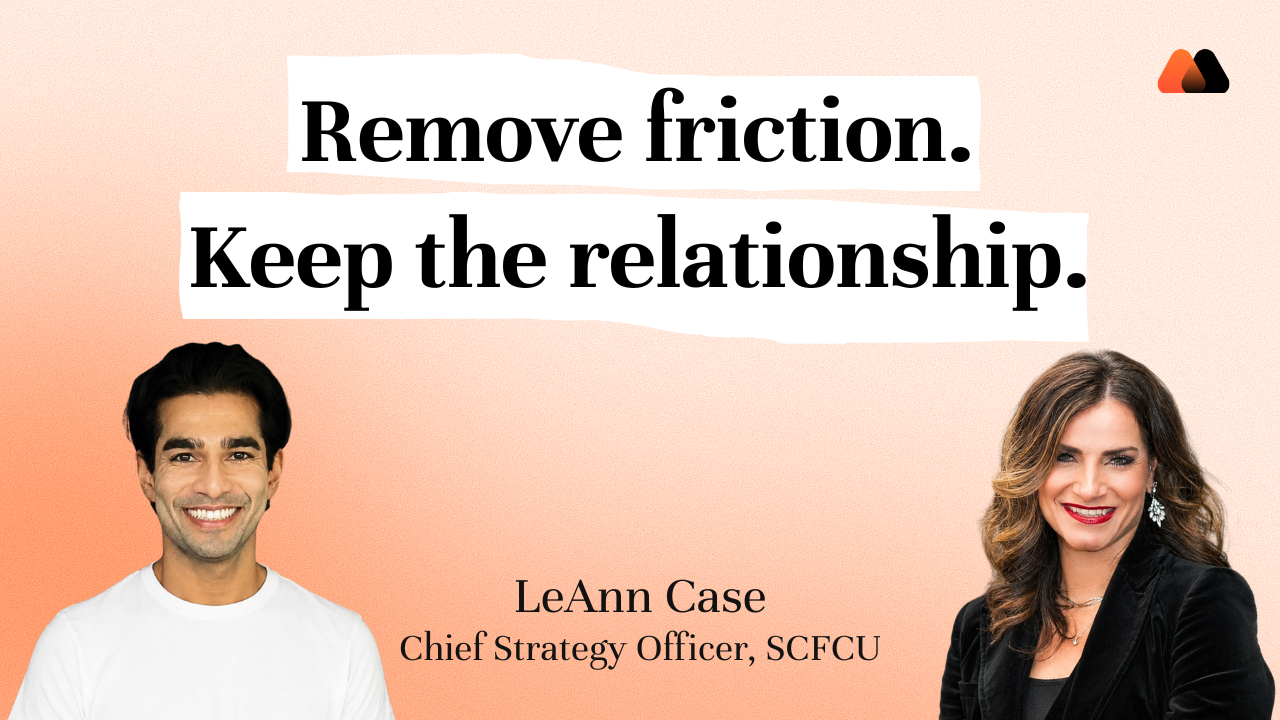
"We intentionally remove friction. But without sacrificing relationships." — LeAnn Case
Case has watched the tooling collapse in real time. Her first credit union websites in North Dakota came from a thick binder of individual codes, and a single purchase bought three pages. Now, she notes, you can build that in a hot second with AI. The discipline isn't resisting the speed. It's staying intentional about who you are so the speed serves relationships instead of eroding them.
Prioritize by the Member Frame, Not the Vendor Pitch
Case starts use-case selection where the paperwork is heaviest. Her cannabis-banking team gave her the number that made the case: a business review takes fifteen hours just to build the file. Automating that, safely and auditably, buys back time to spend with the member instead of the paperwork. Host Ankur Patel frames the stakes plainly: fifteen hours to build a file delays how fast a credit union can get back to the member, and slower institutions risk losing that member to a faster lender.
The sharper tool Case uses is a question, not a technology:
"Where are we unintentionally sending our members somewhere else?"
The answer isn't always a missing product. Sometimes it's simply that the credit union is too slow, and a member goes elsewhere. The exercise forces leaders to look up from day-to-day execution and see the institution the way a member does.
The Bullseye: Table Stakes on the Outside, Loyalty at the Center
Case organizes the strategy as a bullseye. Every member now carries the "iPhone pace expectation," the assumption that a request goes fast, every time. Speed, accuracy, and availability form the outer ring: table stakes a $430M institution has to meet without a megabank's budget, and AI is how it affords to meet them. Clearing that ring earns the right to reach the center, where loyalty lives, in the human connection space where the credit union acts as the member's advocate.
A Vendor Becomes a Partner When They Make You Look Smart
With 34 fintech and CUSO pitches crammed into four-minute slots at a single NACUSO conference, Case is candid that the volume is overwhelming and that human capital is as finite as the technology budget. Vendor selection isn't a spreadsheet exercise; you can't run 30 vendors through a scoring model and pick the top result.
Her filter is advocacy. A vendor earns partner status by educating her in a way that isn't self-serving, so she can carry that education to her board.
"They're helping me look smart... they're the ones that really helped me help others."
The failure mode is the opposite pitch: "we have the solution, just plug it in and it'll be turnkey." Case has heard it too many times to trust it. In a regulated environment with high-stakes decisions and real reputational risk, AI is not something you flip a switch on. It takes a partner who stays in the work with you. Case walked that talk by making St. Cloud Financial an owner of DaLand CUSO, specifically because it was leading the industry on innovation and educating credit unions rather than just selling to them.
Compete on Community, Not on Beating Venmo
Case doesn't pretend the fintech threat is imaginary. St. Cloud Financial surveys members on where they keep the majority of their money, and most still choose the credit union, even though she's clear-eyed that Venmo moves money to your daughter faster than she can. Trying to out-Venmo Venmo isn't the strategy. Presence is.
"We don't just cut a check to the local high school and slap our name on the stadium."
Instead, the credit union teaches financial literacy in classrooms, helps run local football games, and helps raise money for causes like cancer research. For members weighing a fintech with no values alignment against an institution that pairs app-grade convenience with a real community presence, that presence becomes the differentiator a fintech can't replicate.
Lead Change Management Through the "Why"
The hardest part of AI adoption usually isn't the executive team. It's the rest of the organization, where resistance shows up as fear of job loss or simple reluctance to learn something new. Case treats that as change management and starts every conversation with purpose.
"Let's start with the why... here's our organizational why, but here's my personal why."
She counters job-loss fear directly rather than dismissing it, walking through why the change matters to members and how it serves the employee too. She borrows a model from a peer at a major credit card company, whose team is required to use AI so they learn its limits and possibilities, but adds the step most rollouts skip: the debrief afterward. Too often, she says, training ends with "here's how you do it, go, see you never." The follow-up conversation, asking what worked and what efficiencies people found, is what turns a mandate into a capability.
How This Works in Practice
Case is direct that AI regulation in credit unions is still nascent, and that St. Cloud Financial's national advocacy work with legislators on digital assets is part of the job of running a perpetual, member-owned organization. The technical posture that makes explainability defensible in lending is what turns audit risk into audit advantage: decisions need a source-and-evidence trail, and a human in the loop should review anything flagged as low-confidence or high-risk. That combination lets a small credit union tell an examiner, here are the thousands of applications we processed with AI, audit any of them.
That's the same principle behind Multimodal's AgentFlow: every decision carries a traceable, evidence-backed trail, with human review built in at the points that matter, so credit unions get the speed AI provides without losing the audit story regulators expect.
Want more on financial services and AI? Check other episodes here.
Frequently Asked Questions
1. How is St. Cloud Financial Credit Union adopting AI without losing the human connection?
St. Cloud Financial prioritizes AI use cases by the member frame, automating high-effort back-office work like a 15-hour cannabis business review so staff spend more time with members. Chief Strategy Officer LeAnn Case ties every decision to the credit union's vision of human connection and its explicit rule: remove friction, never sacrifice relationships.
2. How should a credit union prioritize AI for credit unions use cases?
Start with the member's perspective by asking where the institution is unintentionally sending members elsewhere. From there, look at where paperwork consumes disproportionate time and where an existing vendor already covers the need, rather than chasing whichever vendor pitched most recently.
3. How should credit unions choose an AI vendor or partner?
No, a slick pitch isn't the signal. LeAnn Case looks for vendors who educate her and her board without a sales agenda, and avoids anyone promising a "turnkey" plug-in. St. Cloud Financial became an owner of DaLand CUSO because it leads the industry on innovation rather than just selling to it. Platforms like Multimodal's AgentFlow are built around that same expectation: audit trails and human review that a partner should be able to walk you through, not just switch on.
4. How do small credit unions compete with fintechs like Venmo and Chime?
Not by trying to out-speed them. Most St. Cloud Financial members still keep the majority of their money with the credit union because it pairs modern convenience with real community presence, financial literacy in classrooms, local event support, and fundraising for causes members care about.
5. How do you manage change when employees fear AI will replace their jobs?
Case starts with the "why," connecting the organization's purpose to each employee's personal reason for serving members, and follows training with a debrief on what worked. That closing loop, not the tool itself, is what turns a mandate into an adopted habit.
What is St. Cloud Financial's "ends statement"?
It's the credit union's 100-year charge to build a perpetual organization delivering democratically controlled capital to its community. Case uses it as the long-horizon test for every strategy decision, AI included, to keep the institution serving its full membership rather than growth for its own sake.


.png)