

.svg)
.svg)

.svg)
This is a summary of an episode of Main Street AI, an educational podcast on AI led by our founder. Join 3,700+ business leaders and AI enthusiasts and be the first to know when new episodes go live. Subscribe to our newsletter here.
TL;DR:
- Youssi Farag, CFO of WEOKIE Federal Credit Union: "credit unions have the resources, but not always the speed"
- CPA and CFO at a $1.5B institution in Oklahoma City, overseeing finance, compliance, and commercial lending
- Came up on the community bank side first, giving her a rare dual vantage point on how each moves
- Her biggest AI vendor red flag: "it's on the roadmap"
- Fraud and compliance are where AI has delivered the clearest win, cutting false-positive alert volume
- Consumer lending has embraced AI; commercial lending is still being assessed, not yet deployed
- AI budgeting has shifted from locked once a year to revisited multiple times per year
Before we dive into the key takeaways from this episode, be sure to catch the full episode here:
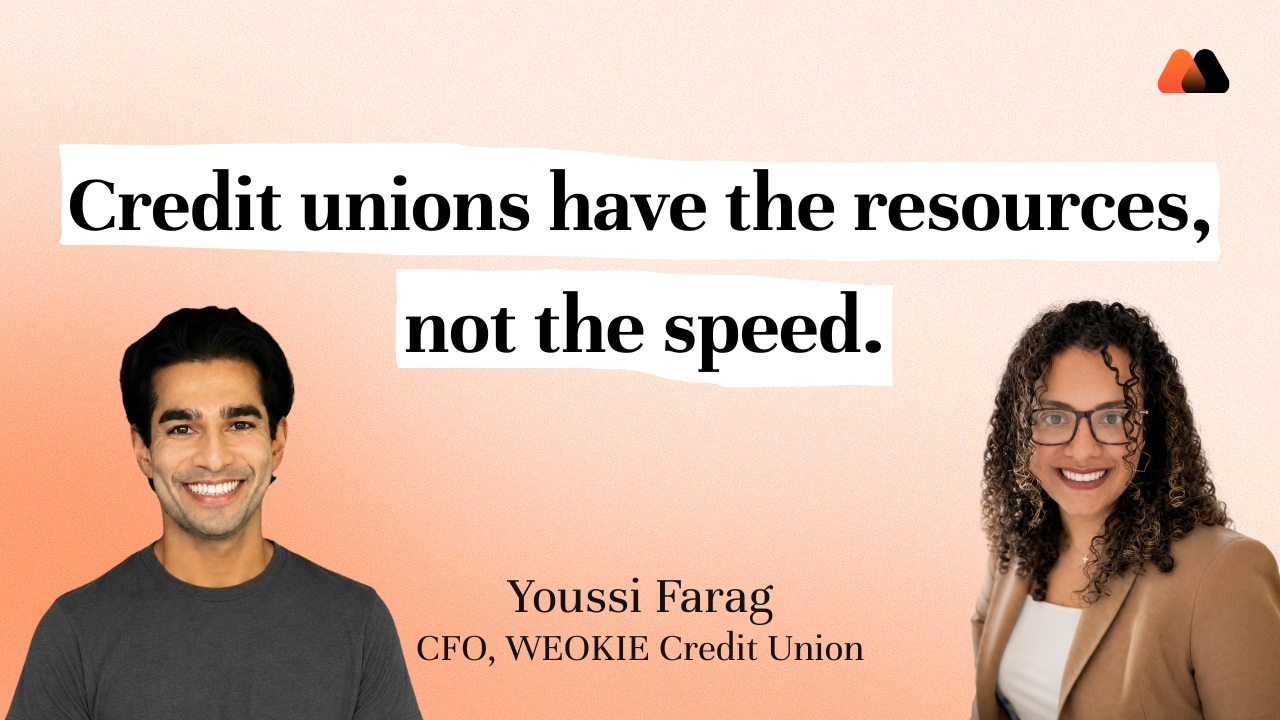
The Credit Union AI Vendor Answer Youssi Farag Won't Accept
Farag evaluates AI vendors as partners, not purchases, and she's specific about the deal-breaker.
"One thing that I absolutely don't like to hear is it's on the roadmap. It's legitimate, it's true a lot of times, but a lot of other times it means that it's not going to happen anytime soon." — Youssi Farag
Her filter is flexibility and honesty about timelines: what a vendor can offer today, stated plainly, beats a future promise. She also tests partnership under pressure. When something isn't working, does the vendor mobilize to fix it, or default to the original roadmap regardless? She adds that credit unions are unusually willing to share notes with each other on vendor experiences, and treats that peer network as part of her own due diligence before signing anything.
Where Is AI Actually Working in Compliance and Fraud Detection?
She names this as the clearest AI win in her seat.
"Legacy systems just generated thousands of alerts where the team had to go back and try to work through these alerts that created false positives. And now some of the systems that embraced automation and AI can learn the behavior of the member and truly can identify what is a normal behavior and what is unusual."
Instead of chasing every alert, the team can focus on the ones that actually indicate risk. She names reporting as the second clear win: pulling trends across months without hours of manual data manipulation, and getting that same reporting into more team members' hands so decisions improve across the organization, not just at the top.
Consumer Lending Is Ready for AI. Commercial Lending Isn't, Yet.
Farag draws a hard line between the two.
"Commercial lending is a totally different game because you have every business has its own story. Financial statements, tax returns, different collateral, the local market conditions... it cannot be done all with one algorithm."
Consumer lending, by contrast, has already proven out: faster decisions, more consistent underwriting, humans still involved for exceptions and adverse actions. On the commercial side, she sees AI's near-term role as gathering documentation and helping assemble the file, not making the call. The lender still builds the story behind the numbers and makes the final decision.
Budgeting for AI When the Plan Changes Mid-Year
The traditional annual budget cycle hasn't held up.
"We definitely found ourselves going back multiple times throughout the year, having strategic sessions... you still want to have the discipline, the financial discipline, but also be quick to adapt and quick to change."
Rather than locking a number in January and defending it through December, WEOKIE's executive team now reassesses AI spend on a rolling basis, a shift Farag attributes directly to how fast the technology itself moves within a single fiscal year.
Risk-Taking or Risk Mitigation? Why It's Not Actually a Choice
Farag rejects the framing that AI adoption forces a choice between innovation and caution.
"We always bring everyone to the table. So we bring our IT team, our compliance team, the legal team, and also the member facing team... people think that always quality and growth will not get on board together, but it's not true." — Youssi Farag
Every use case starts with a real member or staff frustration, not technology for its own sake, and gets pressure-tested by every function that owns a piece of the risk. That cross-functional room, she argues, is what lets WEOKIE move on AI without treating speed and caution as opposites, and what actually gets employee buy-in: explaining the why before the rollout, not mandating the tool.
How This Works in Practice
Farag's compliance win, cutting false-positive fraud alerts by learning normal member behavior, is the same problem Decision AI is built to solve for credit unions carrying thin compliance teams. Her commercial lending gap, AI that assembles the file but doesn't make the call, maps directly onto how Document AI is designed to work: extracting and organizing the dozens of documents in a commercial file so a human underwriter builds the story faster, not to replace their judgment. Both live inside AgentFlow, built for exactly the kind of cross-functional oversight, IT, compliance, legal, and lending in the same room, that Farag describes as her actual risk framework, and for the "today, not roadmap" transparency she demands from any credit union AI vendor.
Want more on how credit unions choose and manage AI vendors? Read what a credit union CIO looks for before buying any AI tool, why you can't outsource the risk in an AI vendor deal, and how LMCU built a single governance board for every emerging technology.
Want more on financial services and AI? Check other episodes here.
Frequently Asked Questions
1. What should a credit union look for when evaluating an AI vendor?
Transparency about what's available today versus what's still in development. Youssi Farag, CFO of WEOKIE Federal Credit Union, specifically distrusts "it's on the roadmap" as an answer, and tests vendors on how they respond when something isn't working, not just on the sales demo.
2. Why do credit unions struggle to move as fast as fintechs on AI?
Resources aren't the constraint, speed is. Farag, who worked in community banking before credit unions, says credit unions typically have greater resources and are able to scale, but legacy systems and risk aversion slow decisions down compared to leaner, faster-moving institutions.
3. Where is AI already working well in credit union compliance?
Fraud and risk alerting. AI systems that learn a member's normal behavior cut false-positive alerts dramatically compared to legacy rules-based systems, freeing compliance teams to focus on alerts that represent real risk.
4. Can AI handle commercial lending decisions the way it handles consumer lending?
Not yet. Consumer lending decisions are consistent enough for AI to speed up and standardize. Commercial lending involves too many variable factors, financial statements, collateral, local market conditions, for one algorithm, though AI can already help assemble and organize the underlying documentation. Platforms like Document AI are built for that document-assembly step specifically.
5. How should a credit union budget for an AI vendor given how fast the technology changes?
Expect to revisit the budget more than once a year. WEOKIE's executive team now holds recurring strategic sessions to reassess AI spend mid-year rather than locking a number in during annual planning and defending it regardless of what changes.
6. Is AI adoption at a credit union about taking more risk or reducing it?
Both, according to Farag, which is why she treats it as a false choice. Every use case starts with a real frustration point and gets reviewed by IT, compliance, legal, and member-facing teams together, so growth and risk management happen in the same conversation instead of competing ones.

%20(1).png)
%20(1).png)