

.svg)
.svg)

.svg)
This is a summary of an episode of Main Street AI, an educational podcast on AI led by our founder. Join 3,700+ business leaders and AI enthusiasts and be the first to know when new episodes go live. Subscribe to our newsletter here.
TL;DR:
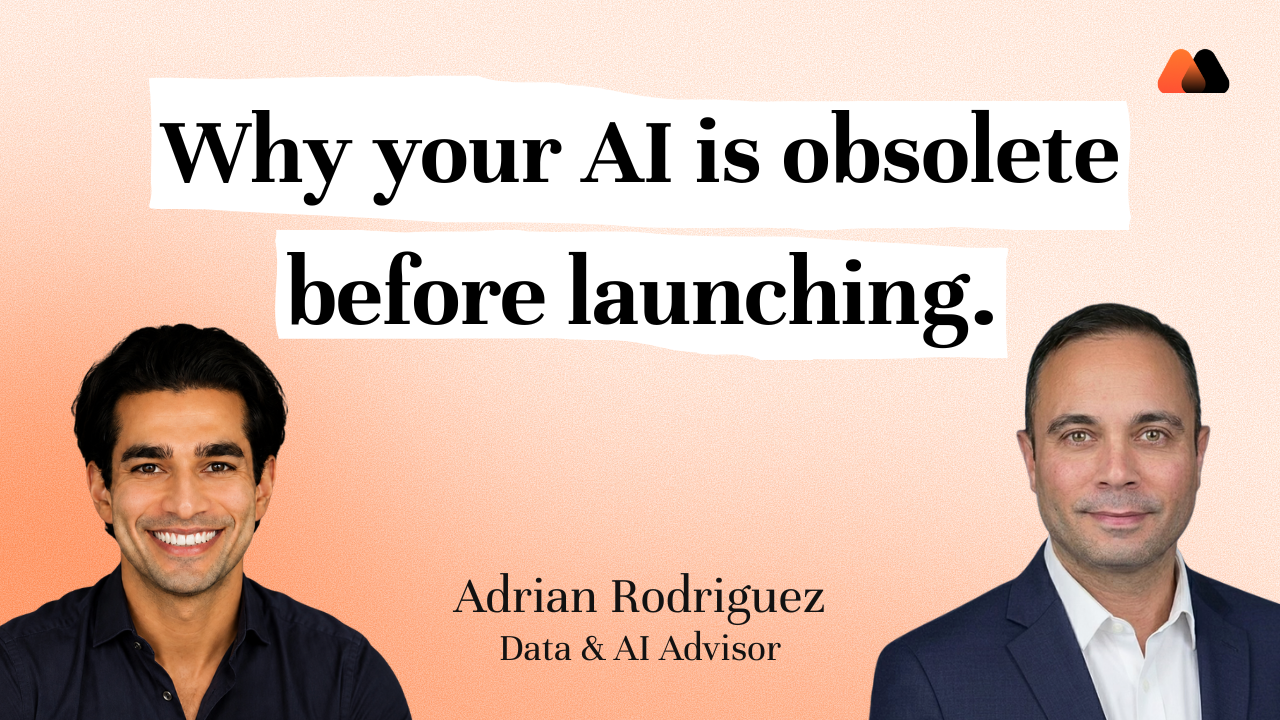
- Most AI failures aren't model failures, they're data failures. Adrian Rodriguez, SVP of Data and Innovation at American Heritage Credit Union, calls this accumulated mess "technical debt" that quietly becomes an anchor on everything an institution tries to do.
- The build-versus-partner decision comes down to timelines. If a capability doesn't already exist in-house, building it takes 12 to 18 months minimum. Most institutions can't wait that long, so partnering becomes the default.
- Vendor-embedded AI is a legitimate starting point, not a compromise, as long as it stays aligned with a broader enterprise data strategy rather than becoming another disconnected silo.
- Token costs are the fear nobody priced in. Institutions are reportedly blowing through a year's AI budget in weeks, especially since usage-based pricing replaced seat-based licensing.
- Being model-agnostic isn't optional anymore. A prompt optimized for one model can break the next week when that model changes, and no institution can afford to go dark while it's sorted out.
Before we dive into the key takeaways from this episode, be sure to catch the full episode here:
The Debt Nobody Notices Until It's an Anchor
Rodriguez came into credit unions as an outsider, joining from information systems work outside financial services, and the first thing he noticed wasn't a lack of ambition. It was accumulated technical and operational debt.
"That debt was the result of years of reasonable decisions made to solve various standalone needs. But over time the vendors improve, the business and member needs change, the workarounds pile up, and the original reason for doing something a certain way either changes or disappears completely. The processes stay because nobody stops to question it."
At American Heritage, one symptom was a CRM that had quietly become the default data warehouse simply because more capabilities kept getting bolted onto it over time.
Build Versus Partner Is Really a Timeline Question
Rodriguez frames the build-versus-partner decision around a hard constraint: speed.
"If you can't accomplish something in six months, it's already obsolete. If that capability doesn't exist in-house, the time it takes to build it or hire for it is already looking at twelve to eighteen months minimum, if you're lucky."
That timeline gap is what pushes most institutions toward partnering by default, not preference. His filter is simple: buy off-the-shelf when the need isn't core to your differentiation, partner when it is and you don't have the capability in-house, and build only when something is genuinely unique to your institution.
Vendor-Embedded AI Isn't a Compromise, If It's Aligned
Rodriguez pushes back on the idea that using vendor-embedded AI tools means an institution isn't serious about its data strategy.
"I would never tell an organization to let perfect be the enemy of good enough. If vendor-embedded AI can deliver a win in a specific silo, go for it. But it still has to be aligned with the overall enterprise AI strategy, or you're just building another silo."
The example he gives is concrete: asking an AI tool for a member number and getting the core system's internal number back, not the number staff actually use, because nobody had defined that semantic distinction anywhere the AI could see it. Without that groundwork, he argues, even a well-built AI tool will give confidently wrong answers.
The Fear Nobody Budgeted For
Token costs come up as the newest, least-prepared-for risk in Rodriguez's world.
"That's probably one of the greatest fears I have right now. Licensing changes from seat-based to usage-based, and it's not something I'm seeing gain traction yet as a discipline. The last three or four weeks it's been nonstop articles about organizations that have blown through their annual token spend in weeks, especially with the latest models."
His fix isn't avoiding AI spend, it's assigning ownership. He argues every institution needs someone in a FinOps-style role explicitly tracking AI cost against ROI, because the alternative is finding out the number only after it's already too large to walk back.
Why Being Model-Agnostic Isn't Optional Anymore
Recent model volatility reinforced a point Rodriguez already believed: don't build a strategy that depends on one AI vendor staying exactly the same.
"Can you really afford to be offline for a week or two while something gets worked out? One week your prompts are perfect, the next week when they change the model, they're no longer optimized and you have to start over. We're going to have to get used to that uncertainty, and the people who can stay agile in that environment will be more successful."
How This Works in Practice
"Don't let perfect be the enemy of good enough, but also stop treating every new tool like a disconnected decision. Understand where you actually are, what you have in place, and what your members want. Then decide what to mature internally versus what to partner on."
— Adrian Rodriguez, American Heritage Credit Union
Multimodal's own research on credit union AI adoption found that fewer than 20% of credit unions currently describe their AI deployments as enterprise-ready, and that the institutions that scale successfully build data readiness before they build automation. If your institution is trying to figure out where its own data debt sits before adding AI on top of it, the state of agentic AI in credit unions is a useful starting point.
Want more on financial services and AI? Check other episodes here.
Frequently Asked Questions
1. Why does AI fail at some credit unions and not others?
AI usually fails because of unresolved data problems, not model quality. Undefined terms, siloed systems, and years of accumulated technical debt mean the AI either gives inconsistent answers or automates a process nobody has re-examined in years.
2. Should a credit union build its own AI capability or partner with a vendor?
Most credit unions should partner rather than build, unless the capability is truly unique to that institution. Building or hiring for a new capability typically takes 12 to 18 months, which is too slow for most institutions to justify when partnering can deliver value in a fraction of that time.
3. Is vendor-embedded AI a bad starting point for credit unions?
No, vendor-embedded AI is a legitimate and often smart starting point. The requirement is that it stays aligned with the institution's broader data and AI strategy, rather than becoming another disconnected silo that duplicates or contradicts other systems.
4. Why are AI costs at financial institutions rising so fast?
AI costs are rising because pricing has shifted from flat, seat-based licensing to usage-based token pricing, and usage scales quickly once AI agents start handling real workflow volume. Some institutions have reportedly exhausted a year's AI budget in weeks under the new pricing model.
5. What does it mean to be model-agnostic, and why does it matter?
Being model-agnostic means an institution's AI strategy doesn't depend on one AI provider's models staying exactly the same. It matters because prompts and workflows optimized for one model can break when that model changes, and no institution can afford extended downtime while things get re-optimized.
6. What should a credit union do before investing heavily in AI?
Do an honest inventory of existing data, systems, and talent first. Define shared terms and ownership across departments, assign clear data stewardship, and align any AI use case with a documented enterprise strategy before scaling beyond a single pilot.

%20(1).png)
%20(1).png)