
AI-Powered Due Diligence for Private Equity: From 6 Weeks to 6 Days
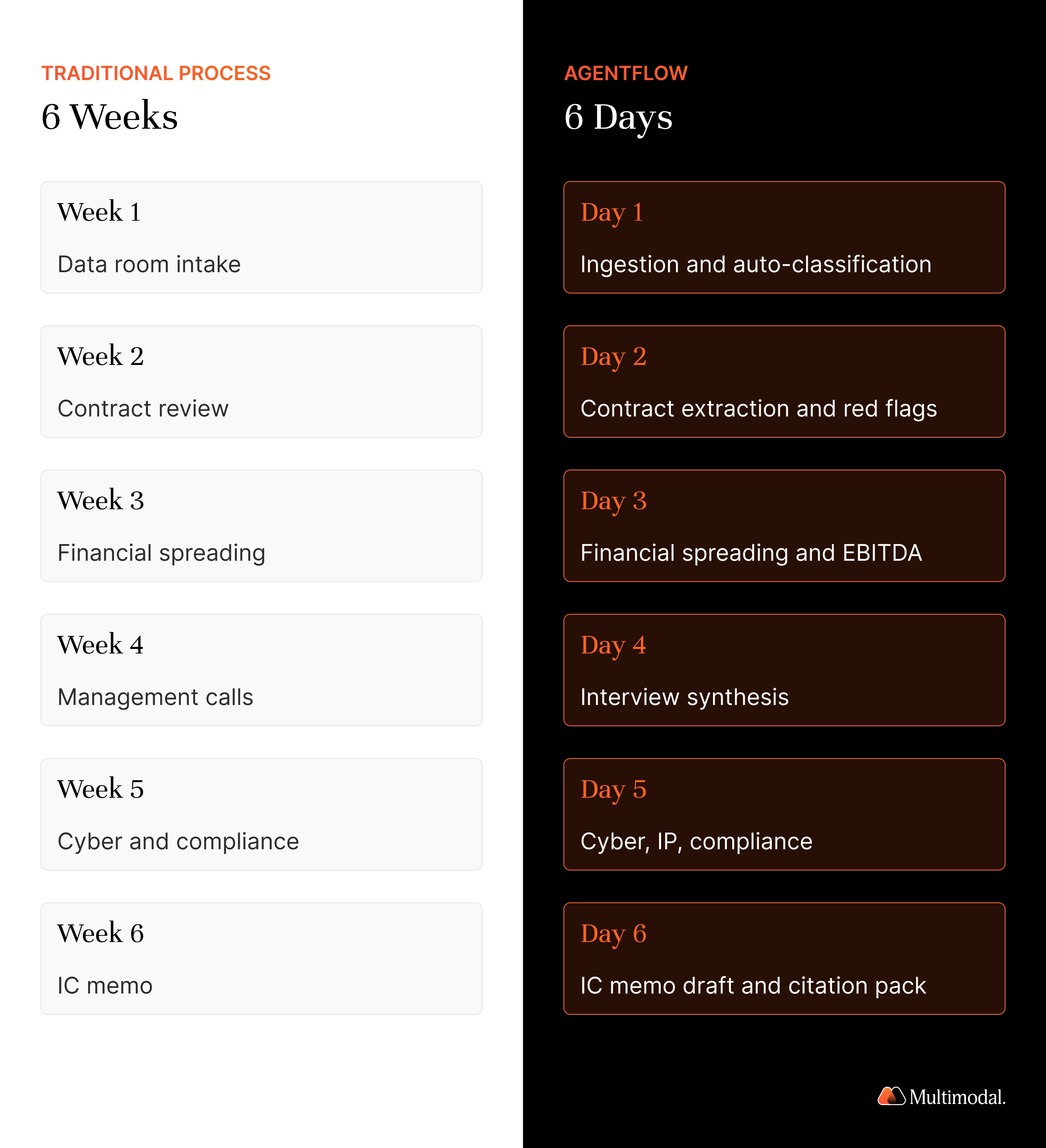
AI due diligence is the use of agentic AI systems, large language models, and machine learning models to ingest, normalize, and analyze the documents inside a virtual data room so a deal team can move from LOI to investment committee in days rather than weeks. For private equity firms running mid-market deals, AI-powered due diligence compresses the three workstreams that dominate the diligence phase, financial spreading, document review across customer and vendor contracts, and management interview synthesis, from a six-week analyst cycle to a six-day, citation-grounded pipeline.
Three categories of platforms now compete for this work. Horizontal AI assistants offer broad data analysis. Purpose-built diligence tools target specific provisions. Financial-services-grade workflow platforms such as AgentFlow combine prebuilt diligence workflows, regulated data handling, and portfolio-wide reuse after close. The deciding factor is which option fits existing workflows, meets industry standards for data privacy and data protection, and produces structured outputs that the deal team can defend in committee.
The short answer: mid-market PE firms running four or more platforms per year are already past the question of whether to use AI for the due diligence process. The question is which platform produces real value on the second deal, not just the first.
Why Traditional PE Due Diligence Still Takes 6 Weeks
A mid-market data room can contain thousands of documents across multiple jurisdictions. Customer contracts, vendor agreements, financial statements, employee files, IP assignments, tax memos, regulatory correspondence, and the long tail of board minutes and side letters that nobody reads until something blows up post-close.
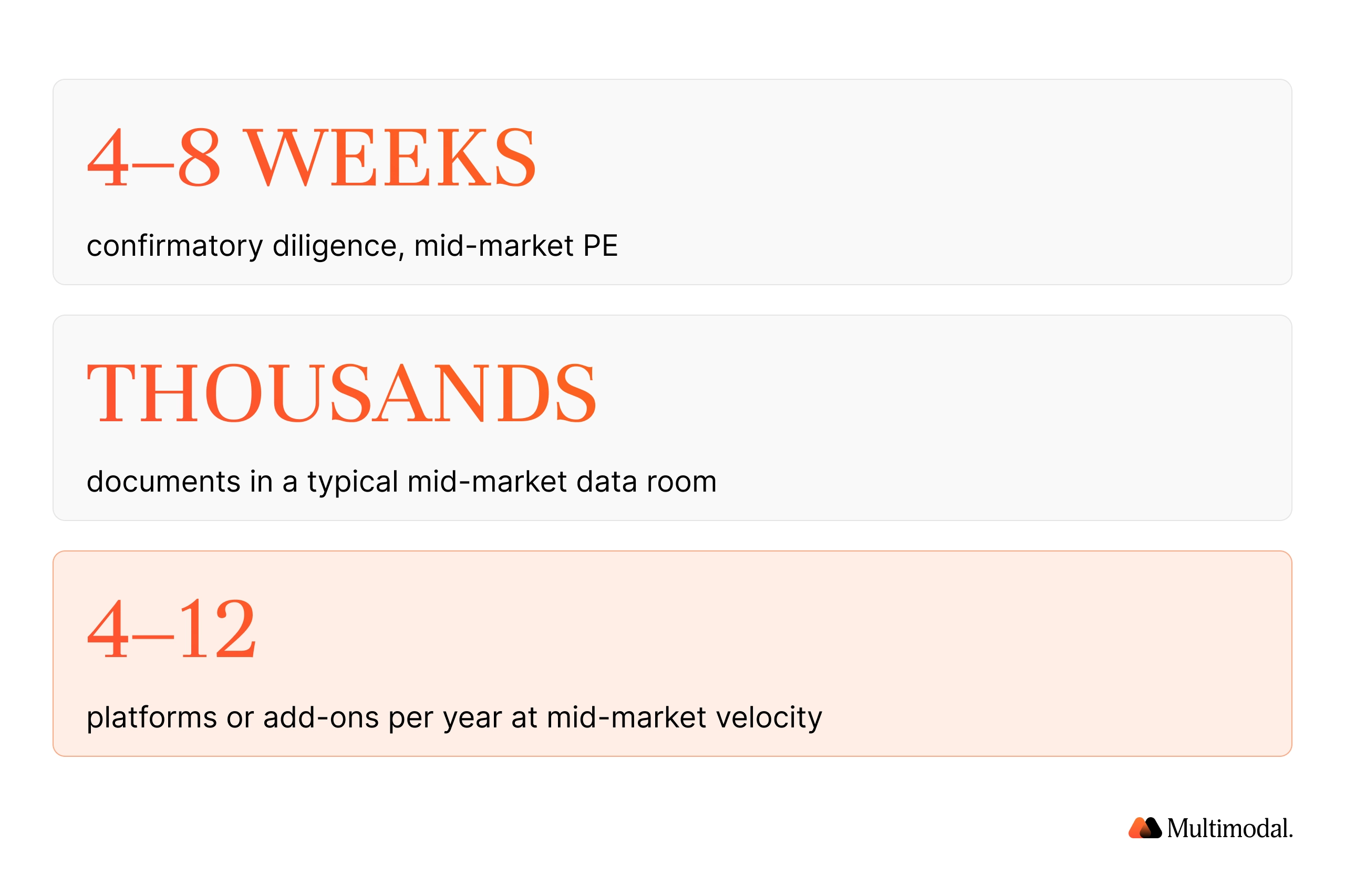
Industry benchmarks consistently put mid-market PE due diligence at four to eight weeks from signed NDA to binding offer, with confirmatory diligence after the LOI typically running the same four to eight-week window before structuring and drafting to close out the deal.
Inside that window, junior analysts and associates carry the load on financial spreading, contract review, and management call synthesis. Law firms run a parallel manual review of legal documents. Third-party diligence advisors handle the quality of earnings and commercials. Each workstream produces its own report, and the deal team stitches them together into an IC memo that partners can sign.
Traditional due diligence processes are expensive in two ways. The visible cost is analyst hours loaded into deal fees and broken-deal fees for deals that do not close on the platforms. The hidden risk is harder to price. Red flags that surface post-close, an unfavorable change-of-control clause, an undisclosed customer concentration, a sanctions exposure in a foreign subsidiary, drive retrade negotiations or write-downs that compound across the entire portfolio.
For funds running four to twelve platforms or add-ons per year, manual methods that worked at lower deal velocity no longer keep pace with the deal flow. Something has to compress, and the diligence phase is the obvious candidate.
What Is AI-Powered Due Diligence for Private Equity?
AI-powered due diligence is the application of artificial intelligence, including natural language processing, machine learning, and generative AI, to the diligence workflows that dominate the due diligence phase of a private equity transaction. It ingests unstructured data from a virtual data room, extracts key provisions and data points, cross-references them against the deal thesis, and surfaces critical insights with citations that the deal team can verify.
What AI due diligence is not: a chat interface bolted onto a data room. Asking a chatbot to summarize a 400-page customer contract produces a paragraph that looks useful and falls apart the moment a partner asks for the page reference. That pattern fails the burden of proof that PE investment committees require for informed decisions.
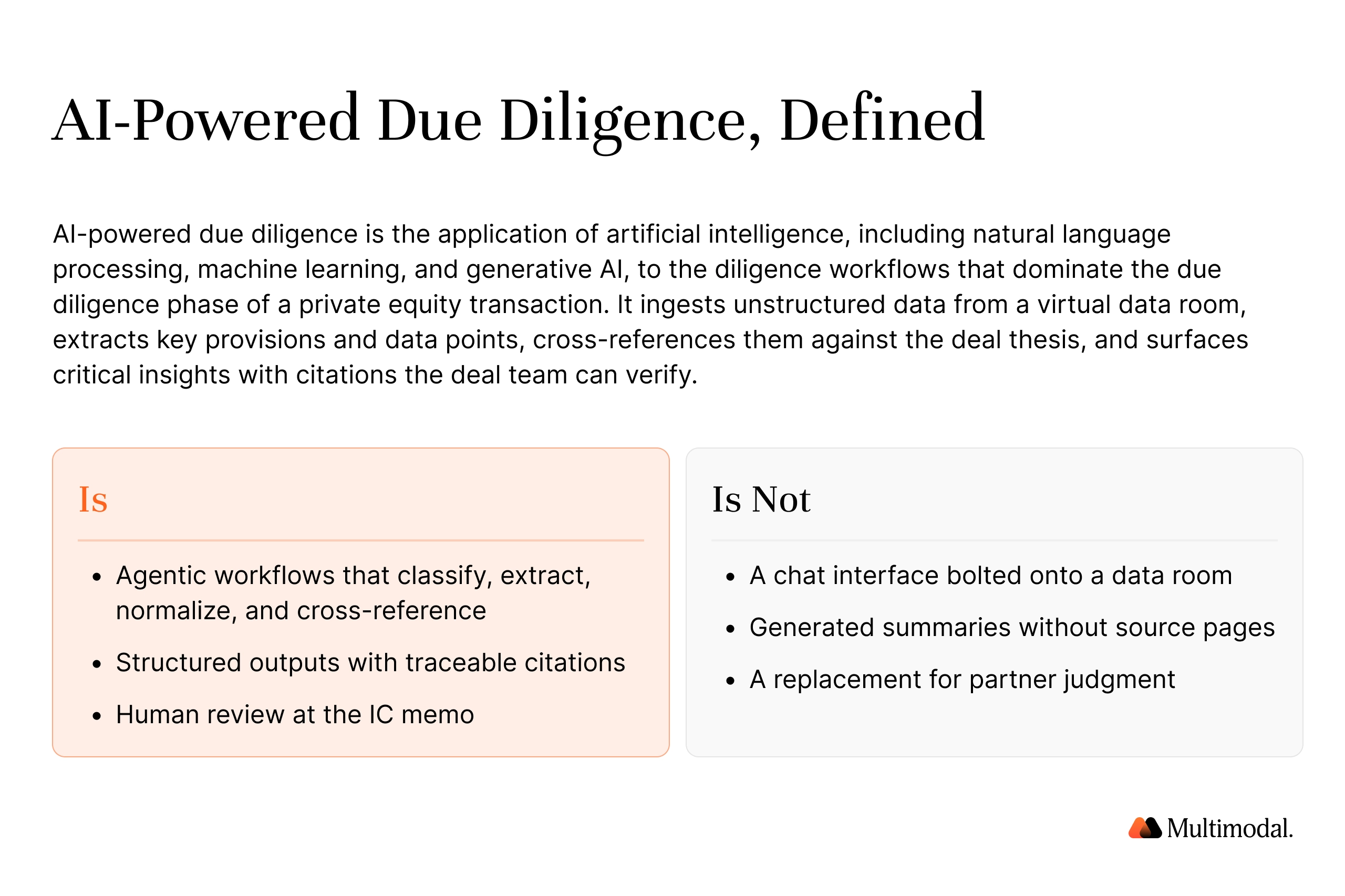
What AI due diligence is in practice: agentic workflows that classify every document the moment it lands in the data room, extract key provisions from contracts, normalize financial statements into a common chart of accounts, de-duplicate themes across management interviews and expert calls, and produce structured outputs every analyst on the deal team can trace back to source. The AI systems handle the document review at scale. Human review handles judgment, risk tolerance, and the IC memo.
The 6-Day AI Due Diligence Workflow
Compression is not magic, and it is not uniform across all workstreams. It is concentrated in the document-heavy, repetitive parts of diligence work where machine learning models and large language models can run thousands of parallel passes that a human team cannot match on calendar time. Here is what a six-day AI-powered diligence process looks like inside a mid-market PE shop.
Day 1. Data room ingestion and auto-classification. Every document landing in the data room is classified into one of the following categories: financial statements, customer contracts, vendor contracts, employment agreements, IP, regulatory, tax, and corporate records. The deal team gets a complete index by the end of day one. In the traditional due diligence process, this index takes a junior analyst the better part of week one.
Day 2. Customer and vendor contract extraction and red flag report. The system extracts key provisions across the contract set: change-of-control, MAC, exclusivity, auto-renewal, indemnification caps, and governing law across multiple jurisdictions. The first red-flag report lands at the end of day two, with citations linking back to the source pages.
Day 3. Financial spreading, working capital normalization, and EBITDA adjustments. AI tools handle the mechanical work of populating the fund's QoE template with statements. Adjustments are flagged for human expertise to confirm. The deal team's CFO and QoE provider start on judgment work earlier in the process, not later.
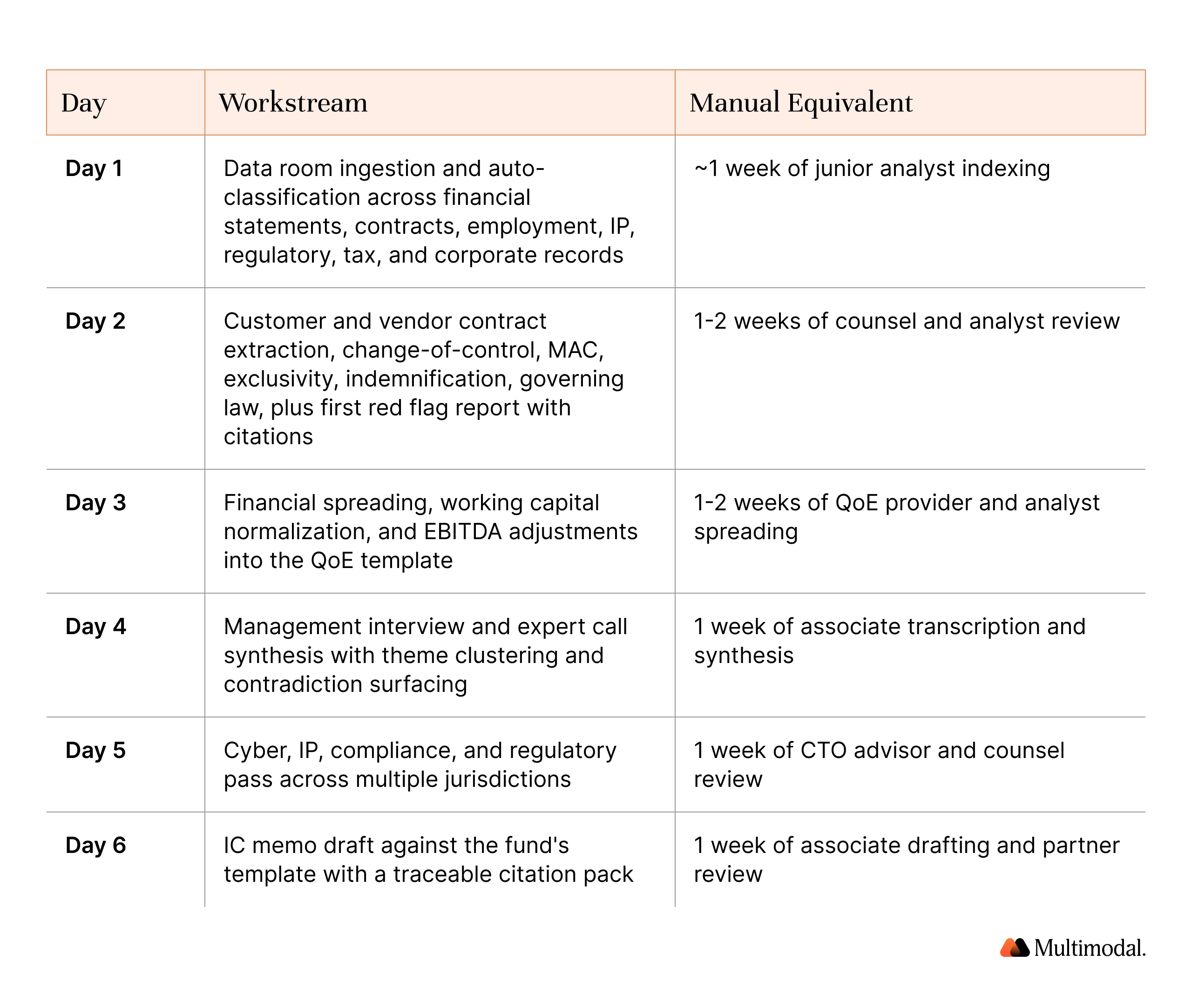
Day 4. Management interview synthesis and expert call de-duplication. Transcripts from Tegus, AlphaSights, and management calls are ingested. The system identifies patterns across interviews, surfaces contradictions, and produces a synthesis that the deal lead can take into the next round of calls. Critical insights don't get lost across 30 hours of audio.
Day 5. Cyber, IP, compliance, and regulatory diligence pass. Tech-stack dependencies are mapped, SOC 2 posture is reviewed, IP assignments are checked for gaps, and regulatory issues across multiple jurisdictions are flagged. Hidden risks that traditional methods miss because no human reads every paragraph, and they don't get surfaced for human review.
Day 6. Investment committee memo draft and traceable citation pack. The system drafts the IC memo using the fund's template, populates exhibits, and produces a citation pack so that partners can trace every claim to its source document. The deal team edits, the partner signs, and the committee meets.
The point is not that AI replaces the deal team. The point is that the deal team spends day six on judgment instead of day forty.
6 AI Due Diligence Use Cases Mid-Market PE Firms Are Already Running
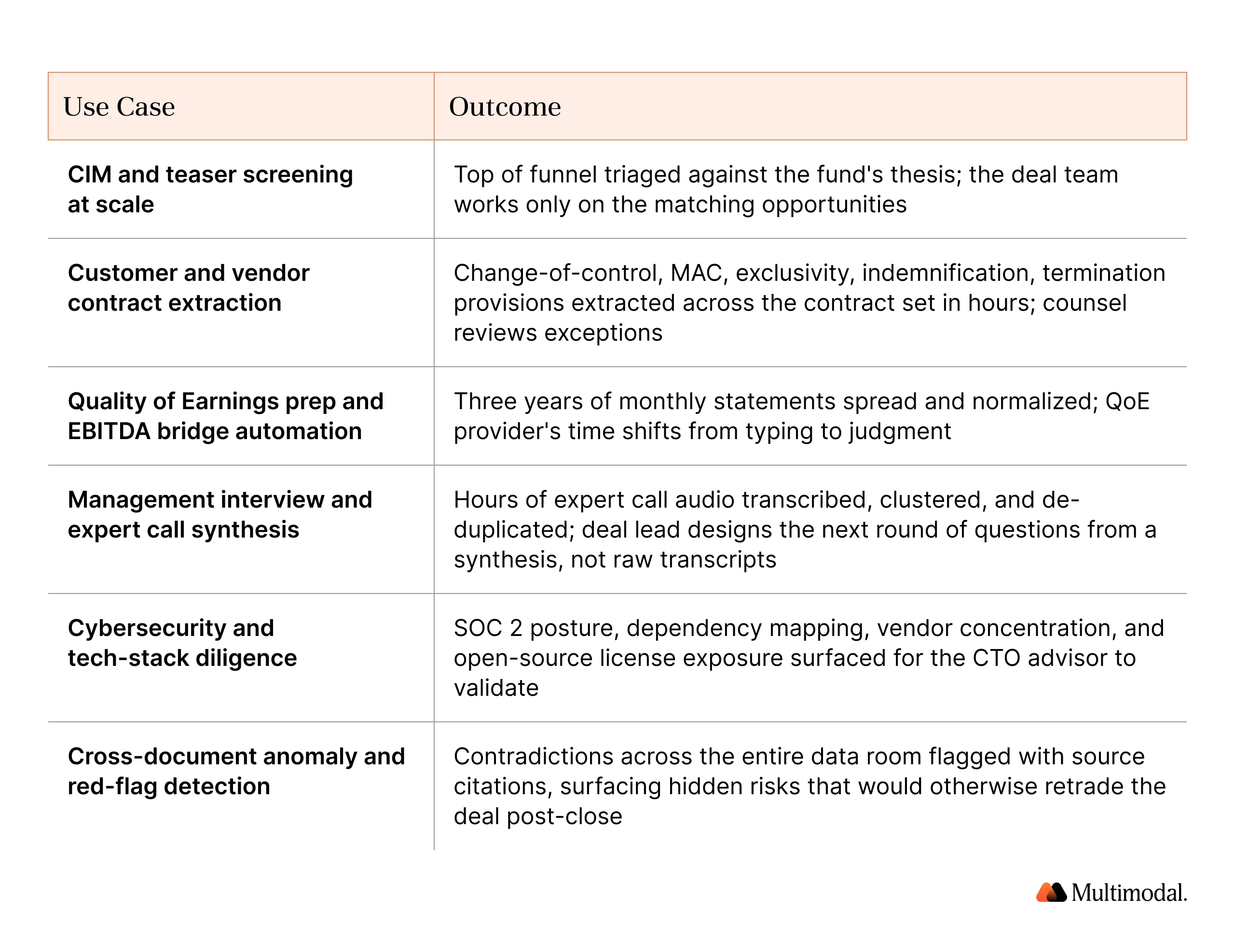
Across the funds that have moved past pilot, six diligence workflows show the clearest, most repeatable efficiency gains. Each one delivers immediate value by targeting a workstream in which the volume of unstructured data dwarfs human review capacity.
CIM and Teaser Screening at Scale
A mid-market fund pulls hundreds of CIMs through its pipeline each year. AI systems screen incoming teasers against the fund's investment criteria, flag the ones that fit the thesis, and route the rest to a no-action queue. The deal team works the top of the funnel on deals that match the risk profile, not on triage.
Customer and Vendor Contract Extraction
Change-of-control, MAC, exclusivity, indemnification, and termination provisions get extracted across the entire contract set in hours. Counsel reviews the exceptions rather than reading every contract end-to-end. The same extraction pipeline runs again at sign-and-close to confirm nothing material has shifted.
Quality of Earnings Prep and EBITDA Bridge Automation
Spreading financial statements, normalizing working capital, and building the EBITDA bridge across three years of monthly data takes weeks of manual review. AI-powered diligence tools handle the spreading and surface adjustments for the deal team and QoE provider to confirm. The accountant's time moves from typing to judgment.
Management Interview and Expert Call Synthesis
Expert network calls through providers such as Tegus and AlphaSights, combined with direct management interviews, can produce many hours of audio across a confirmatory diligence cycle. Identifying patterns across that volume is where human attention breaks down first. AI systems transcribe, cluster themes, surface contradictions, and produce a synthesis that the deal lead can use to design the next round of questions.
Cybersecurity and Tech-Stack Diligence
Dependency mapping, SOC 2 review, vendor concentration, and open-source license exposure get surfaced from the data room. The system flags potential risks for the fund's CTO advisor or cyber diligence vendor to validate. Hidden risks in the tech stack are no longer a post-close surprise.
Cross-Document Anomaly and Red-Flag Detection
The strongest argument for AI in due diligence work is the part that no human team can do at speed: reading every paragraph of every document in the data room and flagging items that contradict one another. Revenue figures in a board deck do not match the audit. A customer named in the CIM but not appearing in the contract set. An employee on the cap table who is not in the option ledger. These are the hidden risks that retrade deals after close. AI catches them during diligence.
The PE Operating Partner's Playbook for AI Due Diligence
The funds getting real value from AI in the due diligence process are running a small number of disciplined frameworks. Three are worth lifting directly.
The 4-Question Evaluation Framework
Before signing a platform contract, the deal team should pressure-test any AI due diligence platform against four questions.
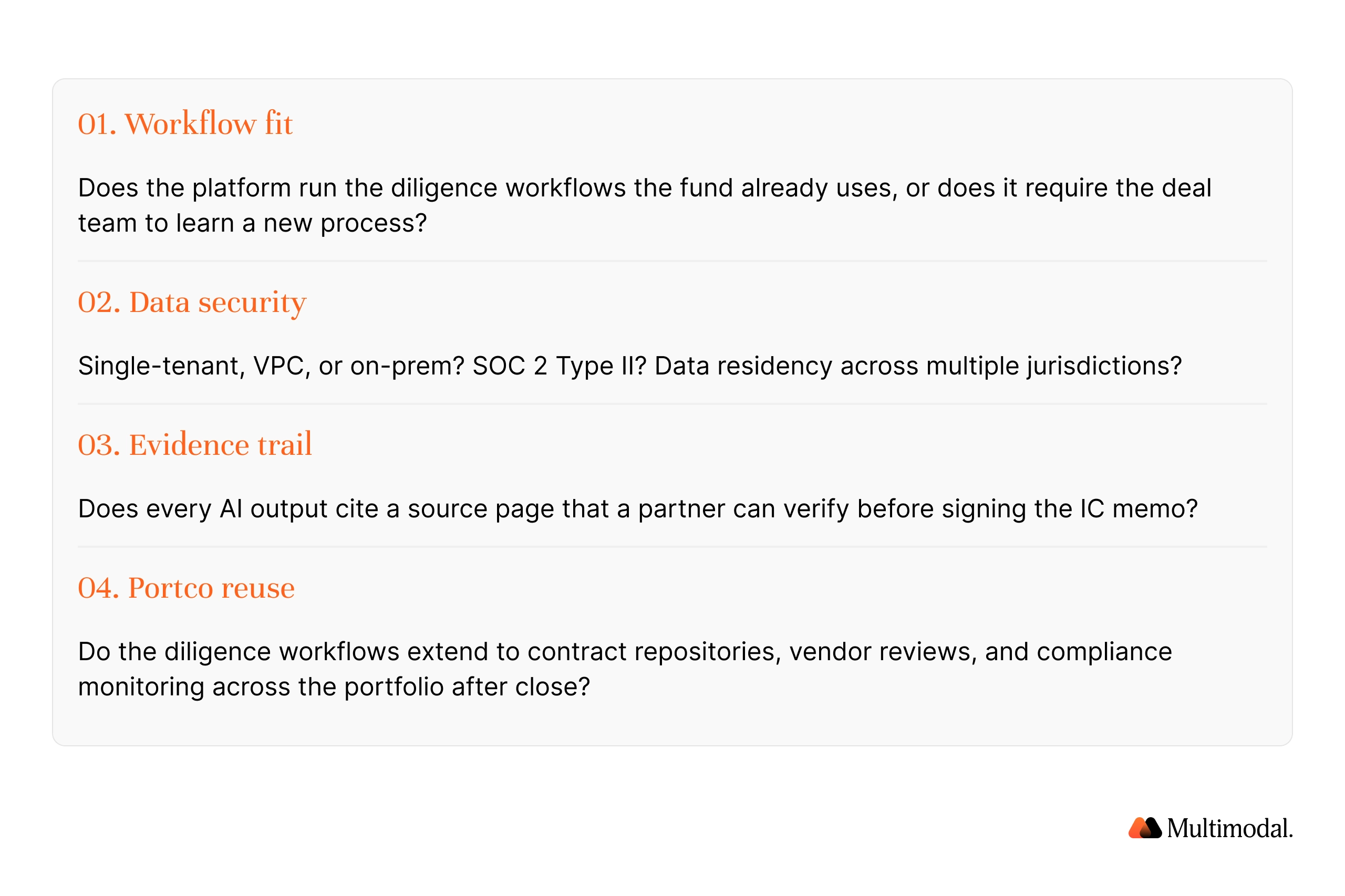
- Workflow fit. Does the platform run the diligence workflows the fund already uses, or does it require the deal team to learn a new process? Real value depends on integration with existing workflows.
- Data security. What is the deployment model? Single-tenant, VPC, on-prem? How is sensitive information handled across multiple jurisdictions? Does the vendor meet industry standards on data privacy and data protection?
- Evidence trail. Does every AI output cite a source page? Can a partner trace any claim back to the document it came from? Without a citation pack, the AI outputs cannot survive IC scrutiny.
- Portco reuse. Once the deal closes, do the diligence workflows extend to the portfolio? Contract repositories, vendor reviews, and compliance monitoring at the portco level are where AI in PE pays for itself a second time.
Where Humans Must Stay in the Loop
The 6-day workflow is not a hands-off pipeline. Three checkpoints require human expertise.
- IC memo sign-off. The partner signs the memo. The AI drafts it. The judgment belongs to the human.
- Red flag triage. The AI surfaces hidden risks. The deal lead decides which ones change the deal thesis, which ones move pricing, and which ones get walked away from.
- Integration thesis. Value creation planning, the bridge from diligence to the first hundred days post-close, is a human conversation between the operating partner and the management team.
Pilot Design: How to Run a 2-Deal Pilot in 60 Days
The funds that get the most out of an AI due diligence platform run a structured pilot before scaling.
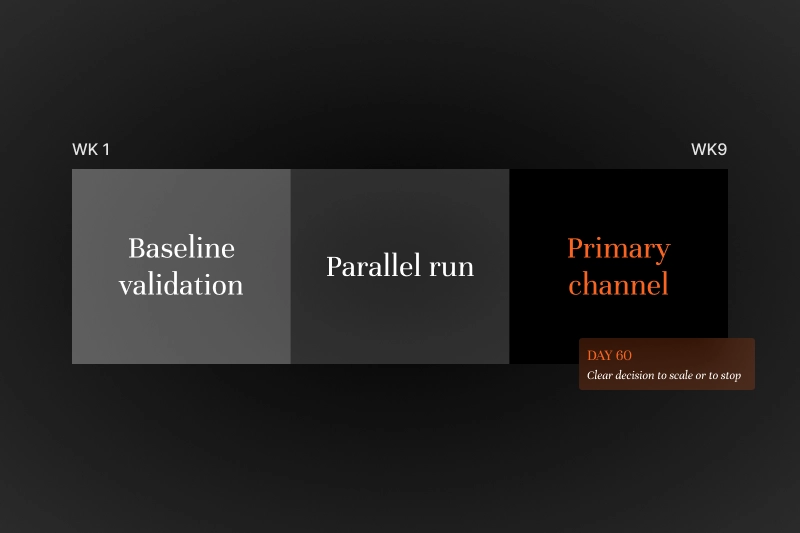
- Weeks 1 to 2. Stand up the platform on a closed deal. Run the AI through the data room from the prior diligence and compare its outputs against the IC memo the team actually wrote. This is model training and baseline validation in one.
- Weeks 3 to 6. Run the platform on an active deal in parallel with the manual review. Measure where the AI outputs match the human work, where they diverge, and where they catch hidden risks the human team missed.
- Weeks 7 to 9. Run the platform on a second active deal as the primary diligence channel, with human review of critical insights and the IC memo.
Sixty days, two deals, a clear answer on whether to scale.
Build vs. Buy vs. Customize: Choosing an AI Due Diligence Platform
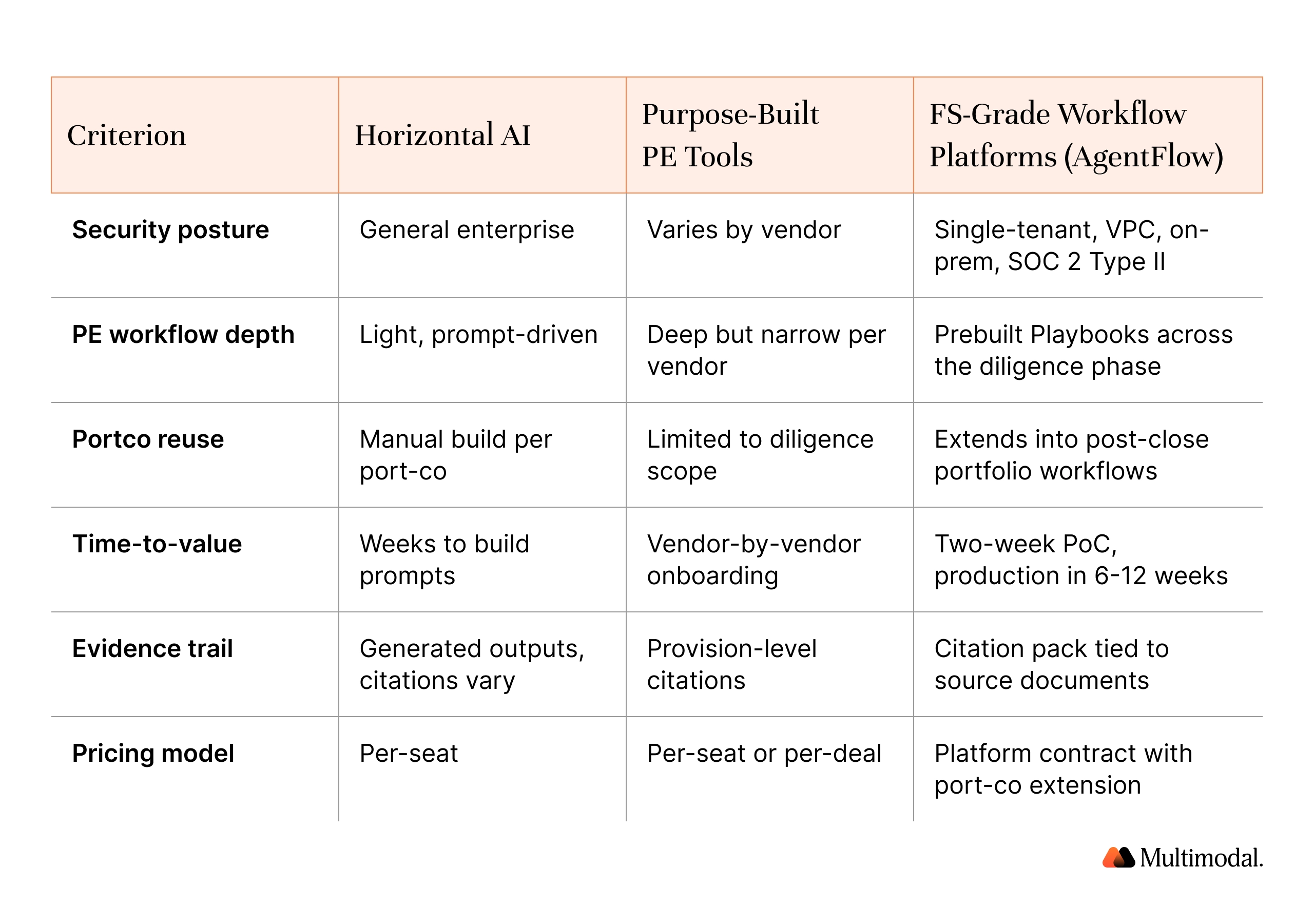
PE firms looking at AI for due diligence are choosing between three categories of options. Each has a defensible use case.
The Three Categories
Horizontal AI. General-purpose AI assistants and LLM platforms aimed at knowledge work across professional services. Broad capability, light on PE-specific workflows, and the deal team builds the prompts and the process.
Purpose-built PE and diligence tools. Vendors targeting specific diligence work, contract extraction, financial spreading, and deal screening. Deeper workflow fit than horizontal AI. Narrower scope, which means more vendors to integrate.
FS-grade workflow platforms. Platforms built specifically for financial services workflows, with prebuilt Playbooks for diligence, regulated-data handling, and the compliance posture FS buyers require. AgentFlow falls into this category, with diligence workflows that extend from the data room to post-close portfolio work.
The Hidden Cost of Building In-House
A handful of large funds have asked whether to build the platform internally. The math rarely works at mid-market scale. A defensible in-house AI due diligence system requires a multi-quarter engineering investment, ongoing model ops, a compliance audit, and a team that competes for talent with the funds' own portcos. The opportunity cost is the deals not done while the platform gets built.
For most funds, the buy-or-customize path delivers immediate value on the next deal. The build path delivers a maintenance liability on a roughly two-year delay.
What 1,000+ PE and FS Buyers Tell Us About AI Adoption
Multimodal's research has tracked AI adoption across the private equity industry. The findings from The State of Agentic AI in Private Equity report show that nearly two-thirds of private equity firms are actively piloting AI, and roughly 40 percent report having formal AI strategies in place.
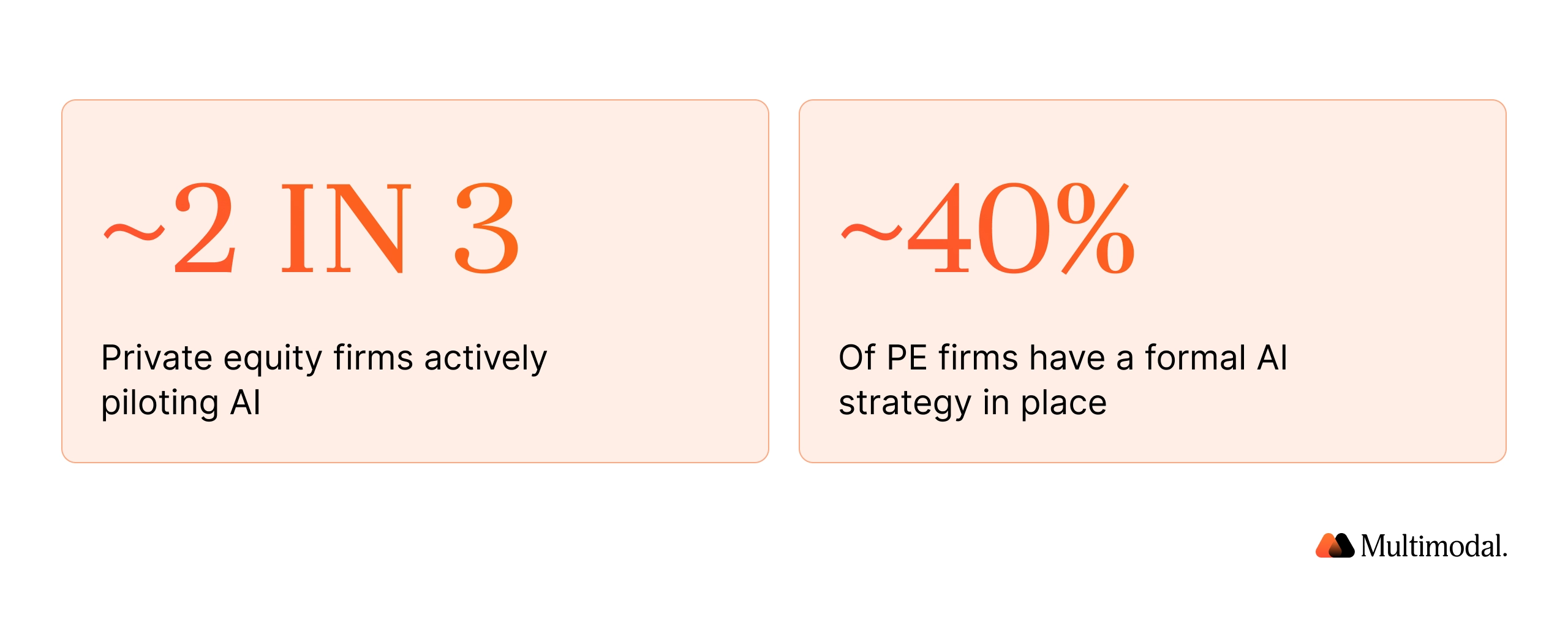
Three patterns from the PE cohort are specifically relevant to the diligence conversation.
Pattern 1. The conversation has moved past whether to pilot. With nearly two-thirds of PE firms already in pilot, the live question for mid-market funds is which platform fits the workflow, not whether AI belongs in the diligence process at all.
Pattern 2. Talent and organizational readiness are the bottleneck, not technology. The same Multimodal research identifies talent as the primary constraint on scaling AI inside PE firms, with junior professionals shifting away from manual data extraction toward analysis and oversight of AI-driven workflows.
Pattern 3. Execution beats experimentation. Multimodal's research reinforces a shift the broader PE industry already sees: technology alone is not the differentiator. How a fund integrates AI into its operating model is what separates firms that produce real value from those running indefinite pilots.
Risks, Limitations, and Governance for AI in PE Due Diligence
Honest framing builds trust with the IC. Four risks deserve direct attention.
Hallucination risk. Large language models can generate confident outputs that are not grounded in source documents. The mitigation is designed, not hope. AI outputs that cite source pages and have traceable provenance back to the data room document give partners a way to verify any claim before it lands in the IC memo. Citation-grounded design is the difference between AI as a diligence aid and AI as a liability.
Data security and sensitive information. Deal data is some of the most sensitive information a fund handles. Acceptable deployment models include single-tenant cloud, VPC, and on-prem. SOC 2 Type II is the floor on vendor security posture. For deals spanning multiple jurisdictions, data residency and cross-border transfer terms need legal review at the same depth as the deal documents themselves.
The partner-judgment limit. AI cannot replace partner judgment, and saying so without operationalizing the handoff is empty. The operational version: AI runs the document review, the data analysis, and the synthesis. Humans run the risk assessment, the risk management decision on what changes the deal, and the integration thesis. The handoff is explicit, documented, and visible in the workflow.
Regulatory and LP-disclosure implications. Regulatory issues around AI use in deal processes are emerging across multiple jurisdictions. LP reporting expectations on the use of AI inside the diligence process are still forming. Funds running AI in production today are documenting their workflows, retention policies, and human-review checkpoints in anticipation of disclosure requirements that have not yet been finalized.
The funds that do this well treat AI governance as part of risk management, not as a separate compliance project.
.svg)


FAQs
AI-powered due diligence is the use of artificial intelligence, natural language processing, and machine learning models to ingest documents in a virtual data room, extract key provisions and data points, and produce structured outputs that the deal team uses to make informed decisions during the diligence phase of a transaction.
The compression depends on the workstream. Document-heavy work streams such as contract extraction, financial spreading, and management call synthesis can compress from weeks to days. Judgment-heavy work, such as IC memo sign-off and integration planning, does not compress. Most mid-market funds running AI in production target a six-day diligence workflow on the workstreams that previously took six weeks.
Safe deployments use single-tenant, VPC, or on-prem hosting, SOC 2 Type II vendor posture, and explicit data residency terms for deals across multiple jurisdictions. Citation-grounded outputs ensure that every claim is traceable to its source, supporting both IC scrutiny and data protection audits. Funds should treat AI vendor evaluation with the same diligence and rigor they apply to other data systems handling sensitive information.
A chat-based data room answers natural-language questions over the documents in the room. AI due diligence runs structured workflows for classification, extraction, normalization, cross-document anomaly detection, and IC memo drafting, producing citation-grounded outputs that the deal team can defend. Chat is a query interface. AI due diligence is a process.
No. AI compresses the mechanical work inside QoE, legal, and commercial diligence: financial spreading, contract extraction, and expert call synthesis. The judgment, attestation, and advisory relationship that law firms and QoE providers bring is unchanged. The advisors who adopt AI deliver faster and stay competitive. The relationship continues.
The standard pattern is a sixty-day, two-deal pilot. Weeks one and two run the platform on a closed deal to validate outputs against the IC memo. Weeks three through six run in parallel on an active deal. Weeks seven through nine serve as the primary diligence channel, with human review of critical insights. By day sixty, the fund has a clear answer on whether to scale.
The right platform depends on workflow fit, security posture, evidence trail, and portco reuse. Mid-market funds running four or more platforms per year usually need an FS-grade workflow platform with prebuilt diligence Playbooks. Funds that already have heavy in-house engineering may evaluate a horizontal AI plus internal build. The four-question evaluation framework above is the deciding tool.
The mitigations are technical and operational. Technical: citation-grounded outputs that tie every claim to a source document page, with retrieval pipelines that prefer extracted text over generated text where possible. Operational: a human review checkpoint at every IC-facing artifact, with the deal team confirming the citation pack before the partner signs. The combination drives hallucination risk to a level the IC can underwrite.
Book a Demo for Your Next Confirmatory Diligence
.svg)
.svg)