


.svg)
.svg)

.svg)
This is a summary of an episode of Main Street AI, an educational podcast on AI led by our founder. Join 3,700+ business leaders and AI enthusiasts and be the first to know when new episodes go live. Subscribe to our newsletter here.
TL;DR:
- Credit unions are cautious about AI because sending member data to a general vendor is a real compliance risk, not because they doubt the technology.
- CUltivate is a CUSO, not a vendor. Filene, Vertice AI, and Vizo Financial are co-founders, and credit unions hold ownership stakes in the platform they use.
- The platform layers credit-union-specific context (NCUA guidance, Filene research, call report data) on top of general AI models, then cites its sources.
- A PII detector blocks staff from accidentally sending a birth date or Social Security number into the system, by design, from day one.
- CUltivate doesn't automate decisions. It calls third-party fintech agents, including Multimodal, when a workflow needs that kind of execution.
- Trust builds fastest inside the credit union movement because institutions vouch for each other in a way public banks never do.
Before we dive into the key takeaways from this episode, be sure to catch the full episode here:
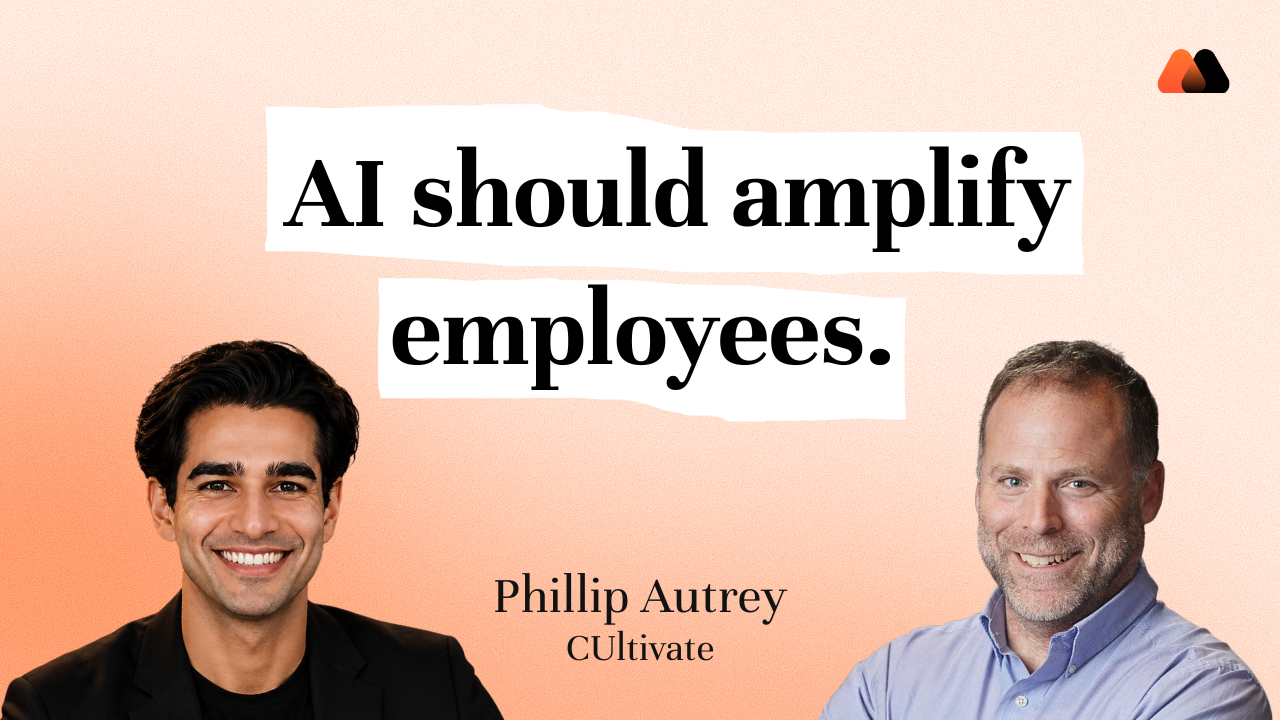
Why Philip Autry Built Trust Into the Product First
Philip Autry came to CUltivate from a career in educational technology, not banking, which gives him an outsider's read on an industry with cooperative DNA at its core. The gap he saw was not a lack of interest in AI. It was a lack of anywhere credit unions could put their trust.
"That trepidation when it comes to, can we trust it? Are we sending our information out to the tech companies?"
That hesitation, Autry argues, slows adoption more than any technical limitation does. So the first thing CUltivate shipped was not a feature that makes the product faster. It was a PII detector that blocks a birth date or Social Security number from ever leaving the chat interface, whether the employee typing it is a new hire or someone who has been at the credit union for twenty years and simply slips.
A CUSO, Not a Vendor
CUltivate was formed as a Credit Union Service Organization by Filene Research Institute, Vertice AI, and Vizo Financial rather than as a standalone AI startup. That structure is deliberate. Credit unions and the movement itself hold ownership stakes in the platform, which means the roadmap answers to the institutions using it, not to outside investors.
"So the idea that this platform is built for credit unions, but by credit union."
Autry contrasts this directly with general models. Copilot, Claude, and ChatGPT are trained on the open web, so a compliance officer asking a credit-union-specific question risks getting an answer blended with information that has nothing to do with the industry's actual regulatory context. CUltivate's context layer pulls from NCUA documents and Filene's private research instead, and cites where each answer came from.
Where CUltivate Fits: Orchestration, Not Automation
CUltivate is not trying to replace every tool a credit union already licenses. Autry compares it to Siri calling Instacart or Evite: the platform's orchestration engine recognizes when a prompt is better answered by a specialized partner, calls that partner, and returns the result inside the same chat window. Multimodal is one of the fintech partners CUltivate can route to this way.
"We're really helping employees make decisions, not making the decisions for them."
That is the line Autry draws consistently. Full workflow automation stays with internal systems or third-party agents. CUltivate's job is picking the right tool for the prompt, not executing the workflow itself.
What the Smallest Credit Unions Are Missing
There are roughly 4,250 federally insured credit unions in the US as of Q1 2026, and NCUA data shows more than half hold less than $50 million in assets. That range, from a two-person office answering member calls to an institution running its own IT department, is the gap Autry says the market underserves most. A credit union with fifteen IT staff and one with a CEO who also answers the phones need fundamentally different things from an AI platform, and most vendors only build for the first one.
CUltivate's answer is a narrow, pre-scoped knowledge base rather than a general-purpose assistant. Responses are geared to the user's role and their specific credit union, using call report data already built in, so nobody needs to be a prompt engineer to get a useful answer.
Is AI Going to Replace Credit Union Jobs?
No. AI will not replace credit union jobs. Autry pushes back directly on the idea that AI is coming for credit union jobs. His framing is the "if I only had time" list: every employee has a higher-value project they never get to because daily tasks eat the day.
"It's not inevitable. It's you having a powerful tool that you choose to use to help you with your role."
The bigger long-term question, in his view, is not job loss but member experience. Automating routine transactions is meant to free staff for the edge cases, the ones where a loan officer's knowledge of what's actually happening in their community changes the outcome in a way no model can replicate.
How This Works in Practice
"We're really helping employees make decisions, not making the decisions for them."
— Philip Autry, CUltivate
Multimodal builds purpose-built AI agents for credit unions on Jack Henry, Fiserv, and Symitar, designed with the audit trail and human-in-the-loop controls that trust-conscious institutions require before any AI-assisted output reaches a member. If your institution is thinking through where a platform like CUltivate fits alongside a purpose-built agent layer, the platform comparison is a practical starting point.
Want more on financial services and AI? Check other episodes here.
Frequently Asked Questions
1. Why don't credit unions trust AI?
Credit unions don't trust general AI vendors because sending regulated member data outside the institution is a real compliance risk, not just hesitation. Credit unions answer to their own membership rather than shareholders, which is why CUSOs like CUltivate were formed as an alternative.
2. What is a CUSO?
A CUSO, or Credit Union Service Organization, is an entity owned by credit unions to provide shared services the industry couldn't build alone. CUltivate is one example, founded by Filene Research Institute, Vertice AI, and Vizo Financial.
3. Does CUltivate automate lending or compliance decisions?
No, CUltivate does not automate lending or compliance decisions. It's built to help employees make decisions, not make decisions for them, and routes full workflow automation to internal systems or third-party fintech agents like Multimodal instead.
4. Can a small credit union use CUltivate without an IT department?
Yes, a small credit union can use CUltivate without an IT department. The platform is a narrow, pre-scoped chat interface rather than a general-purpose assistant, so a lending officer or a CEO answering member calls directly doesn't need prompt engineering skills to get a useful answer.
5. How does CUltivate protect member privacy?
CUltivate protects member privacy with a PII detector that blocks information like a birth date or Social Security number from ever leaving the chat interface. That protection catches the mistake whether it comes from a new hire or a longtime employee, and was built in from day one.
6. Is AI going to replace credit union jobs?
No, AI is not going to replace credit union jobs, at least not in the near term. Philip Autry argues the fear is overblown today, though not something to rule out over five to ten years, and frames AI's role as closing the gap on the "if I only had time" list every employee carries rather than eliminating roles.

%20(1).png)
%20(1).png)