

This is a summary of an episode of Main Street AI, an educational podcast on AI led by our founder. Join 3,700+ business leaders and AI enthusiasts and be the first to know when new episodes go live. Subscribe to our newsletter here.
TL;DR:
- Lake Michigan Credit Union: $17B in assets, 13th-largest credit union in the US
- One Emerging Technology Governance Board owns AI, RPA, stablecoin, and whatever comes next
- Single intake, single prioritization, single risk lens, single roadmap instead of siloed committees
- The HUMDA process: 150 steps cut to roughly 15 through process mapping and agentic AI
- RPA for finite variables, agentic AI for fuzzy logic: complexity drives the decision
- Token bills are the silent ROI killer: cost dashboards matter as much as use case selection
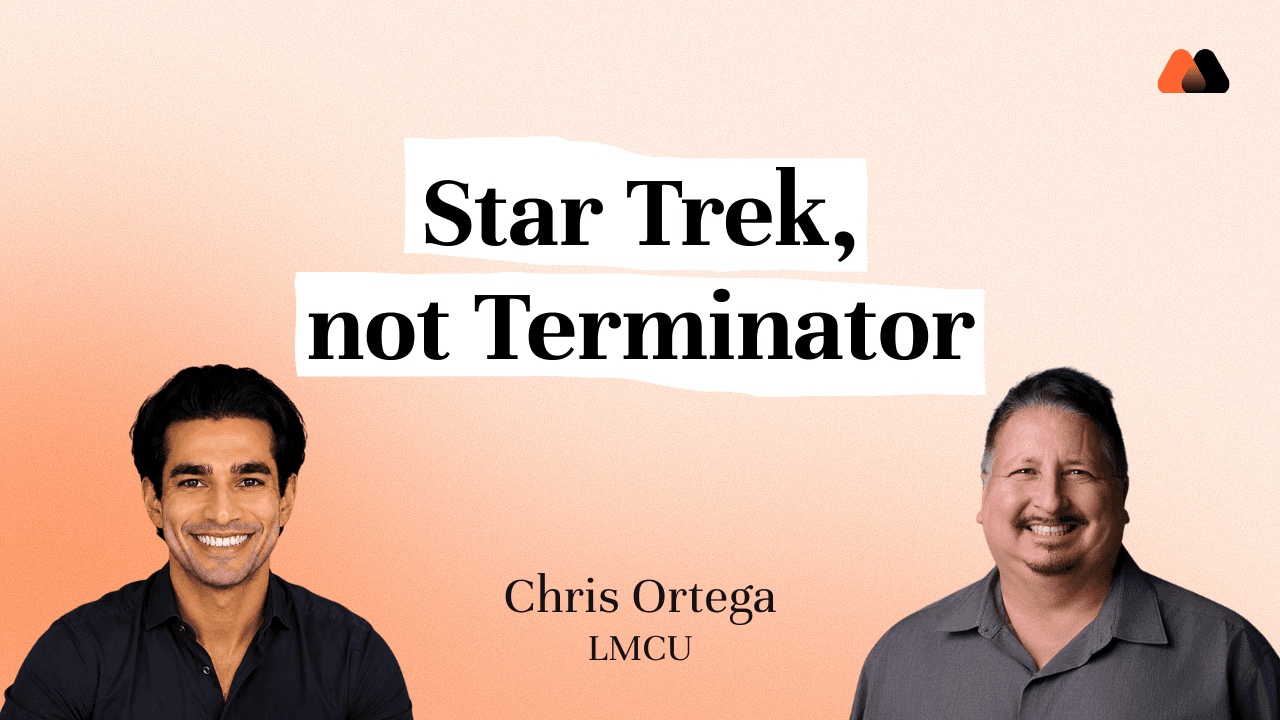
- Adoption philosophy: Star Trek, not Terminator
Before we dive into the key takeaways from this episode, be sure to catch the full episode here:
One Committee for Everything Emerging
Most credit unions create a new committee per technology wave. AI gets one. RPA gets another. Six months later there are five committees, three pilots in flight, no shared roadmap, and a risk posture nobody can explain to the board.
Chris Ortega rejects that model. Lake Michigan Credit Union runs everything through a single Emerging Technology Governance Board under its Center of Excellence.
"We wanted to be able to have one intake method, one prioritization model, one risk lens, one ethical framework, one roadmap."
"When you have all of these different emerging tech committees, you get duplicated spend, conflicting priorities, shadow IT, and a risk posture that's just impossible to manage."
Credit union AI deployment has more than doubled in three years to 45% in 2025, far outpacing banks according to Cornerstone Advisors, but fewer than 1% of organizations have fully operationalized responsible AI per a joint World Economic Forum and Accenture study.
The Operational Layer Beneath It
A governance board only works if there is a delivery layer beneath it. At Lake Michigan, that is the Center of Excellence, led by Beth Baird, which maps business-unit processes, identifies pain points, and determines where technology fits. Solutions architects design the integration. Cross-functional scrum teams with business-unit representation execute. A project steering committee handles cross-priority decisions.
"It's highly coordinated. We have a project steering committee that helps prioritize all that work."
RPA vs Agentic AI: The Complexity Test
"If the decision is one of five variables, or there's a clear finite set of variables, that's a great candidate for rules-based automation. It's cheaper, you have more visibility, the decision making is auditable, and it's just as fast."
RPA is the right tool when decision logic is bounded and predictable. The choice is a complexity question, not a preference.
"The tricky thing comes when you hit fuzzy logic, where the decision could be a combination of all five variables and the choices are so myriad that you need a human to discern that. That's where agentic AI earns its keep."
He also names the trap on both sides. Some institutions are bought into RPA and resist agentic AI. Others were burned by RPA and want agentic AI for everything. Neither posture is right. If an RPA implementation has become overly complex, that is a signal to migrate to agentic AI, not a reason to defend the original choice.
150 Steps Down to 15
The most concrete example is what Chris calls the HUMDA process, a workflow that had grown to roughly 150 discrete steps. After the Center of Excellence mapped it end to end and applied agentic AI to the steps where fuzzy logic was the bottleneck, the count dropped to about 15.
"I was blown away. Almost brought a tear to my eye."
The COE did not lead with technology. It led with the process map. Every step got interrogated: rules-based or fuzzy, automatable or human-only? Only after the process was fully understood did the choice between RPA and agentic AI get made at each step.
The Token Bill That Quietly Eats ROI
"I see so many people out there who are getting burned by how much money they're having to utilize using AI, because their LLMs are churning tokens and you're seeing these big bills come in."
Token pricing inflates when traffic grows, prompts get more complex, or an institution switches to a larger model mid-stream. LMCU is building ROI dashboards showing labor hours saved, opportunity cost reversed, and the cost of AI itself on the same page. That is a next-month deliverable.
Lake Michigan's CEO Julie Leonard came up through finance as a CFO. Her lens has shaped how the technology team presents its work.
"I don't know who I'm talking to today. CEO Julie, or CFO Julie? When CFO Julie is coming out, she's asking the hard questions about how we're saving money or getting that ROI on the investment."
For any credit union deploying agentic workflows, cost dashboards are not optional. They are the difference between an AI program that compounds and one that gets cut.
Star Trek, Not Terminator
Before any tool got deployed, Chris insisted the leadership team agree on the philosophical frame first.
"We want people to adopt AI and to feel safe that it's something they can use as a partner, and that it's not going to overtake their lives."
The operational follow-through: AI bootcamps, lunch and learns, Co-Pilot licenses, productivity dashboards, and surveys to identify champions and laggards. Chris goes directly to frontline staff to ask how they are using AI and whether it is working.
"Sometimes I'll just go ask people how they're using AI, how effective it is. We're very intentional about this. I don't want to mess this up."
Philosophy first, structure second, tools third.
Want more on financial services and AI? Check other episodes here.
Frequently Asked Questions
1.How are credit unions automating lending operations with AI?
By targeting specific friction points first: slow decisioning, document-heavy underwriting, high call transfer rates. Platforms like AgentFlow are built for this kind of targeted deployment in regulated lending environments, with full audit trails on every automated step.
2. Can AI help credit unions approve more loans without increasing risk?
Yes, when configured against the institution's own credit policies and risk thresholds. Edge cases route to a human underwriter while AI handles the straightforward volume. AgentFlow's lending workflows include compliance controls so every decision is explainable and examinable.
3. Does AI in lending lead to credit union layoffs?
Not at UKFCU. Every change has been voluntary, with staff repurposed into open roles through natural attrition. The key is identifying where new roles are opening before tools go live, not after.
4.What is GLIA and how does it work in a credit union?
A virtual assistant platform handling inbound calls and chats without a human rep. UKFCU launched with targets of 60% call deflection and a 70%-plus reduction in after-hours vendor spend.
5. How should credit unions think about AI vendor selection for lending?
Start with the member pain point, not the technology. Map the biggest friction points first, then evaluate whether AI solves them. Avoid tools deployed for their own sake.
 Continue exploring