
Agentic AI Use Cases for Mid-Market Lenders: 12 Workflows Already in Production
- Mid-market lenders are past the pilot stage: agentic AI runs in production across the full loan lifecycle, from document intake through compliance reporting.
- Unlike the automation already in your LOS, which follows preset rules and breaks on the unexpected, an agentic workflow handles what those rules did not anticipate.
- The lenders getting results did not automate everything at once. They picked one high-volume workflow, measured the outcome, then expanded.
- This page covers the 12 workflows those lenders run today and what each one produces in practice.
Why mid-market lenders are moving on this now
Mid-market lenders, institutions with roughly $500 million to $10 billion in assets, carry the same regulatory compliance burden as the largest banks but operate with leaner teams and tighter margins. They are too large for off-the-shelf tools built for community banks and too small to build proprietary AI infrastructure the way a top-10 bank can.
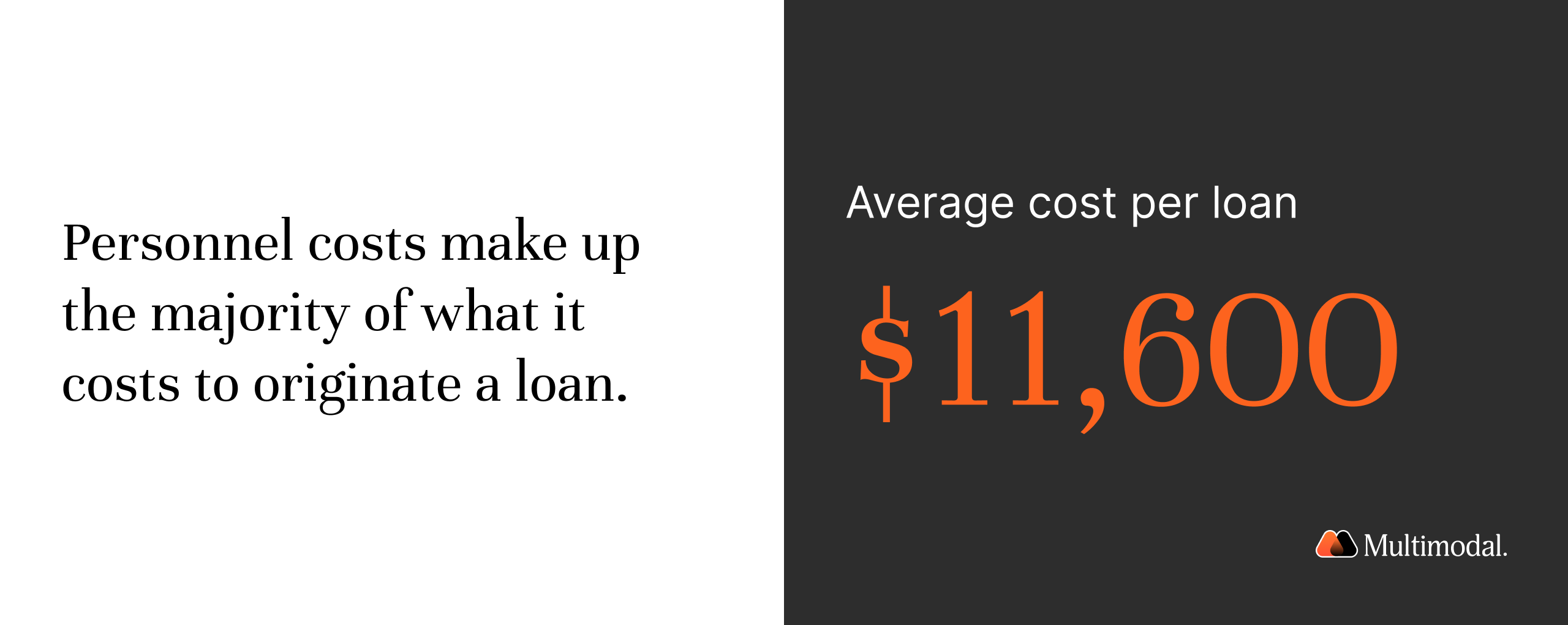
The numbers make the cost pressure clear. According to the Mortgage Bankers Association's Q1 2024 Quarterly Performance Report, total loan production costs hit $12,593 per loan, with labor accounting for roughly two-thirds of that figure per Freddie Mac's 2024 Cost to Originate Study. Financial services institutions implementing agentic AI report operational cost reductions of 15 to 40 percent depending on workflow complexity, with the largest gains in manual processes that require high volumes of repetitive judgment.
Regulatory pressure is tightening from the other direction. The NCUA's 2026 supervisory priorities explicitly cover loan quality, BSA/AML compliance, and fraud prevention. The CFPB has made clear that AI-assisted credit decisions must be explainable and auditable: lenders that cannot produce specific adverse-action reasons from their AI systems are already out of compliance under ECOA and Regulation B. Federal guidance on model risk management, including SR 11-7, applies to any AI model influencing credit risk or lending decisions. Most mid-market lenders also run on legacy systems never designed for real-time data exchange, and that is where integration complexity concentrates and adoption timelines most often slip.
The 12 workflows mid-market lenders are running in production
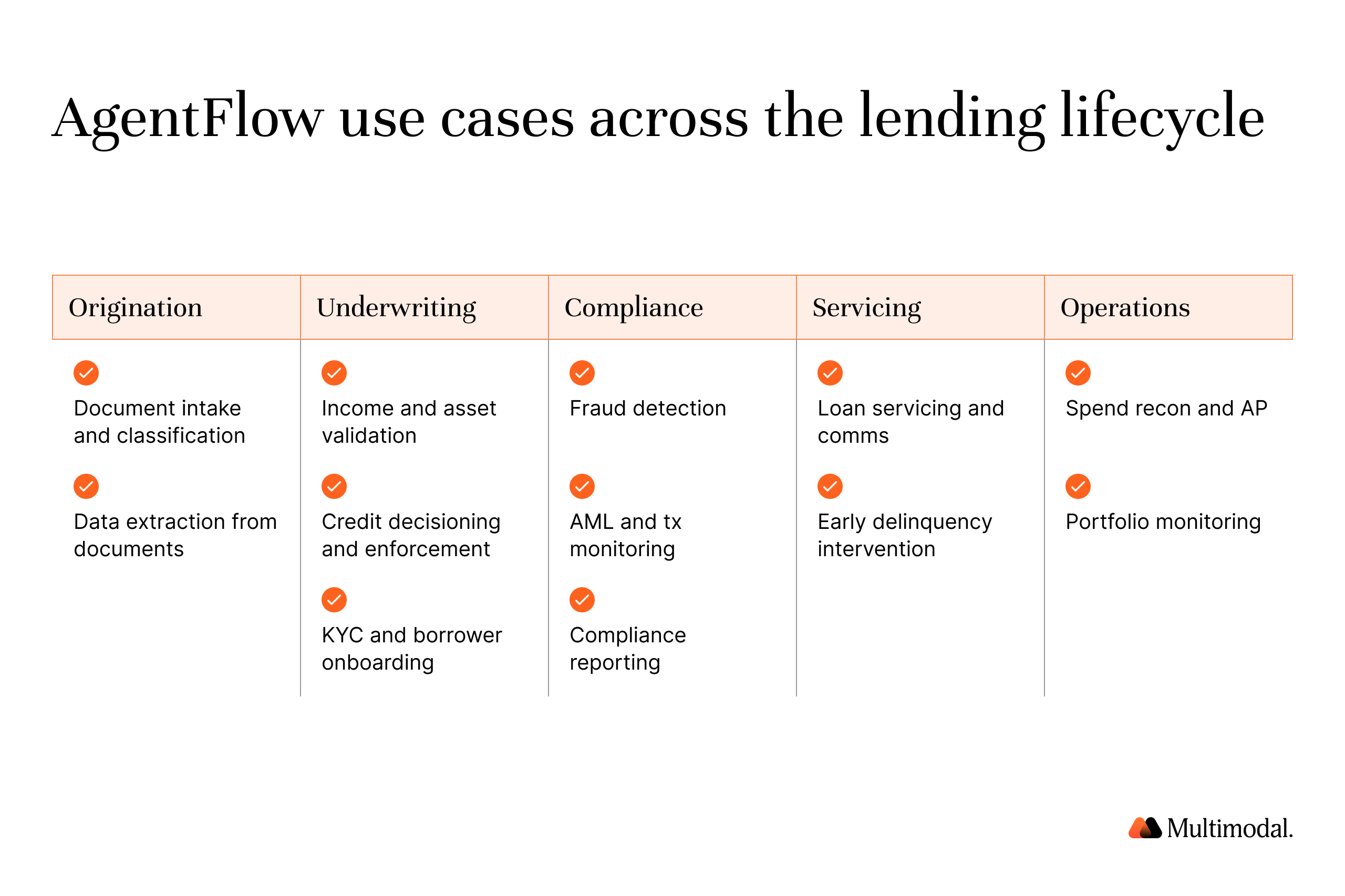
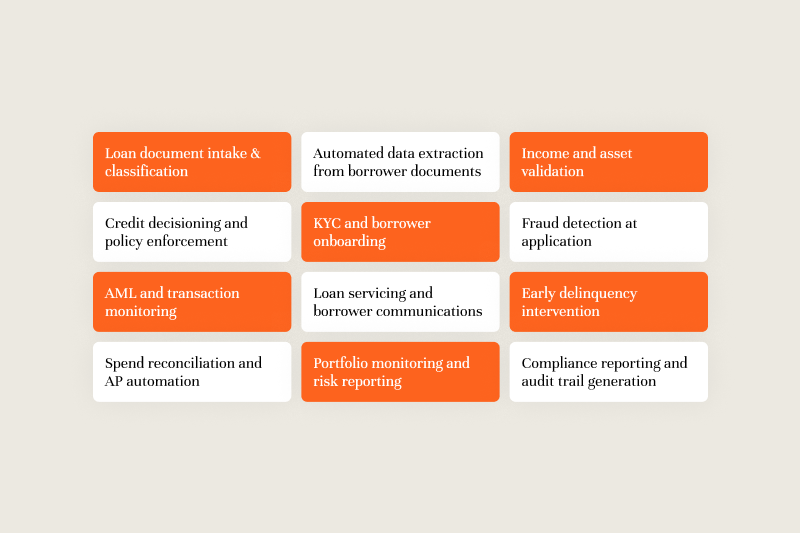
1. Loan document intake and classification
Every loan file arrives as a pile of documents from different sources: email attachments, portal uploads, LOS submissions, and scanned paper. An agentic intake workflow ingests files from every channel and classifies each by type — W-2, pay stub, tax return, bank statement, title, insurance binder, appraisal, and hundreds of others — reasoning about layout and content rather than matching a template, then routing each file to the right queue with no manual handoffs. FORUM Credit Union deployed this across consumer auto loan packages of 15 to 61 pages each, with accuracy at 99 percent across 62 packages.
"With Multimodal's AgentFlow platform, we've seen accuracy levels exceed 99% in both document classification and data extraction, far surpassing our original targets."
2. Automated data extraction from borrower documents
On a typical mortgage file, over 200 fields need extraction from a dozen documents — structured forms, semi-structured statements, and unstructured free-text and handwriting. Manual data entry carries 1 to 4 percent error rates; on a 200-field file even 1 percent means two or more errors per loan, surfacing in QC reviews, repurchases, and exams. An agentic extraction workflow reads every document type through the same pipeline and tags each field to its source location so every value is traceable.
Automated extraction across 200+ document categories, cut document-workflow costs by 80 percent, and accelerated time to decision by 20×.
3. Income and asset validation
An agentic validation workflow cross-checks income across every document: pay-stub year-to-date against the W-2 annual figure, bank-statement deposits against stated income, tax-return income against the application. Every field gets a confidence score — high-confidence fields move through automatically, low-confidence fields flag for human review with the specific discrepancy noted. Research in Royal Society Open Science found meaningful variability in approvals over the workday driven by decision fatigue; agentic validation applies the same logic identically across every file, at any hour.
4. Credit decisioning and policy enforcement
A decisioning workflow takes the validated borrower record, applies your underwriting guidelines, runs affordability calculations, pulls bureau data, and reaches a decision: approve, decline, or route to a human reviewer. Every decision is explainable, with a reasoning trace showing what data was used, what policy was applied, and what drove the outcome — the explainability a regulated environment requires at every decision node.
100 percent automated decisioning across all processed loan packages, with full audit rationale stored for every decision, written straight back into Temenos with no manual re-entry.
5. KYC and borrower onboarding
KYC is one of the highest-cost onboarding steps and a common source of delay. An agentic KYC workflow independently verifies identity documents, runs sanctions screening, checks transaction history against expected patterns, and conducts background checks without manual re-keying across systems. Every borrower goes through the same verification logic, and every check is documented, eliminating the fragmented manual reviews that slow onboarding and create compliance gaps.
6. Fraud detection at application
Synthetic identities, inconsistent documentation, and application patterns designed to pass rule-based checks are standard threats at scale. Static rules catch yesterday's fraud. An agentic fraud workflow continuously scans usage patterns and transaction data for early signals during origination — synthetic-identity markers, cross-document inconsistencies, behavioral anomalies — reducing false positives while catching threats rule-based systems miss, without adding friction for legitimate borrowers. 77 percent of consumers say they are interested in AI that proactively prevents fraud, making visible fraud protection a trust lever, not just a compliance requirement.
7. AML and transaction monitoring
AML teams lose because alert volume outstrips headcount and most alerts are noise. An agentic monitoring workflow continuously analyzes transaction streams, enriches alerts with context from internal and external sources, and routes only cases warranting human oversight to investigators, documenting its reasoning at every step so teams can defend the disposition of every alert during an exam. In compliance-heavy workflows, AI adoption has shown productivity improvements of 200 to 2,000 percent by eliminating alert noise.
8. Loan servicing and borrower communications
Most inbound servicing contacts are routine — payoff amounts, payment history, modification questions — but borrowers arrive with expectations shaped by Amazon and Uber. An agentic servicing workflow handles routine requests across voice, digital, SMS, and email: it authenticates the borrower, retrieves the data, delivers an accurate answer, and escalates complex requests to a human, personalizing outreach based on transaction history and usage patterns.
"Our first-contact resolution is better by 34 percent with the reduction in call transfers. We're answering calls faster because we're solving member questions at a much faster rate than we ever have."
9. Early delinquency intervention
Effective intervention happens before the missed payment, when the borrower is still responsive and options are broader. An agentic collections workflow continuously monitors payment behavior across the portfolio, watching for early indicators — fluctuating balances, irregular income deposits, shifts in cash-flow patterns relative to the borrower's own history — to qualify at-risk borrowers for hardship programs before collections trigger. Every outreach decision is documented with the specific signals that triggered it.
10. Spend reconciliation and AP automation
An agentic spend-reconciliation workflow ingests invoices, POs, receipts, and expense reports, matches line items, applies the right tax treatment, routes exceptions, and posts to the ERP — only true mismatches escalate to a human. A top-5 U.S. bank deployed this to automate travel-and-expense reconciliation across three platforms where transactions were frequently misclassified and audit trails incomplete; with AgentFlow, matching ran automatically with full audit-trail generation and exception-only human review.
11. Portfolio monitoring and risk reporting
Annual and quarterly portfolio reviews produce a snapshot of risk at the moment the report runs, often stale by the time it reaches a decision-maker. An agentic portfolio-monitoring workflow runs continuously, parsing loan-performance data, flagging borrowers trending toward delinquency, surfacing segment-level risk assessments, and generating reporting packages on whatever cadence you set — with the underlying data included so risk teams can drill into any flag without a separate pull.
12. Compliance reporting and audit-trail generation
Every workflow above produces decisions, and every decision needs documentation. An agentic compliance workflow generates documentation as part of the production process — recording which data was read, which decision was made, which policy was applied, and why — and produces the specific reason codes regulators require for every adverse action. AgentFlow ships with field-level source traceability, explainability logs, SOC 2 Type II attestation, and role-based access controls as standard.
As Chris Ferguson put it, the platform delivers "a straight-through process that is faster, more transparent, and audit-ready."
What the lenders running these workflows have in common
They started with one workflow
They picked the process with the highest volume, the clearest manual cost, and the most defined policy logic, measured the result, then expanded.
They kept humans in the loop
None of these workflows eliminates judgment. They remove the work that does not require it, so teams focus where judgment matters — systems that know when to escalate, not autonomous ones without guardrails.
They built compliance in from day one
A unified governance framework covering model risk, explainability, and human oversight is the foundation, not a post-deployment checklist. Retrofitting governance costs more to reach the same outcome.
How to evaluate an agentic AI platform for your lending operation
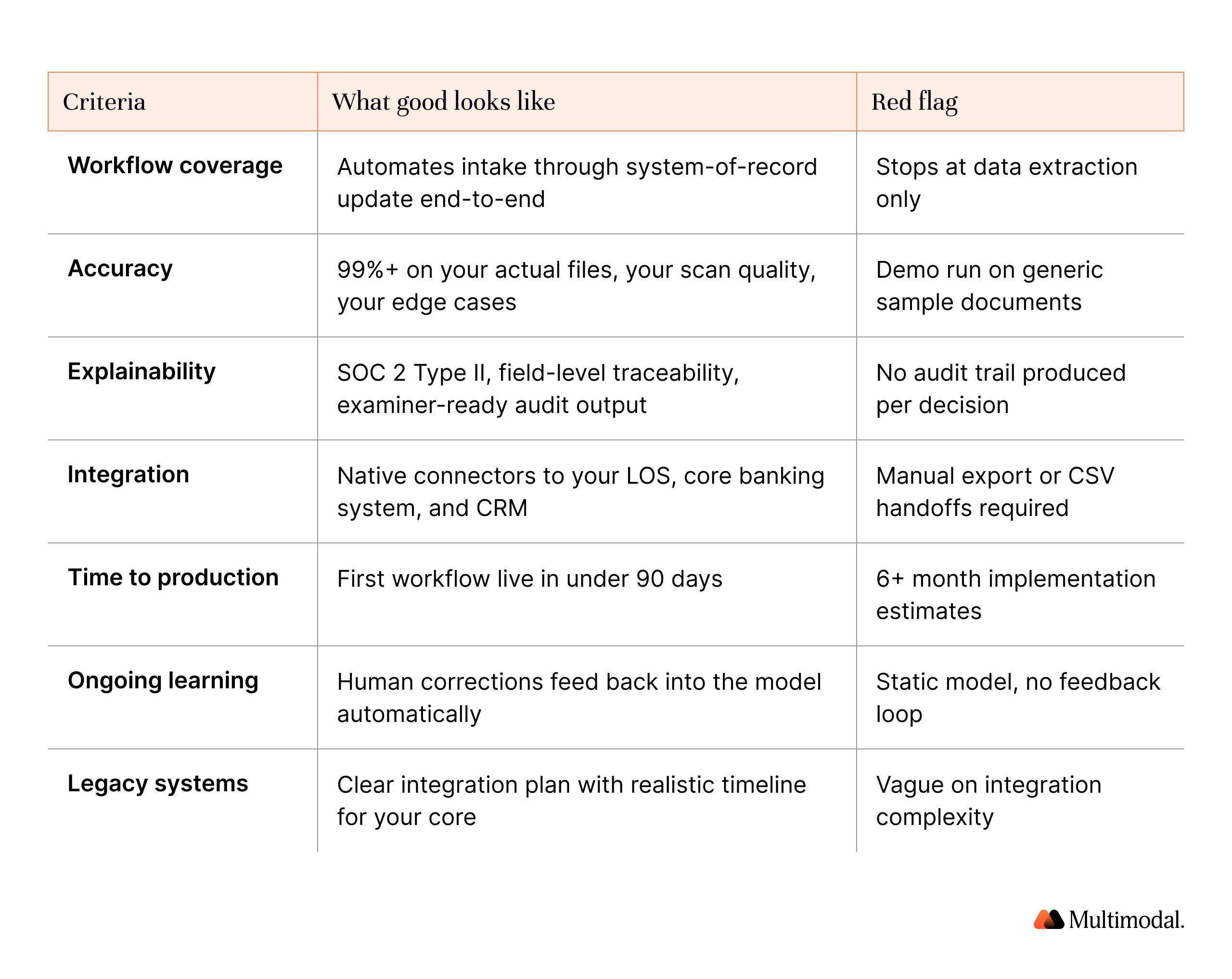
Six criteria separate a platform that moves the numbers from one that stops at data output. Test each against your own files, checklist, and systems.
How Multimodal approaches this with AgentFlow
AgentFlow is Multimodal's agentic AI platform built for regulated financial services. It covers the full workflow stack: Document AI for classification and extraction, Decision AI for policy-driven decisioning, Conversational AI for borrower and employee interactions, and Report AI for compliance-artifact generation. It ships with pre-built Playbooks for the workflows on this page — loan origination, KYC and onboarding, AML monitoring, credit decisioning, and servicing — each a production-grade starting point your team can configure and deploy without rebuilding infrastructure.
For credit unions and community and regional banks that want to see this on their own documents, we start with a proof of concept using your actual files. Related reading: AI agents for loan origination, agentic lending, and our AI for credit unions hub.
Agentic AI for lenders FAQs
Agentic AI in lending refers to AI systems that plan, decide, and execute multi-step workflows autonomously. Unlike automation that follows fixed rules, an agentic system reasons through novel situations, calls external systems, and documents every action without being re-prompted at each step.
Your LOS automation follows rules you configured in advance and breaks when something unexpected comes up. An agentic workflow handles what those rules did not anticipate, including document layouts it has never seen and validation scenarios that require reasoning across multiple sources.
Start with the workflow that has the highest volume, the clearest manual cost, and the most defined policy logic. For most mid-market lenders, that is document intake and classification or data extraction during origination.
AgentFlow Playbooks regularly reach production in under 90 days. The time is spent on integration with legacy systems, testing with your actual documents, and change management.
NCUA, OCC, FDIC, and CFPB guidance all point the same direction: explainable decisions, specific adverse-action reasons, replayable audit trails, and governance frameworks covering model risk management and third-party risk.
Yes. AgentFlow integrates with loan origination systems, core banking platforms, CRMs, and ERPs through native integrations and APIs. FORUM Credit Union runs it with a live Temenos integration, writing decisioning results straight into their core.
High-confidence fields move through automatically. Low-confidence fields escalate to a human reviewer with the specific issue flagged. Every correction feeds back into the model as training data, improving accuracy over time.
Yes, when purpose-built for the use case. AgentFlow ships with SOC 2 Type II, PII and PHI handling, encryption at rest and in transit, tenant isolation, role-based access control, and deployment options within your own virtual private cloud.
.svg)


See AgentFlow run a workflow on your own files
.svg)
.svg)