
What Is Agentic Lending? How Autonomous AI Agents Are Changing Loan Origination, Underwriting, and Servicing
- Agentic lending runs the full loan file autonomously, from intake through funding and servicing.
- Unlike chatbots or RPA, agentic AI reads unstructured data and resolves exceptions within policy.
- Early deployments cut loan turn times up to 80% and approvals from days to minutes.
- Human-in-the-loop, full audit trails, and explainability keep agentic lending compliant.
- Co-existence with your decisioning model and core is the fastest path to production.
Agentic lending is the use of autonomous AI agents to plan and run the lending lifecycle end-to-end, from intake and document verification through underwriting support, funding, and servicing, acting on a lender's own guidelines rather than waiting for a person to prompt each step. Unlike traditional automation, which repeats fixed rules on clean inputs, agentic AI reads unstructured data, adapts during processing, and resolves exceptions on its own before routing anything to a human.
For regulated lenders, the real value sits after the credit decision, in completing and funding the loan file, because that is where most lending operations still lose days of manual effort. This guide explains what agentic lending is, how agentic AI works across loan origination and servicing, where it delivers measurable impact, and how financial institutions can adopt it without replacing the systems they already run.
"The credit decision was solved years ago. The work that still breaks lending is the file behind it, and that is exactly what agentic AI runs, so lenders can fund faster without adding people."
 Ankur PatelFounder & CEO, Multimodal

What is agentic lending?
Agentic AI refers to AI systems built from one or more AI agents that pursue a goal, plan the steps to reach it, use tools, pull real-time data from multiple systems, and adapt when conditions change. Agentic lending applies that pattern to credit. Autonomous AI agents manage complex tasks independently across the lending lifecycle, coordinating document processing, verification, decision support, and status updates as a set of connected, multi-step workflows.
The distinction that matters most to lenders is between generative and agentic AI. Generative AI and chatbots respond to prompts and reorganize manual work. An agentic system takes action: it executes multi-step workflows, follows consistent policy logic, and keeps processing a queue of loan applications without constant human intervention.
What makes agentic AI useful in lending is autonomous decision-making bounded by business rules and human oversight. The agent decides how to complete a task, but the lender defines the guidelines, and human reviewers stay in the loop for anything that carries real risk. That combination is what separates intelligent systems lenders can actually deploy from AI tools that only assist.
How is agentic lending different from a chatbot, RPA, or a decisioning model?
Traditional AI and traditional automation each solve one narrow piece of the problem. A chatbot answers questions. Robotic process automation repeats scripted steps and breaks when a document format changes. A decisioning model scores risk and returns an approval. None of them read, verify, and complete the document packet that turns an approval into a funded loan. Agentic AI systems close that gap, combining intelligent document processing, cross-checks across multiple systems, and exception handling into a single workflow that carries a file from application to funded and serviced.
At Multimodal, we describe it simply: we are not a chatbot. We process the loan file.
What can agentic AI actually do across the lending lifecycle?
Agentic AI works as a digital layer over your existing stack, handling the document and coordination work that sits between an approval and a funded, serviced loan. AI-powered agents can handle hundreds of requests per day without burnout, apply consistent policy logic on every file, and improve accuracy because they do not tire or skip steps. The lending lifecycle breaks into six repeatable stages an agentic system can run end-to-end.
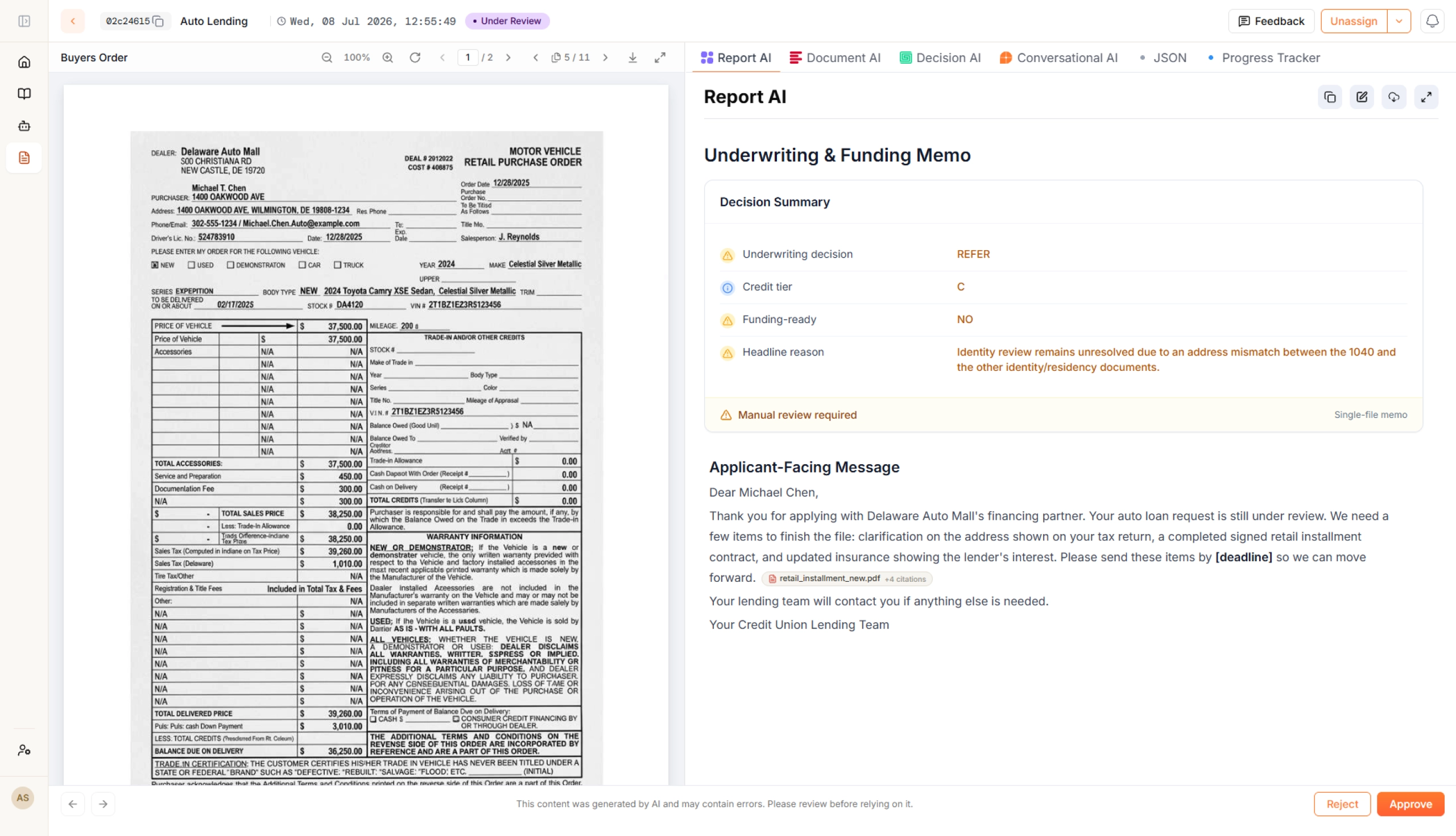
Beyond origination, agentic systems continuously analyze new data to make proactive lending decisions. They can personalize loan options and recommendations using a wider set of data points, run continuous affordability checks, and expand credit eligibility beyond static credit scores by reading real-time signals rather than a single bureau pull. Agents also monitor markets and borrower behavior to send proactive alerts, supporting dynamic loan-term adjustments within policy.
Draw-based lending shows the pattern clearly. In real estate and construction finance, agentic lending unifies draw management and risk oversight into a single workflow: low-risk draws are automated and processed in minutes rather than days, while higher-risk items route to human review. Built reports that its Draw Agent automated more than 500,000 tasks with 99.9% accuracy in a pilot, enabling up to 95% faster draw processing and 2 to 5 times the team's capacity without adding staff.
Why does agentic lending matter most for credit unions?
Mid-market financial institutions feel the operational strain first. Credit unions serve specific member bases, run leaner technology stacks than the largest banks, and carry heavy, recurring lending workflows, so the return on automation is higher and the technical debt of manual processes is more visible.
Indirect lending makes the stakes concrete. A dealer is effectively the customer, and slow funding sends the next deal to whoever funds fastest, so funding speed is a share of dealer business and a direct driver of customer acquisition and long-term loyalty. Multimodal's own field research found that manual funding review runs 40 minutes to 3.5 hours per application today, and an agentic workflow brings that to minutes. One credit union boosted loan processing volume by up to 70% using AI.
"Everyone is selling lenders a faster yes. But nobody bets on a yes. They fund on a complete file, and that is where agentic lending earns its return."
FORUM Credit Union runs AgentFlow in daily production and processes more loan packages with the same headcount, applying consistent checks across every file. Because agentic AI integrates with core banking systems such as Jack Henry, Fiserv, Symitar, and Temenos, the workflow sits inside existing lending operations rather than beside them, which is what turns a pilot into production.
What results are lenders seeing from agentic lending?
The measurable impact of agentic lending shows up as faster service, higher throughput, and lower costs, without adding people. In early deployments, agentic AI can reduce loan processing times from days to minutes, materially increase team capacity, and improve cost efficiency by enabling the same staff to handle greater volume.
These are efficiency and operational gains that compound. Faster funding improves customer satisfaction and experience, higher throughput supports customer acquisition, and lower manual effort frees staff to handle complex cases that require judgment. As adoption spreads, discoverability within AI answers becomes a competitive factor in its own right, since in 2026 many borrowers begin their search inside AI systems rather than a browser.
Is agentic lending safe and compliant for regulated lenders?
Autonomy raises the bar on governance. Regulators will scrutinize compliance in AI lending systems, and an agentic model that acts on its own must explain why it acted. The requirements for regulatory compliance are explainability, robust governance, and a complete record of every step.
Human in the loop
Human reviewers approve anything material and retain final authority over lending decisions. The agent completes the file; people own the call.
Automatic logging
Every action an agent takes is logged automatically, giving each file a compliance trail and full auditability for examiners and risk teams.
Adaptive compliance
Compliance protocols adapt to real-time regulatory updates as rules change, keeping the workflow aligned with current requirements.
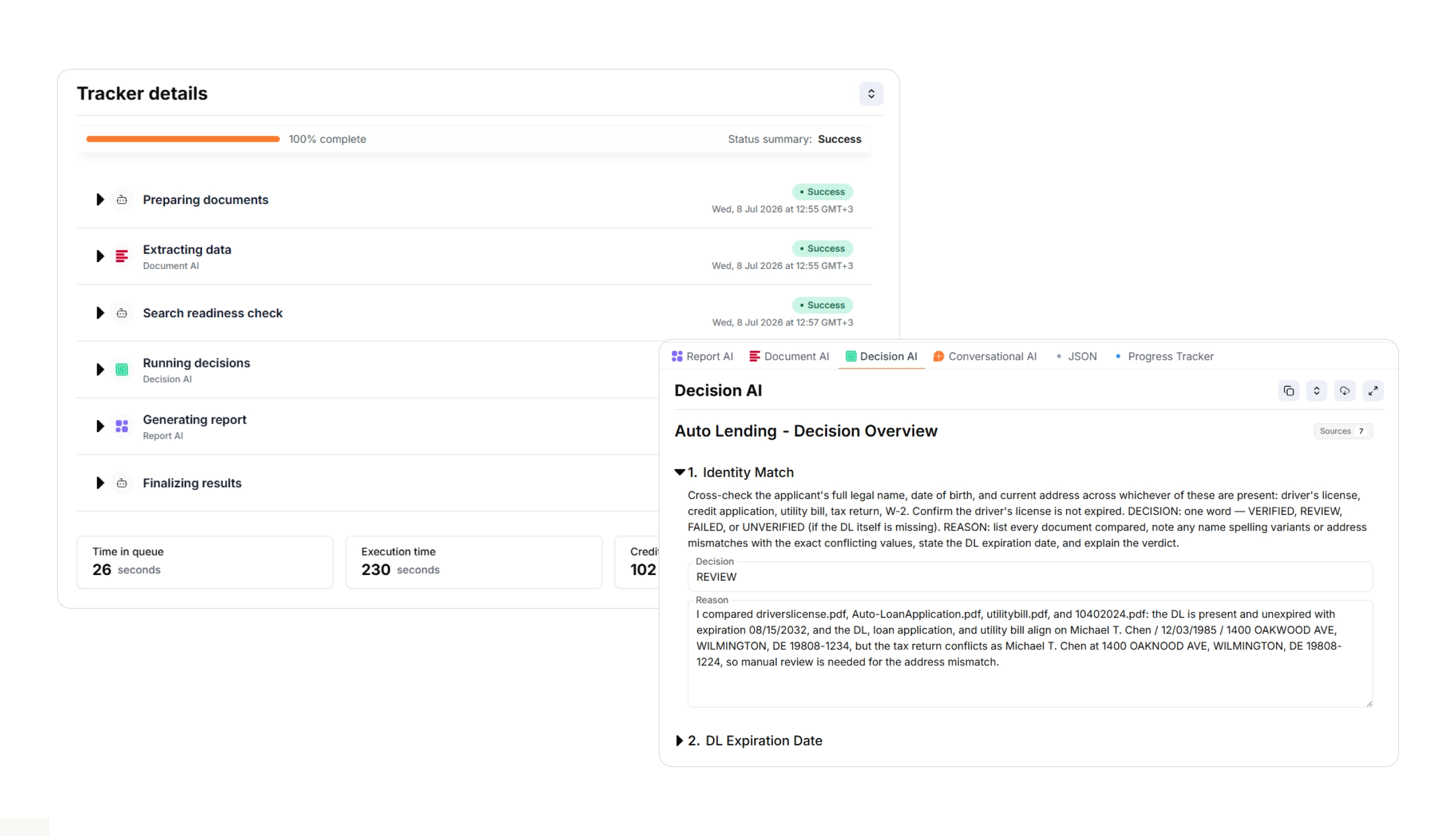
There are real risks to manage. AI discoverability bias can steer borrowers toward more expensive loan options if models are not tested and constrained, which is why fair-lending governance and continuous monitoring belong in the design, not after it. Real-time monitoring also works in the lender's favor: continuous analysis of borrower behavior can surface deterioration well before a missed payment, and documented early-warning approaches reduce credit losses by monitoring risk in real time rather than at the next statement. Done properly, agentic lending strengthens risk management and controls risk more tightly than a periodic manual review can.
How do you deploy agentic lending without replacing your decisioning stack?
The fastest path to production is co-existence. A decisioning model such as Zest AI owns the approval, the core owns the record, and the agentic layer completes and funds the file. Lenders keep the systems that already work and add the layer that closes the gap, lowering costs, reducing integration risk, and avoiding new technical debt.
This is where a platform approach and a delivery model matter. Multimodal's forward-deployed engineering team owns integration, edge cases, and quality assurance through go-live, so the workflow reflects a lender's real policy logic and document set. Prebuilt Playbooks for financial-services workflows give many lenders a running start in origination, servicing, and KYC, and support continuous improvement as volumes grow.
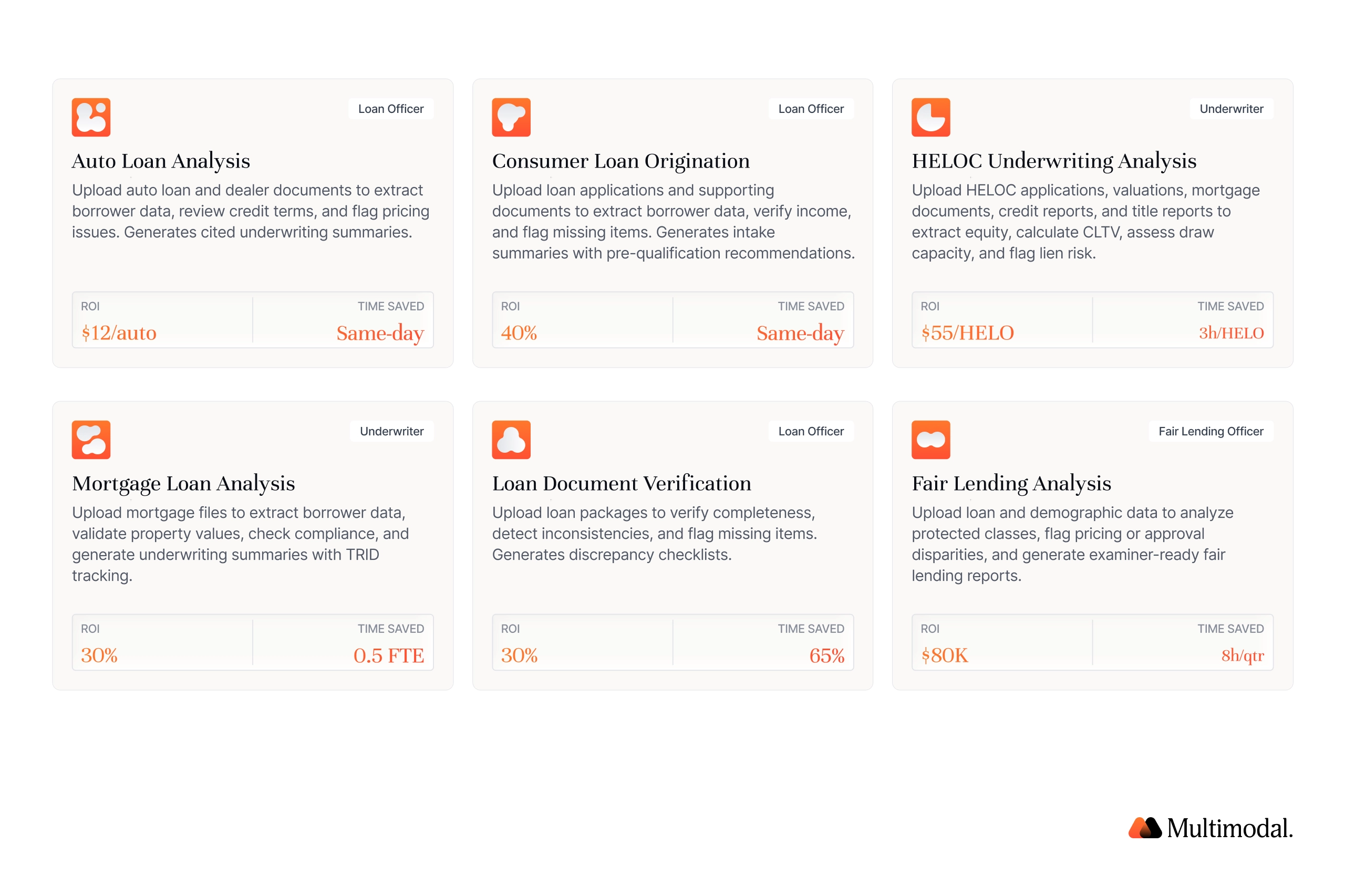
In the lending industry, the competitive advantage over the last decade came from speed and price. In this one, it comes from execution, and specifically from putting agentic AI into production before the rest of the market does.
Agentic lending FAQs
Agentic lending is the use of autonomous AI agents to run the lending lifecycle end-to-end, from intake and document verification through underwriting support, funding, and servicing. The agents plan, use tools, pull real-time data, and act in accordance with the lender's guidelines, with human oversight for anything that carries material risk.
A chatbot is reactive and reorganizes manual work by responding to prompts. An agentic system is proactive, executing multi-step workflows autonomously and integrating with core systems. Generative AI answers; agentic AI acts, completing tasks such as document verification and funding without step-by-step instructions.
Yes. AI-powered agents use intelligent document processing to intake and classify unstructured data, run completeness checks against a configurable checklist, validate details across multiple documents, and verify income and stipulations. They read content rather than fixed templates, so they handle exceptions instead of breaking on them.
No. Agentic lending completes and verifies the loan file that a decisioning model then approves. The decisioning model owns the credit decision, and the agentic layer owns the document and funding work around it, so lenders keep their existing stack and add capabilities without ripping anything out.
It can be, with the right controls. Agentic AI systems must keep a human in the loop, log every action for auditability, and adhere to explainability and fair-lending governance requirements. Compliance protocols should adapt to real-time regulatory updates to keep the workflow aligned with current requirements.
Document-heavy, high-volume workflows benefit first: indirect auto funding, mortgage lending, loan origination and servicing, draw management, KYC and BSA/AML checks, and commercial lending. These are the lending operations where manual effort, exception handling, and back-office work create the most delay.
Early deployments report major gains in lending efficiency, including one credit union processing up to 70% more loans with AI, while Built says its Draw Agent reduces draw turn times and manual effort. Multimodal's field research puts manual funding review at 40 minutes to 3.5 hours per application, reduced to minutes with an agentic workflow.
.svg)


See what agentic lending does with your loan files
.svg)
.svg)