
Automated Invoice Processing: How AI Eliminates the $15-Per-Invoice Problem

The average company spends $15.96 per invoice to process it manually. For financial institutions processing 10,000+ invoices monthly, that is $1.9M+ in annual processing costs, and the figure ignores the working capital tied up by 10-day approval cycles, the missed early payment discounts, the duplicate payments, and the audit hours that compound every quarter.
Automated invoice processing built on agentic AI is the structural fix: AI ingests every invoice format, extracts invoice data with 99%+ accuracy, runs three-way matching against purchase orders, autonomously routes the approval process, and posts approved invoices to the ERP without a clerk touching a keyboard. Top-quartile AP organizations now process invoices for under $2 each, in under three days, with audit trails examiners can pull on demand.
This pillar page explains how automated invoice processing works at each step of the invoice lifecycle, why traditional invoice automation tools (OCR, rules engines, RPA) fall short, what financial services teams need to evaluate in invoice automation software, how to build a defensible ROI case, and where AgentFlow by Multimodal fits in the modern AP stack.
The Accounts Payable Bottleneck: Why Manual Invoice Processing Is Costing Institutions Millions
The accounts payable department is one of the largest and least strategic line items in finance operations. Every paid invoice that flows through manual data entry, paper invoices, email approval chains, and spreadsheet reconciliation incurs direct and hidden costs and exposes the organization to risk that compounds at scale.
What's Breaking in Invoice Processing Today
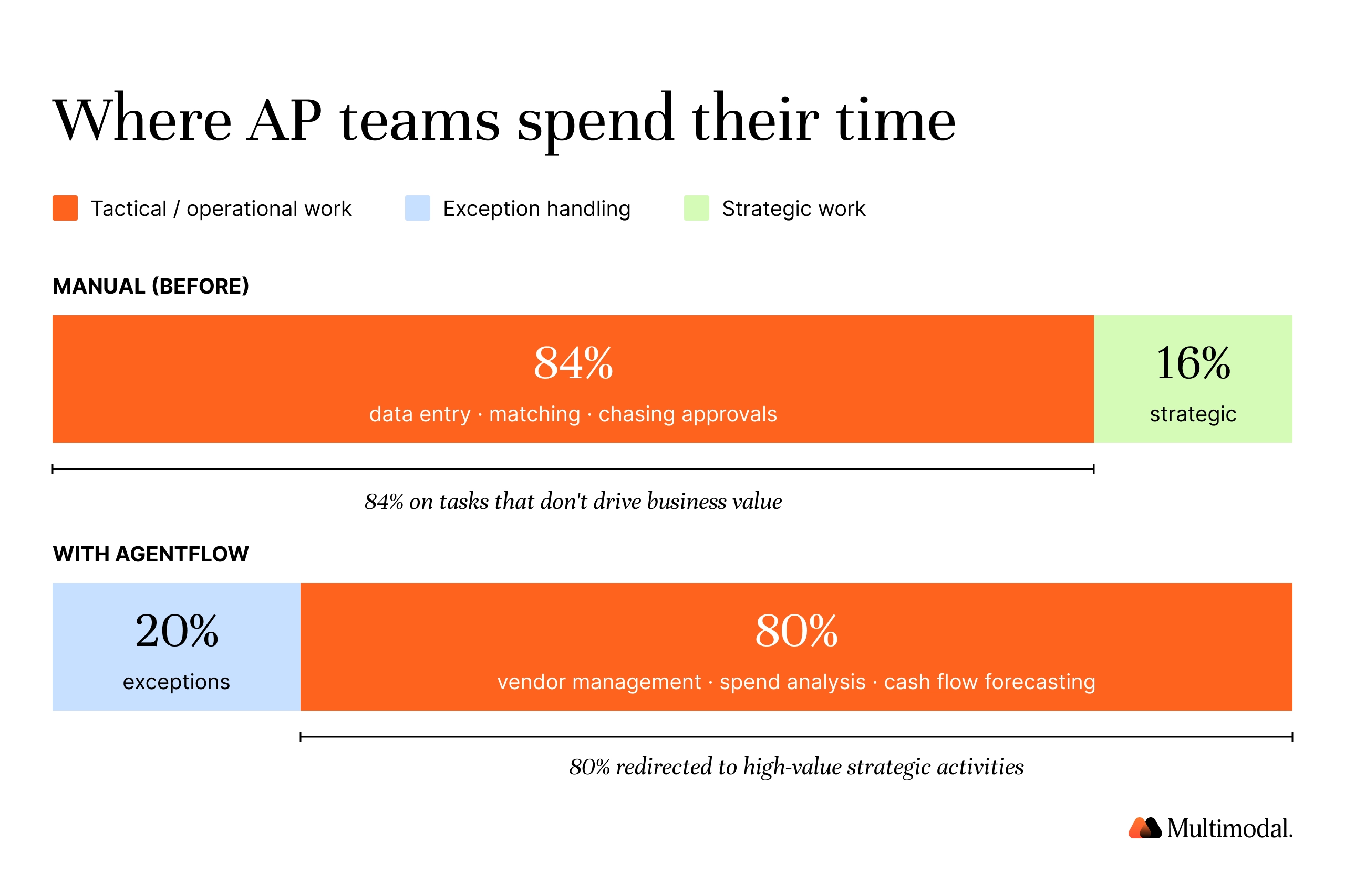
The defining problem in modern AP is not the volume of invoices. It is the manual processes wrapped around each one. Ardent Partners' 2024 State of ePayables benchmark finds that AP staff in the average organization spend 84% of their time on tactical work: data entry, manual three-way matching, chasing down approvals, fielding vendor calls about payment status, and reconciling exceptions. Most institutions still process invoices manually, at least for the long tail of vendor invoices that fall outside their primary procurement system.
The result is an accounts payable system that scales linearly with headcount. When invoice volume grows, the only lever is hiring more AP clerks. Finance teams that try to break the linear relationship with OCR-only invoice automation tools or rules-based RPA find that those systems handle only a narrow band of invoice formats and break down the moment a vendor changes a template.
The True Cost of Manual Data Entry, Approval Routing, and Audit Preparation
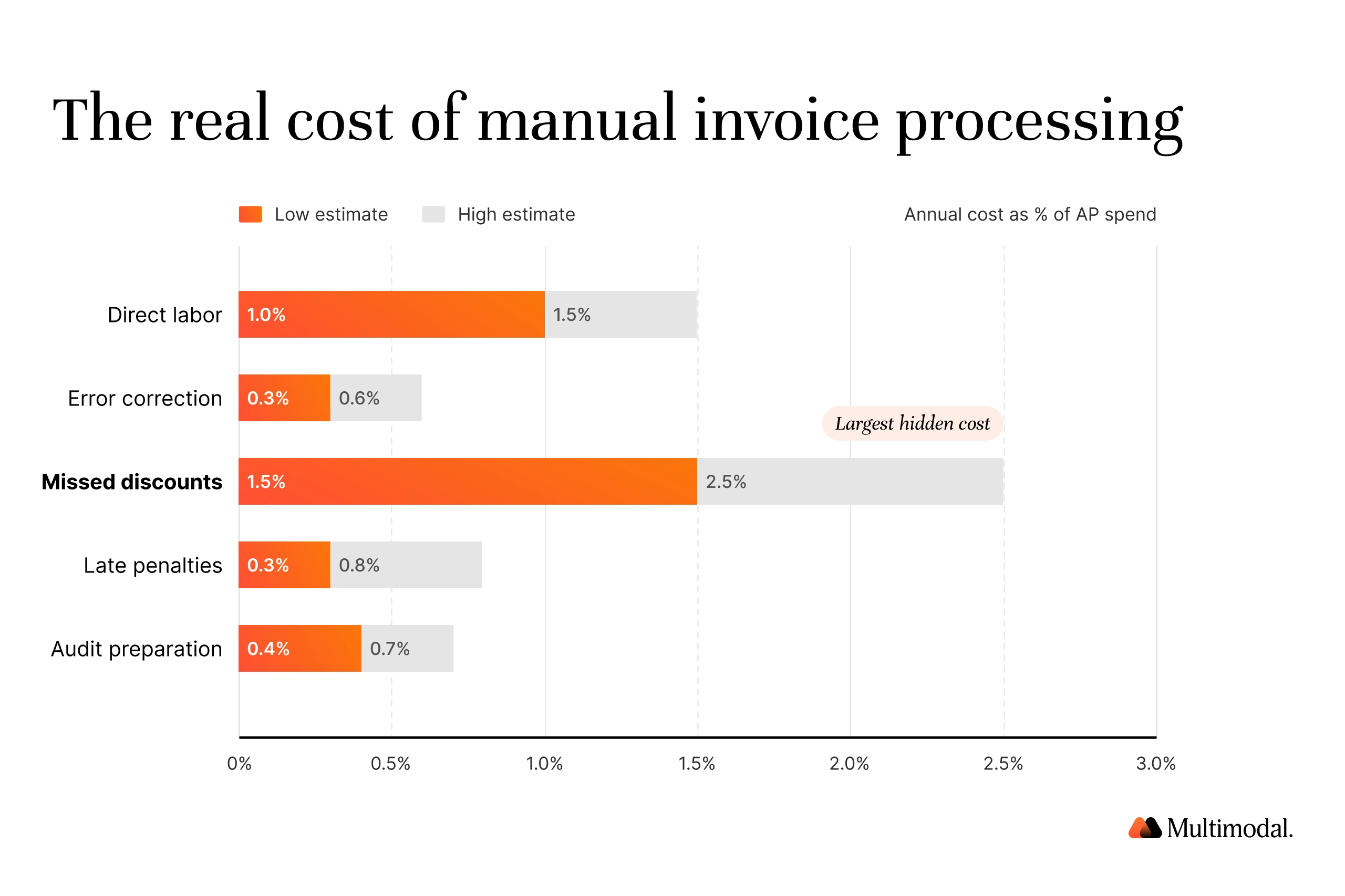
The $15.96 cost-per-invoice figure captures the visible expense. The full cost of manual invoice processing runs two to three times higher when you account for the second-order losses.
Manual data entry and labor costs. A team of 10 AP clerks, fully loaded at $65,000 each, costs $650,000 in salary alone. Most institutions add 10% to 15% to their headcount each year just to keep up with growing supplier invoice volume.
Error correction and duplicate payments. Industry benchmarks place error rates at 1% to 3% per invoice when invoice data is keyed by hand, and each exception costs $53.50 on average to resolve. The Association for Financial Professionals reports that 80% of organizations were targets of payment fraud attempts in 2024, with manual approval processes a primary vector.
Approval routing delays and missed early payment discounts. The average invoice takes 10.4 days to be approved in organizations with manual workflows. Deloitte's finance benchmarking shows that organizations capture less than 20% of the available 2/10 net 30 discounts when invoice approval cycles exceed 5 days. On a $200M annual spend, that is millions in foregone savings every year.
Audit preparation and compliance exposure. Manual invoice processing produces audit risk through scattered documentation (paper invoices, PDFs in shared drives, approval emails) and weakened segregation of duties. Audit preparation alone consumes 40 to 80 hours per quarter for a mid-sized AP function.
McKinsey's 2024 work on finance operations puts the combined cost of manual invoice processing at 1.5% to 2% of total non-payroll spend for the typical mid-market institution. For a $1B-spend organization, the $15-per-invoice problem is a $15M to $20M problem.
Why Traditional Automation (OCR, Rules Engines, RPA) Fell Short
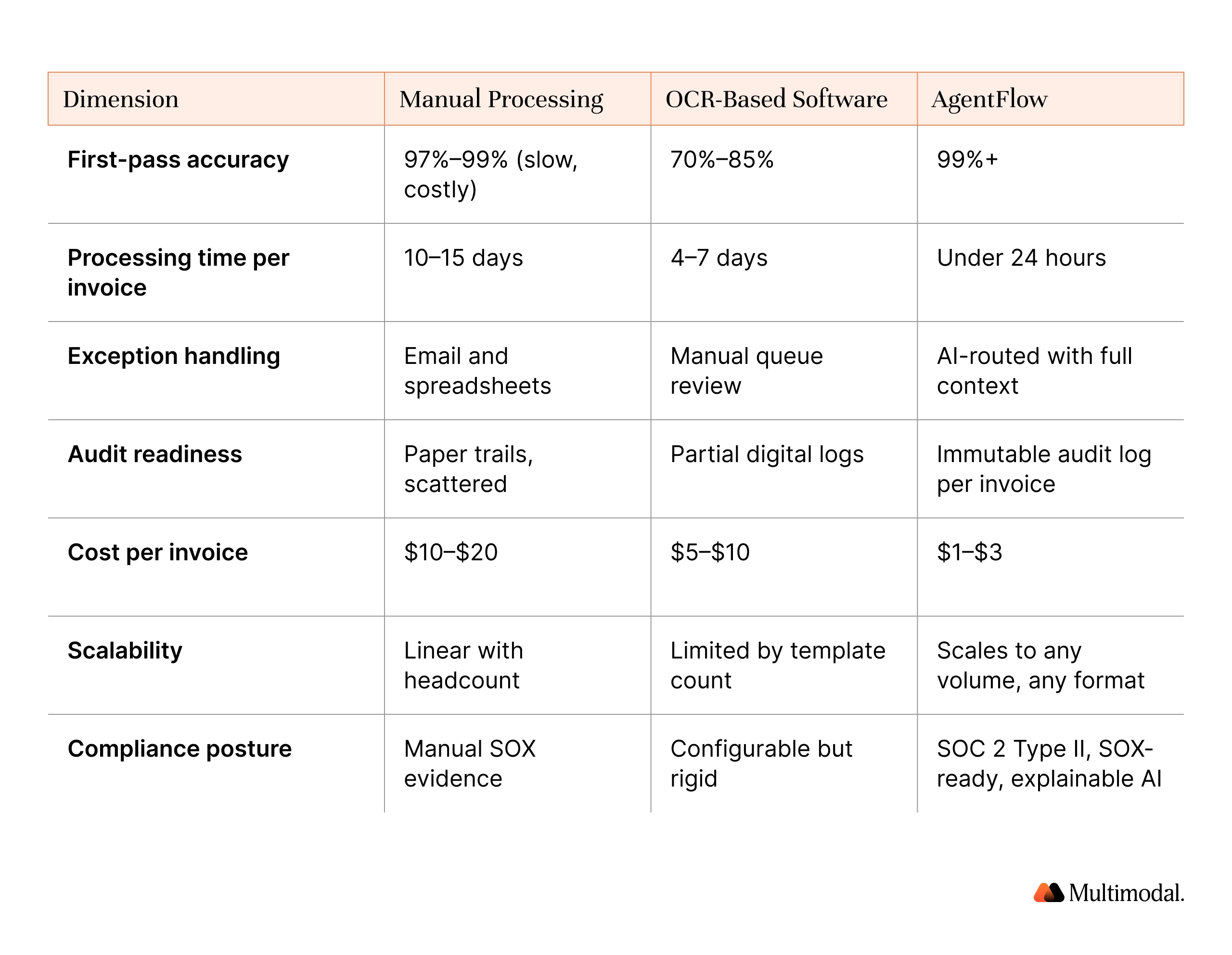
The first generation of invoice automation tools relied on optical character recognition. OCR-only invoice processing software achieves 70% to 85% field-level accuracy in production. At 80% accuracy on ten extracted fields per invoice, the probability of a clean invoice is roughly 11%. Nine out of ten invoices need human review. Rules-based RPA bots break the moment a vendor changes a template or an upstream system updates a screen. These automated systems automate keystrokes but do not work.
What Automated Invoice Processing Actually Means in 2026
Automated invoice processing is the use of agentic AI to ingest, read, validate, route, approve, and post invoices into an accounting system or ERP with minimal human intervention. Modern automated invoice processing systems combine intelligent document processing, machine learning, natural language processing, and rules-driven workflow to replace the manual tasks that AP teams have absorbed for decades.
From OCR to Agentic AI Document Processing
Three AI capabilities define the current generation of invoice automation software.
Intelligent document processing for any invoice format. Intelligent document processing combines optical character recognition, computer vision, and natural language processing to read invoices the way a human AP clerk would. AgentFlow's document processing layer identifies vendor, line items, totals, tax codes, and payment terms regardless of layout, so paper invoices, electronic invoices, scanned PDFs, EDI feeds, and email attachments flow through a single pipeline. Gartner notes that intelligent document processing is now a $2.3 billion market growing at over 35% annually, driven primarily by AP automation use cases.

Machine learning for validation and matching. Once data is extracted, machine learning models compare invoice data to purchase orders, goods receipts, contracts, and historical vendor behavior. The system automatically performs three-way matching, applies business rules at the line-item level, and validates data such as tax jurisdiction, currency, and payment terms. Recurring invoices follow the same pipeline but bypass redundant review when they match an established pattern.
Natural language processing for unstructured context. A meaningful share of invoice exceptions involves unstructured context: an email from a procurement manager confirming a price change, a scanned amendment to a master service agreement. Natural language processing reads that context, links it to the relevant invoice, and either resolves the exception or escalates with a clean summary. For finance teams, this is the difference between a black box and a system they can audit.
The Core Capabilities: Document Intelligence, Decision Support, and Workflow Orchestration
A production-grade automated invoice processing solution combines three layers. Document intelligence handles automated data extraction from any format. Decision support applies business rules, confidence scoring, and validation against purchase orders and existing systems. Workflow orchestration routes approved invoices to ERP posting, payment execution, and reconciliation, with full audit trails at every step.
AgentFlow delivers all three layers as a single platform with pre-built Playbooks for common AP workflows. The Playbook model means finance teams clone, customize, and run a production-ready invoice processing workflow rather than build invoice automation features from scratch.
Where AI Fits in the Invoice Lifecycle (Receipt to ERP Posting)
The invoice management process comprises seven steps: invoice receipt, automated data extraction, data validation, approval routing, exception handling, ERP posting, and payment execution. AgentFlow automates each step end-to-end, eliminating the manual handoffs that historically added time and cost between functions.
.svg)
How AI-Powered Invoice Processing Works Step by Step
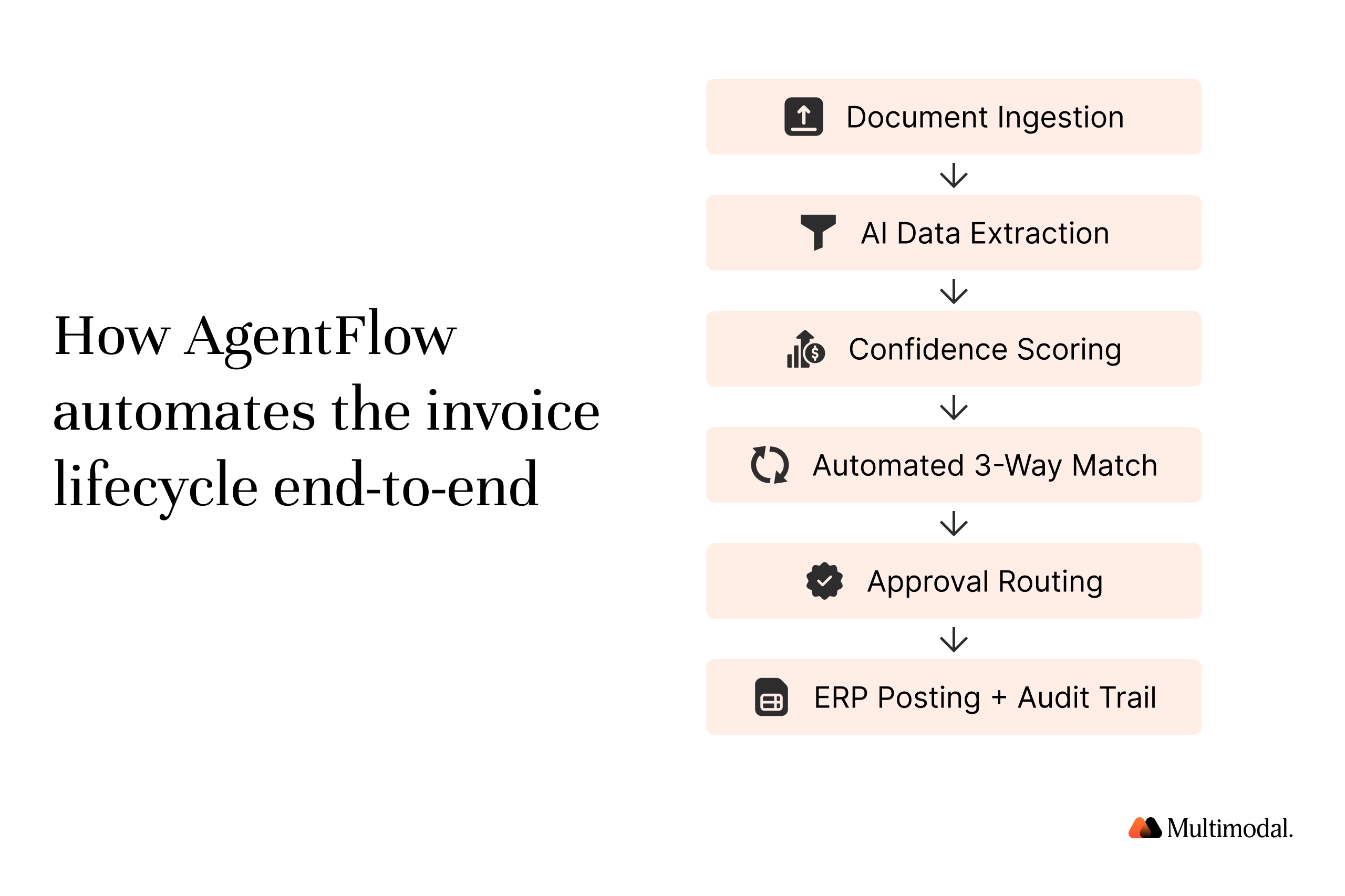
AgentFlow runs each invoice through six steps of invoice processing without manual handoffs.
1. Document Ingestion Across Every Invoice Format
Invoices arrive in dozens of formats: paper invoices scanned to PDF, electronic invoices sent as email attachments, digital invoices pushed through vendor portals, EDI feeds from large suppliers, and photos captured on mobile devices. AgentFlow ingests every format through a single intake layer. Invoice receipt becomes a one-touch event across all channels.
2. AI Data Extraction and PO Matching
AgentFlow extracts vendor, invoice number, dates, line items, quantities, unit prices, totals, tax codes, currency, payment terms, remit-to address, and PO references from every invoice format. Automated data extraction works across structured digital invoices, semi-structured supplier invoices, and unstructured paper invoices with handwritten notes. Extracted data is normalized into the schema that the accounting software expects, so downstream posting requires no translation layer.
3. Confidence Scoring and Exception Flagging
Every extracted field arrives with a confidence score. Fields above the threshold flow through automatically. Fields below the threshold are flagged for human review with full context: the source invoice, the field in question, the system's best guess, and the historical pattern for that vendor. Exception handling becomes targeted rather than wholesale, and AP staff spend their time on genuinely ambiguous cases rather than re-keying data the system already understands.
4. Automated Three-Way Matching
AgentFlow performs 3-way matching automatically by reconciling the invoice against the purchase order and the goods receipt. Tolerance bands are configurable by vendor, by category, and by amount. When the invoice, the PO, and the receipt agree within tolerance, the invoice moves to approval. When they do not, the system routes the exception with the full reconciliation laid out: which fields match, which do not, by how much, and what the historical pattern says.
For finance teams handling tens of thousands of purchase orders a month, automated three-way matching is the single highest-leverage piece of the invoice processing automation pipeline.
5. Approval Routing
Approval routing is governed by business rules: amount thresholds, GL codes, cost centers, vendor risk profile, and entity. AgentFlow routes each invoice to the correct approver, sends SLA reminders, supports mobile invoice approval for executives on the road, and applies delegation rules when approvers are out. The automated workflows compress invoice processing time from 10 days to under 48 hours for the majority of invoices.
6. ERP Posting and Audit Trail
Approved invoices post directly to the ERP or accounting software through pre-built integrations or APIs. AgentFlow writes header, line item, and tax fields cleanly into the GL, attaches the source document, and records every action (extraction, validation, approval, posting) in an immutable audit log. When an auditor or examiner asks for the chain of custody on any paid invoice, the answer is one query away.
"It's helping make things in the back end more efficient, then we can release more value to members." — Andy Mattingly, COO, FORUM Credit Union, Multimodal Pioneers Podcast
Beyond OCR: Why Traditional Invoice Automation Software Falls Short
The choice today is between OCR-era invoice automation tools and agentic AI platforms that handle the full invoice processing workflow autonomously. Three differences separate AI-driven automated invoice processing from legacy OCR.

Context, not just characters. AI agents read invoices the way humans do, using context, layout, and historical patterns. They handle vendor template changes without reconfiguration. Intelligent document processing, built on natural language processing and computer vision, is the technical foundation.
Validation against business rules. OCR extracts fields and stops. AI systems extract, validate against purchase orders and historical patterns, and only forward invoices that pass internal checks. Data validation is part of the same pipeline as data extraction, not a separate manual step.
Adaptive exception handling. Rules-based automation breaks when an exception falls outside the rules. AI-based systems learn from each resolved exception. Over a year of production use, the same automated invoice processing software that started at 85% straight-through processing climbs to 95%+.
Robotic process automation can play a supporting role at the edges, particularly when bridging to legacy accounts payable systems that lack modern APIs. RPA alone is not a substitute for AI-native invoice processing automation.
Manual Processing vs. OCR Software vs. AgentFlow
Invoice Automation for Financial Services: Special Considerations
Banks, credit unions, insurance carriers, and PE-backed enterprises operate under constraints that make generic invoice automation software inadequate. The right invoice automation software for a financial institution has to clear four hurdles at once.
SOX, NCUA, and Bank Examination Readiness
Public companies and financial institutions live under SOX and equivalent regulatory regimes. Every paid invoice must produce a defensible trail: who approved it, under what authority, at what date, with what supporting documentation. AgentFlow's audit log is built for this. Every action by the AI, every approval by a human, every exception and resolution are recorded in an immutable record that finance teams can pull for SOX 404 testing, NCUA examinations, or internal audit.
The NCUA published a formal AI Compliance Plan and AI Resource Hub, updated January 2026, and has hired three dedicated AI officers for the 2025–2026 examination cycle. Automated invoice processing systems deployed within credit unions and banks must align with the NIST AI Risk Management Framework's four core functions: Govern, Map, Measure, and Manage.

Multi-Entity Consolidation and Vendor Risk
Financial services holding companies, insurance groups, and PE platforms run multiple legal entities, often on different ERP instances. The same vendor invoice may need to be posted against different entities, different cost centers, and different chart-of-accounts structures. AgentFlow handles multi-entity consolidation natively, reconciling invoices across entities while preserving the legal separation each subsidiary requires. Vendor master data flows from customer relationship management and procurement systems into AgentFlow, so vendor risk assessments and approved spend categories are applied at invoice creation rather than reconciled downstream.
Integration with ERP and Accounting Systems
The single largest determinant of a successful automated invoice processing rollout is how the software seamlessly integrates with existing systems. AgentFlow's integration capabilities cover three patterns: native pre-built connectors to major enterprise resource planning platforms (SAP, Oracle, Workday, NetSuite, Microsoft Dynamics) and accounting systems; REST APIs for custom enterprise resource planning systems and internal data warehouses; and robotic process automation as a bridge to legacy accounts payable systems without modern APIs.
Building the Business Case: ROI of Automated Invoice Processing
The business case for an automated invoice processing system is one of the cleanest in finance technology. Four categories of cost savings connect directly to metrics the CFO already tracks.

Cost-per-Invoice Reduction and Labor Costs
Cost per invoice falls from $15.96 (manual) to $1–$3 in mature deployments. For a finance organization processing 500,000 invoices annually, that is $5M to $9M in recovered labor costs. AP staff capacity reallocates from manual entry to vendor relationship management, spend analysis, and cash flow forecasting.
Captured Early Payment Discounts and Working Capital Gains
Top-quartile AP organizations close invoices in under three days. Faster invoice processing time means more early-payment discounts captured, better cash flow forecasting, and lower DPO volatility. Capturing even 1/3 of the available 2/10 net 30 discounts on a $200M annual spend yields $1M to $1.3M in recurring savings year over year. PwC's finance effectiveness benchmarks consistently show that invoice processing automation is the single highest-ROI investment available to mid-sized finance functions.
Risk and Compliance Outcomes
Automated systems produce a clean audit trail for every paid invoice. Error rate reductions from 1%–3% (manual) to under 0.5% (AI-driven) translate to $53.50 in saved exception cost per error avoided. Duplicate payment risk drops sharply when machine learning models flag invoices that match historical vendor patterns within tolerance bands.
ROI Calculator: Inputs and Outputs
The ROI model has four inputs and four outputs:
Inputs. Monthly invoice volume (pull from the ERP), current cost per invoice (use $15.96 as baseline if internal figure unavailable), current error rate (1%–3% for manual entry), and current invoice processing time (days from invoice receipt to ERP posting).
Outputs. Annual processing cost savings, hours per week recovered for AP staff, error and exception cost reduction, and captured early payment discounts. The combined ROI on a well-implemented invoice automation solution typically pays back within 12 months, often within 6 months for institutions with high invoice volume.

Our AI ROI calculator estimates your company's payback period and cost savings with our market-leading document processing API.
Multimodal Customer Outcomes in Adjacent Document Workflows
AgentFlow's production track record in document-heavy back-office workflows demonstrates the accuracy and speed thresholds that apply to AP:
- FORUM Credit Union deployed AgentFlow and achieved 70% faster loan processing, 99% accuracy, and full audit readiness, with 60% of consumer loans automated end-to-end.
- Direct Mortgage Corp. reduced loan processing costs by 80% using AgentFlow.
These results come from lending workflows rather than from AP, but they reflect the same document intelligence and workflow orchestration that drive invoice-processing automation outcomes. Forward-deployed engineering and pre-built Playbooks compress time-to-go-live to under 90 days for the first workflow.
Implementation Realities: What Financial Institutions Get Wrong
Three implementation realities separate successful automated invoice processing deployments from stalled ones.
The Pilot Trap and Why Most AP AI Projects Stall
Many institutions launch ambitious pilots that try to automate every invoice format, every entity, and every approval process variation on day one. The pilots stall because scope outpaces data readiness. Higher-performing teams pick the largest, cleanest segment of invoice volume first (typically PO-backed invoices from top vendors) and expand from there. McKinsey's 2024 finance operations work finds that AP automation programs scoped this way reach payback in 6 to 9 months versus 18+ months for big-bang deployments.
Platform vs. Point Solution: Making the Architecture Decision
Point-solution invoice processing software handles one workflow well and integrates poorly with the rest of the AP and finance stack. Platform automation software handles invoice automation as one of several connected accounts payable workflows: invoice receipt, expense report matching, payment execution, vendor onboarding, and procurement integration. AgentFlow is built as a platform, with Playbooks that share a common data model, audit architecture, and integration layer.
Change Management and AP Team Adoption
AP staff who have spent years on manual entry need a clear path forward. The best implementations reframe the role from data entry to exception handling and vendor relationship management, work that is more strategic and more retention-friendly than processing invoices manually. Andy Mattingly's framing applies directly: AI in the back end frees the team to release more value upstream.
The Regulatory Dimension: AI, SOX, and Model Risk in AP
Compliance-ready AI for AP differs from general-purpose AI in three architectural ways.
SOX, NCUA, OCC, and Emerging AI Guidance
The OCC's 2024 guidance on third-party risk management explicitly addresses AI vendors used in financial operations. The NCUA's AI Compliance Plan covers all AI deployments in credit unions, including back-office invoice management process automation. Public companies running AP through AI need to document control points for SOX 404, including segregation of duties between AI extraction, human approval, and ERP posting.
Explainability and Model Governance for AP
Explainable AI matters for audit defensibility. When an examiner asks why the system approved an invoice, "the model said so" is not a defensible answer. AgentFlow surfaces the specific rules, validations, and confidence scores behind every decision, so finance teams can defend every step of the invoice management process. Model risk management documentation (training data lineage, drift monitoring, retraining cadence) supports model governance reviews.

How Compliance-Ready AI Differs from General-Purpose AI
General-purpose AI tools are not built for regulated finance environments. Compliance-ready invoice automation features include role-based access controls, encryption in transit and at rest, immutable audit logs, deployment in a private cloud or VPC, SOC 2 Type II reports, and ISO 27001 certifications. AgentFlow ships with these capabilities as defaults rather than as add-ons.
What's Next: The Trajectory of Automated Invoice Processing
Three trends will reshape AP automation over the next 24 months.
Agentic AI and Autonomous AP Workflows
Autonomous invoice processing means the AI handles end-to-end execution and only escalates the genuinely ambiguous cases. Agentic AI extends invoice processing automation beyond data extraction into reasoning about exceptions, vendor disputes, and edge-case approvals. AgentFlow's Playbook model is the operational expression of agentic AI for AP: the system runs the workflow, the human owns the exceptions.
Real-Time Cash Flow Intelligence
The next generation of AP automation feeds real-time cash flow intelligence. When invoice data, approval status, and payment timing flow into a single system, treasury teams forecast cash flow with higher accuracy, and finance leaders model working capital scenarios in hours rather than weeks.
Convergence of AP, Procurement, and Treasury AI
The artificial line between procurement, AP, and treasury dissolves when one platform handles purchase orders, invoice receipt, approved invoices, payment execution, and reconciliation. The convergence creates the foundation for proactive vendor management, dynamic discounting, and fraud prevention that today's siloed automated systems cannot deliver.
.svg)


FAQs
What is automated invoice processing?
Automated invoice processing is the use of AI to ingest, extract, validate, route, approve, and post invoices into an ERP or accounting system with minimal human intervention. Modern automated invoice processing systems combine intelligent document processing, machine learning, and natural language processing to handle any invoice format end-to-end.
How much does automated invoice processing save?
Automated invoice processing reduces cost per invoice from $15.96 (manual) to $1–$3 in mature deployments. For a financial institution processing 10,000 invoices per month, that is $1.5M to $1.8M in recurring annual labor cost savings, before captured early payment discounts and reduced exception costs. Most institutions reach payback within 12 months.
How does automated invoicing work in practice?
Invoices arrive through email, vendor portals, EDI, or scanning. The software extracts invoice data, validates it against purchase orders and contracts, routes the invoice to approvers based on business rules, and posts the approved invoice to the accounting system. Exception handling routes problem invoices to humans with full context.
Can AI handle handwritten invoices?
Yes. Modern automated invoice processing systems built on intelligent document processing and computer vision read handwritten invoices, scanned PDFs with annotations, and mixed-format documents that combine printed and handwritten content. Field-level accuracy on handwritten content is lower than on typed content, which is why confidence scoring and exception routing matter.
How long does implementation take?
Modern invoice automation software can go live in under 90 days for a first workflow. A practical first milestone is a pilot covering one entity and the top 50 vendors, expanding to full coverage over the following two quarters. AgentFlow's Playbook model compresses deployment further by starting from a pre-built workflow rather than a blank canvas.
Is automated invoice processing compliant with SOX?
Most clients are live in 6–12 weeks, depending on deployment complexity and integrations. We provide implementation support, onboarding, and validation every step of the way.Yes, when implemented correctly. AgentFlow produces an immutable audit trail for every paid invoice, including data extraction, validation, approval, and posting actions. Segregation of duties, role-based access controls, and explainable AI documentation support SOX 404 testing, NCUA examination, and OCC reviews. Reputable invoice automation software vendors provide SOC 2 Type II reports and ISO 27001 certifications.
What integration capabilities should invoice automation software have?
The minimum viable set includes native connectors to major ERP and accounting systems (SAP, Oracle, NetSuite, Workday, Microsoft Dynamics), REST APIs for custom enterprise resource planning systems, two-way sync with vendor master data and procurement systems, and integration with payment execution platforms. Robotic process automation can serve as a bridge to legacy accounts payable systems lacking modern APIs.
What is the difference between OCR and AI invoice processing?
OCR reads characters off a page. AI invoice processing reads invoices the way a human reads them, using context, layout, and historical patterns to extract data accurately across any invoice format. OCR-only invoice processing software achieves 70%–85% accuracy at the field level. AI-driven invoice automation tools built on agentic AI achieve 99%+ on first pass and improve over time.
What are the benefits of automated invoice processing for financial services?
The four primary benefits of automated invoice processing are cost savings (cost per invoice falls 70%–90%), faster invoice processing time (10 days to under 24 hours), better cash flow management through captured early payment discounts, and a stronger audit and compliance posture for SOX, NCUA, and OCC examinations. Each benefit ties to a metric finance teams already report on.
How does AgentFlow handle invoice exceptions?
AgentFlow assigns confidence scores to every extracted field. Fields above the threshold flow through automatically. Fields below the threshold route to a human reviewer with full context: the source invoice, the field in question, the system's best guess, and the historical pattern for that vendor. AP staff resolve exceptions in minutes rather than rebuilding the invoice management process by hand.
Calculate Your Invoice Processing Savings
Book a 30-minute proof-of-Most finance teams underestimate the impact of automated invoice processing on working capital and labor costs until they see their own numbers. Use the AgentFlow ROI Calculator to model your invoice volume, current cost per invoice, error rate, and processing time against the AgentFlow benchmark. Then walk through the deployment plan with a Multimodal forward-deployed engineer.concept. We'll configure a playbook for your workflow, run your actual documents live, and show you production-ready output, not a slide deck.
.svg)
.svg)