

.svg)
.svg)

.svg)
This is a summary of an episode of Main Street AI, an educational podcast on AI led by our founder. Join 3,700+ business leaders and AI enthusiasts and be the first to know when new episodes go live. Subscribe to our newsletter here.
TL;DR:
- Citadel Credit Union expanded its charter in February 2026 to Pennsylvania and seven surrounding states, making digital the only front door in most new markets
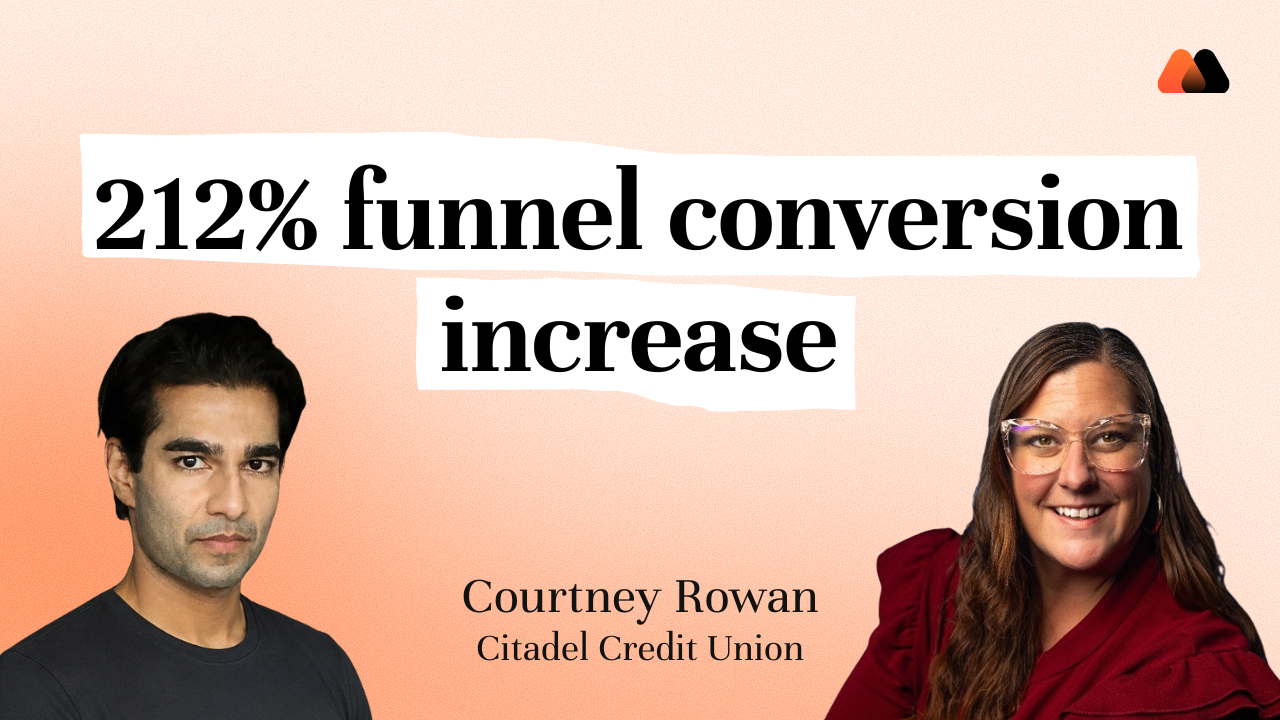
- Previous onboarding took 28 minutes with high drop-off. Non-documentary switch produced 212% more funnel conversions and 58% faster application cycle time
- CDP and CXP being built together to move from segment-level personalization to individualization
- Innovation Steering Committee: governance, education, and use-case enablement as the three pillars
- Active members log in 18 times a month minimum: digital is the relationship, not a channel
Before we dive into the key takeaways from this episode, be sure to catch the full episode here:
Digital as the Only Front Door
When Citadel Credit Union expanded its charter in February 2026 from a five-county Philadelphia metro footprint to all of Pennsylvania and seven surrounding states, the stakes for digital changed completely.
"There's a lot of spaces that today we don't have physical branch presence. And so leading with digital becomes essential. That first impression has to be immensely positive and the stakes of getting it right when digital is truly your only touch point."
For members in counties where there is no branch, digital is not a convenience layer. It is the entire relationship. Courtney Rowan has spent 27 years at Citadel watching digital go from a disk-based experiment in the late 1990s to the institution's primary growth engine. The charter expansion compressed that responsibility into a clear mandate: get the digital member experience right before growing into markets where a branch visit cannot recover a bad first impression.
"Today, for many members, digital is Citadel only. The biggest lesson across those 27 years is that technology alone never won. The real shift wasn't the tools, it was aligning the people, rewiring the processes, and building the discipline around the experience."
Chatbot deployment has reached 45% of credit unions by 2025, up from just 3% in 2019 according to Financial Brand, but most institutions are still thinking in channels. Citadel's transformation is built on a different premise: stop thinking in channels and design for an integrated experience across all of them.
Onboarding Was the Leak in the Funnel
Before the transformation, onboarding took 28 minutes to complete and the funding rate reflected how many members were abandoning before they ever got money into the account. The problem was not the platform. It was the assumption that paper-based verification was necessary.
"A lot of credit unions, I think, that don't have the capability are still a lot of paper-based. They might have a digital application, but they're still collecting signatures, they're waiting for IDs. How do you let the technology sort of lead with that?"
The fix was non-documentary onboarding: removing document upload requirements from the standard path and letting identity verification technology run more sophisticated checks invisibly in the background.
"Not only was it a frictionless experience, it's actually more safe. When you have this technology working behind the scenes, they're doing wildly more checks on who you are as a human than me looking at your ID."
The results after launch:
- 212% year-over-year increase in funnel conversion
- 123% increase in digital account funding
- 286% year-over-year growth in digital prospects
- 58% reduction in application cycle time
- New member applications completed 25% faster
- Existing member additions completed 73% faster
- 116% year-over-year growth in low-cost deposit accounts
Step-up verification still exists for applications that need it: members can upload an ID photo or complete a selfie check digitally. The paper is gone from the standard path.
The CDP: From Segments to Individuals
The next layer of the transformation is a customer data platform and customer experience platform being built simultaneously. Courtney made the decision to evaluate them together because they have to work together.
Before the rebuild, Citadel had email, push notifications, digital banking, and phone systems all running on disparate platforms, none communicating with each other. "Lots of data, but none of it sort of together. Lots of data, no unified brain."
The CDP solves data unification. The CXP solves execution. Together they enable what Courtney calls the shift from personalization to individualization.
"Personalization probably segments today. You are a new homeowner. You are in this income bracket. But the data that comes in with the AI to stitch all of that together, now I really know you. It's no longer you're in this group, here's what we think you want. It's we see you. We know your behavior and your context and so we're going to respond to that uniquely."
Active Citadel members log in a minimum of 18 times a month, most once a day. Every login is a behavioral signal. A segment-level response wastes it. An individualized one, surfacing the right product or guidance at the right moment, is what makes digital banking feel less transactional and more like being known.
How Citadel Selected Its New Stack
The vendor evaluation process is a repeatable blueprint. Audit current partners first: are you using everything they offer? Gap analysis next: what are you trying to accomplish that the current stack cannot do? RFP and four-to-five-week bake-off, evaluating CDP and CXP side by side. KPI modeling before committing spend.
"We can keep plugging the holes in the wall, but why don't we just rebuild it? Let's start from scratch and get this right."
The Innovation Steering Committee
AI was generating hallway conversations across Citadel in different directions with no shared framework. The response was formal: an Innovation Steering Committee anchored in the strategic plan, focused first on AI, designed to expand to whatever comes next.
"We knew that these technologies were coming. AI, stablecoin, who knows what quantum is going to be. Some, depending on where you're at in the stage, you need a plan for a plan, or this is happening, we need to go."
The structure has two layers. An executive leadership subset sets top-level strategy. An operational layer of roughly 15 people drawn from existing AI champions across departments owns day-to-day execution. A consultant supports the methodology.
Three pillars govern the work: governance that defines what is permitted rather than what is not; education that meets employees across the full spectrum of comfort with AI; and use-case-driven enablement that proves value before scaling.
"It's not you can't, it's hey, you can, but stay within here."
On the employee fear question, Courtney is direct.
"You see all these headlines, AI, we're able to let go of people because of AI. No, you're probably over hired and you're using that as a landing point. Because if you're using it right, it should be a production assistant. I might freeze head count because I don't need to hire more, but come on."
"Co-pilot's called co-pilot for a reason. It's co-pilot, like you're the pilot, it's helping you."
How This Works in Practice
Citadel Credit Union rebuilt its digital onboarding from a 28-minute, paper-heavy process into a non-documentary, frictionless experience. Moving to background identity verification eliminated the standard document upload requirement while running more rigorous checks than manual ID review. The results landed within the first year: 212% increase in funnel conversion, 123% increase in digital account funding, and a 58% reduction in application cycle time.
"We knew once we could get you in, we could wow you. But if you don't get that part right, forget about it."
— Courtney Rowan, Citadel Credit Union
Multimodal builds purpose-built AI agents for banks and credit unions on Jack Henry, Fiserv, and Symitar. If your institution is evaluating where AI fits in its onboarding or member experience workflow, the platform comparison is a practical starting point.
Want more on financial services and AI? Check other episodes here.
Frequently Asked Questions
1. What is credit union digital transformation?
The shift from digitizing existing processes to fundamentally reimagining how a credit union serves members through connected technology, clean data, and AI. At Citadel, it meant rebuilding onboarding, consolidating the martech stack into a CDP and CXP, expanding the charter into eight states, and formalizing AI governance through an Innovation Steering Committee.
2. /How do credit unions improve digital onboarding?
By removing documentary friction from the standard path. Non-documentary onboarding uses background identity verification that runs more checks than manual ID review while eliminating upload requirements for most applicants. Citadel's switch produced a 212% increase in funnel conversion and a 58% reduction in application cycle time.
3. What is a customer data platform and why do credit unions need one?
A CDP unifies member data from disparate systems into a single profile that updates in real time. Without it, credit unions respond to members based on segment. With it, they can respond to what a specific member is doing right now. Paired with a customer experience platform, a CDP is what enables the shift from personalization to individualization.
4. How should credit unions govern AI adoption?
Start with three pillars: governance that defines what is permitted rather than what is not, education that meets employees across the full spectrum of comfort, and use-case-driven enablement that proves value before scaling. Citadel's Innovation Steering Committee brings executive alignment at the top and operational champions at the delivery layer.
5. What is the difference between personalization and individualization in banking?
Personalization responds to what a segment of members typically needs. Individualization responds to what this specific member needs right now, based on actual behavior and context. The gap between them is a unified data layer. Most credit unions are at the segment level. The ones building CDPs and agentic AI workflows on top of clean data are moving toward individualization.
6. How do credit unions compete digitally without big bank budgets?
By being more precise with the resources they have. Credit unions hold deeper member relationships and richer behavioral data than most fintechs. The competitive advantage is not spend, it is turning that data into individualized experiences faster. Getting onboarding right first, as Citadel did, creates the acquisition volume that funds the next layer of transformation.


.png)