

.svg)
.svg)

.svg)
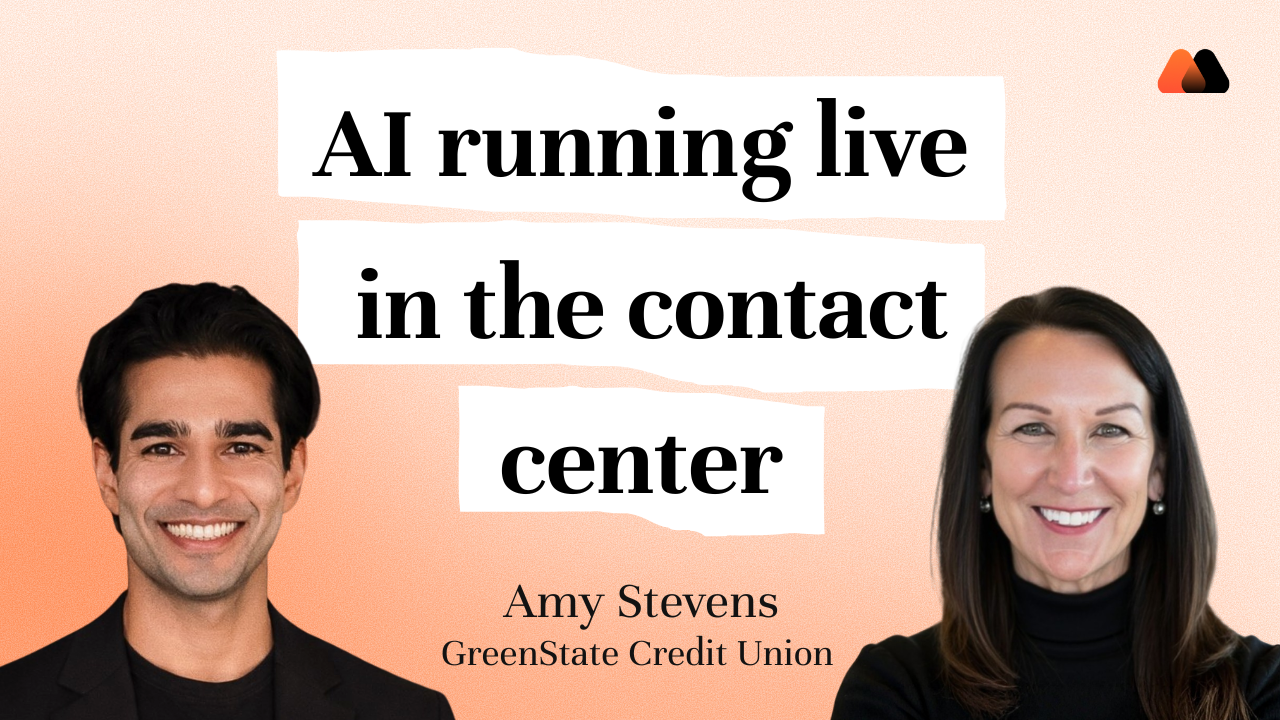
This is a summary of an episode of Pioneers, an educational podcast on AI led by our founder. Join 3,700+ business leaders and AI enthusiasts and be the first to know when new episodes go live. Subscribe to our newsletter here.
TL;DR:
- Green State: largest credit union in Iowa, 20th largest in the US, $11B in assets, 450,000 members
- First major AI win was internal: a 13-minute call now scored in 30 seconds
- Real-time sentiment analysis turns red calls green with measurable agent improvement
- Voice biometrics just launched: authentication without interrogating members
- Digital members are among the most profitable segments
- Agentic AI is on the roadmap for low-risk transactions, with human handoff built in
- Five-year target: frictionless member experience, ethically built AI, values-aligned infrastructure
Before we dive into the key takeaways from this episode, be sure to catch the full episode here:
Digital Members Are Not the Threat. They Are the Most Profitable Segment.
The standard framing of AI in banking positions digital as a branch replacement. Amy Stevens rejects that entirely.
"We want to be both. We think human and digital go together."
At Green State, a new member might open an account in a branch, migrate to the contact center for ongoing service, and eventually become primarily digital, returning to a branch only for a loan or a complex financial conversation. Every in-branch signup is simultaneously enrolled in online banking. The goal is to make the next channel frictionless, not to push members away from any particular one.
The economics validate the approach. Digital members turn out to be among the most profitable in the portfolio. This is not a trade-off between human and digital. It is a both/and growth strategy with data behind it.
The First Big AI Win: A 13-Minute Call Scored in 30 Seconds
Before AI entered Green State's contact center operations, quality management ran on manual sampling. The team could never get to a statistically representative review of agent calls. Volume was too high, process too slow.
"By introducing AI tools within quality management, all of a sudden we were listening or reading transcripts and scoring them, 13-minute call in 30 seconds."
Members never noticed the change directly. What they noticed over time was a measurable improvement in service quality.
What Unlocks Downstream From Faster Call Scoring
Speed is the surface benefit. The deeper value compounds quickly:
- Every agent's calls can now be reviewed, not just a random sample
- Recurring soft-skill or technical gaps become visible at the individual and department level
- Coaching plans are built from actual call data rather than manager instinct
- Training gaps in specific product knowledge surface across the team, not just one agent
This is what AI quality management actually unlocks at scale: the institution gets smarter about its own service delivery in ways that were structurally impossible before. According to research, 40% of organizations now view customer service automation as the most valuable application of generative AI in the contact center, and quality scoring is a key driver of that view.
Real-Time Sentiment Analysis: Turning Red Calls Green
The most visible AI in Green State's contact center today is the sentiment layer that guides agents mid-call. Agents see in real time whether a member is green, amber, or red, and can respond before the conversation deteriorates.
"It's fantastic that you can see that they're green or that they're amber or that they're red, and you've got to de-escalate now."
Stevens points to the reverse path as the real reward: a call that starts red and ends green.
"There's so much reward in creating that happy ending. Seeing that it came in red and now it ended in green, and seeing that they were pretty neutral, but you changed their perception, and they were thanking you."
That data closes the loop on agent coaching and validates the work agents are doing in real time, which matters for morale and retention in high-volume environments.
Voice Biometrics: Authentication Without the Interrogation
The week of the recording, Green State launched voice biometrics for member authentication. The design principle is simple: members should not feel interrogated to prove who they are.
"Nobody wants to be interrogated. They want to know that their credit union is going to protect them, but not do it at the risk of a poor member experience."
Voice biometrics handles identity verification passively while the member is already speaking. No security question gauntlet. The protection is real; the friction is removed. This matters more than it might seem: roughly 6% of inbound calls to call centers were considered high-risk for fraud in 2024, more than double the rate in 2022, making authentication both a security priority and a member-experience priority.
The Agentic AI Roadmap: What Crawl, Walk, Run Actually Means
Stevens is specific about where Green State is heading with agentic AI in banking and where it is not going yet.
The first candidates for fully AI-handled transactions are low-risk, member-initiated, predictable interactions: CD renewals, loan payoffs, routine account actions. Each one creates a case in Salesforce so a human can pick up if anything falls outside the expected flow.
"We're going to crawl, walk, run. We're going to have some controls in place so that we're monitoring our AI."
On the employee question, she is unambiguous. "It's really the latter, augmenting our people." Her framework for all member experience is three components working together: people, processes, and technology. AI fits as an amplifier of the first, not a substitute for it.
Why the Salesforce Handoff Matters
Building a human handoff into every agentic workflow is not a hedge. It is the architecture. An AI agent handling a CD renewal that hits an unexpected condition, a member with a question outside the script, a transaction that flags for review, all of these need a clean path to a live person with full context. The Salesforce case creation ensures that context travels with the handoff. The member does not have to start over.
The Five-Year Vision: Frictionless, Ethical, and Generationally Ready
Looking five years out, Stevens frames the goal in member terms: whatever channel, whatever moment, the experience should have no unnecessary friction.
The harder and more interesting piece is ethical. Younger members are already evaluating financial institutions through a values lens that includes how AI is built and powered.
"They might be actually going to ChatGPT and asking what's the most responsible, socially and environmentally sound credit union or financial institution."
Data center energy consumption. Responsible AI sourcing. Community impact of automation decisions. These are not abstract concerns for the next generation of members. Green State is building its AI roadmap with those signals in mind.
"I want us to be responsible in using AI for protecting our members, benefiting our communities, taking care of our employees, and mostly for serving our members."
Want more on credit unions and AI? How Wescom Credit Union rebuilt a failed Copilot rollout into a contact-center operating system, ft. Hashim Forrester
Frequently Asked Questions
1. How is Green State Credit Union using AI in its contact center?
Green State is running AI in production across three areas: automated quality management that scores 13-minute calls in 30 seconds, real-time sentiment analysis that guides agents mid-call with green, amber, and red signals, and voice biometrics for passive member authentication. Agentic AI for full member transactions is next on the roadmap, starting with low-risk interactions like CD renewals and loan payoffs.
2. What is real-time sentiment analysis in a credit union contact center?
It is a layer of AI that monitors calls in real time and flags the emotional tone for the agent: green for positive, amber for neutral, red for escalating tension. The agent sees the signal and can respond before the call deteriorates. At Green State, the same data is used to validate agent performance and to build coaching plans based on real call outcomes.
3. How does voice biometrics work for member authentication?
Voice biometrics identifies a member passively by analyzing their voice while they are already speaking, without requiring them to answer a series of security questions. The member is authenticated in the background of a natural conversation. Green State launched this specifically to remove friction from the authentication process while maintaining strong identity protection.
4.Will AI replace contact center agents at credit unions?
According to Amy Stevens, no. The role of AI at Green State is augmentation: handling predictable, low-risk transactions so human agents can focus on complex, emotionally charged interactions that require judgment and empathy. Every agentic workflow has a human handoff built in for anything outside the expected flow.
5. How should credit unions approach ethical AI?
Stevens frames ethical AI as a values commitment, not a compliance checkbox. Younger members are already researching which institutions use AI responsibly, including concerns about data center energy use and community impact. Credit unions that treat responsible AI as a core part of their identity will be better positioned with the next generation of members than those treating it as a regulatory requirement.