

.svg)
.svg)

.svg)
This is a summary of an episode of Pioneers, an educational podcast on AI led by our founder. Join 3,700+ business leaders and AI enthusiasts and be the first to know when new episodes go live. Subscribe to our newsletter here.
TL;DR:
- $100M to $425M in assets, 12 years, entirely organic, starting from a low net-worth ratio
- 41 competing institutions in the same market
- $10K employee fund, no approval needed, 3,000 stories a year
- 97% human interaction rate after deploying ITMs
- Biggest AI concern: member-owned bots, not competitor tech
- Board mandate from day one: build a perpetual organization
Before we dive into the key takeaways from this episode, be sure to catch the full episode here:
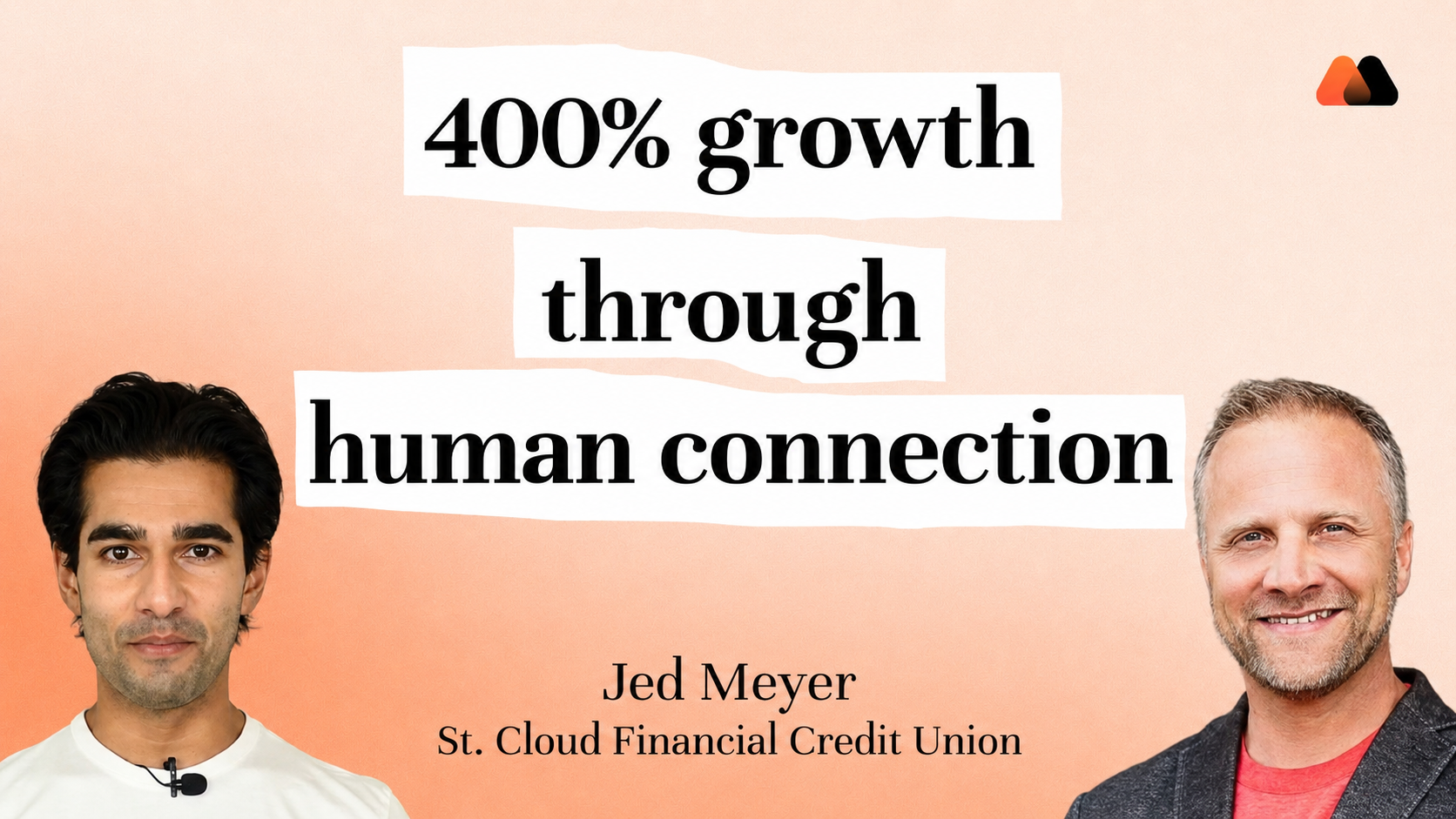
Price Gets Them In. Experience Keeps Them.
Most credit unions are fighting the wrong battle. Meyer maps every banking decision to four levers: price, convenience, service, and experience. Big banks own the first two. Fintechs are closing the gap on service.
That leaves experience, and it is exactly where the credit union model has a structural edge most institutions never fully use.
"If I get them here on price, unless I give them a different reason to stay, they are going to leave for price."
Context makes this sharper: at the median, membership declined 0.5 percent across federally insured credit unions through 2025, and most growth is concentrated in the largest institutions. St. Cloud Financial, a five-branch institution starting from a low net-worth ratio, quadrupled while the median credit union shrank. The difference was not a better app.
Younger members are accelerating this dynamic. Meyer sees Gen Z and millennials choosing financial institutions based on values, community investment, and institutional character, not just rates. The credit union model was built for that. Most just are not playing to it.
The $10K Fund Any Teller Can Spend, No Questions Asked
This is the most concrete example of credit union member engagement done right. The Meaningful Difference program gives every St. Cloud Financial employee access to a $10,000 fund, at any time, for any member, with no manager approval required.
Two rules:
- It has to be legal and ethical
- They have to share the story
Meyer's peers warned him the fund would be empty by day one. His response: "No, they won't. Because they have to share the story with the CEO. I think it is going to be hard to get them to do anything because they won't think their story is worthy enough."
He was right. It took five years to spend $10,000 in a single year. They now log around 3,000 stories annually.
Why the Storytelling Requirement Is the Real Engine
The money is almost irrelevant. The requirement to share what they did turns individual acts of service into institutional memory. It gives every teller a direct stake in the credit union's identity, with the authority and budget to act on it immediately. No escalation ladder. No manager sign-off. That is not easy to replicate at a $5 billion institution, and that is the point.
ITMs Did Not Replace Humans. They Replaced the Tube.
Deploying interactive teller machines across all five branches seemed contradictory for an institution built on human connection. Meyer's position: it was not one.
"The only thing I changed was the tube."
After the rollout, 97% of drive-through interactions were still live humans, over video instead of glass. During the first remodel, Meyer placed ITM operators physically behind the drive-through window so members could see a real person the moment they connected. Cost savings went directly back into human capital: more staff, new products, expanded services.
2 Questions Every Credit Union Should Ask Before Any Tech Purchase
- Does it reduce friction in transactions members do not want human involvement in?
- Does it free up staff for the interactions that actually matter?
If the answer to both is no, it is a distraction regardless of the vendor pitch.
The AI Strategy Most Credit Union Leaders Are Getting Wrong
St. Cloud is in early AI deployment in banking, with Meyer's CTO completing a 12-week MIT program. The philosophy is already clear.
"How is AI an extension of me? How is it 10x-ing Jed, not replacing Jed? That is where it gets impactful."
On open AI access for frontline staff without guardrails: "If I give my frontline staff full range of ChatGPT, I am giving my 16-year-old a Lamborghini and asking her not to go over 35 miles an hour. There has to be an identity context for AI to deliver a human experience."
The Consumer AI Problem Nobody Is Discussing
Meyer's real concern is not which competitor adopts AI fastest.
"I am more worried about what happens when consumers have their own AI bots managing their money. Programmable money in DeFi; AI handles all transactions. How do I build a human connection with that?"
That is the question the credit union industry needs to answer before 2030, not after.
Why Waiting on Apple Pay Was the Right Call
Around 2015, trade publications were declaring that credit unions without Apple Pay would not survive. Meyer's team did the integration prep and identified the partner, then waited three years until members actually wanted it.
"If you do the work before you have to, it creates future doors you can walk through with less human capital."
He calls it "directionally ready": prepared to move fast without moving before the signal is clear.
How a Speedboat Competes Against Cruise Ships
"I am competing with cruise ships. They are really hard to turn. I am a speedboat. I can call a special meeting within 20 minutes and make an important decision."
The equivalent at a $5 billion institution takes 40 people and three months. That gap does not disappear when a big bank hires a chief AI officer.
The member intelligence advantage compounds this further. St. Cloud sends 20,000 emails for its annual survey and gets 2,500 responses, a 12 to 14% response rate. Meyer knows exactly what his members want. A large bank with millions of customers cannot say the same.
The 5-year target:
- 50,000 members
- $1 billion in assets
- Expansion into digital asset custody, cannabis banking, Sharia-compliant products, and a financial safety partnership with domestic abuse shelters via CU Safe
Every product starts with a member's need. Technology follows.
The Mandate That Shapes Every Decision
When Meyer joined, the board gave him one charge: build a perpetual organization, one capable of serving the community a hundred years from now. Every decision since has been tested against that horizon. Not the next quarter. Not the next product cycle. The next century.
The credit union has 96 years behind it. The mandate is to earn the next 100.
Want more on credit unions and AI? Check out Igniting Change in Credit Unions ft. Julie Esser
Frequently Asked Questions
1. How did St. Cloud Financial Credit Union grow 400% in 12 years?
By treating human connection as the product, not a tagline. CEO Jed Meyer built the institution around experience over price and technology, empowered frontline employees through the Meaningful Difference program, and developed products around genuine member needs, including multicultural banking and digital asset custody. Growth was entirely organic, starting from a low net-worth ratio in a market with 41 competing institutions.
2. What is the Meaningful Difference program?
A $10,000 fund that any St. Cloud Financial employee can spend on a member, without manager approval. The only requirement: share the story. It now generates around 3,000 stories a year and primarily serves as a cultural mechanism, giving every frontline employee the authority to act on the institution's values in real time.
3. How do small credit unions compete with big banks on technology?
According to Jed Meyer, they should stop trying. For a sub-$500M institution, technology is a tool, not the value proposition. The edge is human experience and community trust. The right question is not how to match a big bank's app. It is how to use technology to free up people to do what a big bank never will.
4.What does directionally ready mean in a credit union strategy?
It is Meyer's term for maintaining the capability to adopt a technology or launch a product without committing to deployment before member demand arrives. Preparation without premature execution.
5. What is a perpetual organization?
Meyer's term for the board mandate he was given at St. Cloud Financial: build an institution capable of serving the community 100 years from now. It reframes every strategic decision away from short-term metrics and toward long-term community relevance.