

.svg)
.svg)

.svg)
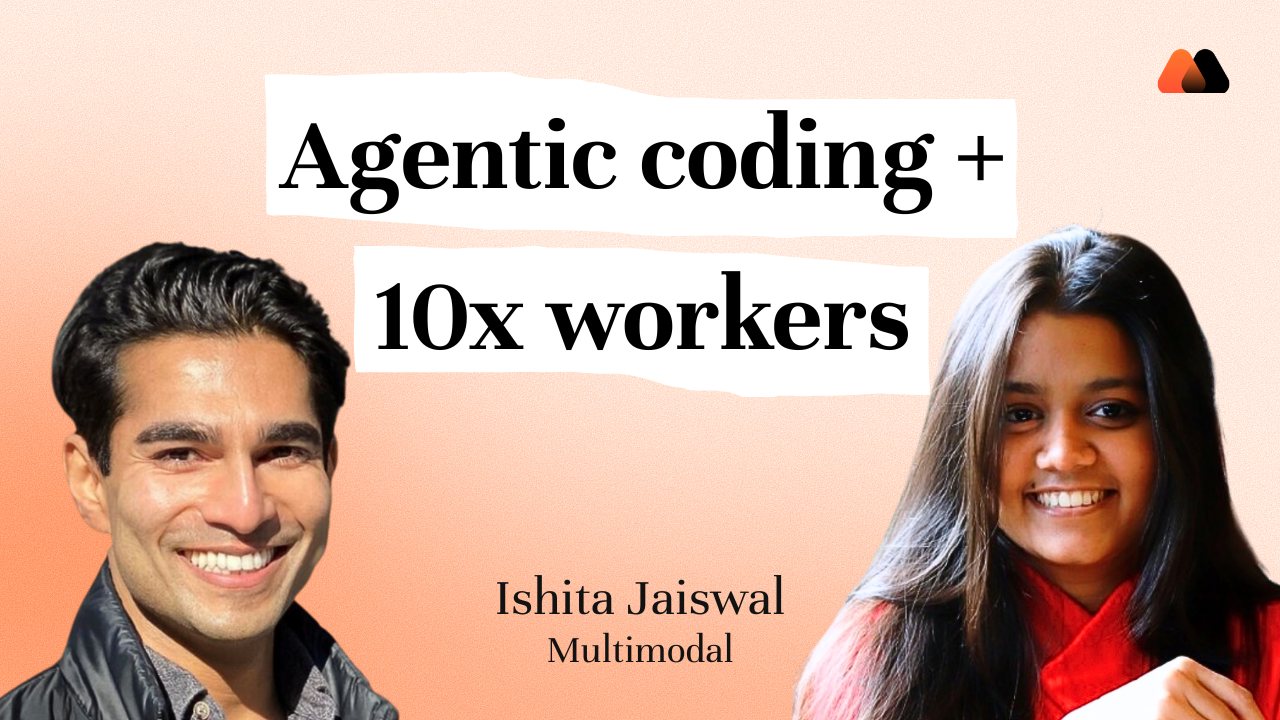
This is a summary of an episode of Pioneers, an educational podcast on AI led by our founder. Join 3,700+ business leaders and AI enthusiasts and be the first to know when new episodes go live. Subscribe to our newsletter here.
TL;DR:
- Claude Opus 4.5 dropped November 24, 2025 and changed the operating model overnight
- Agentic AI means AI that executes multi-step tasks autonomously, not just answers questions
- Code execution is now offloaded to AI: taste and judgment are the new moats
- Chat interfaces got cut from the Multimodal roadmap: hallucination is a solved problem
- Prompt engineering is dead: modern models infer intent, planning is the new skill
- Multimodal is not hiring yet: maximize the existing team on agentic coding first
- The gap between teams that adopt this and teams that don't will be 10 to 20x, not 2 to 3x
Before we dive into the key takeaways from this episode, be sure to catch the full episode here:
What Is Agentic AI and Why November 2025 Was the Turning Point
Agentic AI refers to AI systems that can plan and execute multi-step tasks autonomously, using tools, writing and running code, and completing workflows without human direction at every step. It is the difference between asking AI a question and assigning AI a project.
The industry had been building toward this for two years. What changed in November 2025 was that it actually arrived in production.
"Two years ago, a lot of it felt like autocomplete with code. A year ago, most engineering teams moved to Cursor, which was a much more beautiful experience, but it didn't feel truly autonomous. You couldn't give it a long-standing run at generating code."
Claude Opus 4.5 was released on November 24, 2025, positioning itself specifically for coding, agents, and long-horizon agentic workflows. The timing mattered as much as the capability: Claude Code went viral during the 2025-2026 winter holidays when people had time to experiment with it, including many non-programmers.
"The inflection point is the release of Opus 4.5 in November 2025. People were on holiday. They spent more time with Claude Code and Codex. It was a breaking change for how the product got designed and how code got executed," says Ankur Patel, founder of Multimodal.
Context from outside the startup world confirms the shift was broad. A JetBrains survey of 24,534 developers across 194 countries found that 85% now regularly use AI tools for coding, and 62% rely on at least one AI coding assistant, agent, or code editor. The tooling has gone mainstream. What changed with Opus 4.5 was the ceiling on what that tooling could actually do.
Taste Is the New Moat. Throughput Is Table Stakes.
The most concrete change at Multimodal is what an engineer's day looks like now. Most of the execution layer is gone.
"Most of the execution around code is now offloaded to AI. What people are judged on, what engineering teams are judged on, even at Multimodal, is the taste: what taste do you have in designing the product, in architecting what coding agents work on."
Ishita Jaiswal names the shift directly: "It's just not the case anymore. Everyone can ship things fast with these tools. What's really a moat now is intelligence and judgment."
Software itself has become more transient as a result. "Every six months, if your product doesn't completely reinvent itself in some way to stay relevant, you will feel like you're behind. That's true for startups, that's true for legacy vendors and incumbent vendors."
What Multimodal Is Building Against
The judgment call at Multimodal comes down to durability. High-stakes agentic workflows in regulated industries: lending decisions, compliance workflows, financial services operations. These have to pass compliance and regulatory muster, and that surface area is one Anthropic, OpenAI, and Google will not tackle directly.
"We try to build something that will have a durable moat. A lot of that comes down to supporting high-stakes workflows where our customers expect very pristine results for things like lending decisions. It has to pass compliance muster. It has to pass regulatory muster."
The Product They Stopped Building, and Why
The most surprising decision in the episode is what Multimodal walked away from. In 2025, they invested in two surface areas: agentic workflows and conversational chat interfaces. Workflows stayed. Chat got cut entirely.
"Two years ago, hallucination rates were really high. That is a solved problem for the most part now. There are far easier ways to connect enterprise data to a Claude or a ChatGPT and get really good grounded responses where hallucination rates are minimal."
"That's a product area we dumped altogether. We had to make that tough product decision because we realized it was no longer a differentiated product capability."
The user side confirmed it. People no longer want to write elaborate prompts. They want to define an end goal and let the AI determine what it needs to do from there. Solved hallucination plus reduced user willingness to prompt collapsed the moat under chat. That energy moved into agentic AI workflows that handle the cognitive heavy-lifting automatically.
Prompt Engineering Is Dead. Here Is What Replaced It
The skill that defined 2023 is already obsolete.
"Prompt engineering was a huge discipline 2 to 3 years ago. Modern large language models now understand user intent. Sometimes they even reinterpret what the user is saying because they infer intent."
What replaced it is planning. Agentic workflows require careful upfront architecture, not clever phrasing.
"I spend a lot of time planning with Codex, planning with Claude Code, to make sure we're designing and architecting the right product capability. That's where I spend the bulk of my time."
"Once you have a plan meticulously designed, the AI has remarkable execution."
Ishita sees the same pattern on the GTM side. Roughly 20 to 25 minutes in planning mode, then straight into the build. The pattern holds across every function: deeper plan upfront, faster execution after, fewer iteration rounds in the middle.
Why Multimodal Is Not Hiring Yet
The most contrarian call in the episode is on headcount. With agentic coding delivering significant output per engineer, hiring is available as an option. Ankur is choosing not to.
"We've made the deliberate decision to first focus on empowering our core engineering team to get more productive by using agentic tools, versus hiring more people. You can hire people, but then you're having to basically train and coach and guide more people through the agentic journey."
"I'd rather spend the marginal time with the existing team. Invest within is sort of our mantra."
The hiring filter, when it activates, leans less on years of experience and more on willingness to work at the agentic coding pace. What warrants a hire is every existing engineer fully using agentic tools yet still bottlenecked by ambition.
The 10x Worker Is No Longer Just an Engineering Theory
"You had this theory of the 10x engineer. Now I think it applies more broadly, not just to engineers, but to the average person on the team. They could be 10x workers."
The warning on the other side is harder. "There's going to be a big chasm between teams and companies that adopt agentic coding really well, and ones that don't. You're not going to be 2 to 3x ahead of your competition. If you do this, you're going to be 10, 15, 20x."
Ishita maps this directly onto Multimodal's customers: credit unions, banks, and private equity firms. As they implement more AI agents, they face the same challenge. Domain experts, they want to keep. No appetite to grow headcount. A need to grow volume.
"There is no staying in motion as is. The status quo is dramatically changing. You need to adopt this new technology, and if you do, you'll win market share. The inverse is also true."
Would you like to learn more about AI use in banking? Check out this episode on the future of AI in small business banking ft Jeremy Hodges.
Frequently Asked Questions
1. What is agentic AI, and how does it differ from regular AI?
Agentic AI refers to AI systems that can plan and execute multi-step tasks autonomously: writing code, running it, using tools, and completing entire workflows without a human directing each step. Regular AI answers questions. Agentic AI completes projects. Claude Opus 4.5, released November 24, 2025, marked the point where agentic coding became reliably production-ready.
2. Should a startup hire more engineers or invest in agentic coding tools?
According to Multimodal founder Ankur Patel, invest in the existing team first. Adding headcount before fully leveraging agentic coding tools means spending management time training new people rather than compounding the output of the team you already have. The right time to hire is when every current engineer is fully using agentic tools and is still bottlenecked on ambition.
3. How does Claude Code change software development for startups?
Claude Code shifts the cognitive work from execution to planning. Engineers spend less time writing code and more time designing architecture and outcomes with the AI as a collaborator. A task that previously took days can be completed in hours. The result is that taste and product judgment become the differentiators, not raw throughput.
4. Is prompt engineering still worth learning in 2026?
No. Modern large language models infer user intent without elaborate prompts. The skill has been replaced by planning and architecture: defining the outcome clearly before any execution begins. Time spent on prompt engineering is now better spent on designing what the AI should build.
5. What is a durable moat for an AI startup in 2026?
Taste, judgment, and domain specificity. Because any team can now ship fast using agentic coding tools, the differentiator is the quality of product decisions and deep expertise in a specific domain. For Multimodal, the moat is high-stakes regulated workflows in financial services requiring compliance-grade outputs that general-purpose AI platforms will not tackle directly.
6. What does 10x worker mean in the context of agentic AI?
The 10x engineer concept now applies across functions. Any team member who fully adopts agentic AI tools, in engineering, growth, or operations, can multiply their output significantly. Teams that adopt this well are not 2 to 3x ahead of competitors. They are 10 to 20x ahead.