

.svg)
.svg)

.svg)
This is a summary of an episode of Pioneers, an educational podcast on AI led by our founder. Join 3,700+ business leaders and AI enthusiasts and be the first to know when new episodes go live. Subscribe to our newsletter here.
TL;DR:
- Wescom handles over a million inbound calls a year, 60% routing into the contact center
- The first Copilot rollout in mid-2025 failed: data was accurate but unreadable at contact center speed
- The fix: rewrite every procedure in seventh-grade language with a Quick Reference Guide template
- Post-relaunch: 34% first contact resolution improvement, lowest new-hire turnover in four years, faster speed to answer
- A QA bot in pilot will score 100% of calls instead of a random sample
- The agentic AI vision is real but staged: Tesla today, Waymo eventually
Before we dive into the key takeaways from this episode, be sure to catch the full episode here:
What First Contact Resolution Actually Measures
First contact resolution (FCR) measures whether a member's issue is fully resolved on the first interaction, without a transfer, callback, or follow-up. It is one of the most direct indicators of contact center health.
Wescom Credit Union handles over a million inbound calls a year, with about 60% of them routed to the contact center. The institution also runs an Anywhere Branch serving roughly 30,000 members who live more than 25 miles from a physical location, with plans to expand that cohort by another 30,000. Across all those interactions, first-contact resolution is the metric that connects technology investment to the actual member experience.
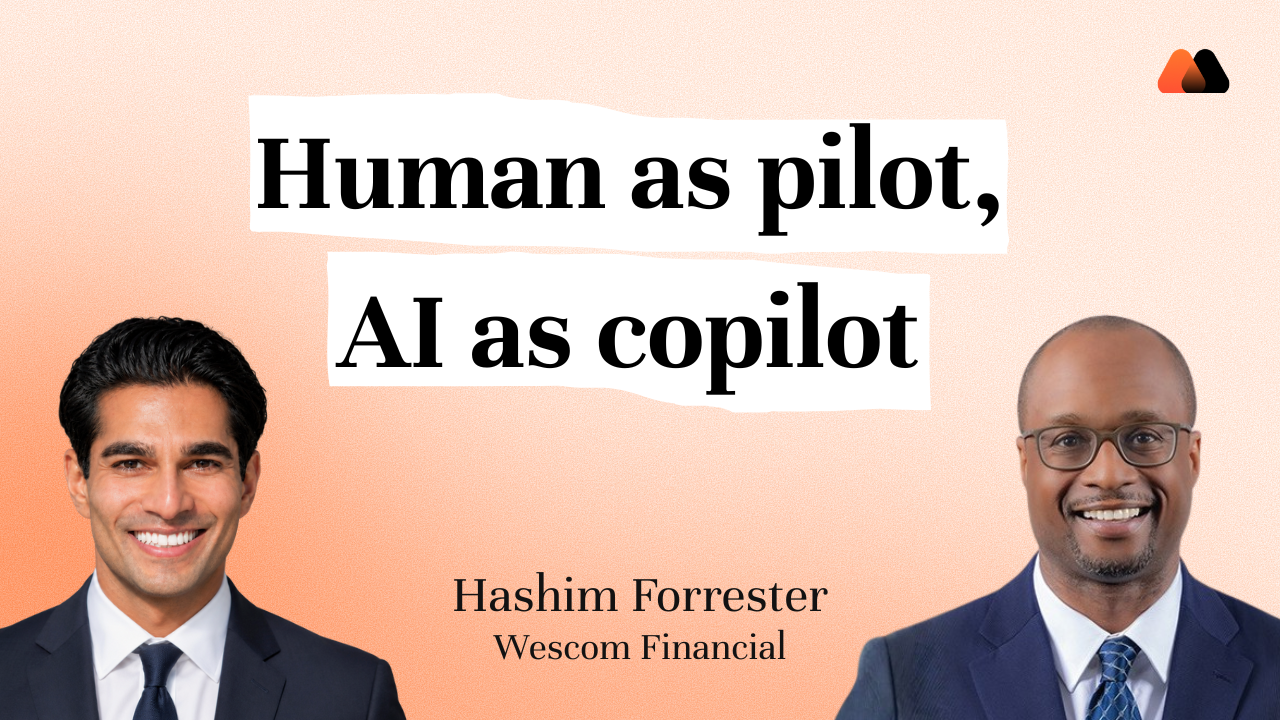
Hashim Forrester has spent three decades in operations and service delivery. His team has become Wescom's lead AI adopter, and the story of how they got there starts with a failure.
Why the First Copilot Rollout Flopped
Wescom launched Microsoft Copilot for contact center reps in mid-2025. It did not work.
"In full transparency, we failed. The first time, we didn't do it right. We rolled it out, thinking everyone was going to use it and we'd all be kumbaya. It didn't work that way."
The data was not the problem. Procedures had been audited and uploaded into Dynamics. The bot could pull the right answers. But reps were not using it on calls.
The issue was the format. Procedures were written the way someone who already knows the job writes: dense, thorough, accurate, and completely unreadable at the speed a contact center rep needs to switch between screens while a member is on hold. Copilot was returning accurate information in a way that reps could not act on quickly. Adoption stalled.
"If your data is not right, your strategy is going to fail. Bad data in, bad data out."
The corollary is equally true: accurate data in the wrong format is also bad data.
The Fix: Seventh-Grade Language and a Quick Reference Guide
The relaunch had three components, each addressing a specific failure point.
First, every policy and procedure was rewritten in what Forrester calls seventh-grade language. The standard was not whether it was accurate. It was whether a rep on a live call could find the answer in ten seconds and act on it.
Second, the team built a standardized Quick Reference Guide template:
- A single summary paragraph at the top: what you need to do, immediately
- Numbered detail below, available only if the rep needs to go deeper
- Output formatting fine-tuned in Dynamics for contact center readability
"The institutions that turn on Copilot without auditing their underlying knowledge base are accelerating their problems, not solving them."
This is the most transferable lesson in the episode. Microsoft Copilot amplifies whatever is in the knowledge base. Clean, properly formatted procedures make it a powerful frontline tool. Everything else makes it faster at delivering the wrong answer.
The Results
The post-relaunch numbers are specific and sustained: 34% improvement in first contact resolution, the lowest new-hire turnover Wescom has seen in four years, faster speed to answer, and steady month-over-month improvement in member satisfaction scores.
For context, Microsoft's own CSS contact center saw a 31% increase in first call resolution after deploying Copilot in Dynamics 365. Wescom's 34% improvement tracks directly with what the tool delivers when the underlying data is clean. NCUA
The results did not come from deploying AI. They came from identifying the root cause first.
"The 34% first contact resolution lift didn't come from deploying AI. It came from identifying that frontline empowerment was the root cause of slow resolution, and then finding the tool that could deliver that empowerment."
Getting Reps to Actually Use the Tool
Adoption is where most AI deployments fail. According to the 2025 CMSWire State of the CMO Report, organizations implementing autonomous AI systems reported a 28% resolution-time improvement and 19% first-contact gains, but those results only materialize when frontline adoption is real. NCUA
Forrester stopped training reps on metrics and started training them on what the tool does for them personally. Faster answers. Fewer transfers. More confidence on calls. Once the team understood the tool was on their side, adoption followed.
"It's no use in having a nice, pretty Ferrari in the garage and no one's driving it."
Three Layers of AI: IVA, Copilot, and a QA Bot
The Copilot story sits on top of two other deployments.
For three years, Wescom has run an intelligent virtual assistant on its phone system. When members call in, the IVA authenticates them and handles five self-service functions: balance inquiries, transaction history, credit card payments, fund transfers, and routing number requests. Members who want a human reach one in about 60 seconds. The IVA runs on Wescom's secure internal data infrastructure. Member data does not pass through a third-party large language model.
The newest layer is a quality assurance bot currently in pilot. Today, QA at Wescom is done by random sampling: a small team reviews a fraction of calls, scores them against an internal scorecard, and coaches accordingly. The bot will move that to near-100% coverage. Every call is already recorded and transcribed. The bot reads those transcripts against the scorecard and produces a score. Supervisors provide the human coaching layer.
"Every member interaction matters, not just the randomized ones."
Member First, Technology Second
Forrester's prioritization framework is the most replicable lesson here for any institution evaluating where to apply AI in financial services.
Most organizations pick the technology first, then search for a problem. Wescom starts in the other direction: identify the biggest member friction points, conduct root-cause analysis, then evaluate whether AI is the right solution. Sometimes it is. Sometimes the answer is a process change with no AI component.
"We look at operational efficiency, member experience, and AI technology, and we match it up to get to the right solution for our members."
The Tesla, Not the Waymo
When asked about the fully autonomous agentic future, Forrester does not dismiss it.
"We're like the Tesla right now, where you can auto drive, but I have to be sitting in the driver's seat with my hand on the wheel. I'm still the pilot. You're the co-pilot."
The Waymo, fully driverless, is the destination. In Los Angeles, where Wescom is based, Waymos are already operating without drivers. The fully agentic AI future for financial services is real. But the path there has to be earned through measurable accuracy improvements at each stage.
"Financial services can't afford to be 80% correct. Members trust their institution with their financial lives, and that trust is built on accuracy."
Each level of autonomy has to be earned, not assumed.
Want more on financial services and AI? Check other episodes here.
Frequently Asked Questions
1. What is first contact resolution, and why does it matter?
FCR measures whether a member's issue is fully resolved on the first interaction without a transfer, callback, or follow-up. High FCR means faster service and higher member satisfaction. At Wescom, a 34% FCR improvement came from empowering frontline reps with better AI tools, not from removing humans from the interaction.
2. Why did Wescom's first Copilot rollout fail?
Procedures uploaded into Dynamics were accurate but formatted for someone who already knows the job, not for a rep moving fast between screens during a live call. Copilot returned correct information in an unreadable format. Adoption stalled. The fix was to rewrite the underlying procedures, not change the technology.
3. What is a Quick Reference Guide in a contact center?
Wescom's standardized procedure template: a single summary paragraph at the top telling the rep exactly what to do, followed by numbered details for when they need to go deeper. Designed to be fully readable in ten seconds during a live member call.
4.What is the Tesla versus Waymo framework for agentic AI?
Hashim Forrester's staged autonomy model: today, AI is the co-pilot, and a human pilot is always in control. The fully driverless Waymo is the long-term destination. But financial services institutions have to earn each level of autonomy through measurable improvements in accuracy before moving to the next.
5. How does a QA bot improve contact center quality assurance?
Traditional QA relies on random call sampling, reviewing a fraction of interactions. A QA bot reads every call transcript against the internal scorecard and produces a score at near-100% coverage. At Wescom, supervisors then provide the human coaching layer. Technology handles coverage. Humans handle judgment.