

.svg)
.svg)

.svg)
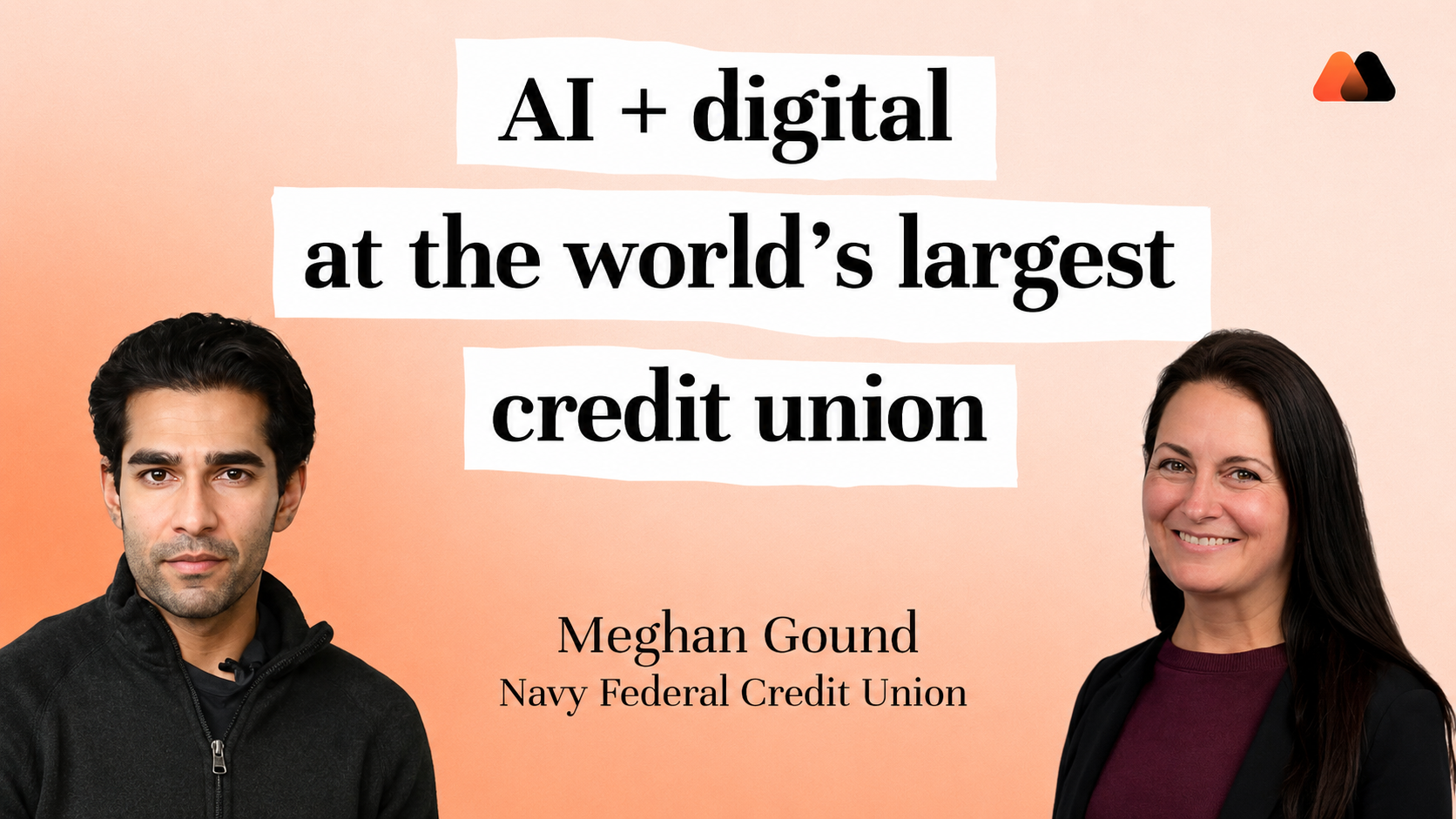
This is a summary of an episode of Main Street AI, an educational podcast on AI led by our founder. Join 3,700+ business leaders and AI enthusiasts and be the first to know when new episodes go live. Subscribe to our newsletter here.
TL;DR:
- Navy Federal: 15.2 million members, $197 billion in assets, 382 branches worldwide as of December 2025
- Over 10 million members log into digital every month, averaging 27 logins each
- Omnichannel means one interface for members and team members: what the member sees, the team member sees
- AI is deployed human-in-the-loop with full transparency: members always know what they are interacting with
- New features ship every two weeks, driven by member feedback across calls, chat, and app store reviews
- Five-year vision: an interaction continuum where digital, conversational, and human channels blur into one
Before we dive into the key takeaways from this episode, be sure to catch the full episode here:
What Digital Banking at This Scale Actually Looks Like
Navy Federal is not a typical credit union digital transformation story. Digital transformation in banking means building the infrastructure to serve members across every channel, at any time, without friction. At Navy Federal, that means doing it for a membership base spread across military bases around the world. As of December 2025, the institution has $197.1 billion in assets and 15.2 million members, making it the largest credit union in the US by both measures.
The usage numbers make the case. Over 10 million members log into online or mobile banking every month, and the average member logs in 27 times. That is essentially daily engagement from people who need to stay connected to their finances regardless of time zone or location.
"Our members want to keep in touch with their money, and they are operating around the world. So we need to make sure we're available."
The branch network reinforces rather than replaces digital. Navy Federal operates 382 branches worldwide, most of which are near military bases. The contact center runs 24 hours a day, 7 days a week. The mandate across every channel is the same: meet the member at the moment of need, in whatever channel they choose.
The Omnichannel Insight Nobody Talks About
Most digital banking customer experience conversations treat omnichannel as a member-facing problem. Navy Federal found the bigger unlock on the other side.
"All of our team members are logging into digital every day, just like our members. And so we can actually make it a lot easier for our team members not only to see exactly what a member's seeing, but also understand how to navigate it."
The decision was deceptively simple: extend the member-facing digital interface directly to team members.
"What if we just use the same interface?"
When a member calls or chats in, the team member sees exactly what the member sees. No translation layer. No separate internal system to cross-reference. The result is faster context, better answers, and a smoother handoff when a conversation needs to escalate from self-service to human-assisted.
Context Management Across Channels
The harder problem in omnichannel banking is keeping context intact when a member moves between channels. Navy Federal addresses it in two ways: the shared interface gives team members immediate visual context, and the chat feature blurs the line between bot and human so escalation feels natural rather than jarring.
"You start off talking with a bot, and then you can escalate that to a team member should you need to. It's a pretty seamless transition in that case."
The goal is also to reduce the need for escalation at all. The more self-service is resolved in-channel, the fewer forced handoffs members experience.
AI With Humans in the Loop
The AI governance stance at Navy Federal is specific enough to warrant precise documentation, because most institutions are not this deliberate about it.
"We are thinking about this really as a human in the loop. We want to make sure that when we offer AI, or it's a part of the experience, we're really transparent about it. The member knows what they're interacting with, and they can see that right there."
This is not just a brand position. Team members monitor AI-assisted interactions, either indirectly through quality review or directly at decision points where the outcome matters. Governance is built into the rollout, not added after the fact.
"We are taking a team member-first approach with this."
The deeper framing is that AI, deployed correctly, does not reduce human connection. It elevates it. A team member with better context gives a more empathetic, accurate answer than one who has to hunt for information mid-call. The AI handles the retrieval. The human handles the relationship.
Where AI Goes Next at Navy Federal
The longer-term bet is conversational. Digital banking today is primarily transactional: you go in, do something, leave. Meghan Gound sees AI changing that texture entirely.
"We're probably going to get to a place where we're much more conversational in all of our interactions. We really want people to feel like they can have that conversation with confidence, whether that's through a digital channel, whether you're calling, whether you're in some sort of other interaction."
That shift from transactional to conversational is the trajectory the entire digital banking transformation space is moving toward. Navy Federal is building toward it deliberately, with human oversight at every stage.
Two Weeks From Idea to Feature
The product development cadence at Navy Federal is worth examining for any institution trying to move faster without losing quality.
"We're actually on a constant launch and release schedule, releasing new features about every two weeks, which means we're constantly planning, reprioritizing, delivering, and testing things all sorts of in the same span of time."
Strategy, security, lending, savings, and digital teams all feed into a cross-functional roadmap. The starting point is always the same: what are members saying? Calls, chats, app store reviews, usage data, and feature adoption all flow into prioritization decisions.
The Trusted User feature illustrates how feedback drives product. Military members who deploy often need a family member to manage their accounts while they are away. The feature existed in online banking but was limited. Member feedback expanded it across the full omnichannel platform and extended it to additional use cases: parents managing children's accounts, family members managing elderly parents' finances, and business users. Built from listening. Extended through infrastructure.
Mission-Driven Product Design
Navy Federal members earned and saved a total of $4.32 billion in 2024 by banking with the credit union, an average of $461 per member per year. That figure reflects a product philosophy where mission shapes what gets built, not just how it gets marketed.
"Our tagline is 'Our members are the mission.' That really holds true."
Two concrete examples of mission-driven product decisions:
The My Making Sense financial wellness section in digital banking pulls in external accounts, tracks spending and subscriptions, and includes a feature that uses checking account transactions to improve a member's credit score at a credit bureau. A member might be approved for a loan elsewhere as a result. Navy Federal built it anyway.
The Bloom Plus checking partnership addresses the credit-building needs of younger members who join with limited credit history. Paired with secured card products on the lending side, the goal is to be present at the beginning of a member's financial life, not just when they are already creditworthy.
"We want our members to be with our credit union for their financial lifetime."
The Five-Year View
Meghan Gound frames the five-year vision in one phrase.
"Digital overall is going to be a part of an interaction continuum. The lines are going to blur between all of our channels and interactions."
The shift is from transactional to conversational, with channel boundaries disappearing. A member might start in the app, transition to chat, escalate to a team member, and continue in a branch, and none of those moments should feel like starting over. The technology, the context, and the relationship all carry through.
What keeps the strategy grounded is a principle that applies well beyond financial services: start with what the member needs, build the feedback loops to hear it clearly, and make sure the technology serves the mission rather than defines it.
Want more on financial services and AI? Check other episodes here.
Frequently Asked Questions
1. What is Navy Federal Credit Union's digital banking strategy?
Navy Federal's digital banking strategy is built around omnichannel availability, human-in-the-loop AI, and a two-week release cycle driven by member feedback. The core principle: one interface for members and team members, so whoever is helping a member sees exactly what the member sees.
2. What does human in the loop mean in banking AI?
It means AI is deployed with a team member actively monitoring interactions, either indirectly through quality review or directly at decision points. At Navy Federal, members are always informed when they are interacting with AI, and team members are positioned to step in at any point.
3. What is omnichannel banking?
Omnichannel banking means members can interact across digital, phone, chat, and branch channels without losing context or starting over. At Navy Federal, it also means team members use the same interface as members, removing the translation layer between what a member experiences and what a team member sees when helping them.
4.What is digital transformation in banking?
Digital transformation in banking means rebuilding the infrastructure to serve customers across every channel, at any time, with context that carries across interactions. At Navy Federal, that means 10 million members logging in an average of 27 times per month, across a global membership base, with AI and human assistance working in parallel rather than in competition.
5. What is the interaction continuum in digital banking?
It is Meghan Gound's term for the five-year trajectory of digital banking: a fluid experience in which the lines between digital self-service, conversational AI, and human-assisted interactions blur into a continuous journey. The member moves between channels without friction, and context travels with them throughout.