

.svg)
.svg)

.svg)
This is a summary of an episode of Main Street AI, an educational podcast on AI led by our founder. Join 3,700+ business leaders and AI enthusiasts and be the first to know when new episodes go live. Subscribe to our newsletter here.
TL;DR:
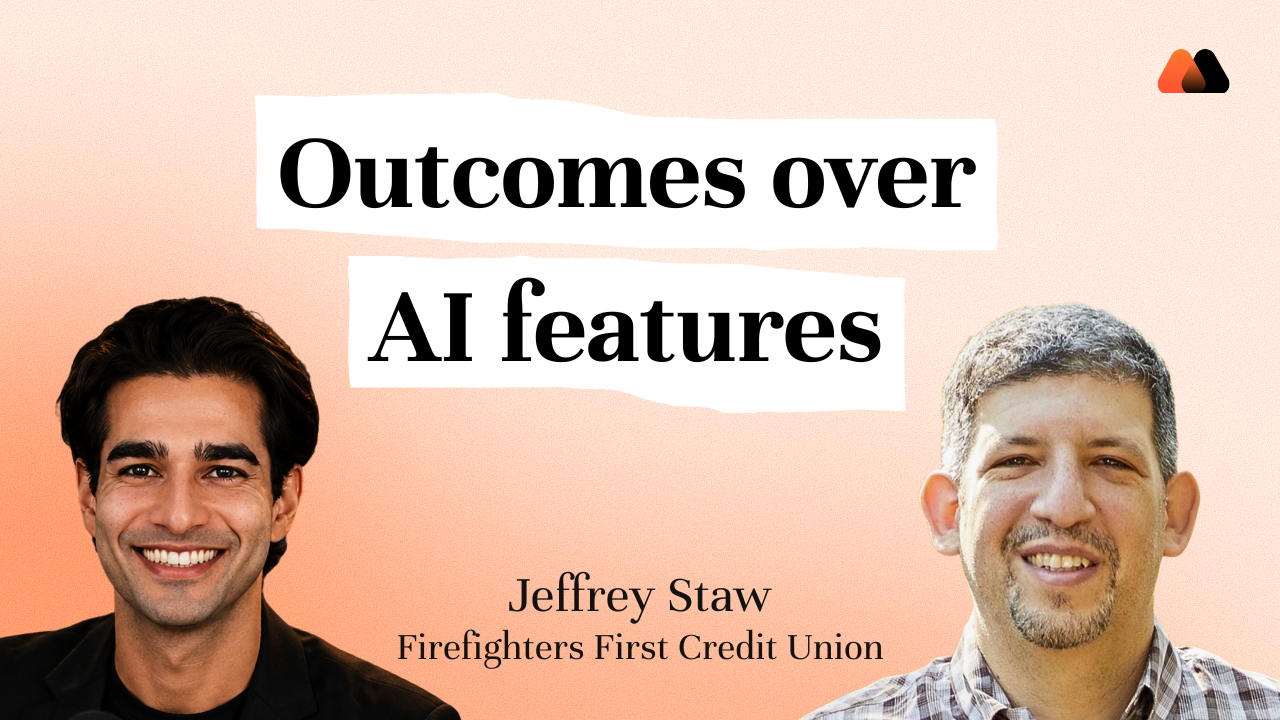
- Firefighters First serves career firefighters only: depth of relationship beats breadth of membership
- Copilot beat ChatGPT on security model and native stack integration, not text quality
- The 80% rule: if Copilot delivers 80% of ChatGPT quality in five years, enterprise architecture wins
- Agentic AI carries a 10% support tax: the same mistake institutions made with RPA
- Data exfiltration through agentic systems is the security risk keeping this CIO up at night
- Digital transformation fails on people and communication, not technology
Before we dive into the key takeaways from this episode, be sure to catch the full episode here:
Why Serving Only Firefighters Is a Strategy, Not a Limitation
Most credit unions are racing to expand their field of membership. Firefighters First went the other direction.
"We look at our credit union as an exclusive club for our members. It's focused 100% on career firefighters. We want to get depth of relationship rather than breadth of membership."
That focus translates directly into product design. Firefighters retire early, so wealth conversations start from a different point. They file unusual taxes, so Firefighters First launched its own tax division that processes returns efficiently because it knows exactly what to expect. They need insurance for high-risk professions. And they own toys: jet skis, boats, campers. Products built around a member you actually know look completely different from products built for everyone.
New members come through personal service managers placed in markets with around 3,000 eligible firefighters, knocking on firehouse doors and building relationships. The goal is to be part of the kitchen table conversation, the center of station culture where word travels fast.
Microsoft Copilot vs ChatGPT: Why Enterprise Architecture Beat Text Quality
About a year before this conversation, Jeffery ran the evaluation most credit unions are running now. ChatGPT had the best text quality. He chose Copilot for enterprise anyway.
Two reasons:
- Security model. "I knew that my data was going to be as safe as possible compared to all the competitors."
- Native integration. Copilot lived inside the Microsoft productivity stack already on every desktop, removing the adoption friction of a separate tool.
The second leg was a five-year projection, not a current-quarter benchmark.
"If I can get 80% of the quality in responses from Copilot compared to ChatGPT five years from now, then from an enterprise architecture perspective, Copilot beats it hands down."
Usage and depth-of-relationship metrics at Firefighters First are now at or above Microsoft's industry benchmark every month.
How He Evaluates Any AI Vendor
When fintech vendors pitch AI, Jeffery Staw redirects immediately. His criteria are practical:
- Does the product solve a specific, real problem?
- Will this vendor still be a viable partner in five years?
- Is the AI making the product genuinely better, or is it just the pitch?
"I don't want to talk about AI. I want to talk about the products and features you bring to me. If you happen to use AI in a responsible way to make those real, great. But if you're just bringing AI to the table for me to say you're an AI vendor, I'm not doing that."
The underlying principle is fiduciary. Credit union members are the owners. Swapping systems every six months because a new model hit a leaderboard is churn, not strategy.
Agentic AI vs RPA: The Same Mistake Playing Out Again
Jeffery Staw spent years doing large-scale technology work at one of the most influential CUSOs in the country. He sees the agentic AI vs RPA pattern repeating.
"We did a lot of RPA. It drove some value, but the margins were not nearly what we thought. We went way down the journey and then pumped the brakes because costs were catching up with us we were not expecting."
The cost nobody budgets for is the support tax.
"There's about a 10% support tax on any project. You build an agentic system, what happens when it breaks? Some system is not there anymore. Permissions are not granted anymore. Nobody knows why it's broken."
The RPA version of this: processes get automated, staff move elsewhere, and when the automation breaks there is no backup. Agentic AI is on the same trajectory at larger scale.
"If you say you're all in on agentic, you're probably also all in on adding a couple people to your staff."
The Audit Risk Nobody Has Priced In
Beyond the support tax, there is a regulatory dimension most institutions have not thought through.
"The most you're going to get from an NCUA auditor right now is, let me see your AI governance policy. They haven't started saying, show me how your agents work, show me you're validating the data, show me you're not discriminating."
That scrutiny is coming. A packaged vendor system comes with documentation auditors recognize. A homegrown agentic AI deployment carries an entirely different level of scrutiny, and most institutions building their own agents today are not prepared for it.
The Security Risk That Keeps This CIO Up at Night
The deepest concern in this conversation is data exfiltration through agentic systems.
"I think we're going to find we're going to have a lot of exfiltrations caused by agentic AI that we didn't know how to stop, how to detect. They're just there. If there's something that keeps me up at night right now, it's how exfiltration risk is just going through the roof."
Existing detection tools were built for human-generated data movement. An agentic system operating under valid credentials, with broad access to enterprise environments, can route around monitoring in ways that look like routine authorized activity. According to Proofpoint's 2025 Data Security Landscape report, 32% of organizations already identify unsupervised data access by AI agents as a critical threat. Gartner projects that by 2028, 25% of all enterprise generative AI applications will experience at least five minor security incidents per year, up from 9% in 2025.
For credit unions deploying agentic systems today, the access model matters as much as the automation itself.
Why Digital Transformation Fails on People, Not Technology
Jeffery closes with the lesson he carries from two decades of large-scale credit union technology work.
"Digital transformation is not about technology. It's about people. The problems you have are about communicating with people, making sure they understand where you're going and why."
The most undervalued skill for a technology leader is not technical depth. It is the ability to explain why a change is happening specifically enough that a skeptic becomes a standard bearer.
"As a technology leader, your acuity with technology may not be your greatest asset. Your ability to explain the why of that technology, that's what your job is."
The five-year vision follows directly: members who trust Firefighters First in a way they do not trust Bank of America or Chime, an institution that has doubled its membership without proportional headcount growth, with technology doing the scaling work.
High tech delivering high touch. At national scale.
Want more on financial services and AI? Check other episodes here.
Frequently Asked Questions
1. Is Microsoft Copilot better than ChatGPT for credit unions?
For enterprise deployment, yes, according to Jeffrey Staw. Copilot's security model and native Microsoft stack integration outweigh ChatGPT's advantage in text quality when evaluated over a five-year architectural horizon.
2. What is the hidden support tax on agentic AI?
Any agentic system carries roughly a 10% ongoing support burden for maintaining permissions, handling breaks, and keeping integrations current. Institutions that skip budgeting for this will hit the same wall RPA deployments hit a decade ago.
3. What is the difference between agentic AI and RPA?
RPA automates fixed, rule-based tasks. Agentic AI reasons and adapts across systems autonomously. Agentic AI is more capable but carries the same hidden support costs as RPA, plus new exfiltration and audit risks RPA never introduced at the same scale.
4.How should credit unions evaluate AI vendors?
Evaluate the product, not the AI label. The real question is whether this vendor will be a five-year partner, because integration costs make frequent swaps prohibitively expensive.
5. What is the agentic AI data exfiltration risk for financial institutions?
Agentic systems with broad enterprise access can move data in ways existing monitoring tools were not built to detect. Proofpoint's 2025 research identifies this as a critical threat for nearly a third of organizations already deploying AI agents.