


.svg)
.svg)

.svg)
This is a summary of an episode of Main Street AI, an educational podcast on AI led by our founder. Join 3,700+ business leaders and AI enthusiasts and be the first to know when new episodes go live. Subscribe to our newsletter here.
TL;DR:
- NACUSO: trade association for credit union service organizations, fighting to raise the 1% CUSO investment cap.
- The cap blocks credit unions from investing in AI and stablecoin CUSOs, especially after the GENIUS Act made CUSOs the required issuer for credit union stablecoins.
- AI is a culture project, not an IT project: it should be led from the executive suite, not delegated to technology teams.
- Biggest blocker to AI adoption isn't regulation, it's fear of exposing member data and fragmented legacy tech stacks.
Before we dive into the key takeaways from this episode, be sure to catch the full episode here:
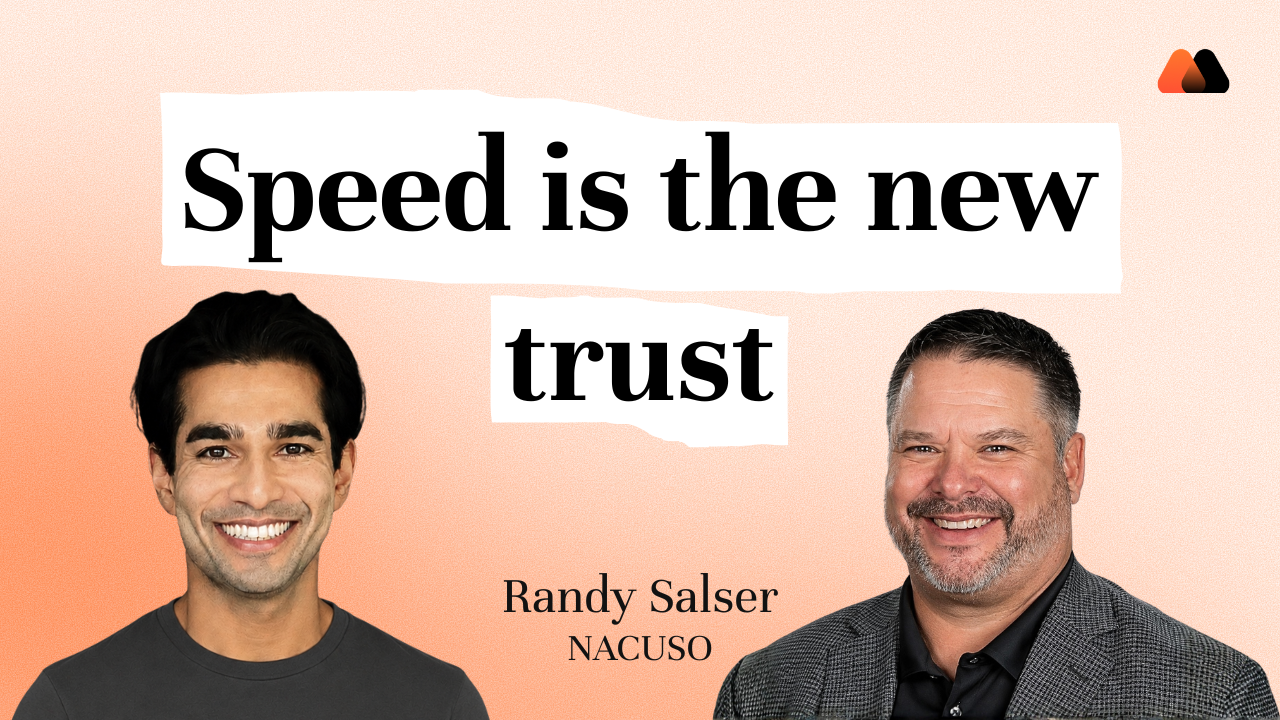
What CUSOs Actually Are and Why They Matter Now
Credit union service organizations have been part of the credit union model for forty years. The original use cases were practical: shared CFOs, commercial business lending infrastructure, property and casualty insurance, pooled underwriting expertise. Things individual credit unions needed but could not afford alone.
The model has always been about collaboration over competition. But the stakes of that collaboration have shifted dramatically.
"QSOs are right in the middle of the next phase of where we're going. AI is here and there's a real competitive advantage that can really help credit unions for the next forty, fifty, hundred years."
Randy Salser took the helm at NACUSO six months before this recording, after more than a decade leading NAFCU and strategic partnerships at Allied Solutions. His read on the moment is direct: the CUSO model is not just relevant, it is the structural mechanism credit unions need to stay competitive against a field that now includes JP Morgan spending five billion dollars a year on fintech investment, Meta, Amazon, and Ford Motor Credit, which recently obtained a banking license.
"Speed is the new layer of trust. Consumers want access to their information when they want it, where they want it, with the same experience they get from Starbucks or Amazon. Partnering with fintechs makes it a lot easier for credit unions. It really flattens the playing field."
A single five hundred million dollar credit union does not have a meaningful seat at the table with Visa, Mastercard, or a major core provider. Five hundred million dollar credit unions pooled through a CUSO do. That is the structural logic that has driven the model for four decades and is now being tested by the pace of technology change.
The 1% Cap Is the Concrete Problem
Federal credit unions can invest up to 1% of their total paid-in and unimpaired capital and surplus in CUSOs, in the aggregate. That means every CUSO investment across every initiative counts against the same ceiling. A credit union that has already invested in a commercial business lending CUSO and an insurance CUSO may have almost no capacity left to invest in an AI or stablecoin CUSO.
"These numbers are completely arbitrary. There's not even any congressional record of why one percent was the number they chose."
NACUSO has launched a Capitol Hill effort to raise or eliminate this cap, securing support from America's Credit Unions and the Defense Credit Union Council and hiring a Washington-based advocacy firm. The effort became urgent when the GENIUS Act passed in 2025 and designated credit union service organizations as the issuing entity for credit union stablecoins, meaning the 1% cap now directly constrains credit unions' ability to participate in the digital asset space.
"Who could have scale at one percent of their capital in a stablecoin environment? Navy Federal wouldn't even have enough scale to participate against the Walmarts of the world who can give a two percent discount to use their stablecoin."
The Starbucks card example illustrates how quickly deposits can migrate outside the traditional financial system. The amount sitting on Starbucks cards alone would qualify as a top fifty US bank if the company became a licensed institution. Credit unions competing against that disintermediation need capital flexibility that the current cap does not allow.
The cap requires an act of Congress to change. NACUSO is making that case now.
What the GENIUS Act Means for Credit Unions
The GENIUS Act, passed in 2025, provided the first comprehensive regulatory framework for payment stablecoins. It designated the NCUA as the primary federal regulator for credit union-issued stablecoins and explicitly put credit unions on equal footing with banks in the stablecoin space.
The structural requirement, however, is that credit unions cannot issue stablecoins directly. Issuance must flow through a separately organized CUSO or permitted payment stablecoin issuer. That makes CUSO investment capacity not a theoretical future concern but an immediate operational requirement.
"The world is still out there for this. But I go all the way back to it is just another payment rail. Don't confuse the consumer. All they really want is to use their currency to pay for something. When I swipe my card, they don't tell me I'm going through the Visa debit rail."
The near-term stablecoin use cases Randy sees as most concrete are cross-border payments, where the speed and cost advantages are immediate, and interbank settlement among credit unions collaborating on commercial business loans. Consumer adoption at scale requires more infrastructure maturation, but the regulatory framework is now in place for credit unions to begin building toward it through agentic AI workflows and CUSO structures simultaneously.
Why AI Adoption Is Stalling and What Actually Fixes It
The biggest barrier Randy hears from credit union leaders is not regulation. It is the fear of exposing member data and the uncertainty of what that exposure looks like in practice.
"How do you make sure you're not putting PII out into the echo sphere? Your team goes out to ChatGPT or Claude to get better feedback, but what are they exposing to bad actors? The boards are very concerned. That's such a breach of confidence."
The CUSO model offers a structural answer here too. SOC 2 certification at the CUSO level lets multiple smaller credit unions share the cost of security infrastructure that would be prohibitive individually. Moving slower than fintechs on AI adoption, Randy argues, is acceptable as long as there is regulatory parity across the competitive field. The frustration is not the pace. It is that non-traditional players like SoFi and Robinhood operate without equivalent scrutiny while credit unions carry the full regulatory burden.
On the legacy tech stack problem, Randy is characteristically direct.
"A core is just a debits and credits system. It's literally just an accounting system. But as it's grown through the years, they've bolted on new products. What's happening now with a lot of the new fintechs in the space is they can bring all this together in one spot and take out about eight steps along the way. That's where AI is the biggest benefit."
AI Is a Culture Project, Not an IT Project
The most replicable line in the episode came from a keynote speaker at NACUSO's recent conference.
"AI is a culture experiment, not an IT project. It should be led from the executive suite. Start every week with what do we do now that could be done with AI? And run until you hit the wall."
Randy echoes it directly. The institutions getting the most out of AI are the ones whose leadership teams are asking the question continuously, setting the guardrails, and making it part of daily function rather than a technology initiative with a discrete launch date.
For smaller credit unions, the path forward is partnership rather than independent build.
"Partner. It's a lot easier to do it as a group. Whether it's a QSO model or not. What I really want to do is educate so much that during strategic planning, the QSO model and framework is on the table."
How This Works in Practice
"The innovation requires capital, and credit unions need to be able to invest and have a seat at the table in shaping these technologies. That constraint has become an obstacle."
— Randy Salser, NACUSO
Multimodal builds purpose-built AI agents for credit unions on Jack Henry, Fiserv, and Symitar, designed to work within the existing tech stacks Randy describes, pulling together legacy systems without requiring a core replacement. If your institution or CUSO is evaluating where AI fits in its lending or operations workflow, the platform comparison is a practical starting point.
Want more on financial services and AI? Check other episodes here.
Frequently Asked Questions
1. What is a credit union service organization?
A CUSO is an organization owned in whole or in part by credit unions that provides permitted financial or operational services primarily to credit unions or their members. CUSOs allow credit unions to pool capital, share expertise, and access technology and services that individual institutions could not afford independently. Federal credit unions can invest up to 1% of their capital in CUSOs in aggregate.
2. What is NACUSO?
The National Association of Credit Union Service Organizations, founded in 1985, is the only trade association serving CUSOs and their credit union owners. NACUSO advocates on Capitol Hill for CUSO-related regulatory issues, facilitates collaboration among credit unions and fintechs, and runs an annual conference and marketplace connecting credit unions with CUSO investment and partnership opportunities.
3. Why is the 1% CUSO investment cap a problem for AI adoption?
The cap limits federal credit unions to investing a combined total of 1% of their capital across all CUSO investments. Credit unions that have already invested in multiple CUSOs may have little or no capacity left to invest in new AI or stablecoin CUSOs. NACUSO is fighting to raise or eliminate the cap, arguing it was set arbitrarily for a pre-internet era and now constrains credit unions' ability to compete with banks and fintechs that face no equivalent restriction.
4. What does the GENIUS Act mean for credit unions and stablecoins?
The GENIUS Act, passed in 2025, designated the NCUA as the primary federal regulator for credit union stablecoins and required that issuance flow through a CUSO or permitted payment stablecoin issuer rather than directly from the credit union. This puts CUSOs at the center of any credit union stablecoin strategy and makes the 1% investment cap directly relevant to credit unions' ability to participate in the digital asset space.
5. How should credit unions approach AI adoption?
Start with culture before technology. AI adoption led by the executive suite, with a standing question of what current work could be done with AI, outperforms AI adoption delegated to IT teams as a discrete project. For smaller credit unions, the CUSO model offers a practical path: pooling resources for SOC 2 certification, shared data scientists, and AI infrastructure across multiple institutions rather than building independently.
6. What is blocking credit unions from using AI effectively?
The biggest barriers are fear of member data exposure and legacy tech stack fragmentation. Credit unions worry that employees using public AI tools may inadvertently expose PII. On the infrastructure side, years of bolted-on systems mean AI tools often cannot integrate cleanly across core, LOS, and digital banking platforms. CUSOs and fintech partners that can serve as an abstraction layer across those systems are where the practical path to AI adoption runs.

%20(1).png)
%20(1).png)