AI Portfolio Management for Private Equity: A Guide for Operating Partners


Table of contents

Key Takeaways:
- AI monitoring turns 6-week reviews into real-time dashboards, freeing 400+ analyst hours/quarter.
- MOIC improvements of 0.3–0.5x = $30–50M on a $100M exit.
- 47% of LPs are monitoring GP AI adoption as a fundraising differentiator.
- 84% have appointed a CAIO, but most ops teams still run on spreadsheets.
Get 1% smarter about AI in financial services every week.
Receive weekly micro lessons on agentic AI, our company updates, and tips from our team right in your inbox. Unsubscribe anytime.
The Real AI Opportunity Is Post-Close
Private equity teams have spent the last two years funding AI for deal sourcing and due diligence. That work matters, but it’s rarely where operating partners feel the bottleneck. The biggest operational leverage shows up after close, when you have to run portfolio management across 30–50 portfolio companies, keep LPs informed, and drive repeatable value creation while your team capacity stays flat.
That’s also where most firms still operate with spreadsheets, quarterly cycles, and brute-force analyst hours. Financial data arrives in different formats. Reporting cadences don’t line up. Market conditions shift between board meetings. By the time portfolio review packets are assembled, the information is already stale, and the opportunity to intervene early has narrowed.
The timing behind this shift is showing up in the data. 84% of PE firms have appointed a Chief AI Officer. 84% of fund managers report longer holding periods, making portfolio monitoring more critical than ever. Longer holds and slower exits raise the cost of blind spots across investment portfolios.
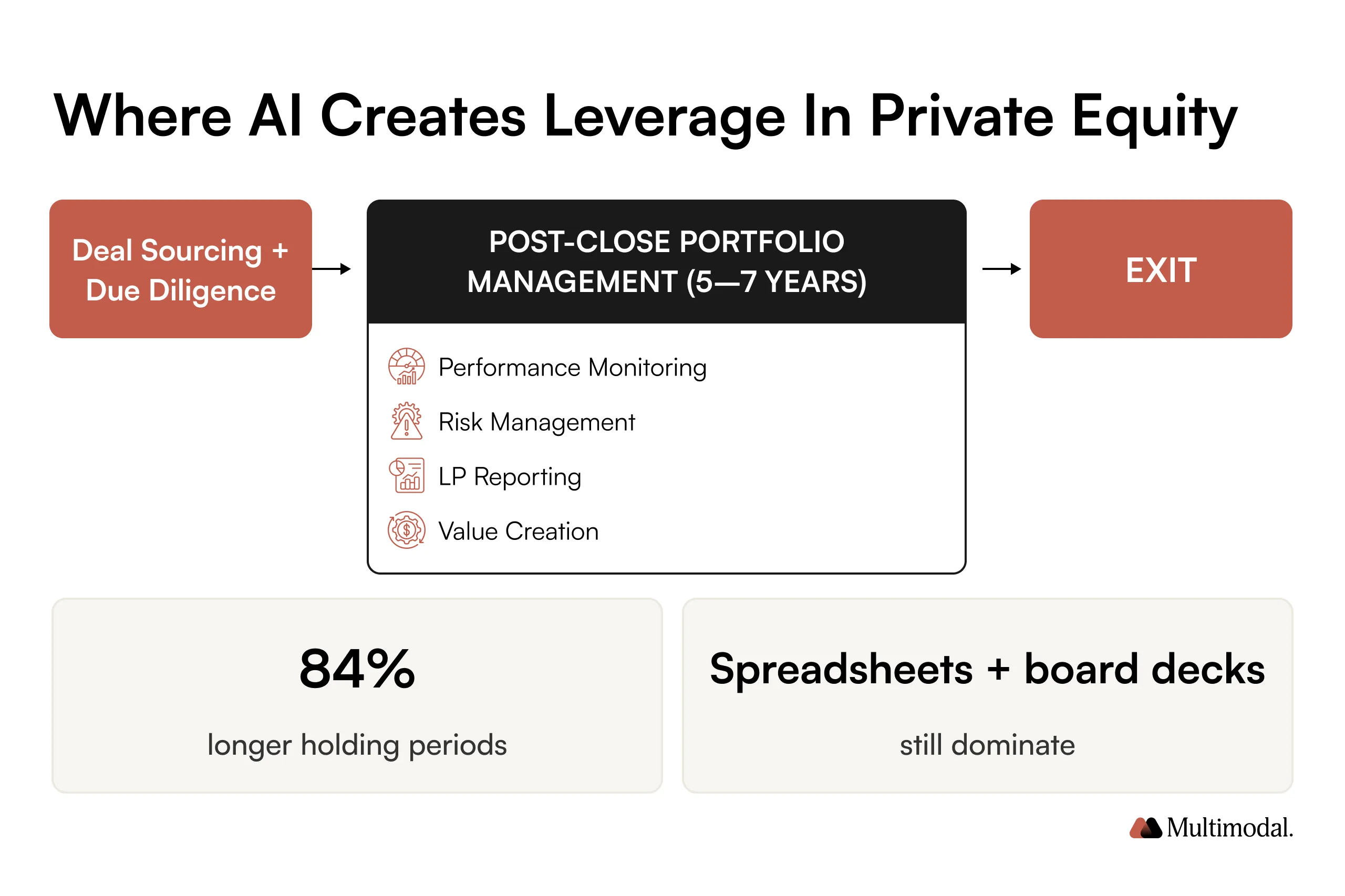
EY captures the broader change in how firms think about value: “AI is establishing itself as a third pillar of value enhancement in private equity, alongside financial engineering and operational excellence.” For operating partners, that's a direct signal: post-close operations are where AI ROI will be measured, and where most firms are furthest behind.
That’s why this guide focuses on AI in portfolio management. You’ll see practical workflows to monitor portfolio companies, strengthen risk management, accelerate LP reporting, and scale value creation across the portfolio.
Where PE Firms Stand on AI Adoption
AI adoption in private equity is no longer a pilot-stage conversation. Execution is now the differentiator, and the gap between firms that have operationalized AI and those still experimenting is starting to show up in fundraising and returns.
Early traction has appeared first in deal workflows. Deloitte reports that 86% of corporate and PE leaders have incorporated generative AI into M&A workflows, and 88% have invested $1M or more. The next shift is toward agentic capability: AI that runs multi-step workflows across portfolio companies with minimal human intervention, rather than simply assisting individual tasks on demand.
LP scrutiny is arriving at the same time as that capability shift, which means the stakes for getting it right are rising. PEI's LP Perspectives data shows that 47% of LPs are actively monitoring GP AI adoption, while 46% hold mixed views due to risk concerns. That combination, LP pressure alongside evolving agentic tools, is what's driving budget allocation upward: EY reports that by 2026, two-thirds of PE firms expect to invest 25%+ of budget in AI.
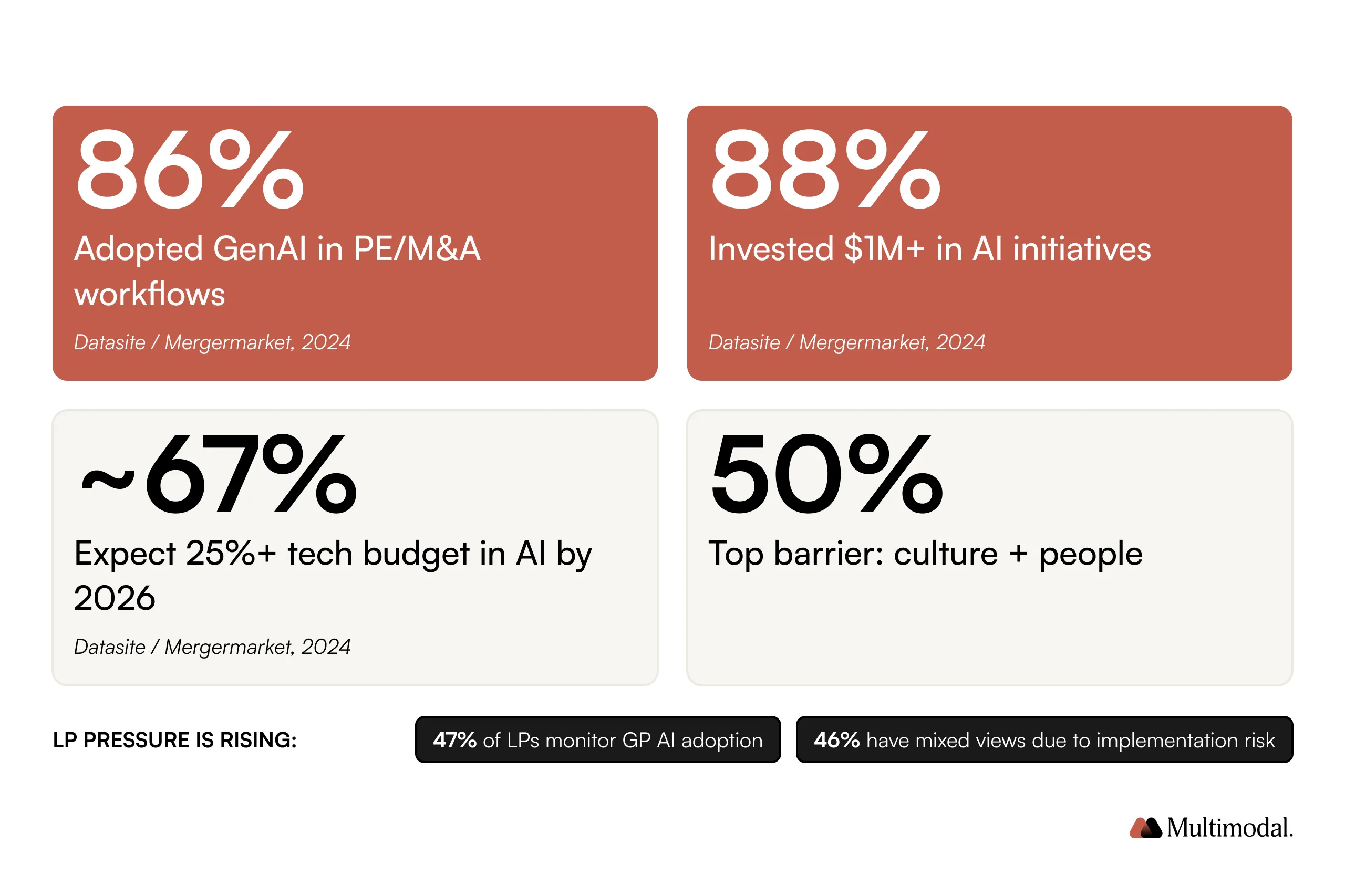
For operating partners, the implication is concrete: AI adoption that improves portfolio visibility and reporting is becoming part of the fundraising narrative. How you manage AI portfolio management today is part of how LPs will evaluate you tomorrow.
Four Ways AI Transforms Post-Close Portfolio Management
Operating partners managing 30–50 portfolio companies face a structural capacity problem: the work scales with portfolio size, but headcount doesn't.
Using AI in portfolio management addresses that issue. The four use cases below each target a specific operational bottleneck, from turning fragmented data into continuous visibility to scaling value creation plays across the portfolio.
Evaluate them against your current workflows and prioritize where to start.
Portfolio Company Performance Monitoring
Operating partners have data. What they lack is usable data that arrives on time, in a consistent format, and with KPI definitions that hold up across the portfolio.
In that environment, portfolio management becomes packet production instead of performance control, especially as holding periods stretch. BDO’s 2025 Private Equity Survey reports 84% of fund managers are experiencing longer holding periods compared to 2024, which makes blind spots between quarterly reviews more expensive.
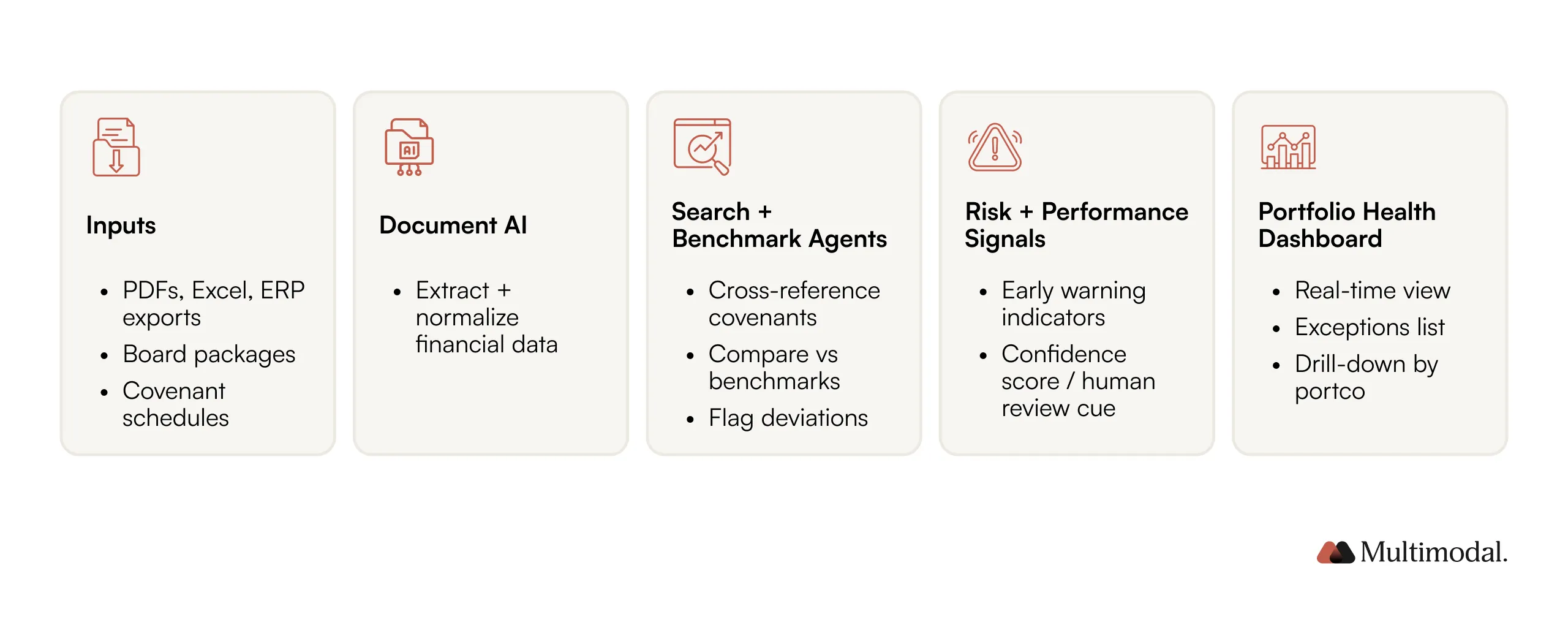
AI portfolio management tightens that loop by turning messy inputs into a consistent monitoring layer. More specifically, AI can:
- Ingest quarterly financials, monthly KPI packs, and board materials in all formats, then normalize them into a common schema for portfolio managers and investment professionals.
- Standardize core metrics (revenue, margin, cash, churn, pipeline) so portfolio construction discussions start from comparable numbers across investment portfolios.
- Summarize variance drivers using natural language processing (NLP), and flag anomalies that warrant review (for example: margin compression, cash conversion deterioration, or covenant headroom shrinking).
- Track changes against historical data and market conditions, so you can separate company-specific issues from market shifts.
This pattern shows up in large-scale platforms, too.
Blackstone's Pattern Recognition platform shows how this works in action. Aggregating operational and market signals across its portfolio allows firms to identify changes in revenue growth, margins, and sentiment earlier than traditional reporting would allow.
To summarize, when portfolio data becomes structured and continuously analyzable, firms gain a portfolio-wide view that was previously impossible to maintain manually.
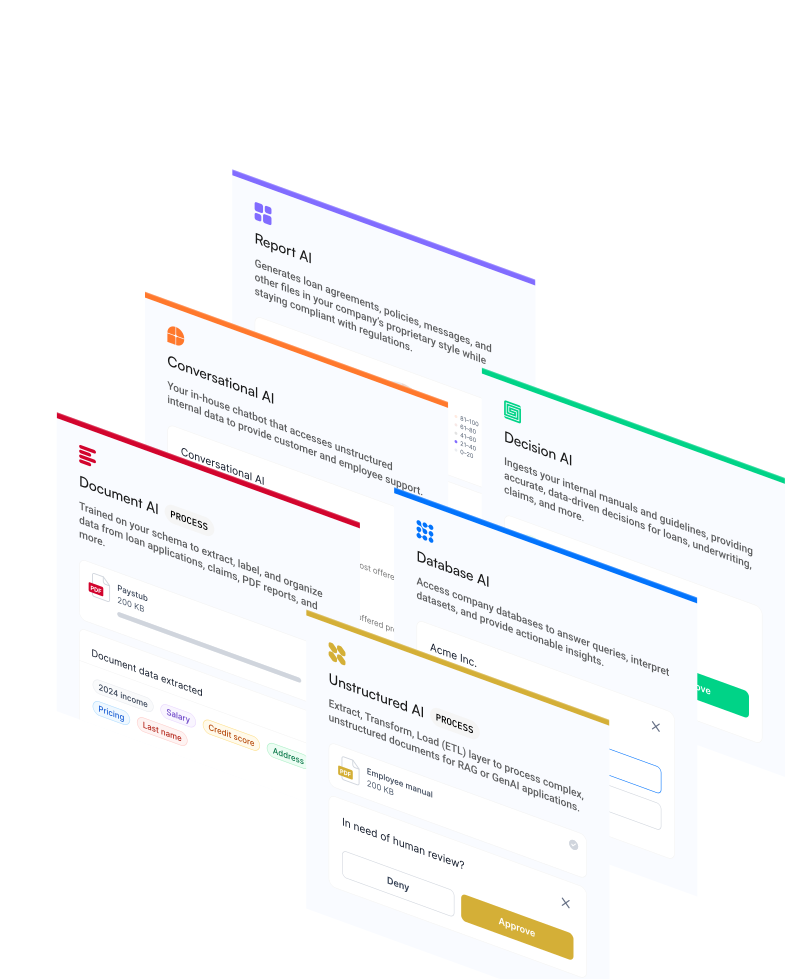
With a multi-agent platform like AgentFlow, an operating partner can configure a document processing agent to ingest quarterly financials from 40+ portfolio companies, regardless of format, while Search Agents cross-reference industry benchmarks and flag covenant breaches, delivering a unified health dashboard in hours.
Portfolio Risk Management & Early Warning
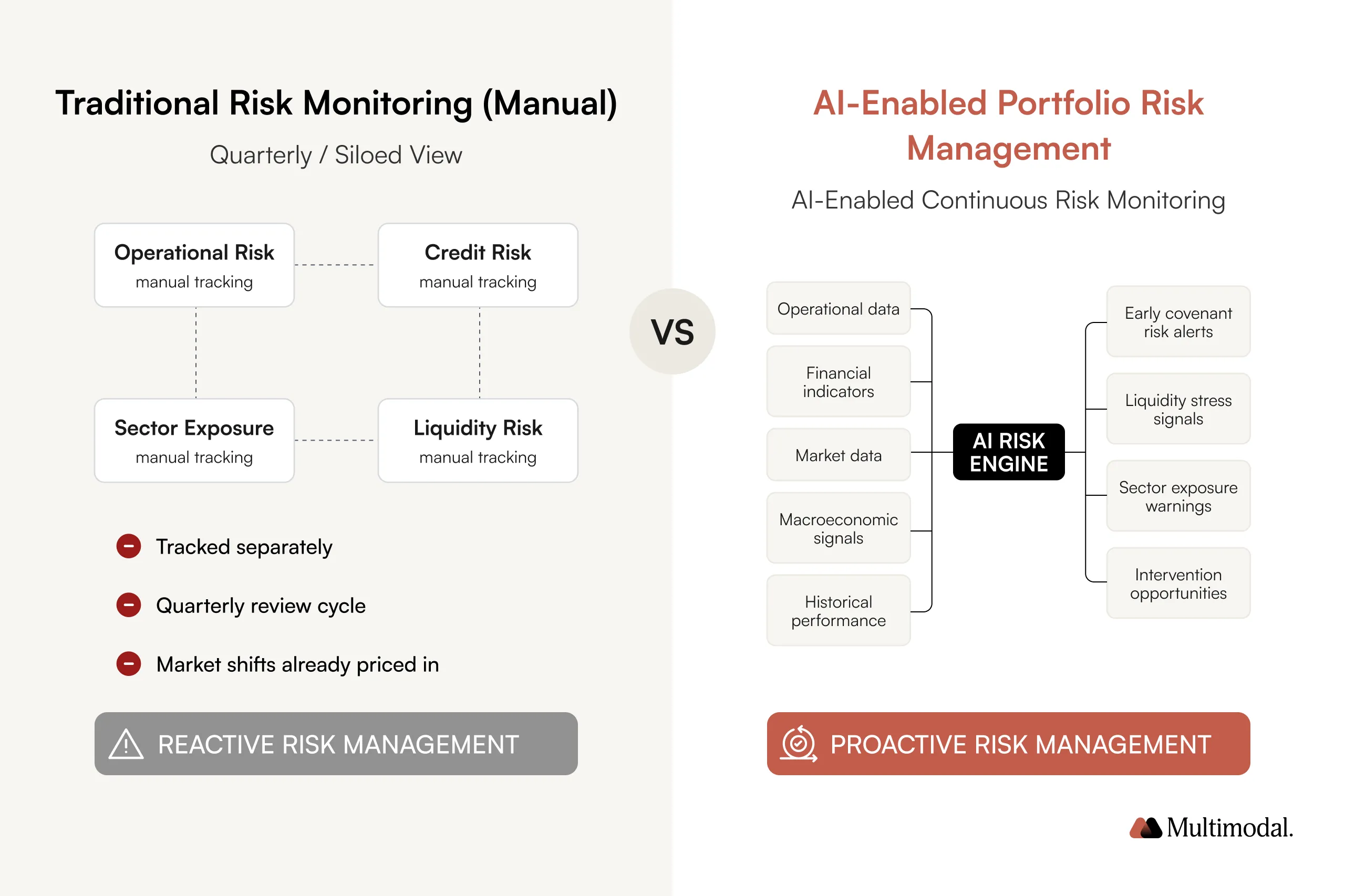
Risk rarely shows up as a single red flag. It builds across the portfolio in fragments: covenant headroom buried in financial reports, liquidity pressure in weekly cash updates, operational drift in KPIs, and external shocks in market data.
When those signals only get stitched together at quarter-end, portfolio managers end up reacting late, after market shifts have already hit EBITDA, or after a board meeting forces rapid adjustments.
AI portfolio management tightens risk management by continuously scanning for early signals across financial, operational, and compliance indicators. AI can:
- Monitor covenant compliance, liquidity, and working-capital indicators alongside operational KPIs so risk assessment reflects how the business actually runs.
- Use predictive analytics and machine learning models to spot identifying patterns that historically precede underperformance, then escalate exceptions based on risk tolerance.
- Apply sentiment analysis and natural language processing to unstructured data (board notes, monthly CFO commentary, audit memos) to surface “soft” risk signals that don’t appear in structured metrics.
- Tie alerts back to source documents and timestamped changes so investment professionals and portfolio managers can quickly validate and apply human judgment.
One constraint worth naming: Software Improvement Group found that 73% of AI systems score below average on build-quality benchmarks, a reminder that implementation discipline matters as much as the underlying technology.
That combination is the practical message for operating partners: AI can help you manage risk earlier and more consistently, provided data quality and governance are built in from the start. Firms that treat them as afterthoughts spend the pilot proving the wrong things.
LP Reporting & Investor Communications
LP reporting breaks teams for a structural reason. Every quarter, you're forced to turn inconsistent inputs from across the portfolio into one coherent, auditable story under a deadline.
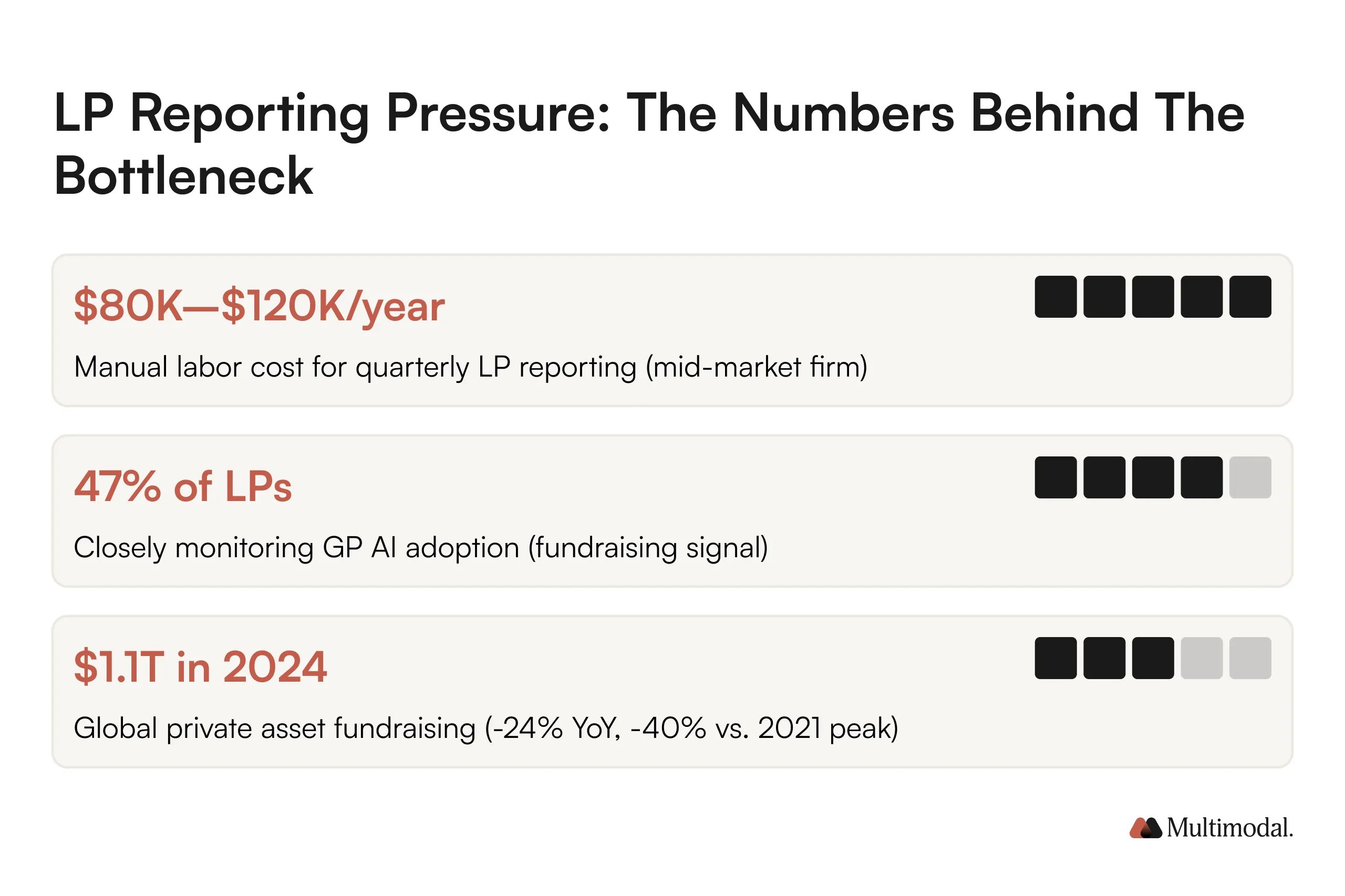
The result is a workflow where analysts spend more time formatting and reconciling than doing investment management work. For a mid-market firm, that manual process carries a real cost: $80K–$120K per year in labor just to produce quarterly LP reporting at an acceptable standard.
The stakes are rising because LP scrutiny is intensifying, and that scrutiny is intensifying because the fundraising environment has tightened. Global private asset fundraising fell to $1.1T in 2024, down 24% year over year and 40% below the 2021 peak.
In a market where GPs are competing harder for fewer LP dollars, operational maturity has to stand next to the returns track record in diligence conversations.
AI portfolio management reduces the reporting burden by treating it as a governed pipeline rather than a quarterly scramble. AI solutions can:
- Standardize portfolio company data from different sources into a consistent reporting schema, so numbers reconcile the same way every quarter.
- Draft first-pass narratives from historical data, quarter-over-quarter movements, and management commentary, with traceability back to source financial reports.
- Populate report templates automatically, then route exceptions and unclear items to investment professionals for review.
- Provide a controlled self-serve layer for common LP questions, grounded in the same standardized dataset with full human oversight.
The operational payoff shows up in both speed and capacity. A $4.2B PE firm used an AI dashboard to answer 90% of LP questions in under 2 hours, freeing 400+ analyst hours per quarter. Faster answers and fewer manual cycles reduce cost, and they change what reporting signals to LPs. A firm that responds to LP questions in hours rather than weeks is demonstrating operational maturity in real time.
Multi-agent tools like AgentFlow can automate the heaviest part of LP reporting: standardizing portfolio company data from different sources, generating first-draft narratives, and populating report templates, reducing a 40-hour quarterly process to a few hours of review.
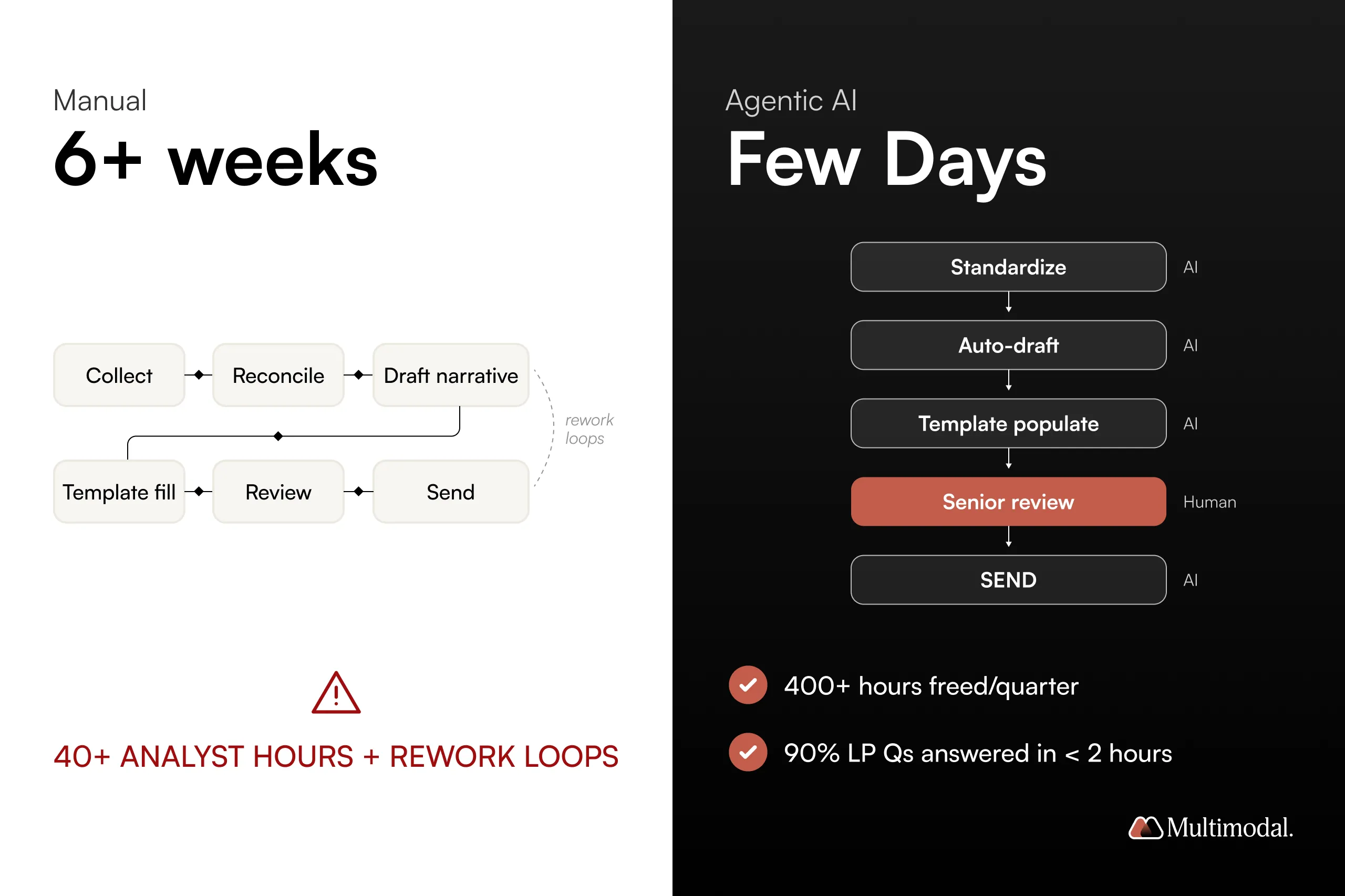
Multi-agent tools like AgentFlow can automate the heaviest part of LP reporting: standardizing portfolio company data from different sources, generating first-draft narratives, and populating report templates, reducing a 40-hour quarterly process to a few hours of review.
Value Creation Across the Portfolio
Once monitoring and reporting stop consuming the week, operating partners can shift attention to the work that actually moves returns: scaling repeatable EBITDA levers across portfolio companies.
The challenge is consistency. Value-creation ideas are rarely in short supply, but applying the same play reliably across 10 portfolio companies with different systems, teams, and levels of data maturity is where most firms lose momentum.
AI portfolio management supports that scale by making “value creation plays” easier to deploy, measure, and replicate across the portfolio.
- Commercial execution: pricing and discount diagnostics, churn prediction, customer segmentation, and sales pipeline hygiene based on CRM notes and support logs (unstructured data).
- Operations: demand forecasting, inventory optimization, and supplier risk monitoring using internal KPIs plus market data.
- Finance and planning: faster variance analysis, automated management reporting, and better forecasting models that improve decision cadence.
- Software productivity inside portcos: AI-assisted development and QA that reduces delivery bottlenecks and accelerates automation projects tied to margin and working capital.
Two real-world benchmarks show what this looks like when AI moves from pilot to measurable value creation:
- Apollo’s Barnes Group: GenAI for product spec indexing delivered 5x return on AI investment in year one.
- AI can cut programming time at portcos by 50%+.
For operating partners, the takeaway is straightforward: treat AI-driven value creation as a portfolio-level operating capability. Standardize the playbooks, instrument the measurement (margin, cash, churn, cycle time), and deploy the same “known good” patterns across portfolio companies so improvements compound instead of resetting every quarter.
CLA Connect frames the directional bet clearly: “Firms embedding AI into operational playbooks may create measurable value faster and position portfolio companies for premium exits.”
The ROI Case — And the Cost of Spreadsheet Status Quo
Operating partners rarely need convincing that AI portfolio management can relieve capacity constraints. The harder part is getting internal buy-in from managing partners and CFOs who want ROI in numbers and clarity on tradeoffs.
This section gives you the talking points and data to make that case.
What It Delivers
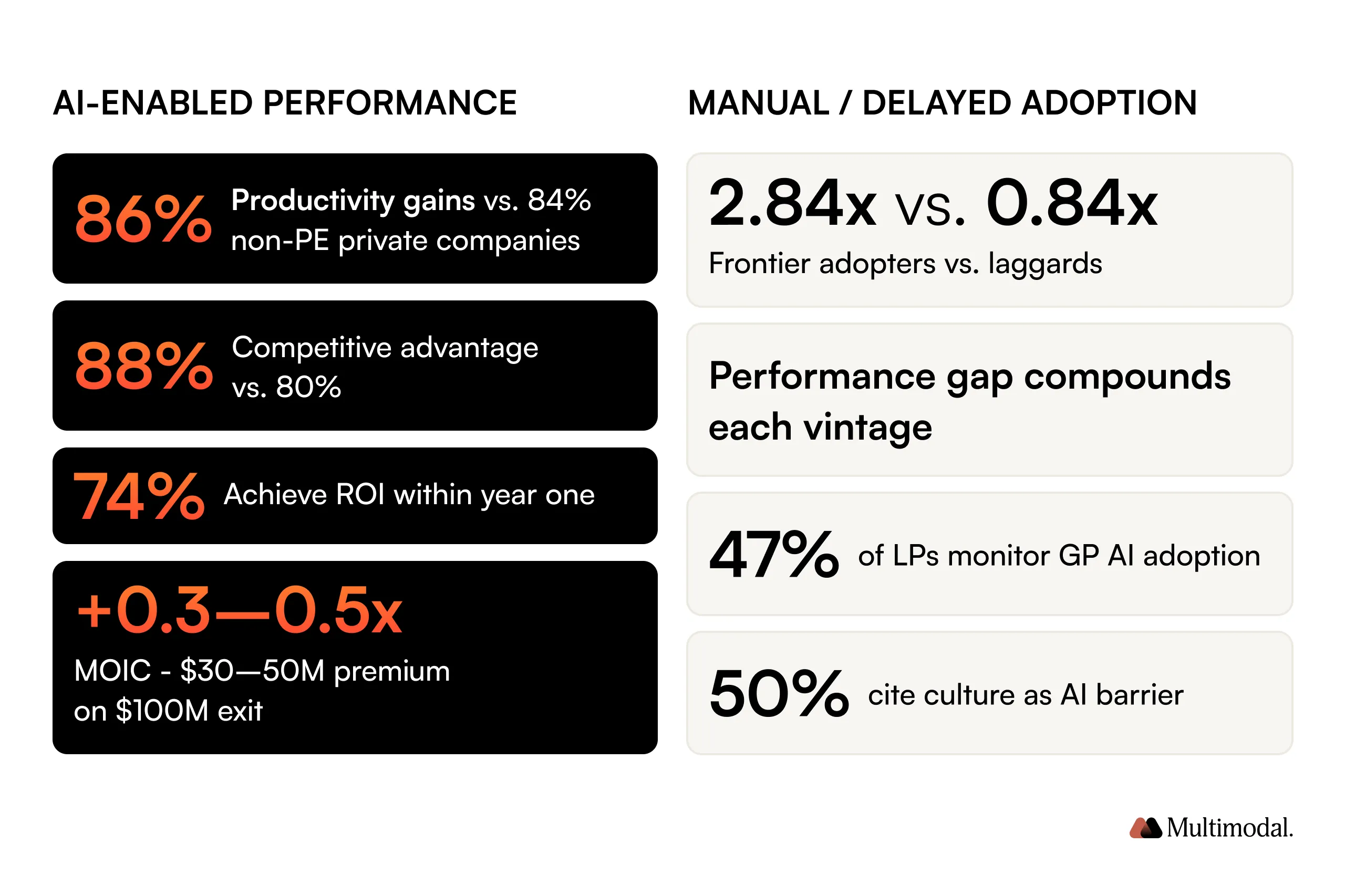
PE sees outsized upside from AI because the workflows are repetitive, time-bound, and data-heavy. In 2025, research from BDO stated PE firms reported higher AI ROI than private companies overall, productivity impact 98% vs. 84%, and competitive advantage 94% vs. 80%.
That translates into outcomes you can actually underwrite:
- Faster portfolio review cycles without adding headcount
- Cleaner reporting and fewer “where did this number come from?” escalations
- Earlier risk detection that prevents value erosion and reduces after-the-fact explanation cycles, strengthening risk management and faster investment decisions
And the payback window isn’t hypothetical. 74% of executives report ROI from genAI within the first year. In PE terms, that’s attractive because it lines up with annual planning cycles rather than multi-year transformation timelines.
At the fund level, the payoff shows up as better timing and better decisions. Preqin’s 2025 benchmark points to MOIC improvements of 0.3–0.5x from better portfolio intelligence and exit timing. In practice, treat that benchmark as the ceiling you’re building toward. Stronger portfolio intelligence links day-to-day operating signals to higher-confidence exit timing, turning AI portfolio management into a returns lever as well as a workflow upgrade.
What It Costs to Wait
The spreadsheet status quo means you fall behind while the portfolio grows.
- Performance gap widening: According to Microsoft and IDC, Frontier AI adopters are achieving 2.84x returns vs. 0.84x for laggards. Even if you treat that as directional, it reinforces the same point: AI adoption creates separation over time.
- LP confidence: Firms without an AI capability story are losing fundraising conversations. In a tighter capital environment, ops maturity is part of diligence.
- Talent: Next-gen analysts expect AI-assisted workflows; manual-only firms lose the recruiting war. When packet prep becomes the job, the best people leave.
The final constraint is execution. In 2025, EY reports culture and people rank as the #1 barrier to AI adoption, with technology ranking behind them. That’s why the goal is to ship one AI portfolio management workflow that saves time, earns trust, and becomes the new default, then scale across the portfolio.
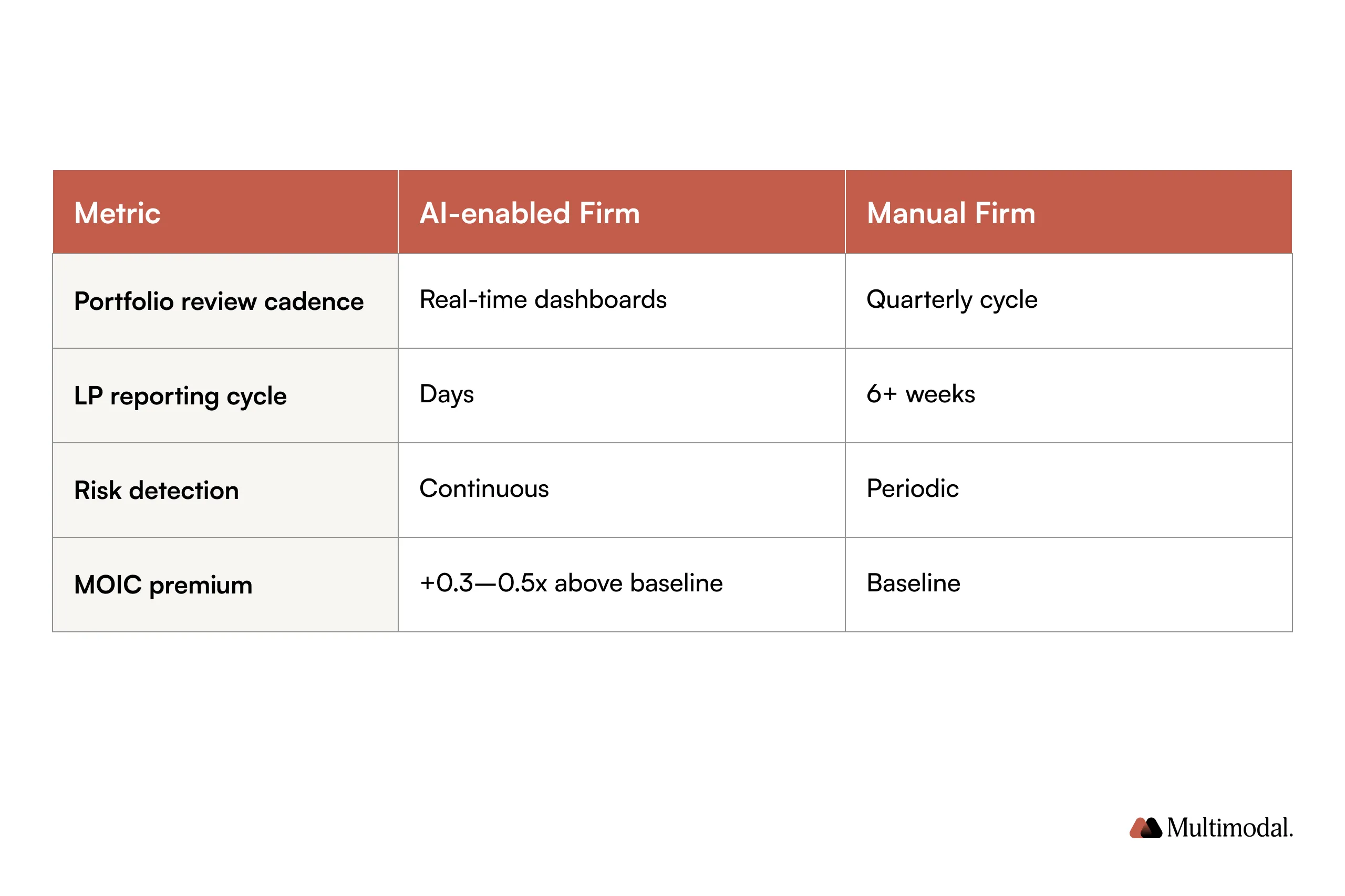
Spreadsheet Status Quo vs. AI Portfolio Management
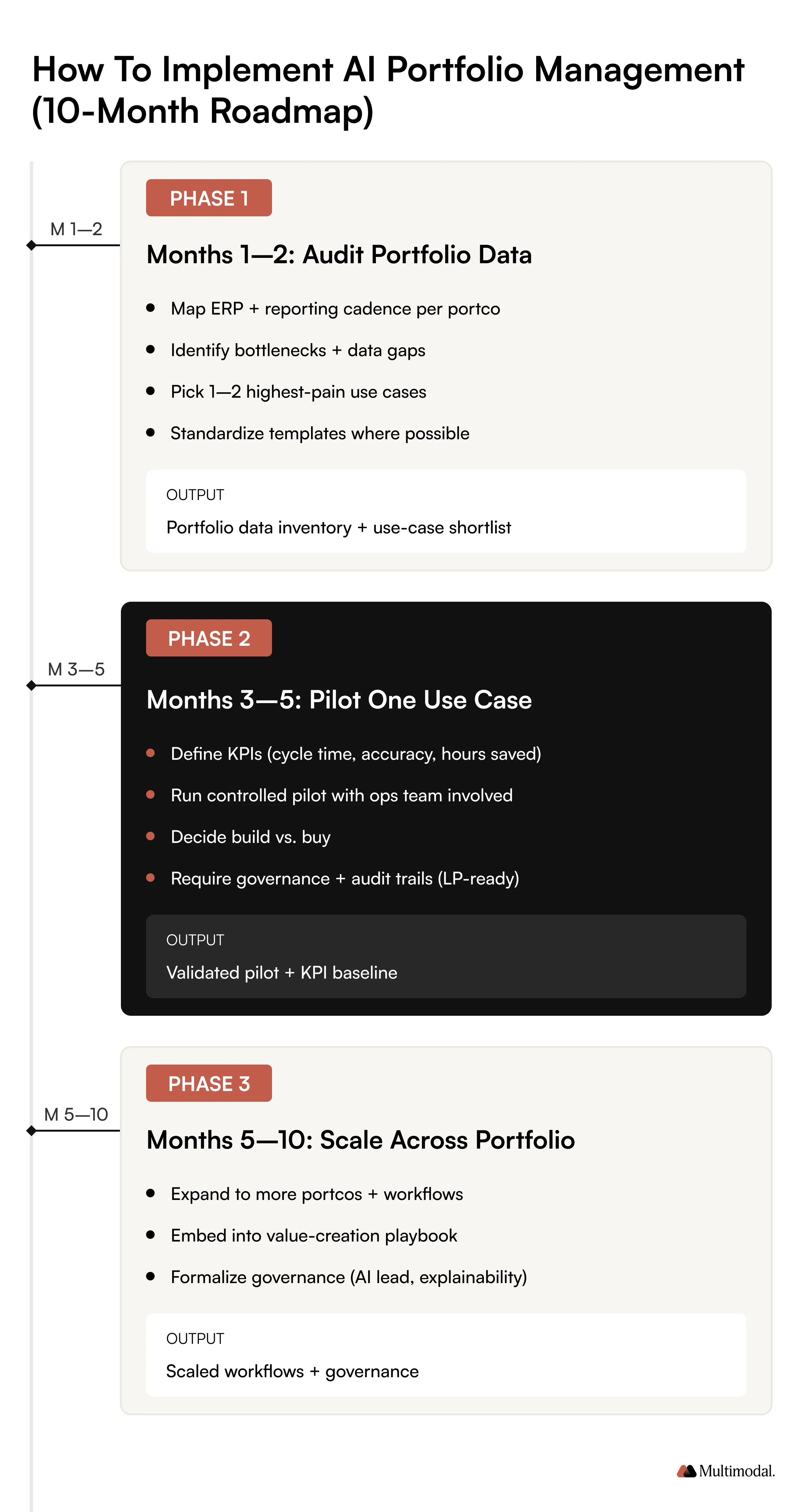
Getting Started — A 3-Phase Approach
The firms that operationalize AI portfolio management fastest don't start with the most ambitious use case; they start with a disciplined pilot: one workflow, clean inputs, clear ownership, and a measurable outcome they can take back to partners. That proof point is what earns the mandate to scale.
Phase 1: Audit Your Portfolio Data (Months 1–2)
Run a structured audit across portfolio companies:
- Map every portfolio company reporting system, file format, and cadence.
- Identify where financial data is reliable, and where data quality breaks (definitions, missing fields, inconsistent time periods).
- Catalog unstructured data sources worth indexing: board decks, monthly KPI emails, customer feedback summaries, operational runbooks.
- Pick 1–2 use cases with obvious ROI. For most operating partners, that starts with portfolio company monitoring or LP reporting.
Deliverable: a single “portfolio data map” that shows systems, owners, and gaps.
Phase 2: Pilot One Use Case (Months 3–5)
Choose one workflow and make it measurable. Pilot design checklist:
- Define success metrics: cycle time, accuracy, analyst hours saved, and reduction in rework.
- Set explicit human oversight rules: what the system can auto-complete, what requires review, and what escalates.
- Use a representative subset of portfolio companies: mix formats, mix ERP maturity, mix industries.
- Include fund finance, portfolio ops, and the data team from day one.
This phase is where you pressure-test the full investment process impact: data processing, draft generation, exception review, and stakeholder trust.
For firms handling sensitive portfolio data, purpose-built platforms like AgentFlow deploy on your own infrastructure (VPC or on-prem), with configurable agents, built-in explainability, and audit trails designed for LP scrutiny.
If you need a governance-first checklist for regulated environments, Multimodal’s security and governance materials outline practices like encryption, RBAC, confidence thresholds, and immutable logging.
Phase 3: Scale Across the Portfolio (Months 5–10)
Once the pilot works, scale the pattern:
- Extend to more portfolio companies and additional workflows (risk management, covenant monitoring, monthly flash reporting).
- Standardize templates where possible to improve data processing quality.
- Formalize governance: access controls, audit trails, and change control for prompts, schemas, and model versions.
- Embed the workflow into the operating rhythm: weekly ops review, monthly CFO review, quarterly board cadence.
Conclusion
AI portfolio management is becoming the operating system for modern portfolio ops. It compresses reporting cycles, improves risk management, and expands team capacity without adding headcount. The firms that get this right turn portfolio monitoring into a continuous capability with real-time data processing and rapid adjustments as market trends shift.
The market signals are clear:
- 84% of PE firms have appointed a Chief AI Officer.
- 84% are experiencing longer holding periods vs. 2024.
- 47% of LPs are closely monitoring GPs’ use of AI, with 46% holding mixed views due to risk concerns.
Start with one post-close workflow, prove ROI with real metrics, then scale across the portfolio with governance and human oversight built in.
Run AI Portfolio Management Without Adding Headcount
Standardize portfolio company data, surface risks early, and ship LP reporting faster—with human oversight and audit trails built in.
See how PE firms use AgentFlow to operationalize AI portfolio management.