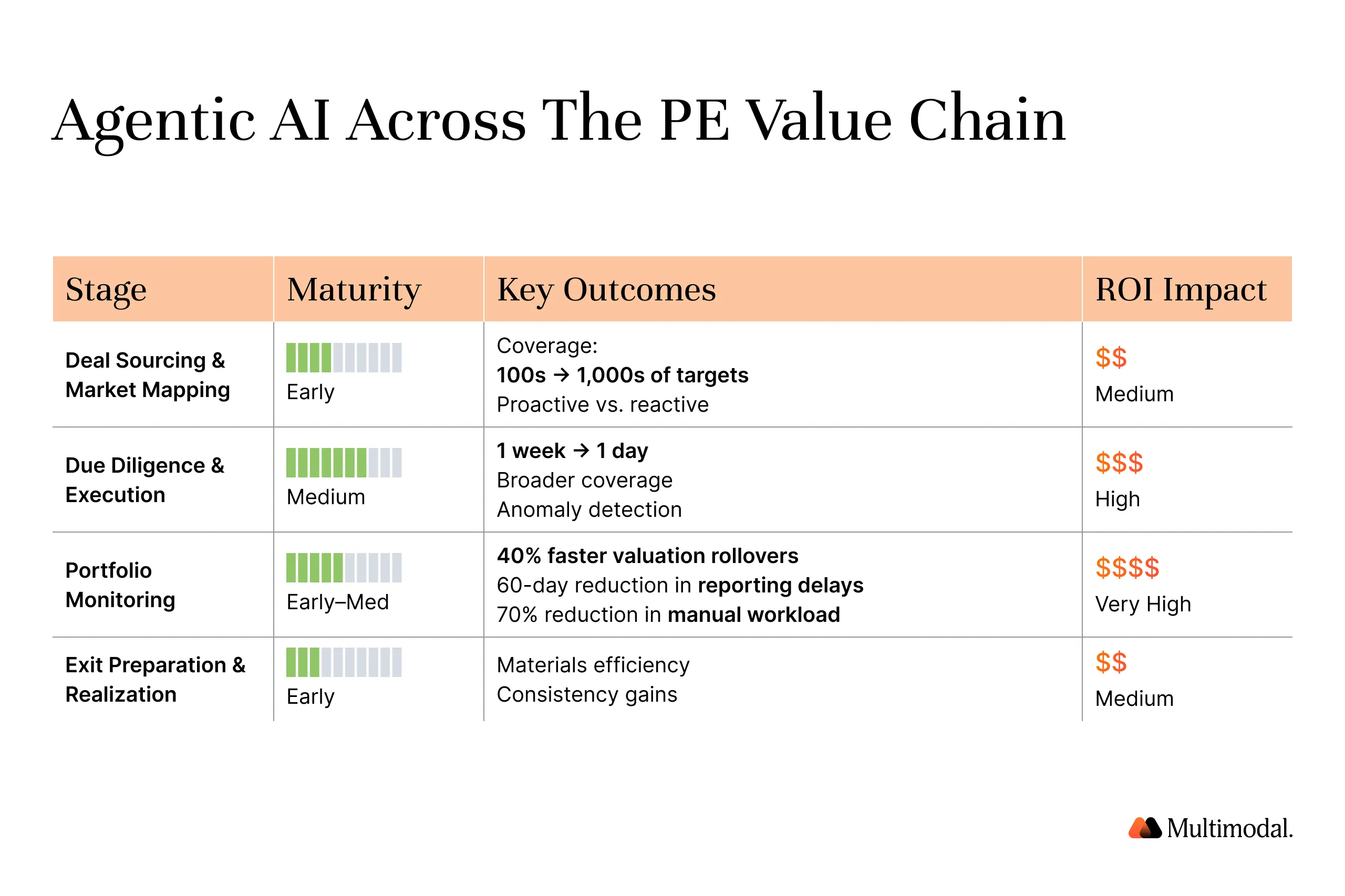
Agentic AI expands sourcing from hundreds to thousands.
Due diligence drops from one week to one day.
Portfolio monitoring cuts delays and manual work sharply.
Execution issues, not interest, remain the main blocker.
Get 1% smarter about AI in financial services every week.
Receive weekly micro lessons on agentic AI, our company updates, and tips from our team right in your inbox. Unsubscribe anytime.
Thank you! Your submission has been received!
Oops! Something went wrong while submitting the form.
Private equity firms know AI matters. The harder question is where it creates real value across the deal lifecycle, and what separates a pilot from a repeatable operating model. That is exactly why we published our 2026 research report, The State of Agentic AI in Private Equity. In the report, we analyzed how PE firms are using generative AI, where agentic AI is moving into production, and why so many initiatives stall before they reach measurable value creation. You can download the full report here.
In this post, we cover the biggest findings, what they mean for private equity firms, and where AI agents are starting to change deal sourcing, due diligence, portfolio monitoring, and exit strategy.
Only 10%–15% Of Private Equity Firms Have Turned AI Pilots Into Systematic Deployment
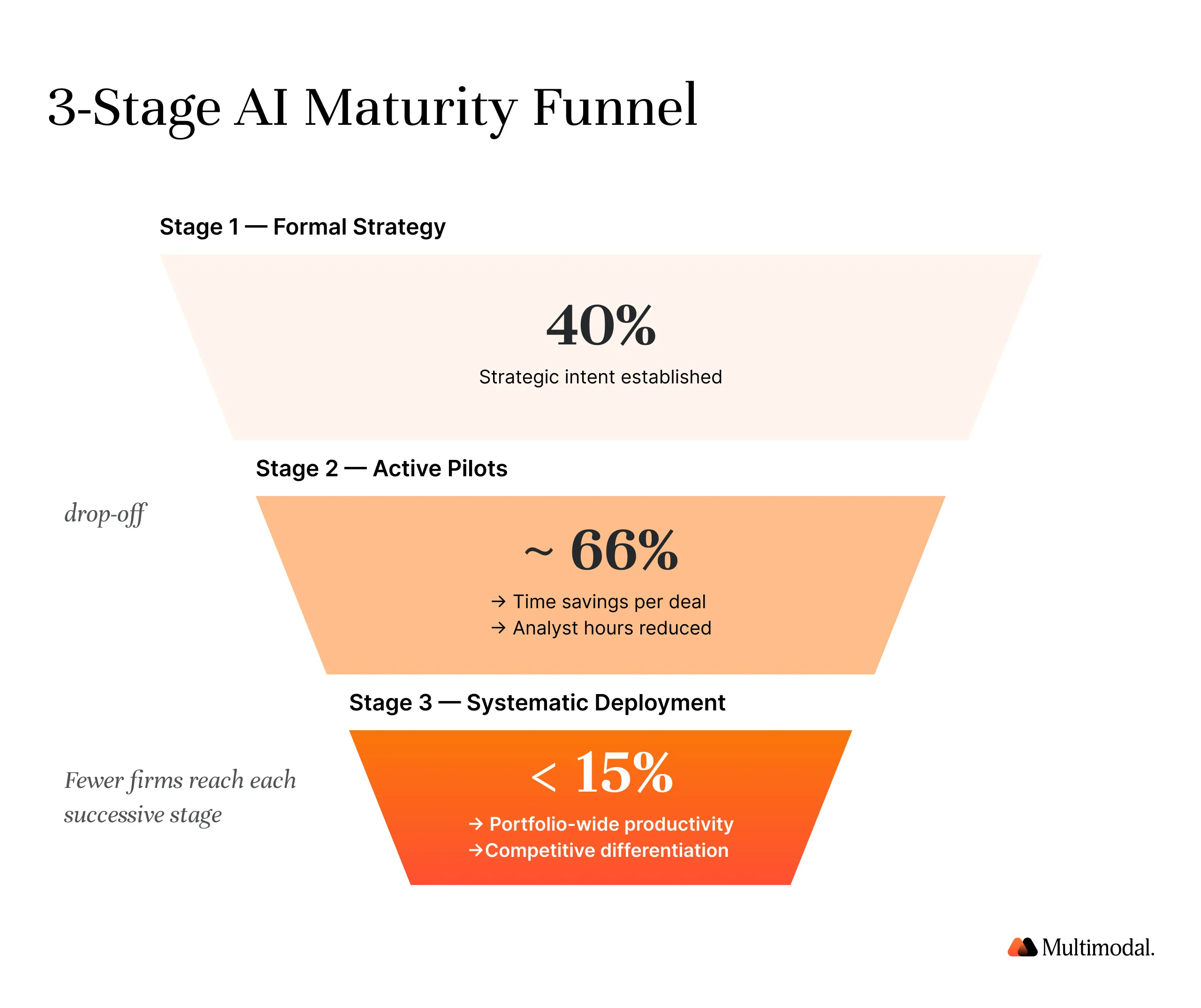
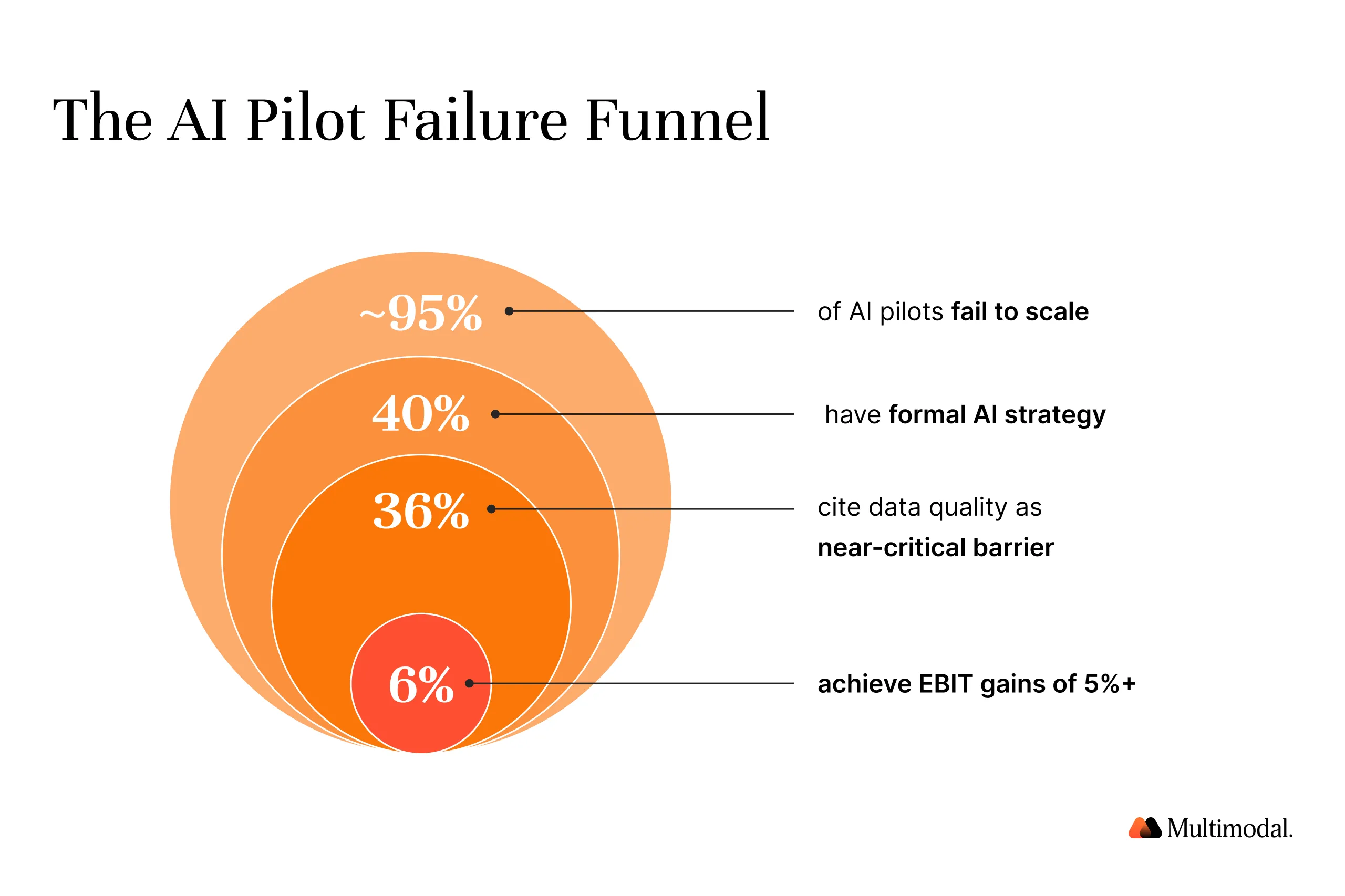
The clearest finding in the report is the execution gap. Roughly 40% of GPs report having a formal AI strategy, and about two-thirds are actively piloting AI. But only 10% to 15% have reached systematic deployment with measurable impact, based on the primary source cited in the report from Pictet.
Our take: This is the real state of AI in private equity in 2026. Most private equity firms are past the “should we use AI?” stage. They are now stuck in the harder middle ground between experimentation and operating model change. That matters because in private equity, a pilot on one deal does not create a durable competitive advantage. Scaled deployment across deal teams, internal processes, and portfolio companies does.
As the report puts it, “The gap, from widespread piloting to scaled production, represents the defining challenge for PE firms adopting agentic AI.” That framing matters because it shifts the conversation away from generic generative AI tools and toward execution maturity.
The full report adds more detail on what separates the firms that pilot from the firms that actually redesign core workflows.
Download Full Report
See how private equity firms are applying agentic AI across sourcing, diligence, portfolio operations, and value creation.
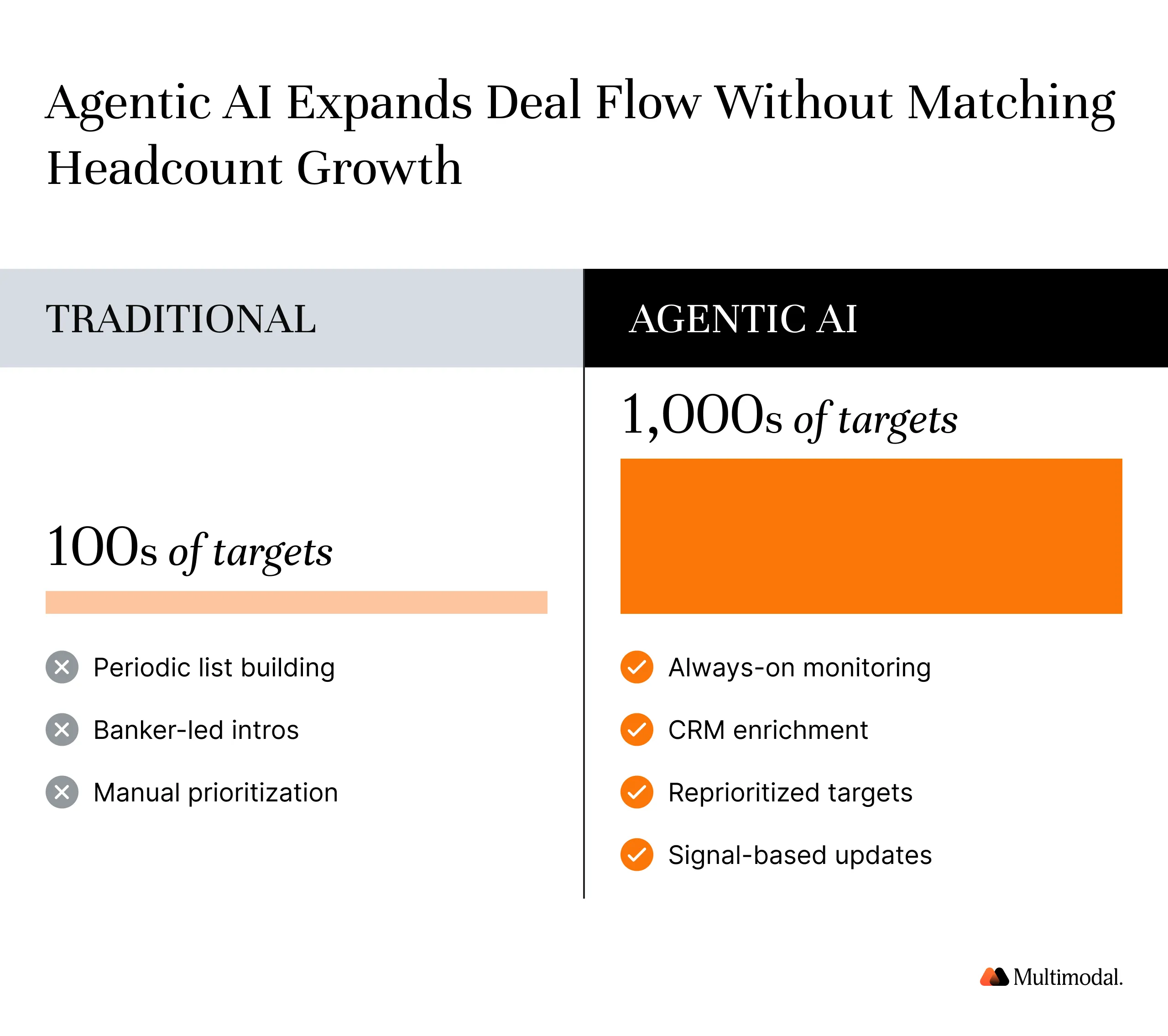
Agentic AI Expands Deal Sourcing From Hundreds To Thousands Of Targets
In deal sourcing, the report shows that agentic AI is changing how private equity firms manage deal flow. Instead of periodic Excel-based scans and banker-led introductions, AI agents can continuously monitor company universes, news, CRM activity, and market data. The report’s primary source for this section includes Evalueserve, IOSCO, and Grata, which support the shift from episodic screening to always-on sourcing.
Our take: for PE firms, this is one of the clearest use cases for an AI agent. Deal teams need agentic AI that tracks targets against an investment thesis, updates the CRM, reprioritizes names when signals change, and improves deal sourcing beyond simple single-company summarization. That is where deploying AI agents starts to create tangible value.
This also changes the role of human expertise. The best systems do not replace relationships or human judgment. They widen the funnel top, improve signal detection, and allow deal teams to spend more time on outreach, qualification, and decision-making.
Generative AI Can Cut Due Diligence Work From One Week To One Day
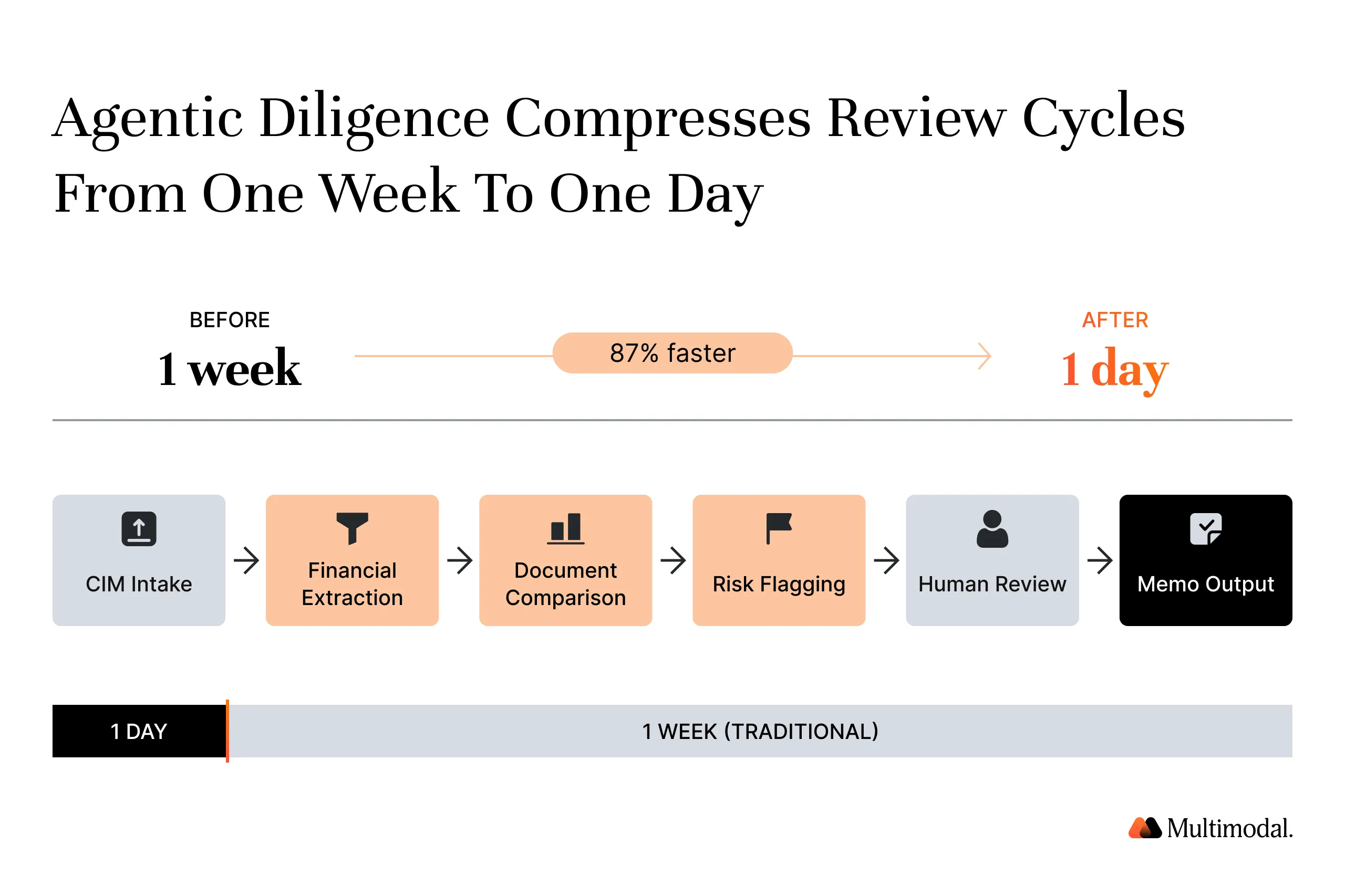
Due diligence is where generative AI is already moving from curiosity to real workflow impact. In the report, early adopters using generative AI for deeper diligence cut summarization work from about one week to roughly one day, based on the report’s cited primary source from Bain. The report also cites McKinsey and Datasite on using AI to structure outside-in diligence.
Our take: This is one of the strongest use cases for artificial intelligence in private equity because the work is document-heavy, time-consuming, and full of unstructured data. CIMs, financial statements, contracts, board decks, Q&A logs, and data rooms all create exactly the sort of messy data processing problem where agentic AI outperforms traditional automation. A good AI agent goes beyond summarization. It extracts fields, compares claims across documents, flags false positives, and preserves audit trails for review.
That last point matters. In high-stakes diligence, AI outputs cannot be accepted as-is. They need traceability. This is why private equity firms are moving toward human-in-the-loop operating models rather than fully autonomous systems.
In the report, Multimodal’s AgentFlow appears as an example of this pattern: a leading PE firm used it to automate teaser intake and CIM extraction while maintaining full auditability and human review. That is what separates an AI tool from a production workflow.
The full report breaks this down further across diligence maturity levels, from summarization to anomaly detection to memo creation.
AI-Powered Portfolio Monitoring Cut Reporting Delays by 60 Days and Manual Workload by 70%
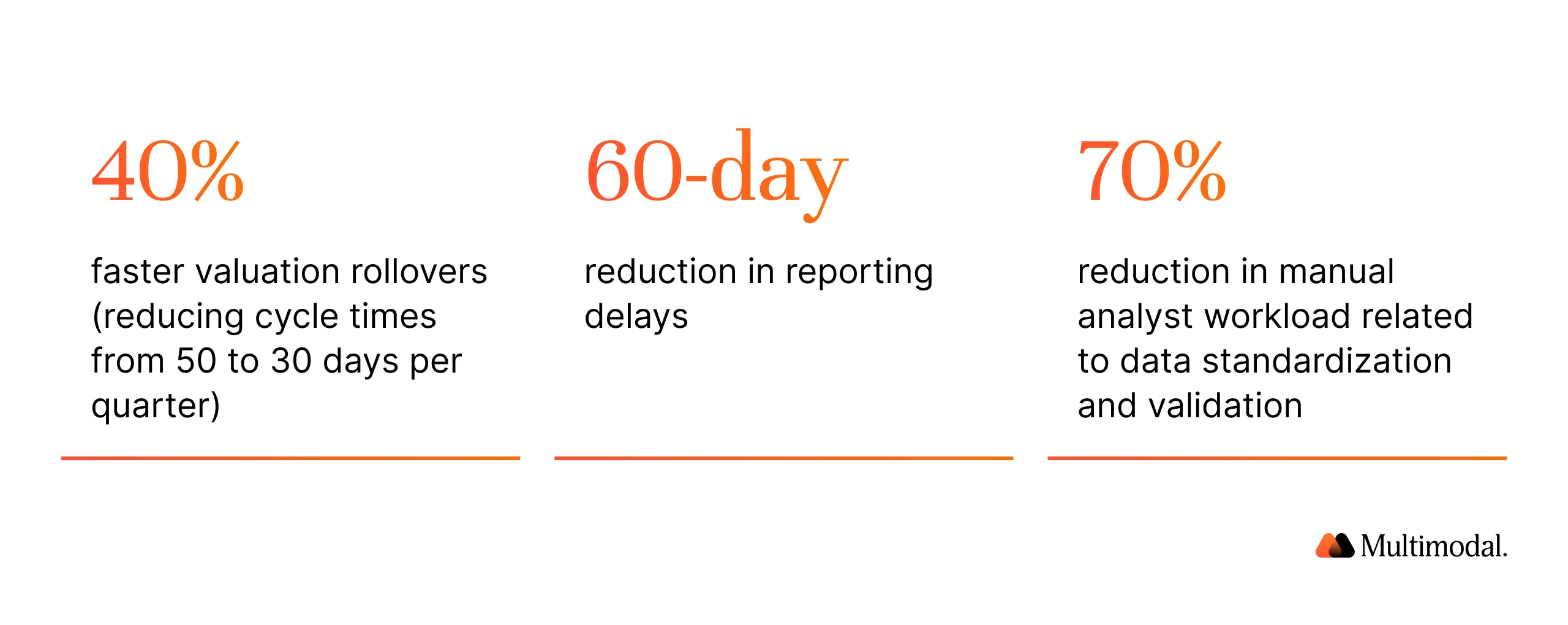
The report’s strongest operating results show up in portfolio monitoring. In one cited example, a mid-sized PE firm achieved 40% faster valuation rollovers, a 60-day reduction in reporting delays, and a 70% reduction in manual analyst workload after implementing AI-powered data management, based on sources cited from BDO and Planr.
Our take: This is where private equity PE firms can create measurable value across the full portfolio, not just on one transaction. But it only works when firms first standardize data. The report calls this the “data spine”: a shared data layer that normalizes KPIs across portfolio companies, connects to ERP, CRM, and finance systems, and validates inconsistent inputs before downstream analytics start. Without that spine, AI systems inherit fragmented financial data, inconsistent metric definitions, and weak comparisons across business models.
This finding is especially important for any operating partner focused on operational excellence. Portfolio monitoring plays a direct role in the value chain, far beyond basic reporting. When one portfolio company solves churn, pricing, supply chain, or talent acquisition issues, the goal is to transfer that learning across the rest of the portfolio. Agentic AI makes that transfer more systematic. It gives management teams and operating partners a way to spot patterns earlier, act faster, and improve portfolio performance.
As the report notes, firms often start with 15 to 20 core KPIs across 30 to 50 portfolio companies. That sounds operationally simple. In practice, it is a large internal process challenge, and that is exactly why portfolio monitoring becomes a test of execution maturity.
The Biggest Barrier Is Still Data Quality, Not Interest In AI
Adoption is no longer the main problem. Execution is. The report notes that approximately 36% of GPs cite data quality and output reliability as near-critical barriers to AI adoption, with the underlying context supported by sources from Pictet and multiple McKinsey publications.
Our take: Most private equity firms struggle when they layer AI onto fragmented systems, inconsistent inputs, and unclear review rules. That is why so many AI initiatives become orphan pilots. The stack may look impressive in a demo, but it breaks down when it has to read from CRMs, write back to workbenches, pull data from data rooms, process unstructured data, and preserve audit trails for every step.
This is where agentic AI differs from generic generative AI tools. Generative AI can produce a good draft. Agentic AI has to complete multi-step business processes inside real operating constraints. For private markets, that means permissions, compliance, data lineage, approval thresholds, and explicit ownership rules.
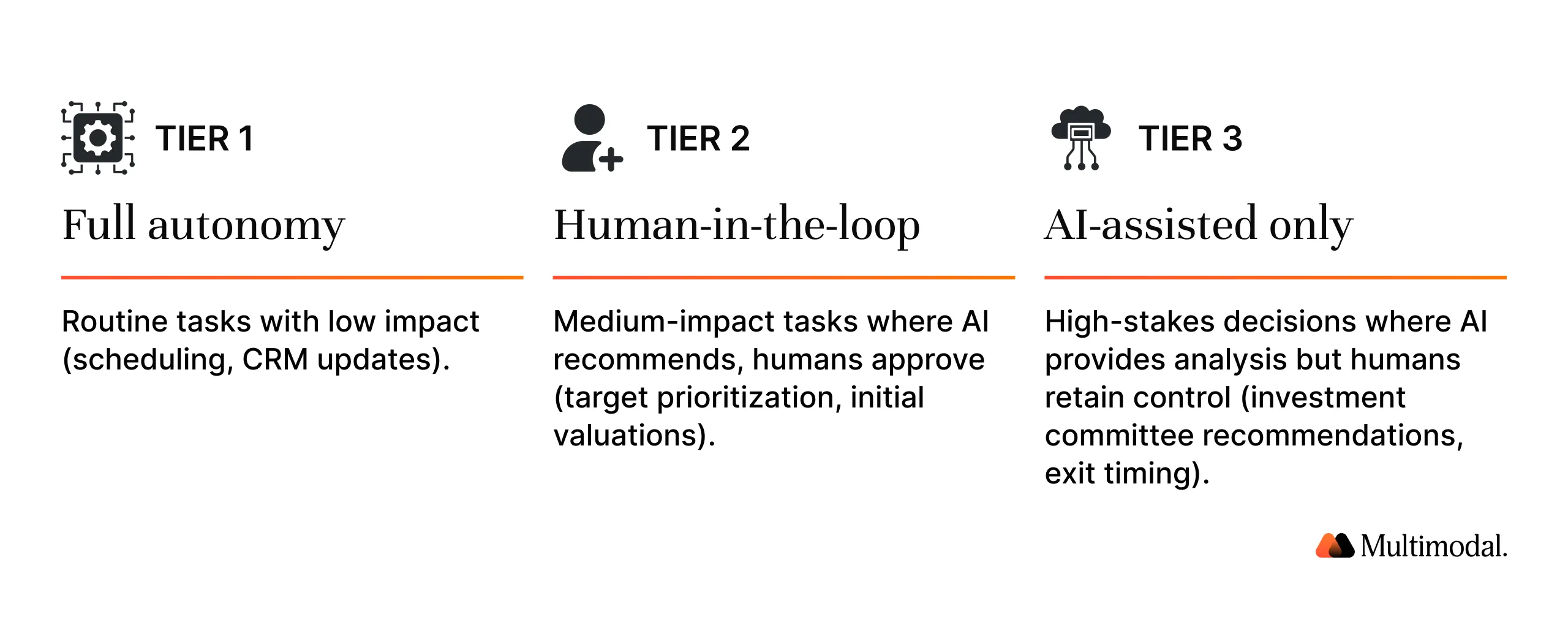
The report’s governance model is useful here. Tier 1 covers routine tasks with full autonomy. Tier 2 covers medium-impact tasks where humans approve recommendations. Tier 3 keeps high-stakes activities, like investment committee recommendations and exit strategy decisions, firmly in human hands. That is the practical path for integrating AI systems without losing fiduciary discipline.
Execution-Mature Firms Redesign Operating Models First — Then Deploy AI
The firms creating real value are the ones that align data infrastructure, governance, ownership, and workflow integration, rather than the ones with the flashiest demos. That is consistent with the broader evidence in the report, including the claim that 95% of AI pilots fail to scale and that only a minority of organizations have developed the capabilities needed to move beyond proof-of-concept, based on sources cited from BCG and EPAM.
Our take: Competitive advantage comes from integrating AI into core workflows across the investment lifecycle, not simply from having access to AI. That includes deal sourcing, due diligence, investment committee preparation, portfolio monitoring, financial reports, and eventually exit strategy support. In other words, the winning firms are changing the operating model.
That has implications for talent and structure. An operating partner cannot treat this as a side project. PE leaders need cross-functional ownership across investment, operations, and technology. They need AI systems that produce explainable AI outputs. They need human expertise to validate what the models are doing. And they need to connect AI work to measurable value creation, not vague productivity gains.
This is also why we think purpose-built systems matter in regulated workflows. In private equity, the real challenge lies in integrating AI agents into live workflows without losing control, compliance, or confidence in the output.
Where Agentic AI Is Creating The Most Value Across The Private Equity Value Chain
Will Agentic AI Become Table Stakes For Private Equity By 2031?
The report’s answer is nuanced. On one hand, it projects that agentic AI will expand across deal sourcing, due diligence, and portfolio monitoring over the next several years. On the other hand, it also includes a counterpoint: some industry practitioners believe AI itself will become commoditized, while judgment, relationships, and execution remain the real differentiators.
Our take: Both views can be true. The models and many generative AI tools will become more accessible. But the firms that integrate AI into their data, workflows, and decision rights first will still create a performance gap. In that sense, AI in private equity may become table stakes at the technology layer while still producing a competitive advantage at the operating layer.
That distinction matters for private equity firms deciding what to do next. The focus has moved from whether to apply AI to how firms can integrate it into the value chain to create measurable value, protect fiduciary standards, and improve decision-making across portfolio companies.
This post only covers the headline findings. The full report goes deeper into vendor strategy, build-vs-buy decisions, governance models, and where agentic AI is most mature across the private equity lifecycle. Download the full report now.
For firms whose pilots are not reaching production, the issue usually comes down to data infrastructure or integration. We can show you what a production-ready deployment looks like for your workflows. Book a walkthrough.

.svg)
.svg)

.avif)
.png)

.png)