Best AI Tools for Private Equity in 2026: A Buyer's Guide for Operating Partners


Table of contents
Key Takeaways:
- 84% of PE funds expect AI to have a transformative impact on their business model. Most are still in early deployment.
- PE AI tools divide into deal-team tools and operating-team tools. Most buying guides conflate the two.
- Generic AI tools fail PE workflows. Tools must be embedded in the investment lifecycle to drive adoption.
- Operating partners deploying an AI portfolio-wide report 200 to 400 basis points of EBITDA expansion within 12 months.
Get 1% smarter about AI in financial services every week.
Receive weekly micro lessons on agentic AI, our company updates, and tips from our team right in your inbox. Unsubscribe anytime.
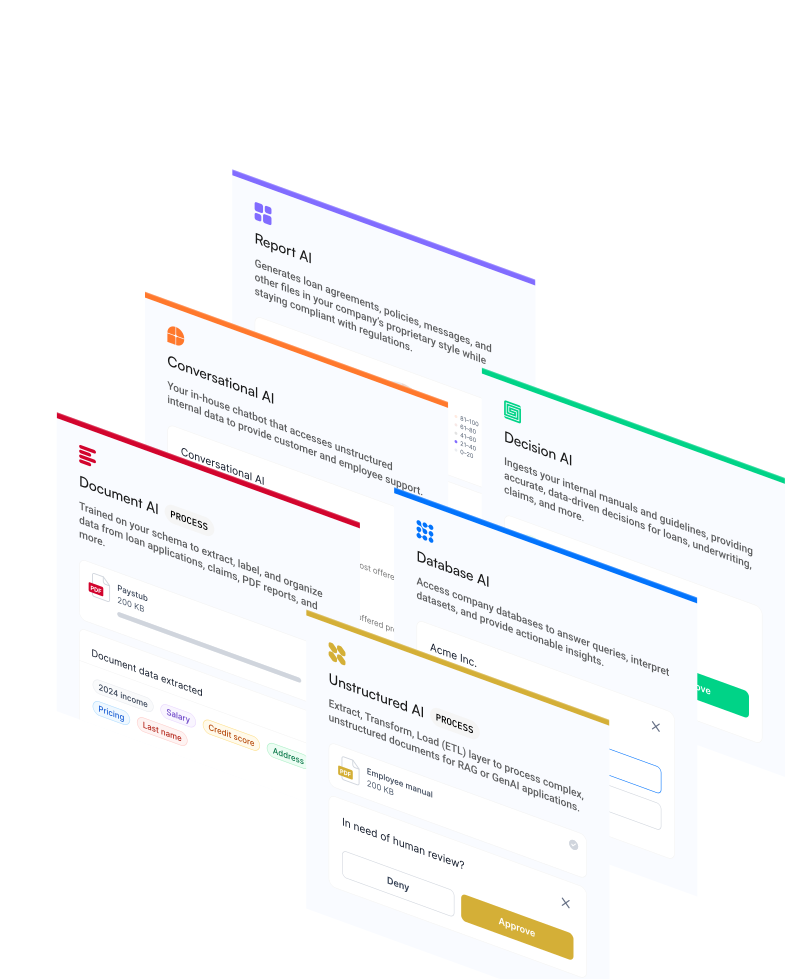
According to EY's 2026 analysis of AI in private equity, 84% of PE funds expect AI to have a significant transformative impact on their business model. Artificial intelligence has emerged as a standalone third value lever, alongside financial engineering and operational improvement, fundamentally changing how private equity firms source deals, manage portfolio companies, and generate returns. The gap between expectation and deployment is where most firms are stuck.
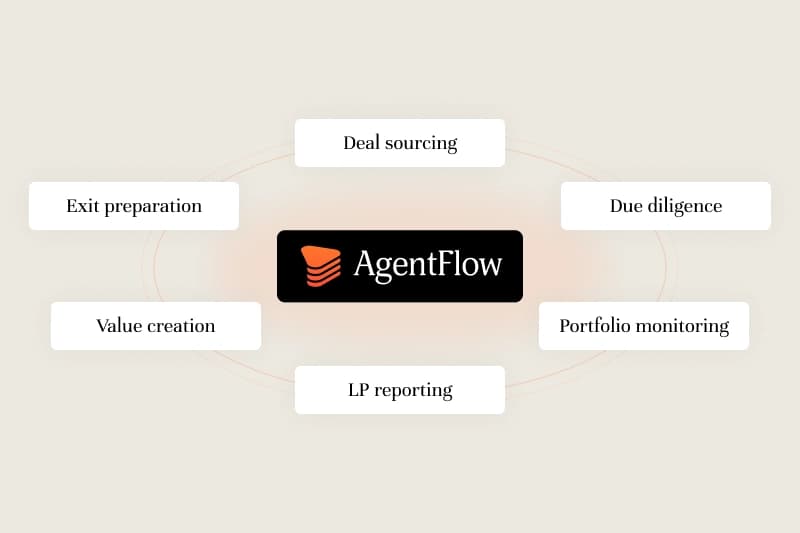
The challenge is that most AI buying guides for private equity are organized by technology categories rather than workflows. Deal sourcing, due diligence, portfolio monitoring, value creation, LP reporting, and exit preparation each have distinct tool requirements. Generic AI tools fail to meet these requirements because they are not built for the investment lifecycle.
This guide compares the leading AI tools for private equity in 2026 across all six workflow categories, with AgentFlow, Hebbia, Rogo, BlueFlame, Grata, AlphaSense, and others assessed on their actual delivery.
The PE AI Landscape in 2026
BlueFlame was acquired by Datasite in July 2025, following Datasite's earlier acquisition of Grata in June 2025. Rogo announced a strategic partnership with LSEG for market data access and acquired Subset, an AI spreadsheet engine, in September 2025. Both BlueFlame and Grata now operate as Datasite business units. Rogo integrated LSEG market data and acquired a spreadsheet AI engine. The operating side of the market, portfolio monitoring, value creation, and LP reporting, remains less consolidated and represents the larger differentiation opportunity. According to BCG's AI-First Private Equity report, most firms are still in the first stage of AI adoption: deploying a horizontal tools portfolio-wide. Managing multiple portfolio companies with fragmented ERPs and inconsistent reporting standards remains the primary bottleneck. AI tools that sit outside existing workflows produce insights that nobody acts on.
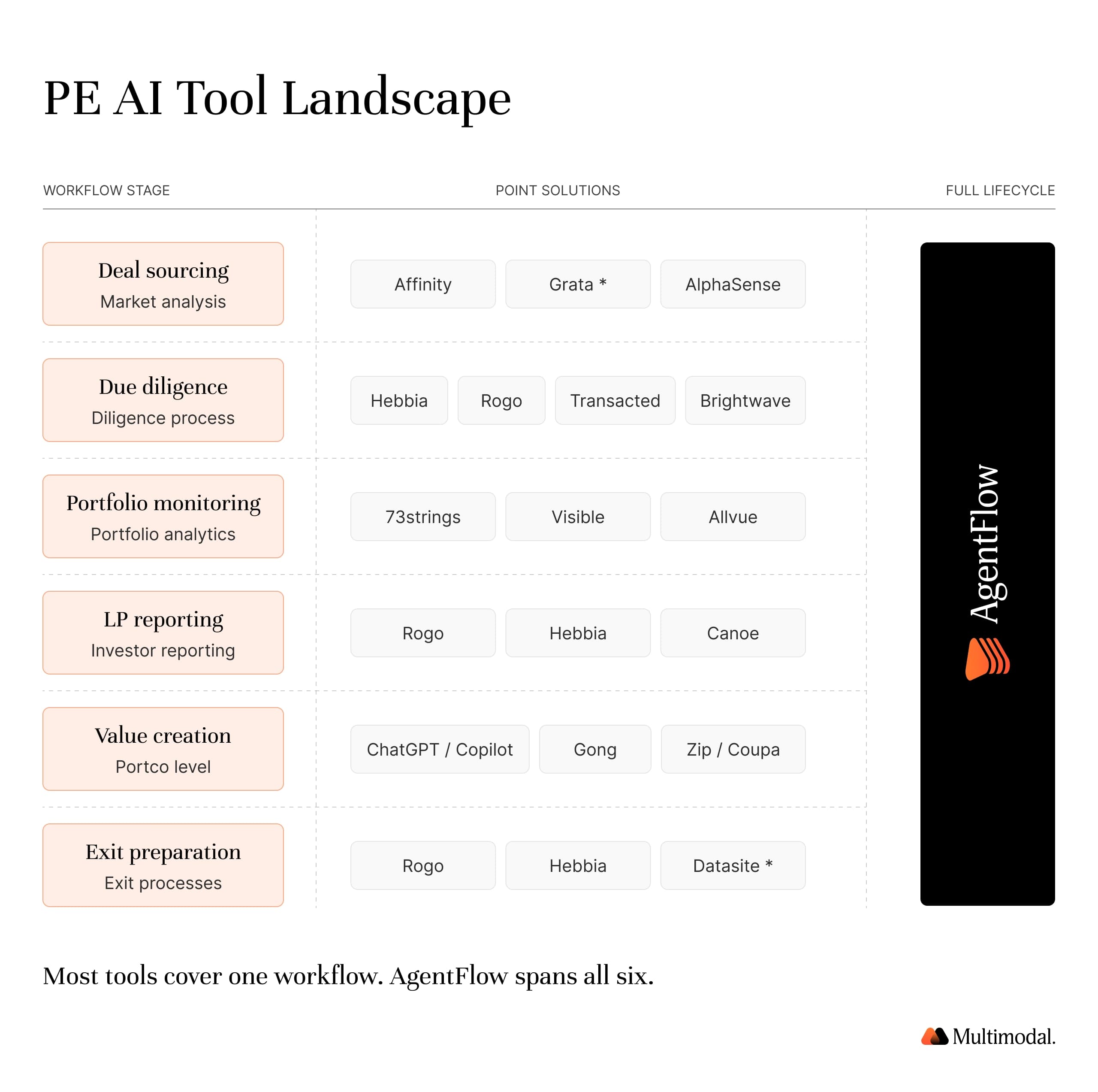
1. Deal Sourcing and Market Analysis
AI tools for deal sourcing replace manual text mining with real-time aggregation across external databases, public filings, and expert interview transcripts, surfacing relationship intelligence and market data before targets reach the open market.
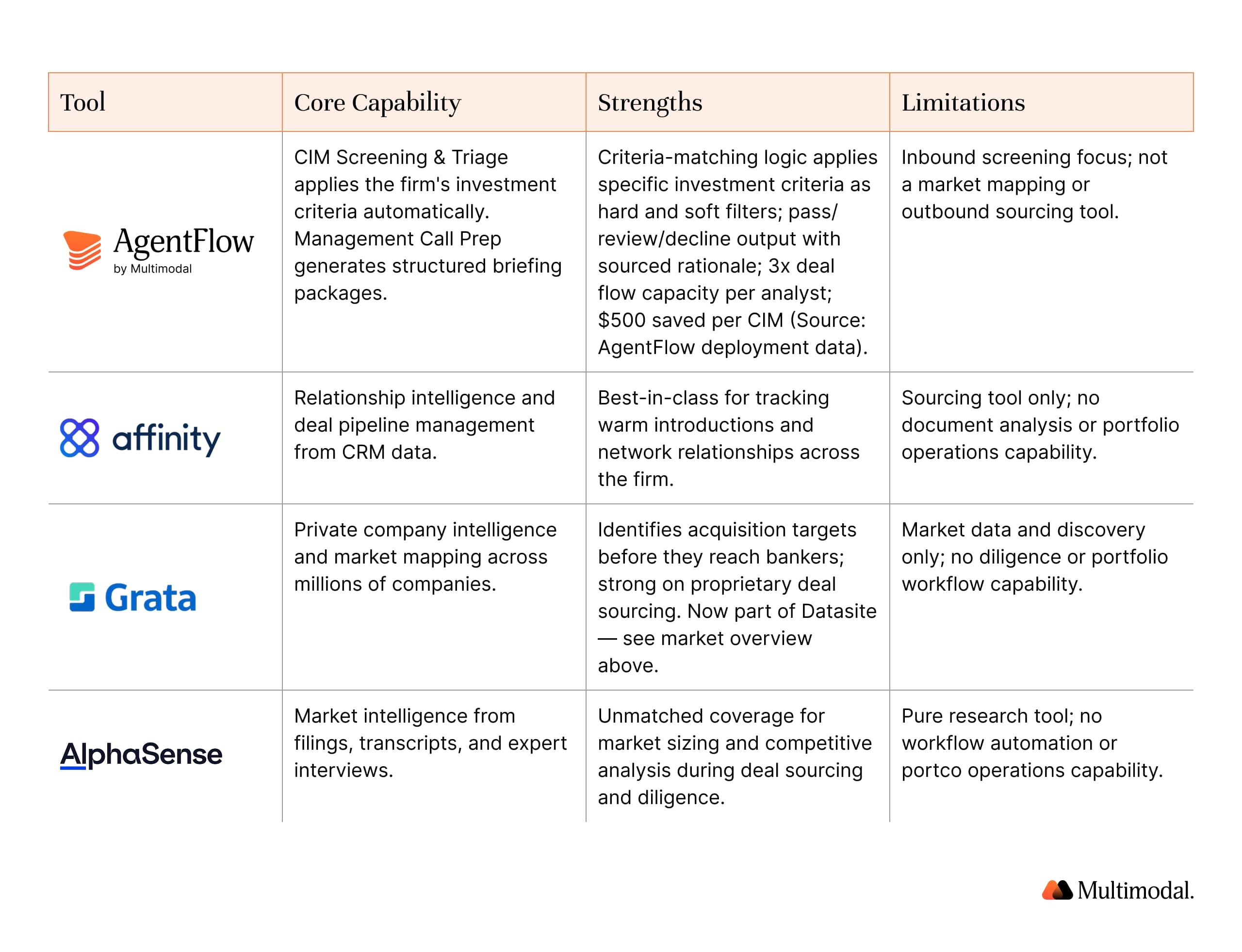
AgentFlow's CIM Screening & Triage workflow screens a CIM in under 30 minutes, compared to a two-day manual review cycle, reclaiming 150 or more analyst hours annually.
2. Due Diligence and the Diligence Process
Due diligence requires parsing data rooms full of legal contracts, customer lists, and financial histories. The core challenge is indexing documents at scale, identifying gaps against diligence checklists, and simultaneously extracting specific provisions. Teams running competitive processes need decision quality on financial and operational risks without sacrificing speed.
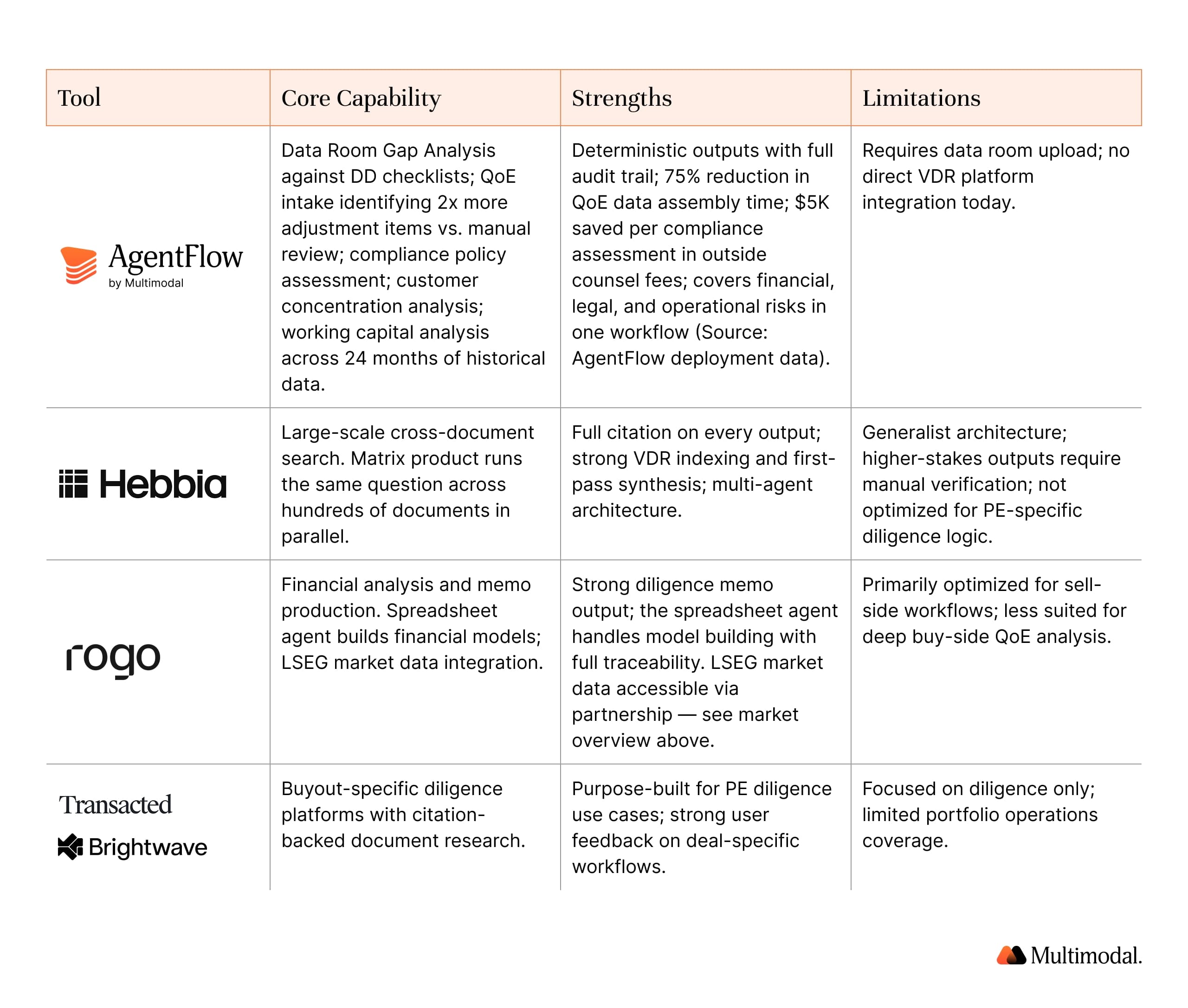
3. Portfolio Monitoring and Portfolio Analytics
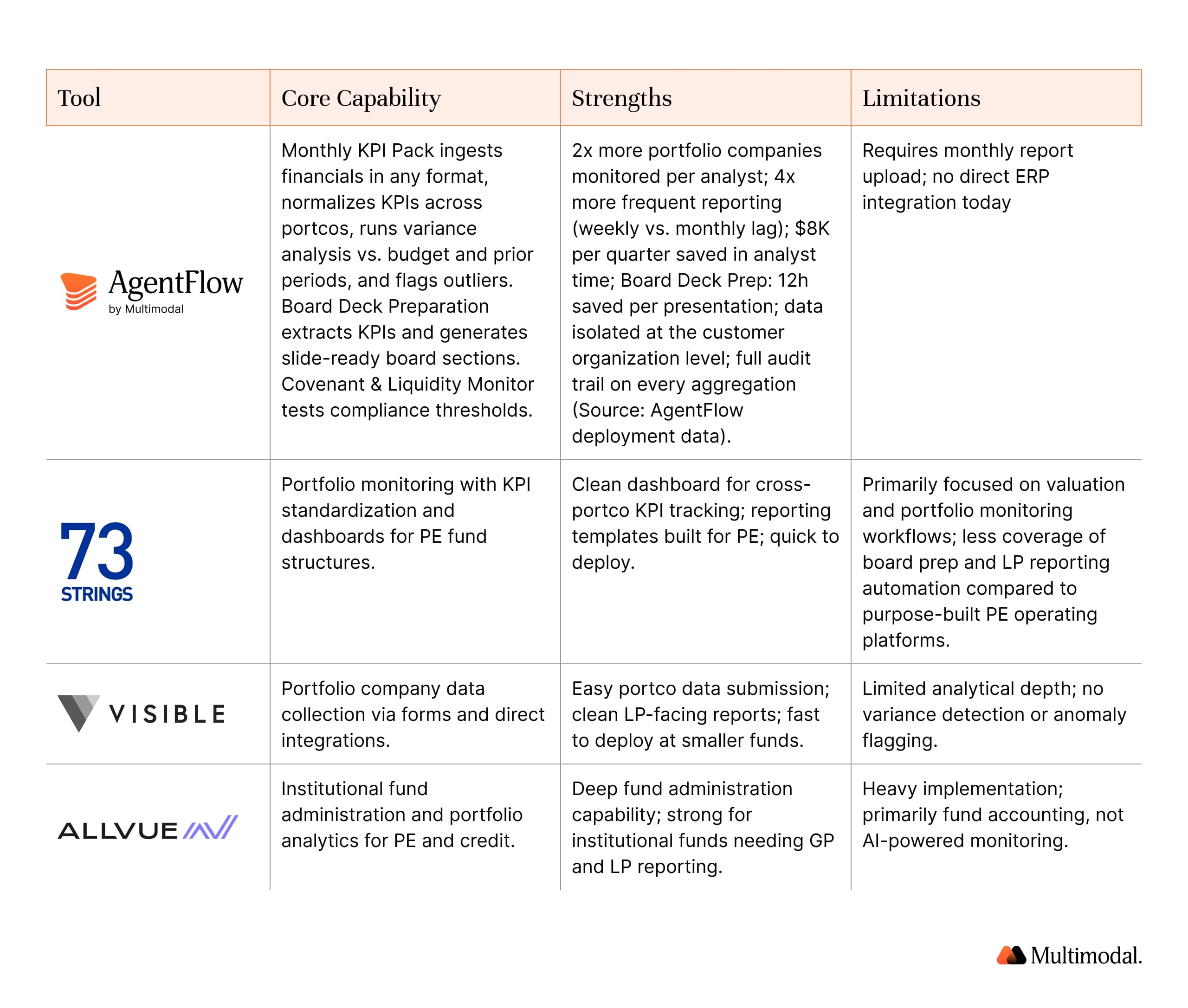
Every portfolio company reports monthly financials in a different format from a different accounting system. Normalizing the data, running variance analysis, and generating actionable insights across the portfolio consumes operating partner capacity at scale. The right AI tool ingests data in any format, normalizes for cross-portfolio comparison, and surfaces anomalies automatically.
4. Investor Reporting and LP Reporting
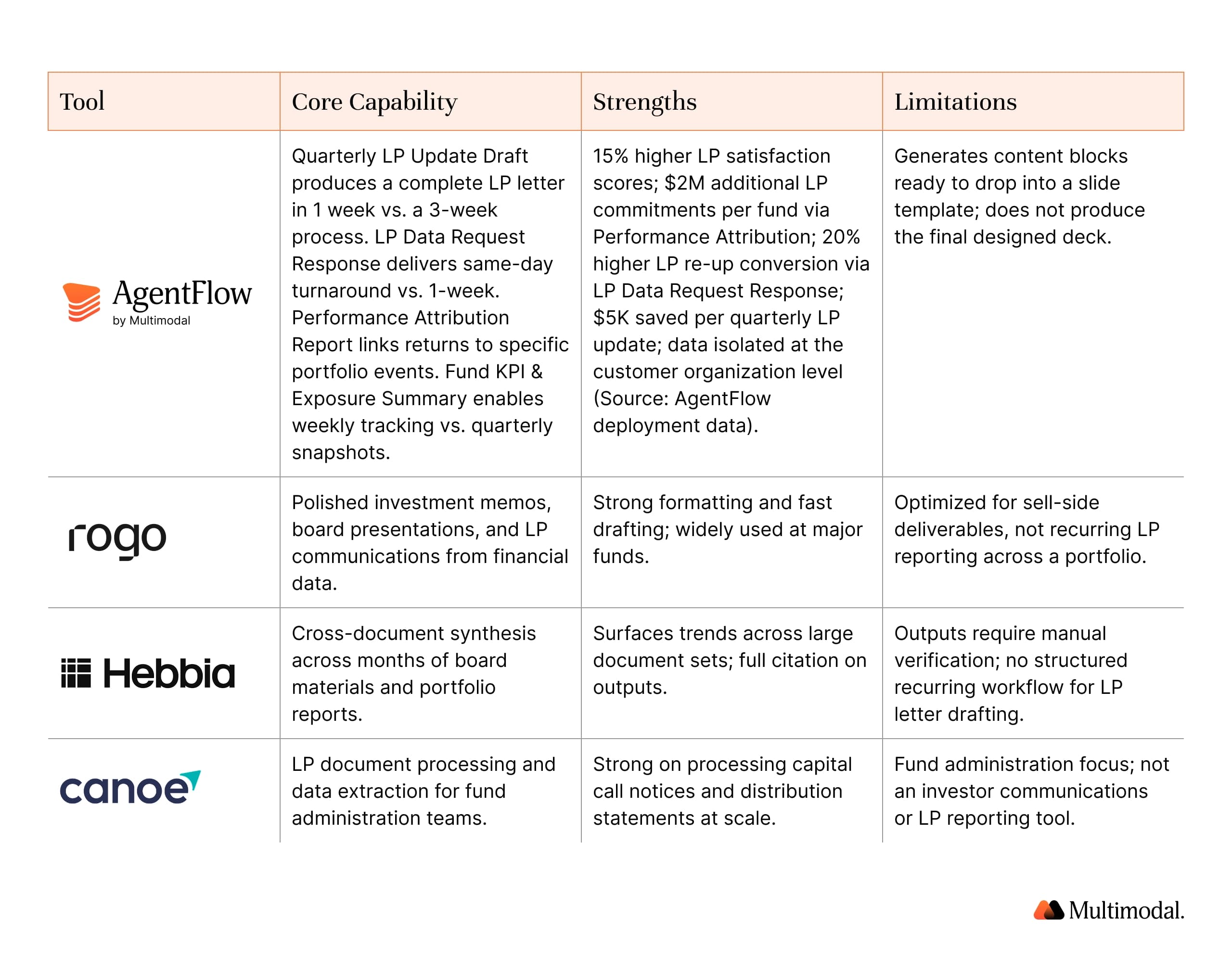
Investor reporting covers quarterly LP updates, performance attribution, LP data request responses, risk disclosures, and fund KPI summaries, all of which draw on the same underlying portfolio company financials. The administrative burden of assembling this manually across a portfolio is one of the highest recurring costs on an operating team.
5. Value Creation at the Portfolio Company Level
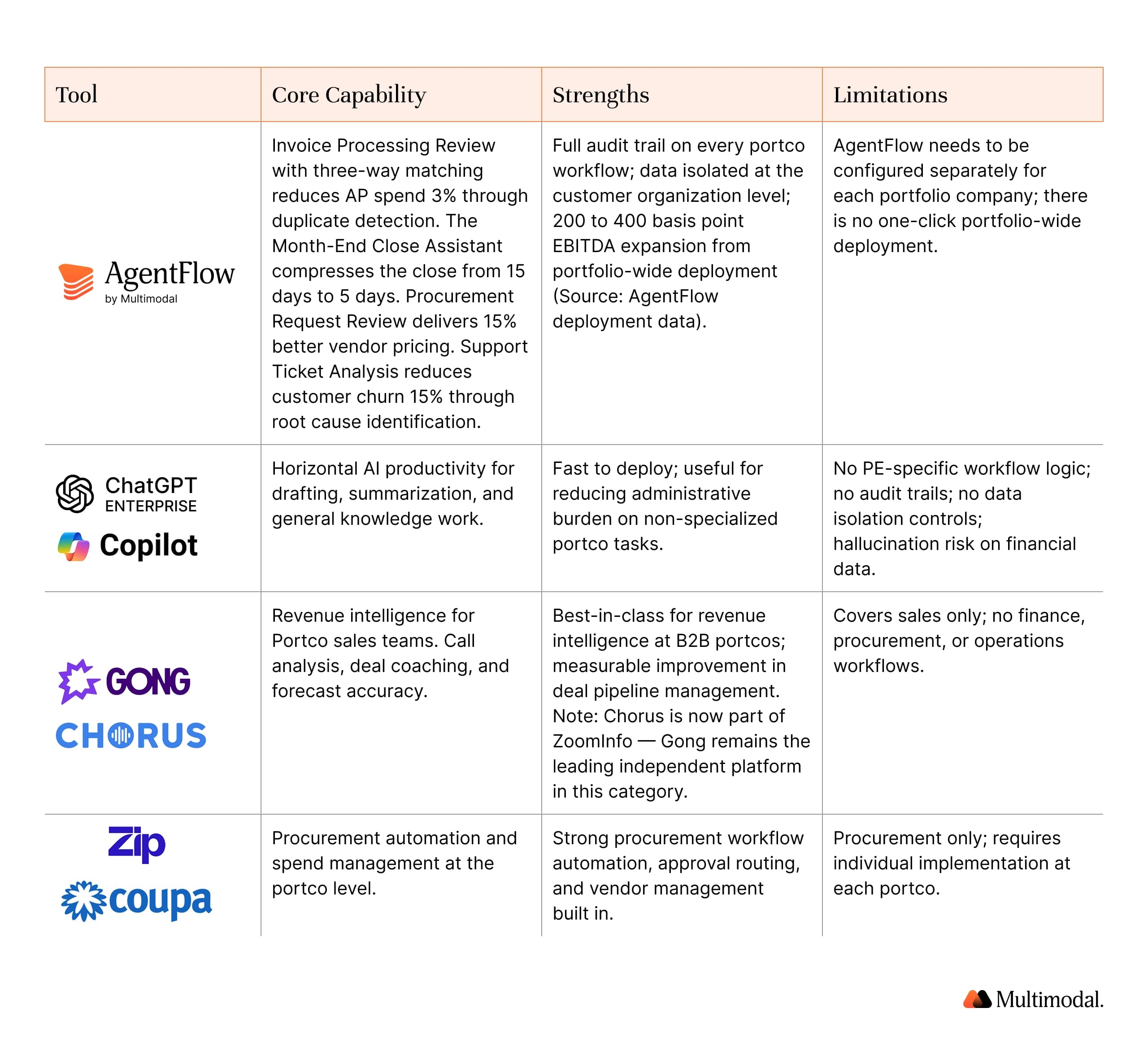
AI enables PE firms to analyze vast amounts of operational data in real time, driving faster decisions at the portfolio company level. Generic AI tools generate productivity value on drafting and research tasks, but cannot automate the governed, multi-step financial workflows that drive EBITDA improvement at scale. Buyers in 2026 are paying premiums for portfolio companies with demonstrated AI capability inside their operations.
6. Exit Preparation and Exit Processes
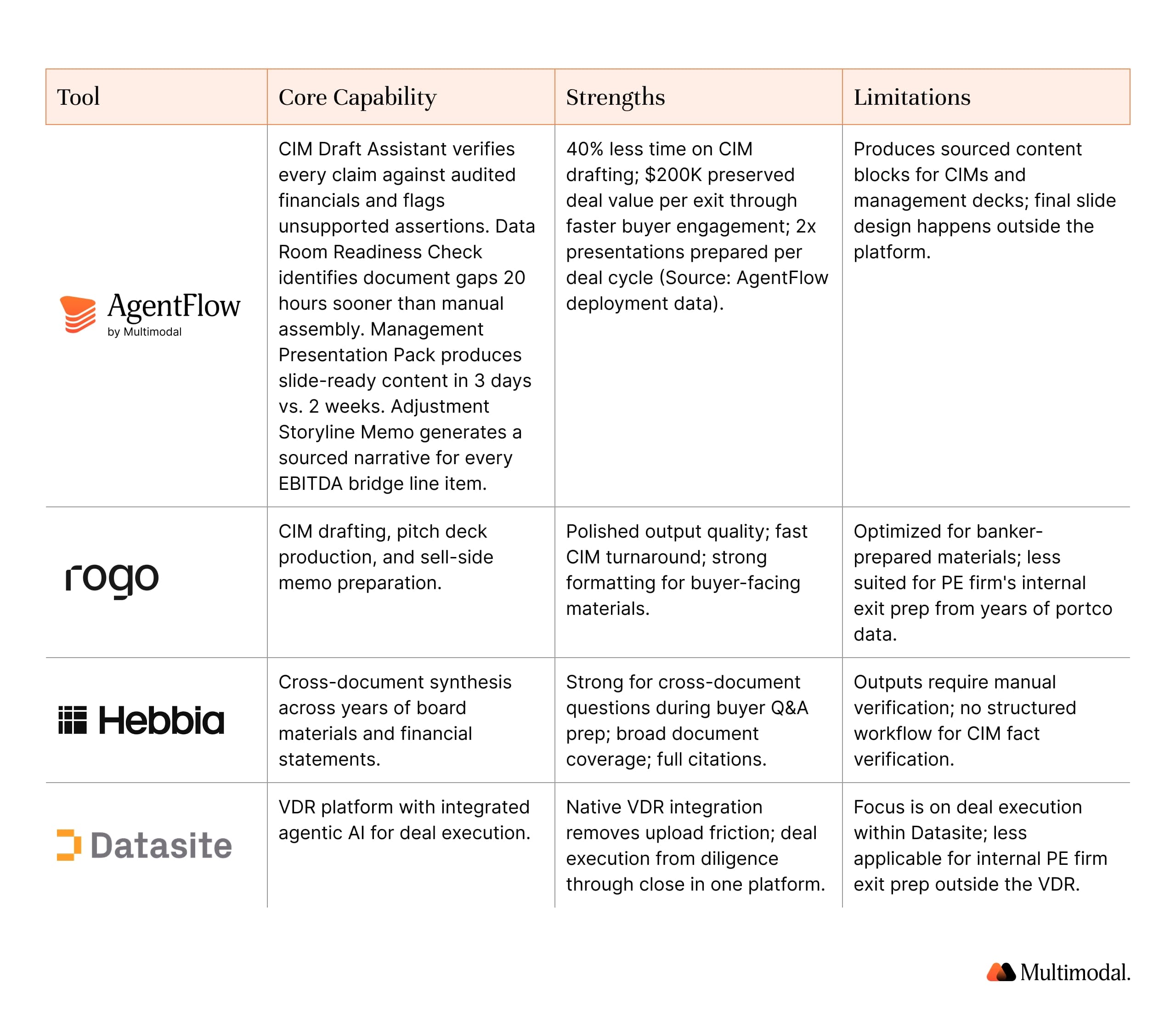
CIM drafting, data room readiness, management presentations, adjustment storyline memos, and buyer Q&A management all depend on accurate, well-sourced data that tells a consistent story. Errors discovered during buyer diligence erode deal value and create negotiating leverage for buyers. AI tools for exit processes must verify claims against audited financials, not just synthesize them.
How to Evaluate AI Tools for Private Equity
AI tools must be embedded directly into the investment lifecycle to be effective. Standalone tools that require users to context-switch from existing workflows lead to stalled adoption regardless of model capabilities. These questions separate vendors that reach production from those that remain in pilot mode.
1. Show me a reference customer at our scale, in our sector, with our use case.
Demos on idealized data say nothing about data quality challenges, ERP fragmentation, or portco adoption realities.
2. What does deployment look like in 30, 60, and 90 days?
Vendors with genuine deployment capability tell you exactly which workflows are running by when, without a large professional services engagement first.
3. How do you handle data isolation across portfolio companies?
Ask vendors to describe their isolation architecture explicitly and at what level separation is enforced. Verify this before deployment, not after.
4. What does an audit trail look like for an AI-assisted decision?
Explainable AI and version control on every output are governance requirements. Ask for a live example from a customer workflow, not a mockup.
5. Who are the end users at the portfolio company, and what does adoption look like at six months?
Portco end users are operations managers, not engineers. Tools requiring technical configuration will fail at the portco level.
6. What happens when the model is wrong?
Every AI system produces errors. Ask the vendor to walk through a recent one: how it surfaced, and how it was resolved.
For most operating teams, buying delivers faster time-to-value than building. A vendor with proven PE deployment experience delivers the first live workflow in 8 to 12 weeks. Building in-house requires a dedicated technical team and 12 to 18 months before the first production workflow, with ongoing maintenance as models evolve.
The Bottom Line
The PE AI market in 2026 has real tools producing real results. Buying deal-team tools to address operating-team problems is the most common and most expensive mistake PE firms make. The firms generating 200 to 400 basis points of EBITDA improvement from AI agents are running workflows with AI embedded where the work actually happens: in the monthly KPI pack, in the board prep cycle, in the portco finance team, and in exit documentation.
Frequently Asked Questions
What are the best AI tools for private equity in 2026?
The best tool depends on the workflow. Hebbia and Rogo lead on document analysis and diligence memos. AgentFlow is purpose-built for PE operating teams across portfolio monitoring, board prep, value creation, and LP reporting, with 29 pre-built playbooks across the investment lifecycle.
Why do generic AI tools fail in private equity workflows?
They are not built for PE-specific investment criteria, diligence logic, data isolation requirements, or audit trail standards. They cannot normalize KPIs across portcos with different ERPs or produce the decision documentation LP accountability requires.
How do PE firms handle data governance and isolation when using AI?
The standard requirement is data separation between portfolio company data sets so queries about one portco cannot surface data from another. Ask any vendor to describe their isolation architecture at the level it is actually enforced before deployment begins.
How do you measure ROI from AI tools in private equity?
At the fund level: analyst hours reclaimed and cost per workflow (e.g., $500 per CIM screened, $5K per quarterly LP update). At the portco level: EBITDA basis points from AP automation, close cycle compression, and procurement savings. (Source: AgentFlow deployment data)
Build AI Your Industry Can Trust
Deploy custom multimodal agents that automate decisions, interpret documents, and reduce operational waste.