Member Onboarding and Account Opening Automation for CUs
Credit unions cut account opening to minutes, and abandonment did not move. The new-member journey is worth automating, from intake to core record creation.
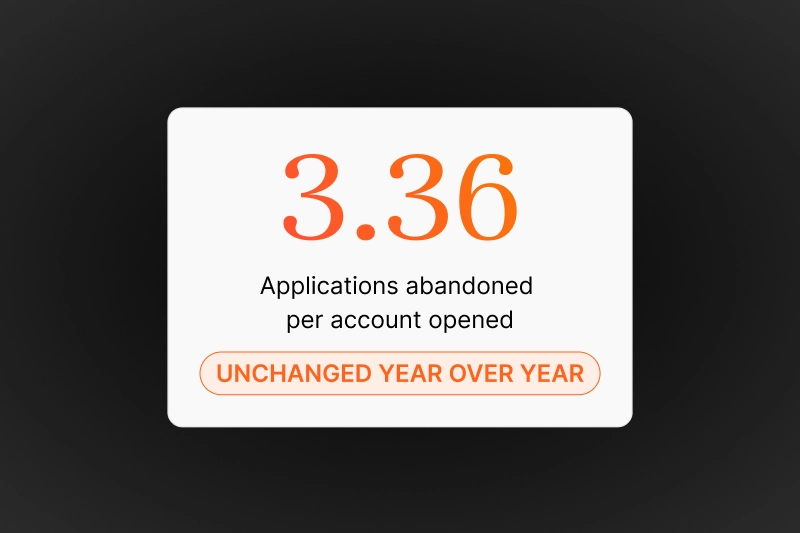
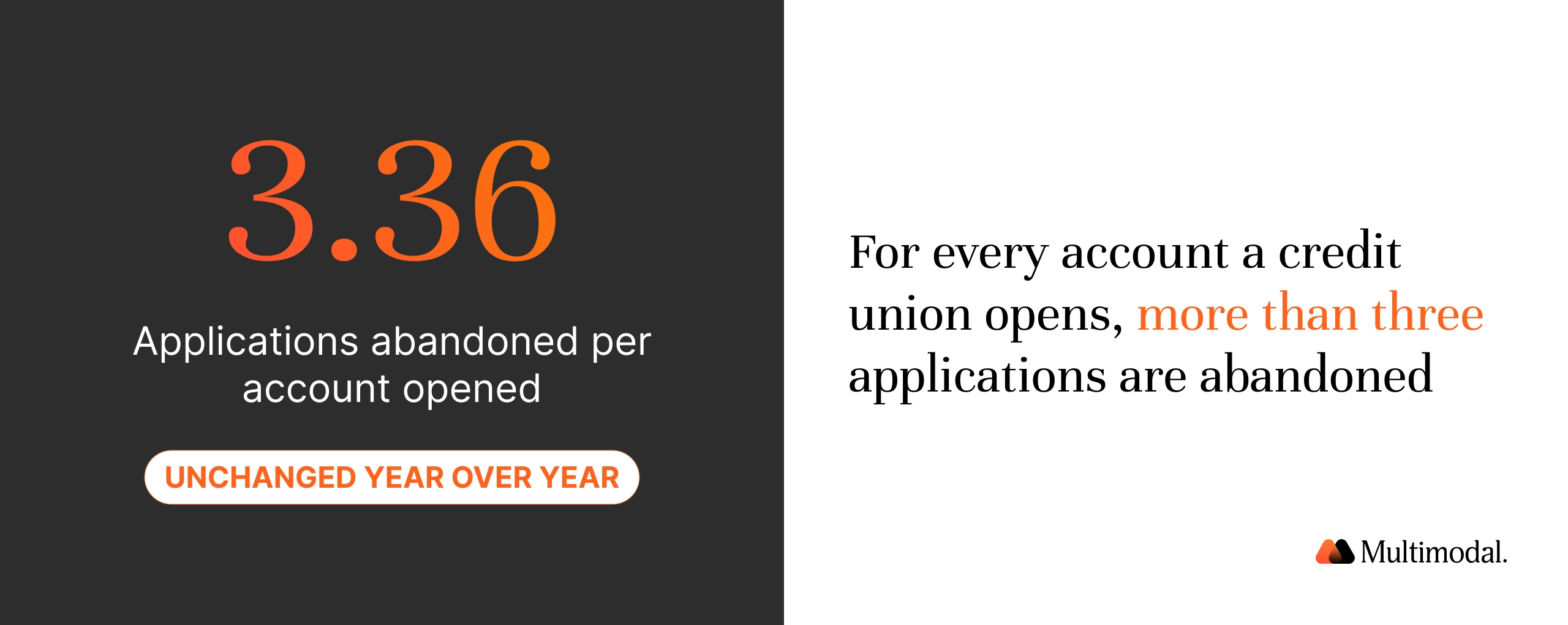
Credit unions lose 3.36 applications to abandonment per account opened.
Digital now drives 27% of checking openings and 40% of all new relationships.
The real leak sits after submit: document review, funding, and core record creation.
Acquiring a checking customer costs $559, roughly double the 2018 figure.
Baseline the share of applications a person touches, never minutes-to-apply.
Get 1% smarter about AI in financial services every week.
Receive weekly micro lessons on agentic AI, our company updates, and tips from our team right in your inbox. Unsubscribe anytime.
Thank you! Your submission has been received!
Oops! Something went wrong while submitting the form.
Credit unions cut the application process to minutes, and 3.36 applications are still abandoned for every one completed. Here is the new-member journey worth automating, stage by stage.
Digital account opening is a fully online process that lets someone apply for, verify, fund, and activate a bank account without visiting a branch. Most credit unions have that front end; what most lack is automation for everything after submit, where new members are lost.
Cornerstone Advisors' 2026 Digital Banking Performance Metrics found 3.36 applications abandoned per one completed across nearly 150 institutions, flat year over year, and calls the problem "stubbornly unsolved".
Why Is Digital Account Opening Suddenly a Growth Problem?
Membership is growing. The institutions serving those members are not. NCUA's 2026 Q1 data summary reports 145.8 million members, up 2.5 million, while federally insured credit unions fell from 4,411 to 4,250.
Digital account opening reached 27% of total checking account openings in 2025, up from 21% in 2024 and 16% the year before. Curinos puts digital at 40% of new relationships, passing 55% by 2027.
So did the economics. Acquiring a checking customer now costs $559, double that in 2018, and after 12 months, only 41% of digitally acquired relationships survive, compared with three in four opened in a branch. Retention of digitally acquired new customers is the weak link, and community banks chasing the same deposits face the same math.
Why Do Members Abandon Account Opening?
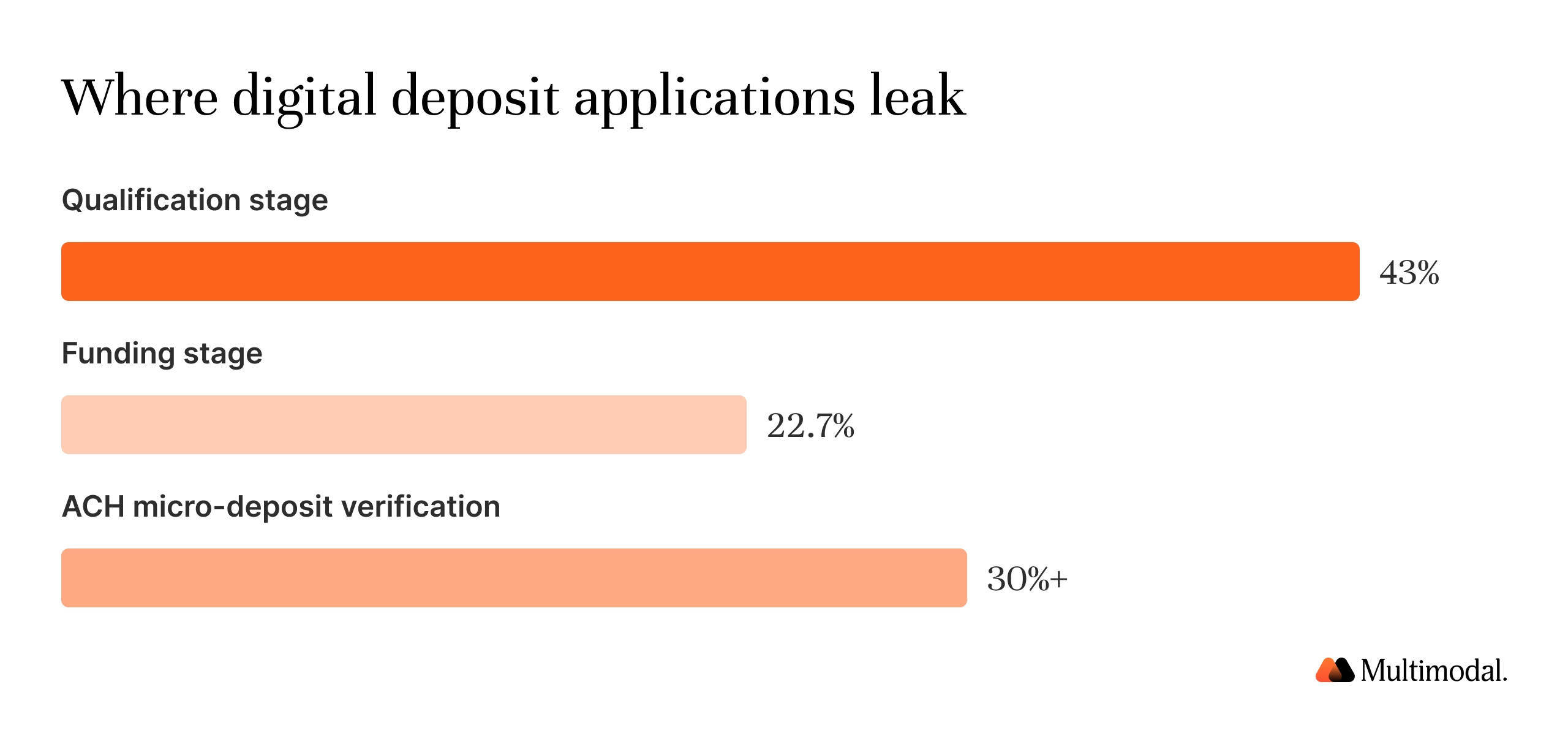
Cornerstone Advisors' benchmarking across 184 institutions, published in CU Management, put the average abandonment rate for retail deposit applications at 55%. The stage detail is the diagnosis: 43% of abandonments happen at qualification, 22.7% at funding, and more than 30% of applicants walk away when ACH micro-deposit verification is required. Human follow-up on abandoned applications produced no measurable lift.
Qualification is an eligibility decision, and funding is a payment decision. Both sit behind the form.
"A lot of credit unions... are still very paper-based. They might have a digital application, but they're still collecting signatures, they're waiting for IDs... 28 minutes to complete, [and] the funding rate was not very strong." — Courtney Rowan, SVP and Chief Digital and Transformation Officer, Citadel Credit Union
The industry knows how to fix a 28-minute application. Mobile-first design reduces abandonment; save-and-resume lets an applicant finish later; progress indicators show what is left; and fees, terms, and disclosures displayed within the flow remove a reason to leave. Those patterns are widely deployed, and by themselves they have not moved the number.
The Form Was Never the Bottleneck
Vendors compete on seconds, but those are self-reported figures and abandonment held flat over the same period. Cornerstone Advisors, in research commissioned by MANTL, found that 80% of financial institutions cite business account opening speed as a pain point, and 40% need 4 or more hours per small-business application. Almost none of those hours are typing. They are a person who reads articles of incorporation, an EIN letter, and a beneficial ownership certification, then keys the results elsewhere.
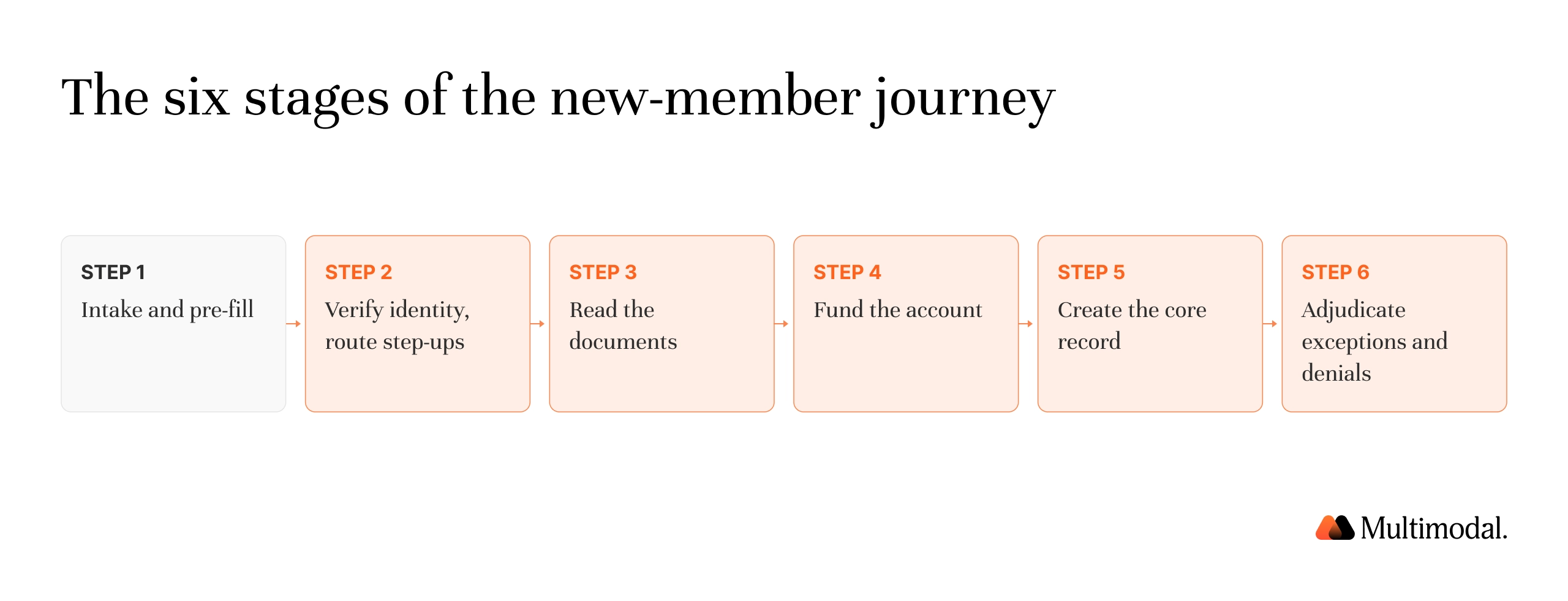
The Six Stages of the New-Member Journey Worth Automating
1. Intake the application and pre-fill what you already know
Ask only what you need, progressively. Digital account opening allows applications anytime and anywhere, so intake must hold up on a phone at 11 PM. Automated data capture does the shortening: fields inside an uploaded document should populate the form. Newcomers need the full onboarding process, while a returning member adding checking accounts, savings, or money market accounts should see only new questions.
2. Verify identity and route the step-ups
Credit unions must verify identity information under Customer Identification Program rules. What varies is how much a person touches. Automated identity verification clears most applicants in the background, and the rest get a step-up: scanning a government-issued photo ID or a selfie check.
This stage decides the outcome, and the category leaves it alone. Every application that fails a clean check produces documents: photo IDs, proof of address, employer or SEG letters establishing field-of-membership eligibility, and business formation records. Agentic document processing classifies them on arrival, extracts the fields, and cross-checks values against the application, scoring confidence for each field so that tiered review is possible.
4. Fund the account and chase the failures
Funding is the second-largest abandonment stage at 22.7%, and micro-deposit verification alone sheds more than 30% of applicants. Real-time funding activates accounts instantly, and accounts can be funded by ACH transfer or debit card. Immediate online banking access upon approval creates an active relationship the same day. This piece stops at activation; what follows is member engagement.
5. Create the record in the core without re-keying it
An approved, funded application still has to be recorded in the core system, the digital banking platform, and the document repository. At many credit unions, a person opens two windows and types. That re-keying introduces errors and scales with volume, so a campaign that works creates a back-office backlog. Automated write-back to existing core systems eliminates typing, and AgentFlow works alongside Jack Henry, Fiserv, Symitar, and other systems that credit unions already use.
6. Adjudicate the exceptions and the denials
Flagged and declined applications do not disappear. Some are genuine fraud. Some are legitimate applicants with a data mismatch, a thin file, or a changed address, and most get reviewed by hand or written off in bulk. Second-look adjudication reads the documents, resolves the mismatch where evidence supports it, and re-decides with an audit trail.
What Does Good Look Like on the Numbers?
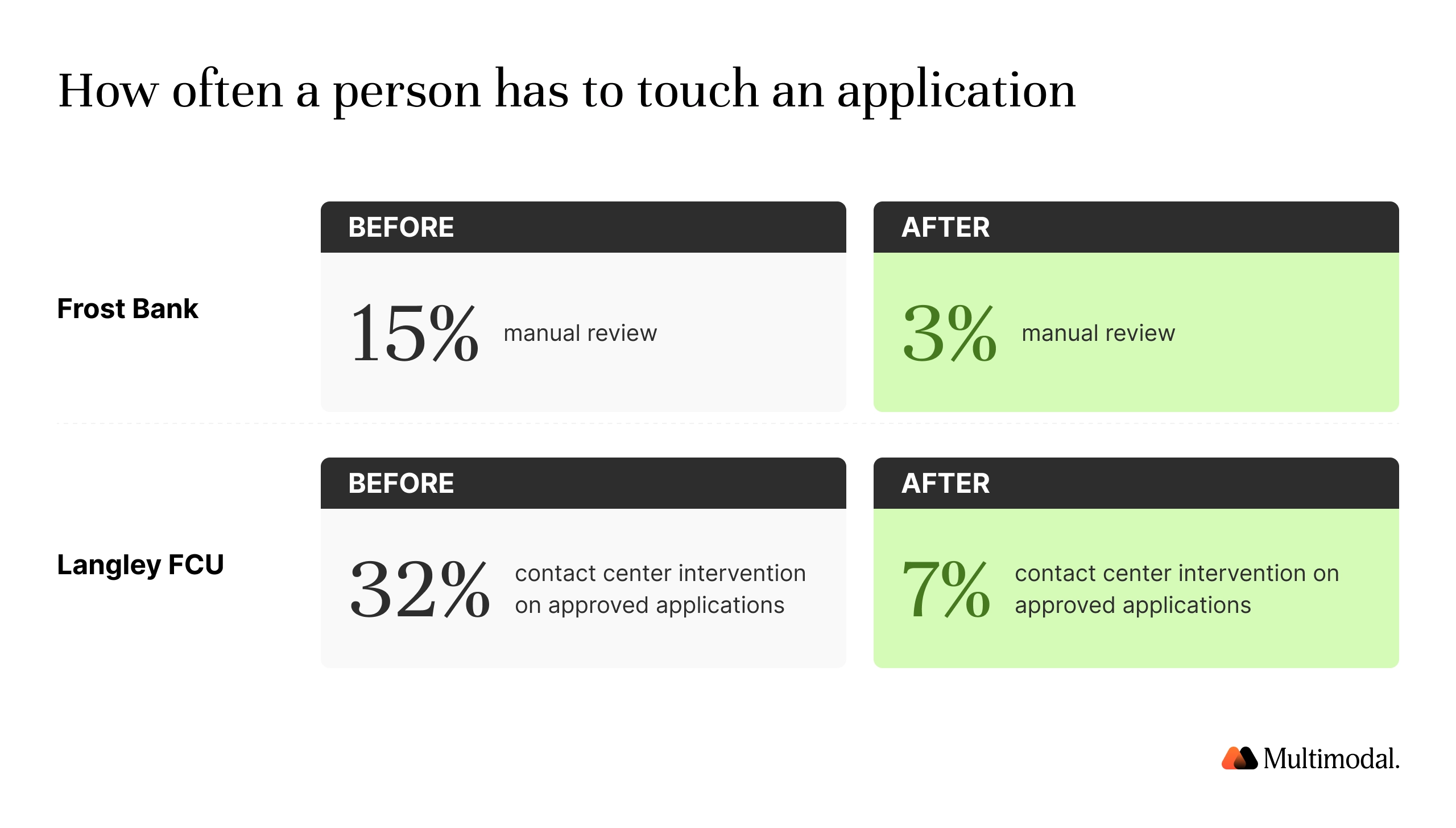
Citadel Credit Union rebuilt its onboarding experience around a non-documentary flow and reported a 212% year-over-year lift in funnel conversion and a 58% cut in application cycle time. Frost Bank, in partnership with Blend, increased application completion from 50% to 80% and reduced manual review from 15% of applications to 3%. Langley Federal Credit Union reported 37% growth in new digital account openings, with contact center intervention on approved applications down from 32% to 7%.
Both measure how often a person had to touch an application, and both moved by roughly 25 percentage points. That is the metric this category does not publish.
"Bring them in through the front door of my online account opening tool. Well, online account opening tools is very important to us. That's just a method. That's not what makes it happen." — Jeffrey Staw, Chief Information and Innovation Officer, Firefighters First Credit Union
What About Fraud and the Risk Team's Objection?
A faster digital account opening process is not a looser one.
New account fraud losses reached $6.2 billion in 2024, more than double a decade earlier, and credit unions absorb a disproportionate share. Roughly half reported higher fraud-related losses in 2025, and Alloy's 2026 State of Fraud Report found the largest increases among credit unions and community banks.
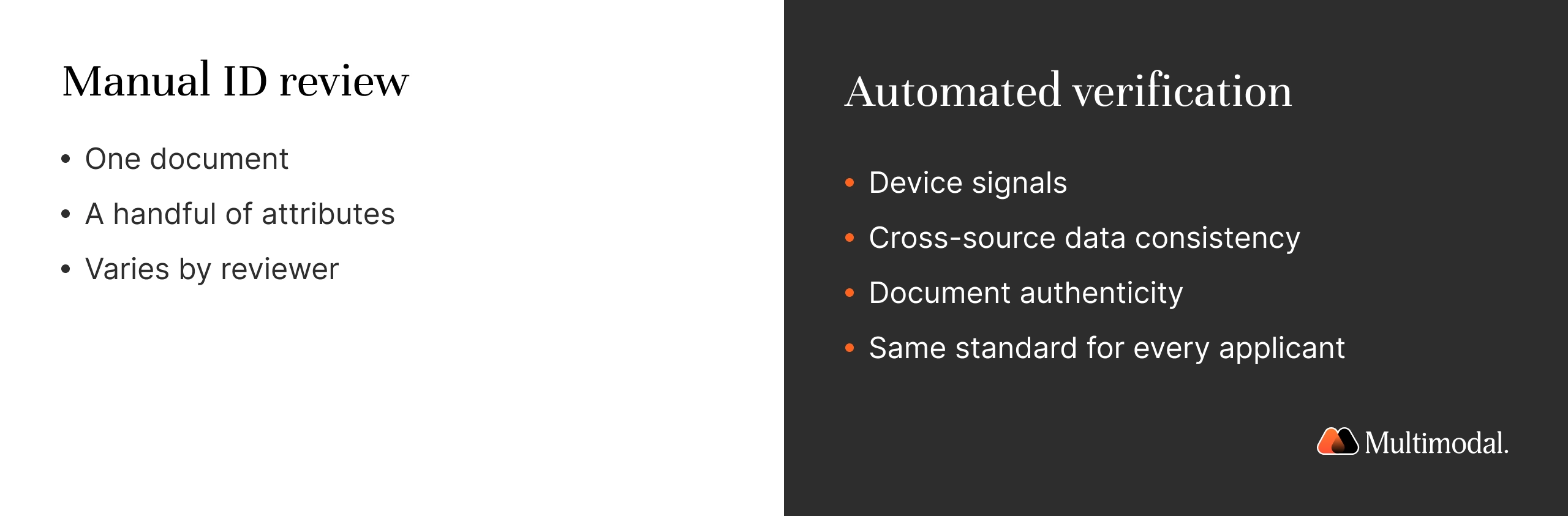
A person comparing an ID against an application checks a handful of attributes. Automated verification checks device signals, cross-source data consistency, and document authenticity simultaneously, to the same standard for every applicant. Expect the following from any platform here:
Built-in CIP, KYC, and beneficial ownership workflows, plus anti-money laundering controls any licensed digital institution must maintain.
Multi-factor authentication and encryption of data in transit.
Continuous monitoring for unusual transactions, since new account fraud often surfaces in the first weeks.
Auditable workflows with logs an examiner can follow from application to decision.
On-premise deployment where data residency requirements make it necessary.
Ask about implementation timelines in the same conversation.
How Do You Run the First 90 Days?
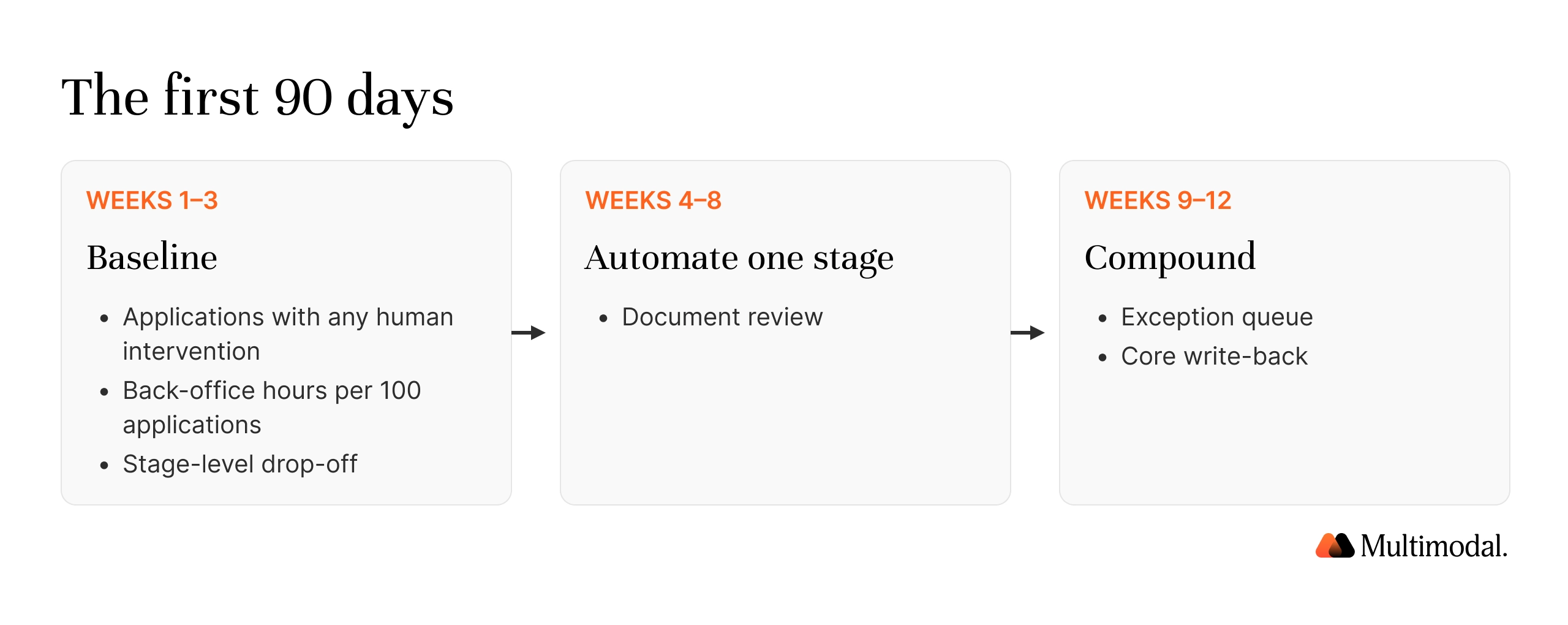
Weeks 1 to 3, baseline. Applications with any human intervention, back-office hours per 100 applications, stage-level drop-off.
Weeks 4 to 8, automate one stage. Document review is the largest pool of manual minutes and the easiest to measure.
Weeks 9 to 12, take the exception queue and the core write-back. These compound, removing work that scales with volume.
Report progress on the intervention rate rather than the clock.
The Application Is Finished. The Onboarding Is Not.
Credit unions have spent a decade shortening the digital account-opening form, but the abandonment rate has not changed. The applicant was never the slow part. The slow part is a queue of documents, a failed funding attempt, and a record waiting to be typed into a core system, all of it after someone already decided to join.
That work is documentary and rule-bound, which makes it the kind of work an agent should do. Credit unions that automate it will spend their $559 on members who make it through the door.
Send us a week of real application records and your exception queue. We will run them through AgentFlow and give you the numbers in writing: how many applications a person touched, how many minutes were spent on document review, and where applicants drop out.
Run Your Own Files Through It
Send us your exception queue and we will produce the equivalent for yours, using your documents and your rules, before you commit to anything.
How long should it take to open a credit union account?
Platforms advertise 90 seconds to six minutes, though those figures are self-reported. A better target is the full journey: apply, verify, fund, and reach online banking in one session.
Why do members abandon account opening?
At two points behind the form: 43% of abandonments at qualification and 22.7% at funding, with more than 30% dropping out at ACH micro-deposit verification.
What documents are needed to open a credit union account?
A government-issued photo ID, a taxpayer identification number, proof of address, and documentation of field-of-membership eligibility. Business accounts also require formation documents, an EIN letter, and beneficial ownership certification.
Can AI automate new member onboarding?
Yes, across most of the journey. Automated data capture and identity checks shorten the application, agentic document processing scores confidence per field, and automated write-back creates records in the core system without re-keying.
How does digital account opening connect to the core system?
Through integration with existing core systems and the digital banking platform, so an approved application creates member and account records without manual entry. Field mapping and exception routing decide whether it holds up under volume.
What is a good account-opening abandonment rate?
Benchmarks put the average at 55%, or 3.36 abandoned per one completed. A more actionable target is the share of applications requiring human intervention.

.svg)
.svg)

.avif)
.png)

.png)