Skip-a-pay looks like a single approval, but it runs on eligibility logic that varies by loan type, state, and institution policy.
Most credit unions still process skip-a-pay by hand, even where a digital banking form exists on the front end.
Digital self-service only reaches members who use it - branch, call center, and indirect-lending members are left out.
Skip-a-pay volume spikes hard around the holidays and tax season, exactly when lending ops teams are already stretched.
A governed automated workflow needs eligibility logic, exception routing, and a documented audit trail, not just a form.
Get 1% smarter about AI in financial services every week.
Receive weekly micro lessons on agentic AI, our company updates, and tips from our team right in your inbox. Unsubscribe anytime.
Thank you! Your submission has been received!
Oops! Something went wrong while submitting the form.
Nearly every credit union offers some version of skip-a-pay. Members defer one or two loan payments a year, usually for a processing fee, and the loan's maturity date is extended to cover them. Now, if we describe it that way, it sounds like a weekend automation project.
It isn't. Skip-a-pay is member-facing, fee-bearing, and tied to a real change in a loan's amortization schedule. It also spikes hard around the holidays and tax season, exactly when lending operations teams are already stretched thin. Most credit unions still process it by hand today, even at institutions where a digital banking form exists on the front end.
This breakdown covers what actually has to happen behind that form: the eligibility logic, the exception handling, the documentation an examiner will eventually request, and how a governed automated workflow differs from a self-service form bolted onto digital banking.
Why Skip-a-Pay Resists a Simple Automation Fix
A skip-a-pay request appears to be a single yes-or-no decision by the member. From the lending operations side, it is a policy lookup wrapped in an eligibility check wrapped in a fee calculation, repeated differently for every loan type the institution carries.
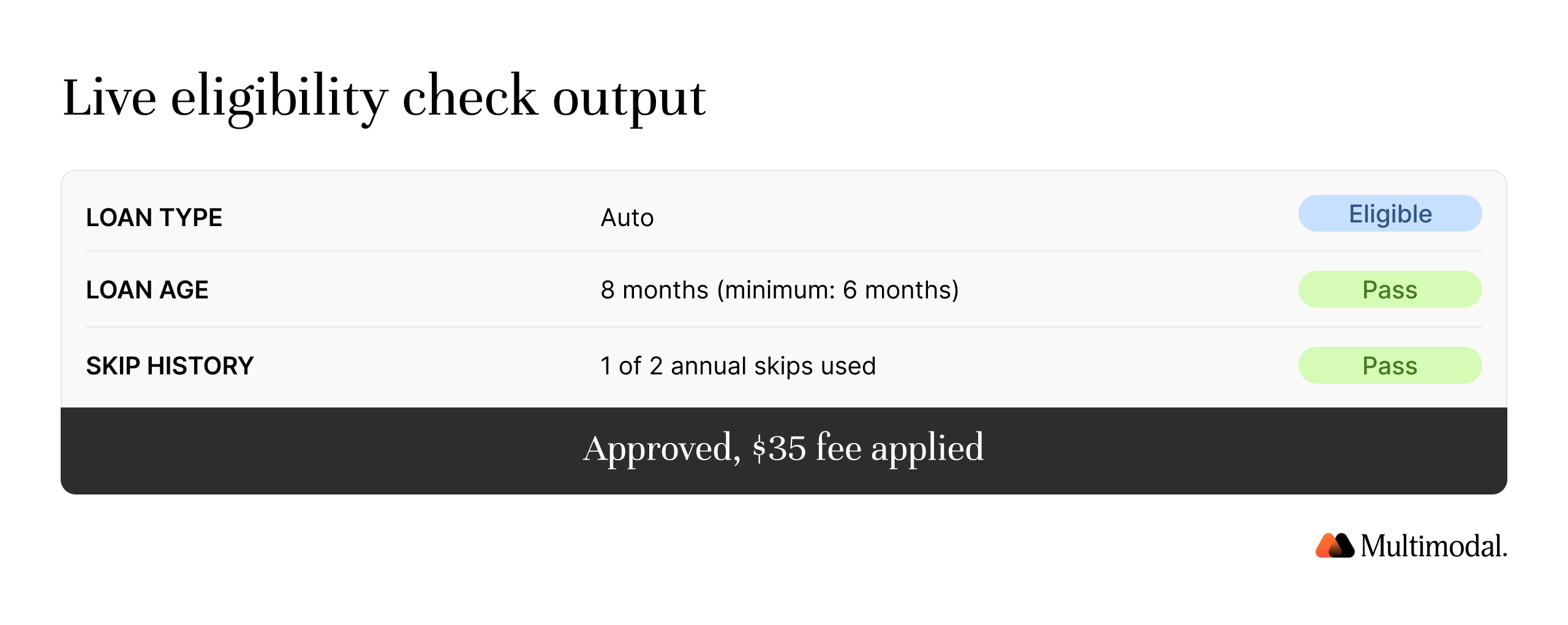
Eligibility criteria are rarely uniform across a loan portfolio. A credit union might exclude VISA cards, mortgages, home equity products, and any loan already in an active payment arrangement, while allowing auto and personal loans to qualify freely. Loan age requirements are common, too.
Many institutions require that a loan be open for at least 6 months before a member can request a skip. Fee amounts vary by state and institution, and skip limits typically cap out at around 2 per year, with a lifetime maximum, sometimes with a rule against skipping 2 consecutive months.
None of that is exotic. It is standard credit union policy, documented in dozens of member-facing disclosure pages. But it means a true automation layer has to encode institution-specific rules correctly for every loan type, not just route a member's request to a queue. This is where basic digital banking add-ons tend to stop short. They can collect a request, but the eligibility logic still gets checked by a person before approval.
The Coverage Gap in Digital Banking Self-Service
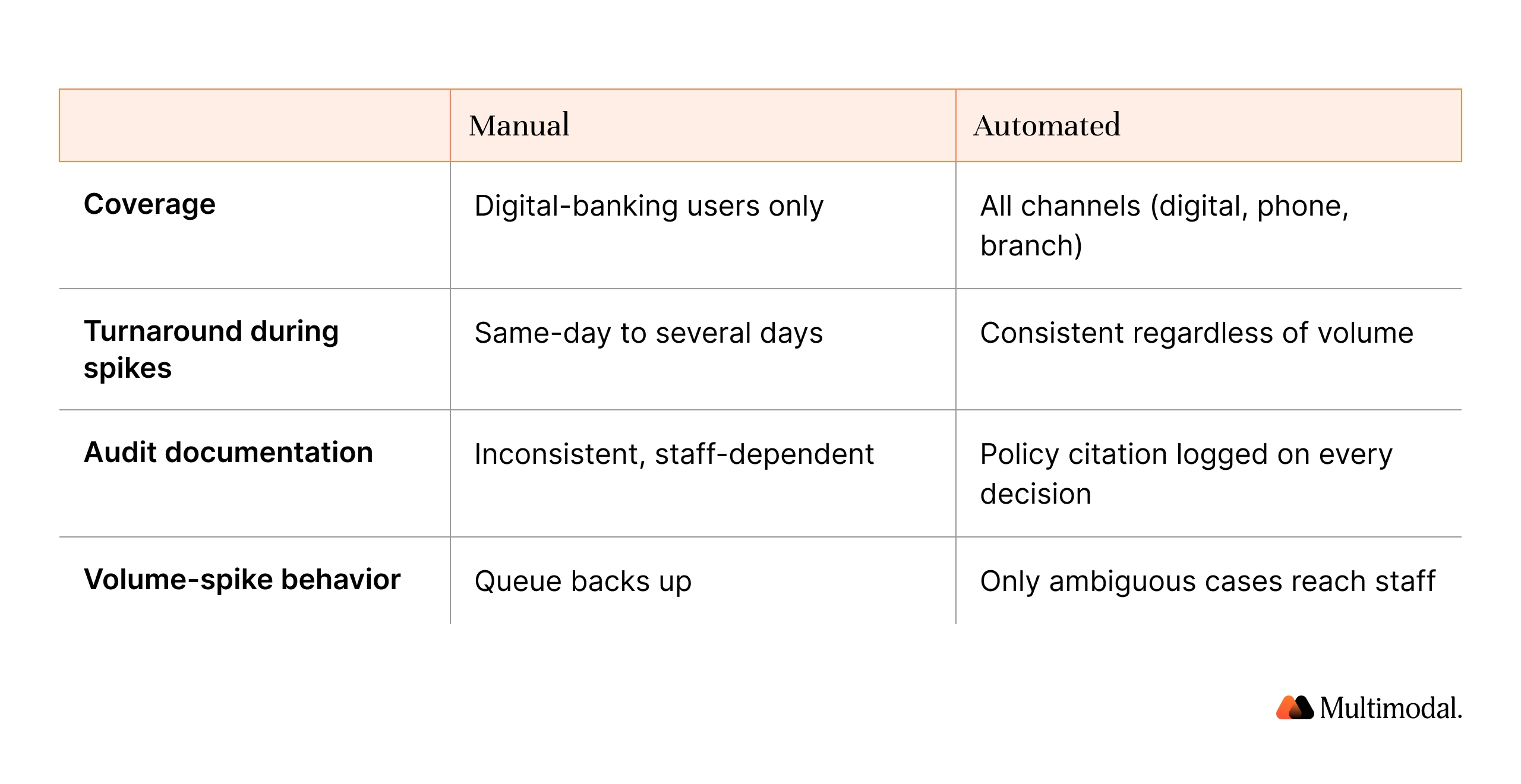
Digital banking integrations solve part of the problem. A member logs in, selects a loan, submits a skip request, and the core system posts the fee and adjusts the due date. For members who use online or mobile banking, this works reasonably well, but it only covers them. Even at credit unions with skip-a-pay built into digital banking, members still call in or visit a branch to request one, often because they don't realize the self-service option exists or aren't enrolled in online banking at all.
That gap matters more than it looks. Members who call are often the same members least likely to use digital banking in the first place. Older members, branch-dependent members, and a meaningful share of indirect auto loan holders who financed through a dealership and may not even know skip-a-pay is available to them.
Indirect lending relationships carry their own risk profile here. Members who obtained a loan through a dealer often have a thinner relationship with the credit union, are less likely to be enrolled in digital banking, and are statistically more likely to become delinquent without some form of proactive outreach. A digital-banking-only automation strategy misses exactly the population most likely to need the program.
The Skip-a-Pay Decisioning Loop: What a Governed Automated Workflow Actually Does
A production-grade automated skip-a-pay workflow generally runs through four stages, whether the request comes through digital banking, a call center transcript, or a branch interaction. Call it the Skip-a-Pay Decisioning Loop: Intake, Verify, Decide, Document.
1. Intake: The request enters the system regardless of channel. Digital banking, phone, text, or in-branch - along with the member's loan identifiers and, where available, the stated reason. A decisioning agent classifies the request and pulls the relevant loan record from the core.
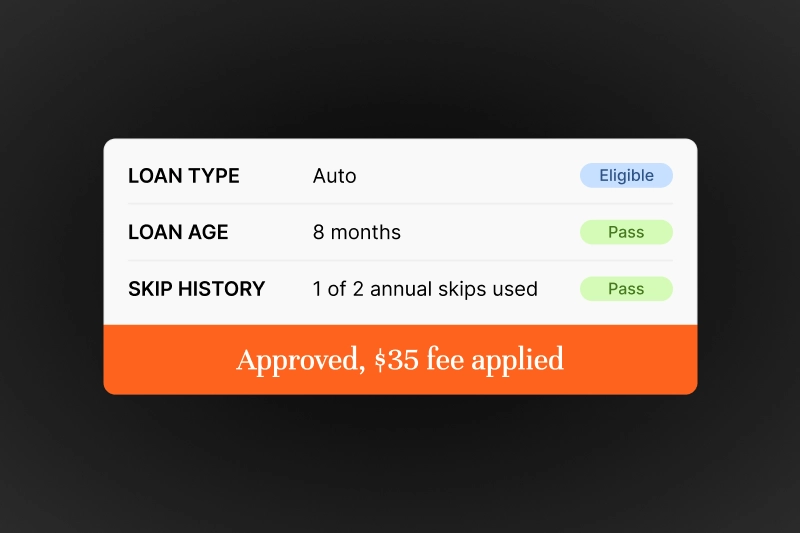
2. Verify: The system checks the loan type against the institution's inclusion and exclusion list, verifies that the loan has been open long enough to qualify, confirms that the account is current and in good standing, and checks the member's skip history against annual and lifetime limits. Each check cites the specific policy rule it applied.
3. Decide: The system calculates the applicable fee based on the loan type and state, confirms the availability of funds where required, and produces a recommendation to approve, deny, or refer the request to staff. Borderline cases such as a loan open for exactly six months or a member whose additional skip falls within an ambiguous annual window — route to a human reviewer with the relevant policy citation attached rather than getting auto-approved or auto-denied.
4. Document: Approved requests write back to the core to post the fee and adjust the due date. The system generates a record of which policy rules were checked, the outcome, and the rationale, creating the documentation trail a compliance officer or examiner would need to review later.
This structure is close to what several credit unions already run for loan modification and hardship deferral requests. Payment deferral is one of the restructuring options a modification workflow evaluates alongside term extensions and rate adjustments. Applying the same eligibility-check-plus-audit-trail structure to skip-a-pay specifically is a narrower, higher-volume version of that same pattern.
Handling the Seasonal Volume Spike
Skip-a-pay requests are not evenly distributed across the year. Volume concentrates around the December holidays and again around tax season, when members are managing competing cash needs. A manual review queue sized for average monthly volume gets overwhelmed at exactly the moments members most need a fast answer.
This is where the difference between "digital banking has a skip-a-pay button" and "skip-a-pay is actually automated" becomes visible operationally. A queue that requires staff to manually check loan eligibility for every request does not scale during a volume spike; instead, it just gets slower, and approval turnaround times stretch from same-day to several days. An automated eligibility check does not care whether it is processing ten requests or ten thousand in a given week; only the requests that legitimately need human judgment reach a staff member's queue.
The Audit Trail Examiners Actually Expect
Skip-a-pay involves real money and a real change to a loan's terms, which puts it squarely within the scope of examiners' interest, even though it rarely receives the same rigor as underwriting. When a member disputes a denial, or when an examiner samples skip-a-pay decisions during a review, the credit union needs to show which policy was applied, what data supported the decision, and why an exception was or was not granted.
Regulatory attention to model and AI governance in banking has increased broadly. In April 2026, the Federal Reserve, OCC, and FDIC jointly issued SR 26-2, revised guidance on model risk management that supersedes the long-standing SR 11-7 framework. The revised guidance explicitly excludes generative and agentic AI from its scope, directing institutions to apply separate governance frameworks to those systems rather than to the traditional model risk management structure.
That carveout does not remove the expectation of good governance; it means credit unions deploying decisioning agents for workflows like skip-a-pay should expect institution-specific AI governance practices to keep evolving, and should build automated workflows that document their reasoning by default rather than waiting for a framework to require it. Our breakdown of what regulators expect from explainable AI in lending covers this shift in more depth.
Practically, this means every automated skip-a-pay decision should carry a traceable record: which eligibility rules were checked, what the loan record showed at the time, and what the system recommended versus what a human ultimately approved. That documentation is the difference between an automation that speeds up processing and one a credit union can actually defend during an examination.
Build, Buy, or Configure
Most credit unions evaluating skip-a-pay automation are really deciding how much of this eligibility and audit-trail logic they want to build and maintain themselves versus configure within an existing lending automation platform. Building it internally means encoding institution-specific policy rules, maintaining them as policy changes, and building the core write-back integration from scratch. Configuring it within a broader lending decisioning platform means the eligibility logic, exception routing, and audit documentation come built in, and the work is mapping the credit union's specific policy rules into the system rather than building the underlying mechanics.
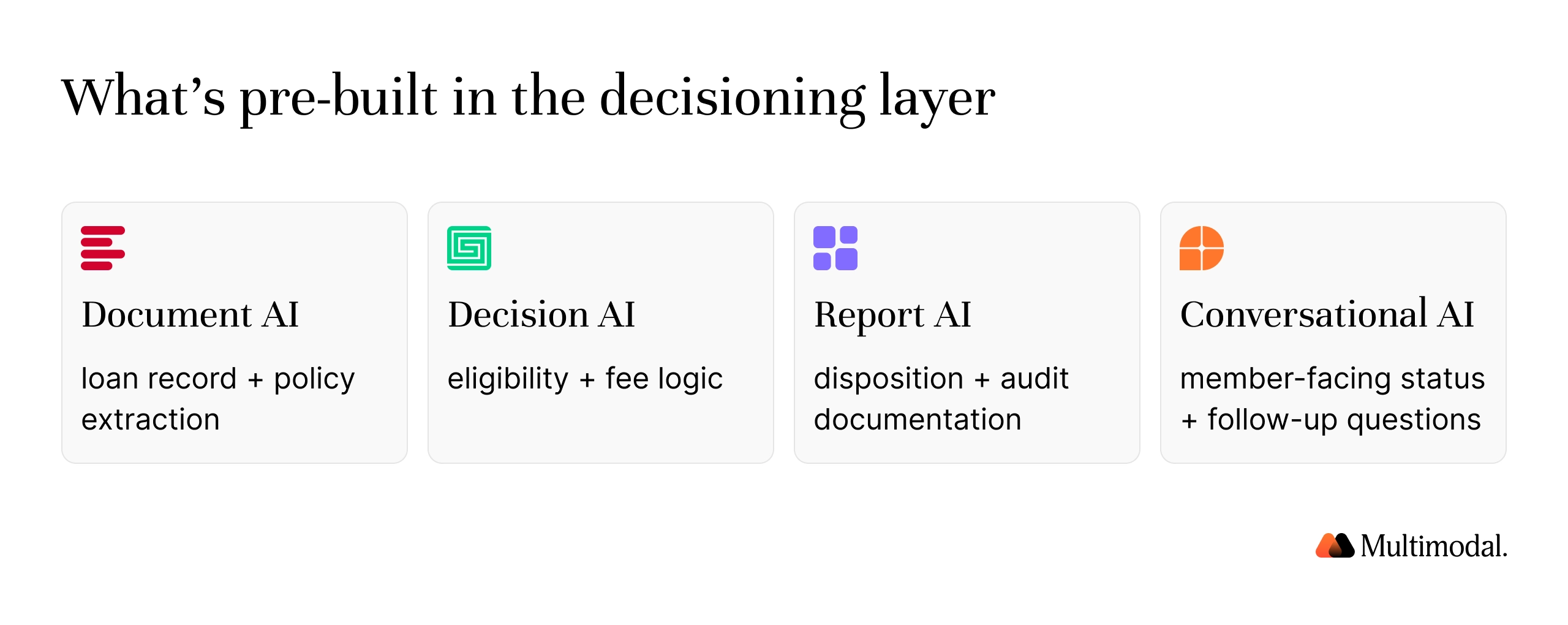
AgentFlow approaches this through the same agentic AI infrastructure it applies to loan modification and payment deferral workflows more broadly — the eligibility checks, exception routing, and audit documentation described above are standard capabilities of that decisioning layer, configured to a given institution's skip-a-pay policy rather than built as a one-off. For lending operations teams evaluating options, our breakdown of agentic AI versus generative AI covers why the distinction matters for workflows that make real decisions rather than just draft text, and our state of agentic AI in credit unions report covers how the broader category is being adopted across lending operations right now.
To see how this same eligibility-and-audit-trail pattern plays out in a related lending workflow, our loan processing automation case study walks through a live implementation. If you're evaluating AI agents for credit union lending operations more broadly, booking a demo is the fastest way to see how the eligibility logic maps to your specific policy set.
Frequently Asked Questions
What is skip-a-pay automation?
Skip-a-pay automation applies eligibility checks, fee calculations, and exception routing to member payment-skip requests without requiring staff to manually verify policy compliance for each request. It differs from a digital banking self-service form, which collects the request but still relies on staff to confirm eligibility.
Why do most credit unions still process skip-a-pay manually?
Digital banking forms typically handle intake but not the eligibility logic itself. Loan type exclusions, fee variance by state, and skip-limit tracking are usually still checked by a staff member before approval, even when the request came in digitally.
What eligibility rules typically affect skip-a-pay approval?
Common rules include loan-type exclusions (often mortgages, home equity, and VISA), a minimum loan age (commonly 6 months), current account standing, and annual or lifetime skip limits. These vary by institution and by state.
How do credit unions handle skip-a-pay volume spikes?
Manual queues sized for average volume slow down significantly during holiday and tax-season spikes. Automated eligibility checks process requests at consistent speed regardless of volume, routing only genuinely ambiguous cases to staff.
What documentation should an automated skip-a-pay decision produce?
A defensible record includes which eligibility rules were checked, what the loan record showed, and the basis for approval, denial, or referral to staff. This matters for member disputes and examiner review.
Does skip-a-pay automation help with indirect or dealer-originated loans?
It can, if the workflow covers channels beyond digital banking. Indirect loan holders are less likely to use online banking and more likely to be unaware that skip-a-pay is available, so automation limited to a digital banking form does not reach them.
Build AI Your Industry Can Trust
Deploy custom multimodal agents that automate decisions, interpret documents, and reduce operational waste.

.svg)
.svg)

.avif)
.png)

.png)