How to Monitor AI Answer Accuracy in Banks and Credit Unions
An operating manual for measuring AI accuracy: sample sizes, golden-set testing, drift thresholds, retention rules, and the review cadence examiners expect.
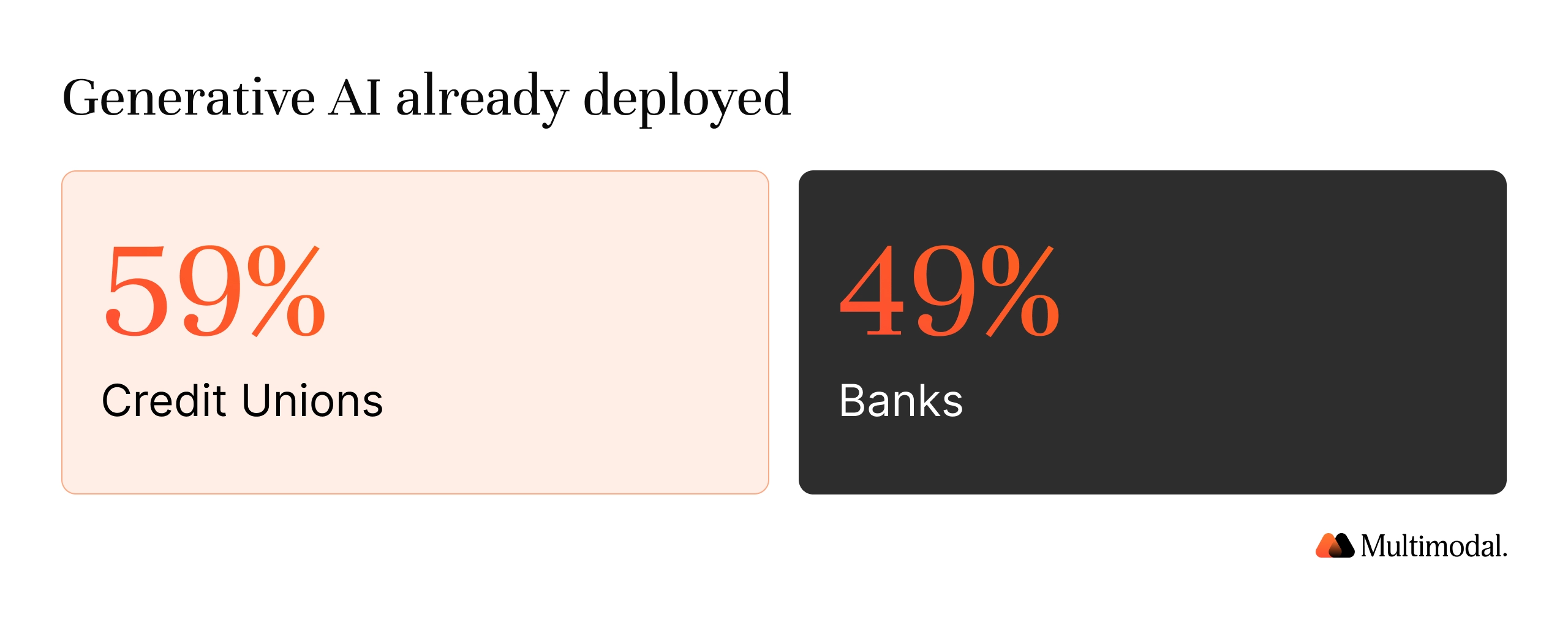
59% of credit unions and 49% of banks have already deployed generative AI.
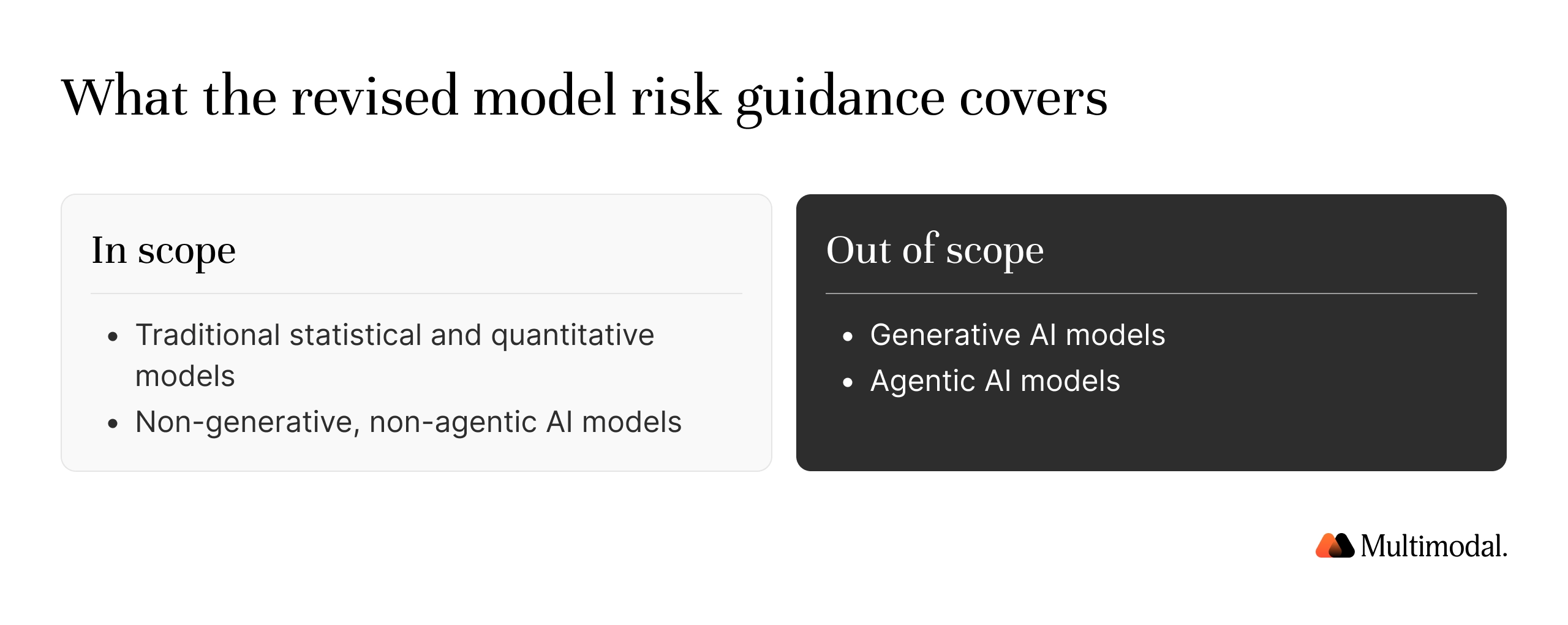
Federal model risk guidance was rewritten in April 2026 and excludes generative AI.
NCUA has no AI-specific rules, and its 2026 supervisory priorities never mention AI.
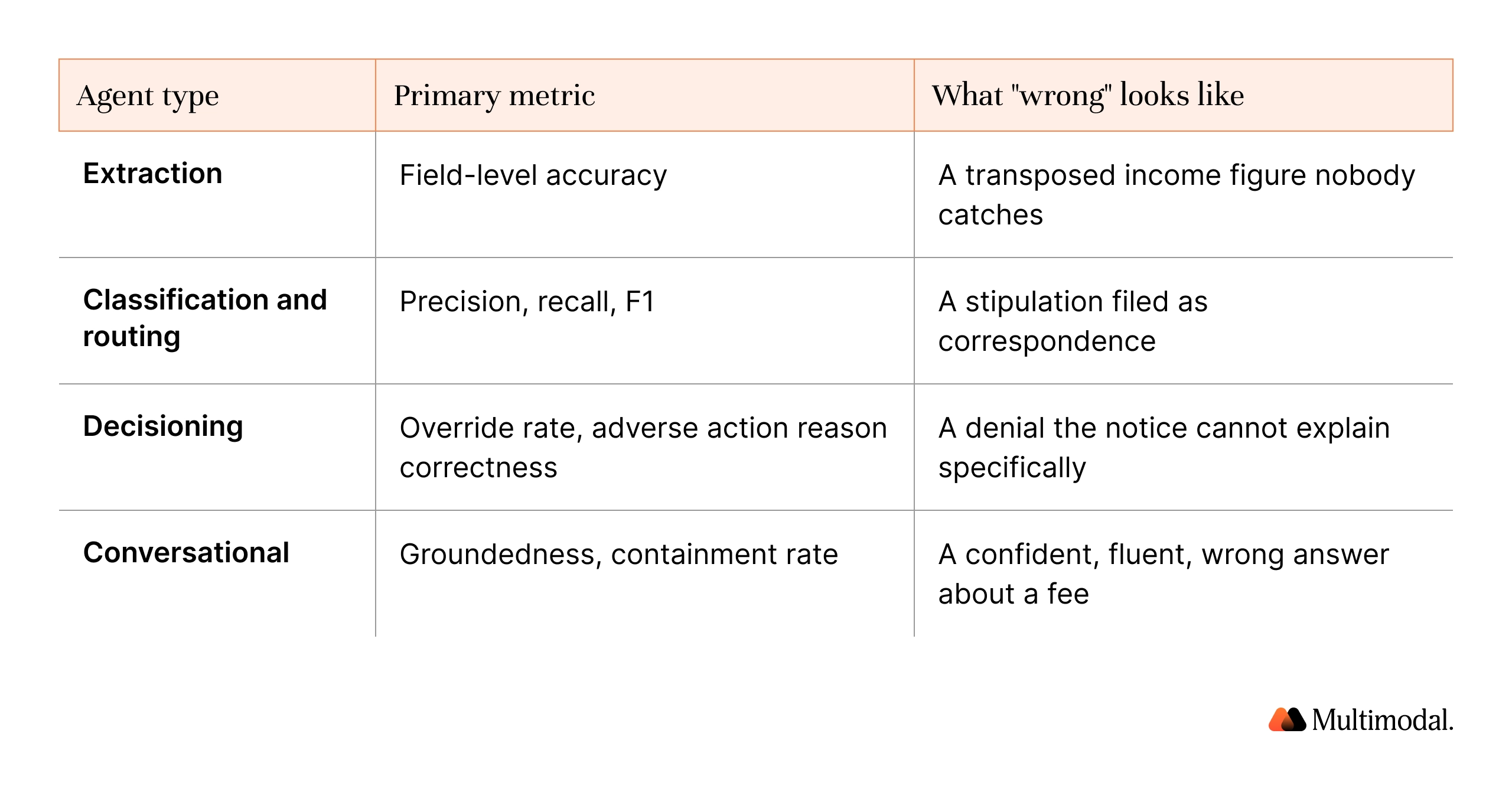
Accuracy is a different number for extraction, classification, decisioning, and chat.
Regulation B requires 25-month retention of any information used to evaluate an application.
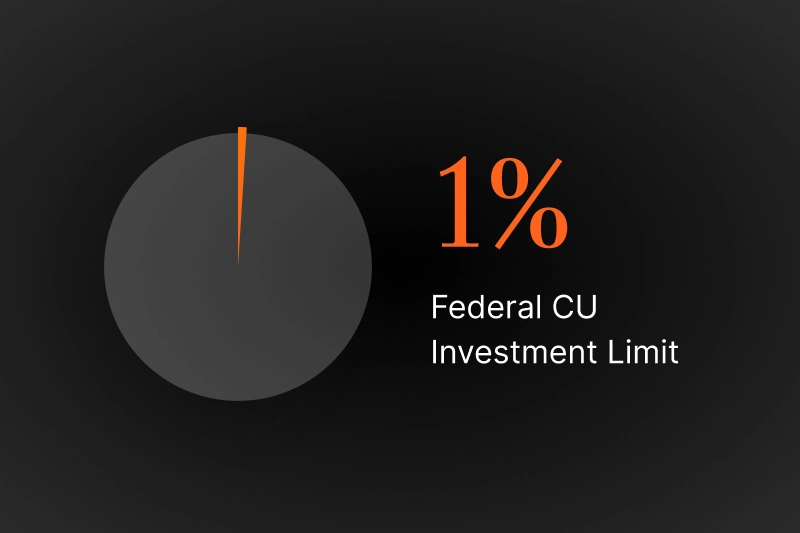
Get 1% smarter about AI in financial services every week.
Receive weekly micro lessons on agentic AI, our company updates, and tips from our team right in your inbox. Unsubscribe anytime.
Thank you! Your submission has been received!
Oops! Something went wrong while submitting the form.
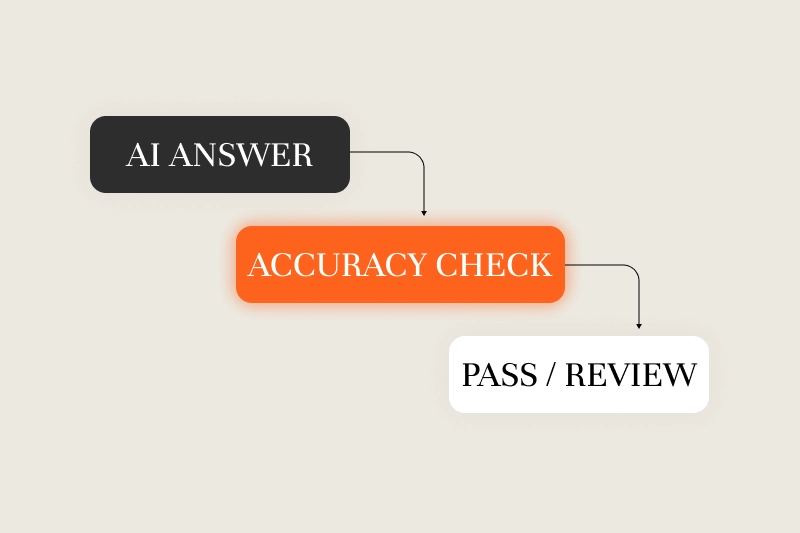
Knowing how to monitor AI answer accuracy in banks and credit unions comes down to four decisions: what "correct" means for each system, how many model outputs you review, what number triggers an alert, and what you keep on file when an examiner asks. Everything else is tooling.
One clarification first, because the phrase is now overloaded. This is about whether the AI agents reading your loan files and answering your members are right, and not about tracking what ChatGPT says about your institution.
The urgency is arithmetic. 59% of credit unions and 49% of banks have already deployed generative AI, based on a survey of 416 senior executives. The federal rulebook that most financial institutions would reach for was rewritten in April 2026, and it excluded generative AI from its scope.
What Does AI Answer Accuracy Actually Mean?
A single accuracy number across an entire AI program tells you almost nothing. Four kinds of AI systems fail in four different ways, and each needs its own instrument.
NIST calls the core failure mode confabulation, and warns that generative outputs "may also include confabulated logic or citations that purport to justify or explain the system's answer, which may further mislead humans into inappropriately trusting the system's output".
The reasoning a model offers for its answer can itself be fabricated. A reviewer checking the explanation rather than the underlying fact has no control at all. That is the practical limit of human-in-the-loop design, and the reason it has to be paired with measurement against verified datasets. Accuracy monitoring sits downstream of confidence scoring, and neither substitutes for the other.
Why the Model Risk Rulebook No Longer Covers Your AI
Most risk management programs in financial services rest on model risk guidance that no longer exists in the form people remember.
On April 17, 2026, the Federal Reserve, OCC, and FDIC issued revised guidance in the form of SR 26-2 and OCC Bulletin 2026-13, superseding SR 11-7. It then states: "Generative AI and agentic AI models are novel and rapidly evolving. As such, they are not within the scope of this guidance." The agencies add that a banking organization's own governance practices "should guide the determination of appropriate governance and controls for any tools, processes, or systems not covered in this document". Out of scope, still your responsibility.
For credit unions, the gap runs wider. NCUA states on its AI resource page that it "has not issued AI-specific rules or regulations," that existing regulations "are technology-neutral," and that credit unions should "monitor and measure those risks regularly". Its 2026 Supervisory Priorities letter does not mention artificial intelligence at all, and the GAO found that NCUA's model risk guidance "is limited in scope and detail."
Buying AI tools from a vendor does not transfer the obligation. Sound practice, per the revised guidance, involves "conducting ongoing monitoring and outcome analysis to assess whether vendor models are accurate, remain fit for purpose, and continue to be reliable." Stanford researchers tested three legal research tools marketed as eliminating hallucinations and found the LexisNexis and Thomson Reuters products "each hallucinate between 17% and 33% of the time".
"Bad outputs and hallucinations is still a very real issue with regards to attorneys… The issue really comes down to are you actually going through and seeing what the recommendations might be." — Michael Heller, Associate Attorney, Messick Lauer & Smith
Put the measurement obligation into the contract during due diligence, not after go-live.
How Many AI Outputs Do You Have to Review?
"We spot-check a few" is a feeling. To state that your extraction agent runs at a 5% error rate and defend it, the sample size is a calculation.
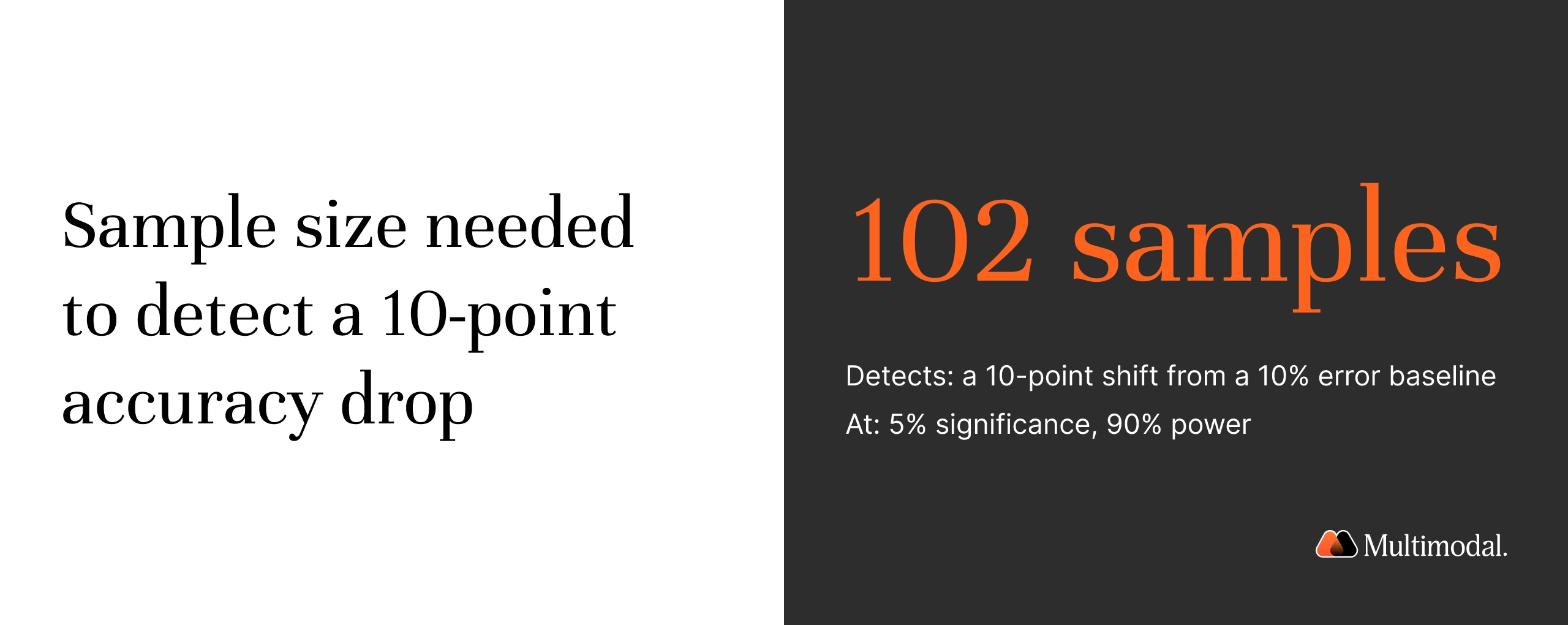
An accuracy rate is a proportion, so use the sample size required to detect a shift in a proportion of defectives. The NIST/SEMATECH e-Handbook, section 7.2.4.2, gives the formula and a worked example: detecting a 10-point shift from a 10% baseline at 5% significance and 90% power takes roughly 102 samples.
Size the plan by consequence rather than volume. High-consequence queues, such as loan approvals, warrant 100% review, which is usually cheaper than relying on statistics. Material workflows get a calculated random sample plus a risk-weighted oversample because random sampling estimates your true error rate, while risk-weighted sampling identifies the errors that hurt. Track false positives separately, since a system that escalates everything looks safe on an error report while degrading the member experience.
A reviewer who disagrees with the other reviewer is a measurement problem before it is a model problem. Measure inter-rater reliability with Cohen's kappa first, where anything below 0.60 is inadequate for high-stakes work.
"We don't get to score every call… So what we're going to do now is we're going to move from a random sampling to a near total coverage of calls. Right now we are calibrating with the quality assurance bot." — Hashim A. Forrester, SVP of Remote Service Delivery, Wescom Credit Union
The word doing the work is "calibrating." An automated scorer is another model, and it needs its own accuracy measurement before you trust its verdicts.
Building the Golden Set
A golden set is a fixed collection of input data with human-verified correct outputs, used to test the same cases every time something changes. It turns model performance from an opinion into a measurement.
Pick the cases, not the volume. 150 to 300 well-chosen items beat 5,000 random ones. Cover every document type, every exception path, the edge cases that have already burned you, and a block of malformed inputs.
Write the ground truth twice. Two independent annotators, then calculate kappa.
Version it and freeze it. Date-stamped, change-logged, named owner.
Run it on every change. New model version, prompt change, vendor release, policy update, new document format.
Keep a holdout the vendor never sees, and write into the agreement that they run it and show you the results.
This maps onto the NIST AI Risk Management Framework, the most citable structured framework for AI governance in banking. The AI RMF covers the full lifecycle, from model development through production monitoring, which is why it survives the gap the federal guidance left open.
What Should Trigger an Alert?
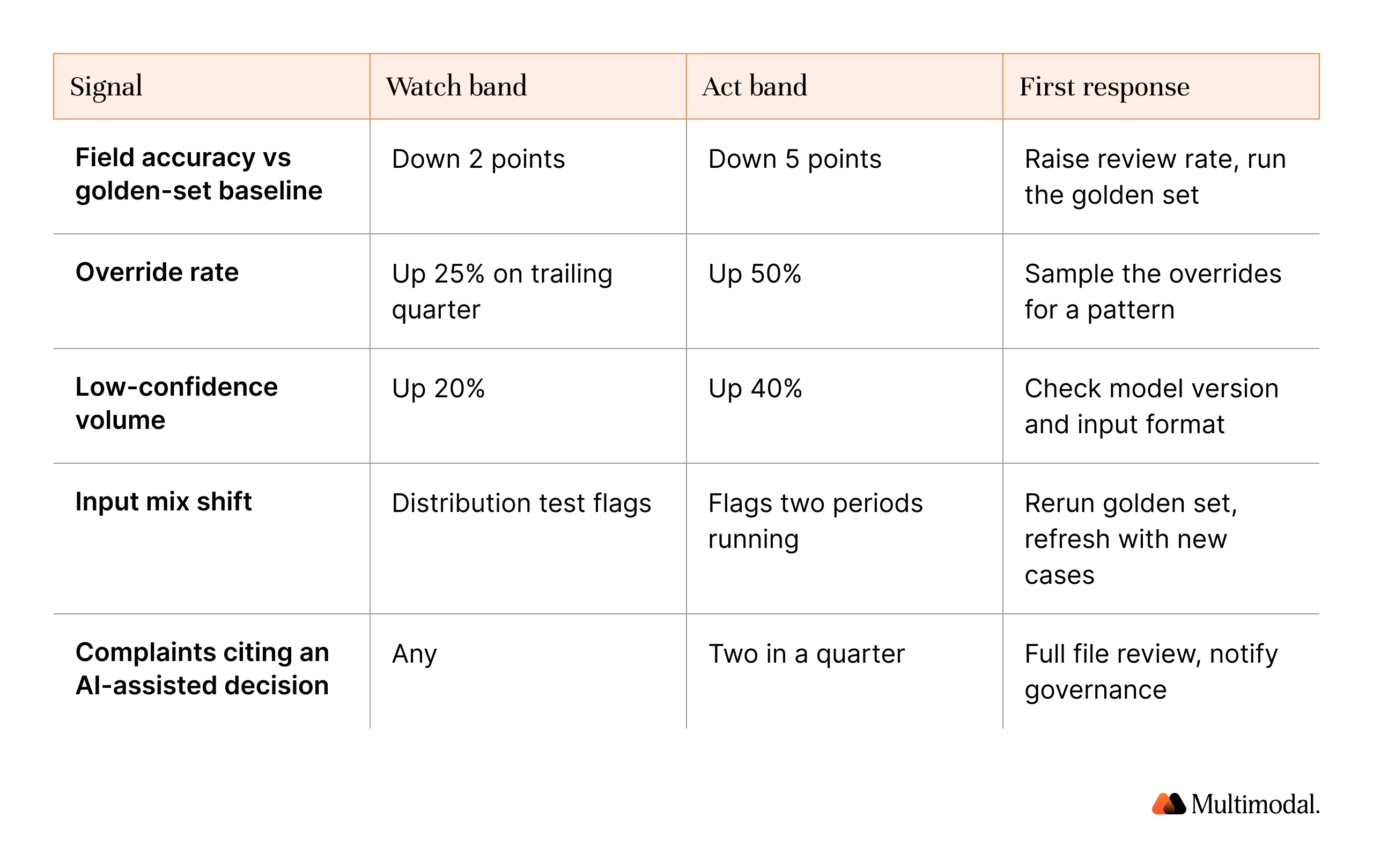
Model drift quietly degrades performance, which is why a proactive approach is worth the setup cost. Concept drift is a change in the relationship between inputs and correct answers, such as a change in a lending policy. Data drift is a change in the input distribution, such as a new dealer's document format. Real-time monitoring of input data catches the second before accuracy moves. Only outcomes analysis catches the first.
Those bands are a worked template on stated assumptions rather than published thresholds. None exist. Set yours against your own baseline and risk appetite, then hold to them. The response ladder escalates in fixed steps: raise the review rate, tighten the confidence threshold, route the affected class to human analysts, roll back to the last version that passed the golden set, disengage.
What Does the Examiner Actually Want to See?
The obligations with real teeth never moved. CFPB withdrew its circulars on adverse action and complex algorithms in May 2025, but the underlying regulation remained unchanged.
12 CFR 1002.9(b)(2) requires a statement of reasons that is "specific," and says reasons citing internal standards or a failed qualifying score "are insufficient." In practice, "the model said no" is not a reason, which makes explainable AI a regulatory requirement rather than a preference.
12 CFR 1002.12(b)(1) is the sharper edge. For 25 months after notifying an applicant, a creditor must retain the application and "any other written or recorded information used in evaluating the application." If an AI output informed the decision, it sits inside that phrase.
Build audit trails that carry, per item: the input reference, model and prompt version, the output with its confidence score, who reviewed it and when, what they changed, the reason code that triggered the notice, and the golden-set run that passed at the time. Those logs also capture member data, so retention and data access controls should be included in the same policy as the accuracy thresholds.
Testing for bias and disparate impact belongs on the same cadence, because a system can be accurate in aggregate and still fail fair lending compliance.
Who Reviews What, and How Often
Most credit unions have no model risk function and no data scientists on staff. The framework has to map onto existing roles.
IT or vendor manager. Model versioning, golden-set run on every release, vendor SLA evidence.
Internal audit or supervisory committee. Validation sits apart from whoever built the system.
Board or designated committee. Quarterly scorecard, so AI decision-making stays visible at governance level.
Maintain a registry of every AI system in production, classified by risk tier and assigned a named owner. This is the artifact most institutions are missing.
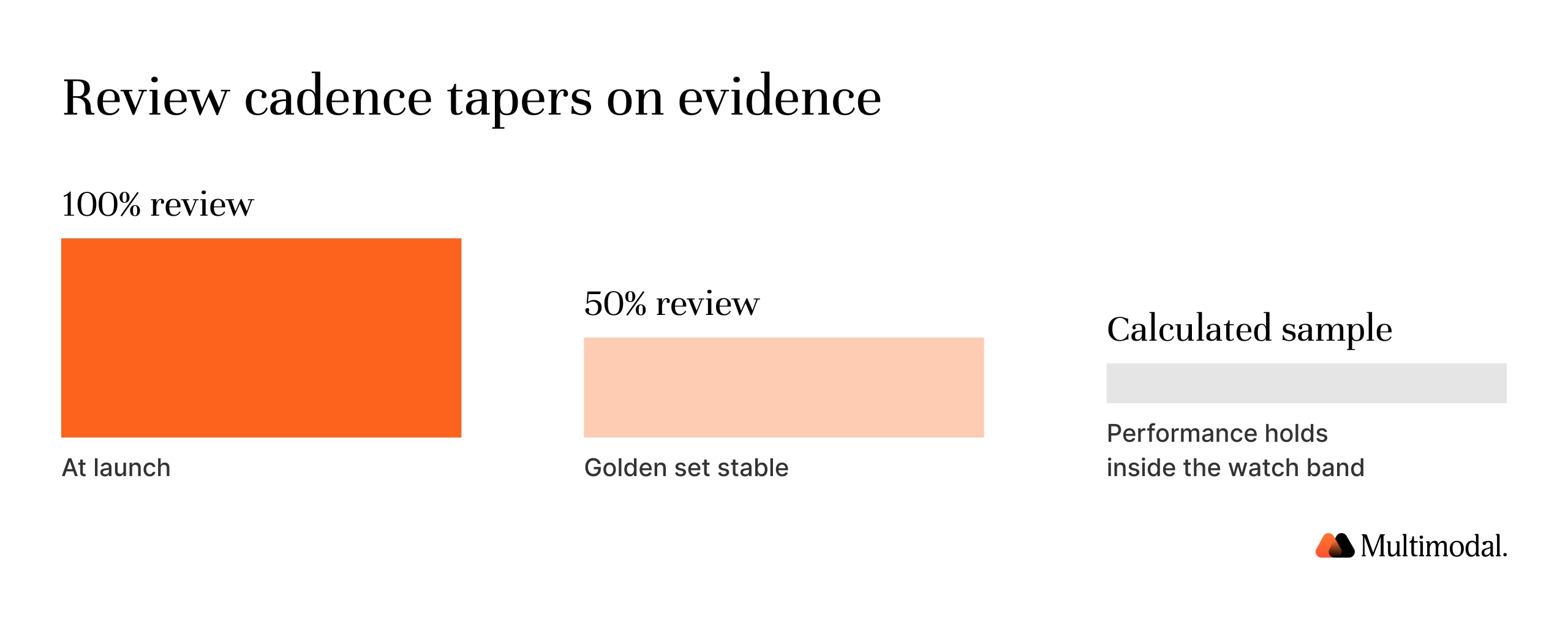
The review cadence tapers on evidence: 100% at launch, 50% once the golden set is stable, then a calculated sample once performance holds inside the watch band. Every step down is a documented decision with evidence attached, and any trigger event puts the rate straight back up. Across organizations, 75% have AI usage policies, while only 59% have dedicated AI governance roles.
The Number You Cannot Produce Is the Answer
FORUM Credit Union runs AgentFlow at 99% extraction accuracy with 60% of loans auto-underwritten. What matters less is the 99%; more is how it is produced: measured against verified ground truth on a defined document population, at a defined cadence, with everything below the confidence threshold routed to a person.
AI adoption in financial services has outrun AI governance. The federal framework was rewritten, leaving generative AI outside its scope while keeping the responsibility within your building. NCUA has no AI-specific rules. Regulation B still wants 25 months of records. Nobody is sending a template. The institutions that come through this well will be the ones that can produce a number, explain how it was measured, and show the sample it came from.
Send us one week of your document queue and your current review process. We will run it through AgentFlow, hand back field-level accuracy for your files, and show you the audit trail an examiner would request. Your files, your numbers.
See the Accuracy Number on Your Own Files
Send us one week of your document queue and your current review process. We will run it through AgentFlow, hand back field-level accuracy for your files, and show you the audit trail an examiner would request.
How do you monitor AI answer accuracy in a bank or credit union?
Classify each AI system by type, define the right metric, build a golden set of human-verified cases, sample production outputs at a calculated rate, set thresholds that trigger action, and log every decision with its model version and reviewer.
How many AI outputs do you need to review to measure accuracy?
Enough to detect the change you care about. Using the NIST/SEMATECH method, detecting a 10-point shift from a 10% error baseline at 5% significance and 90% power takes roughly 102 samples. High-consequence queues usually warrant 100% review.
What is a golden dataset in AI testing?
A fixed set of inputs with human-verified correct outputs, versioned and frozen, used to test the same cases every time a model, prompt, vendor release, or policy changes.
Does NCUA have AI guidance for credit unions?
No. NCUA states it "has not issued AI-specific rules or regulations" and that existing regulations are technology-neutral. Its 2026 Supervisory Priorities letter does not mention AI, and its AI Compliance Plan governs the agency's own internal use.
Is SR 11-7 still in effect for AI models?
No. SR 11-7 was superseded on April 17, 2026, by SR 26-2 and OCC Bulletin 2026-13, which state that generative and agentic AI models are outside its scope while still expecting institutions to govern them.
How long do you have to keep AI decision records?
Regulation B requires 25 months, or 12 months for business credit. The operative phrase is "any other written or recorded information used in evaluating the application," which covers AI outputs that informed a credit decision.

.svg)
.svg)

.avif)
.png)

.png)