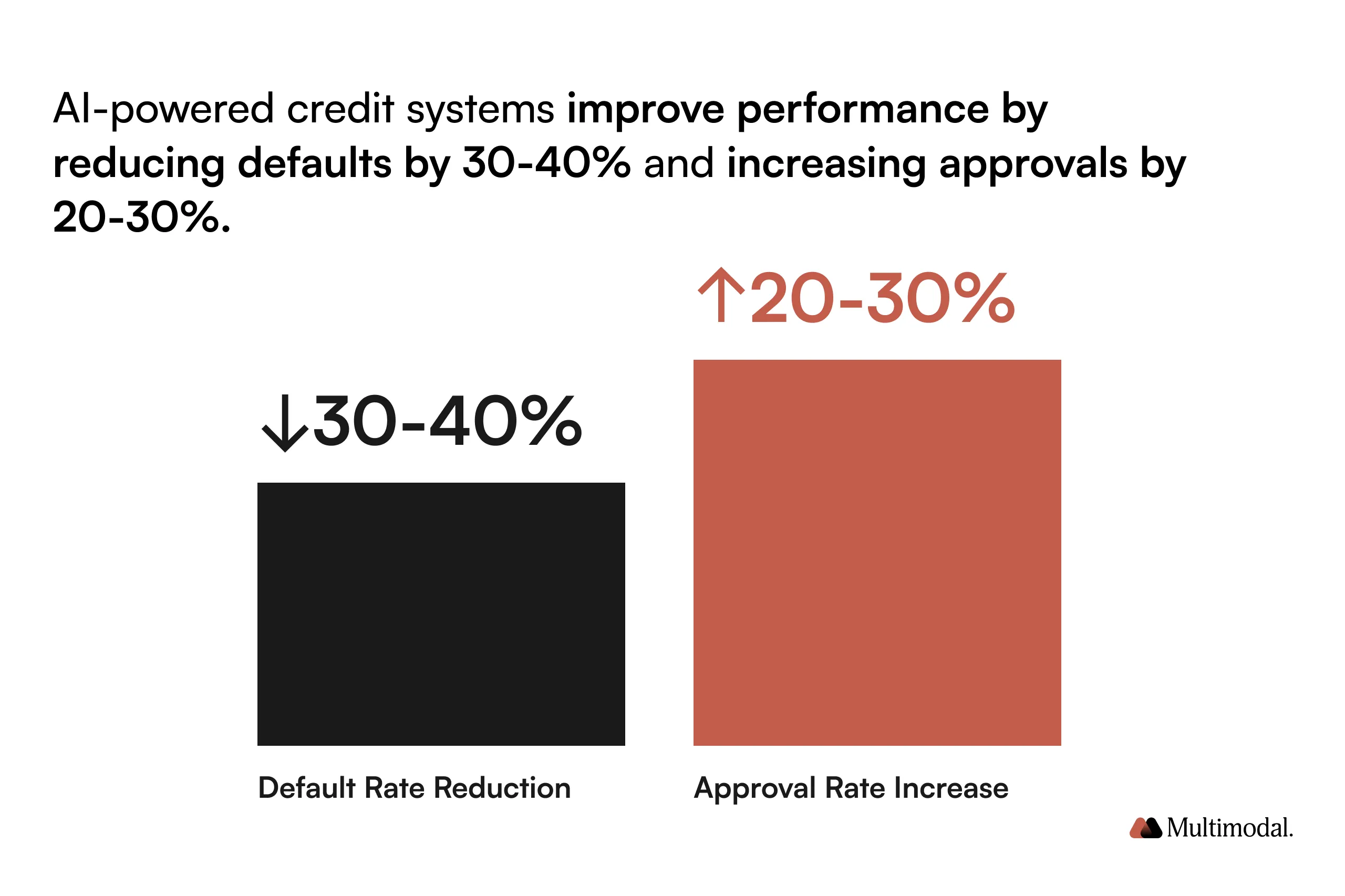
AI transforms credit risk management by automating processes and improving decisions.
Explainable AI ensures transparency, compliance, and trust in credit decisions.
Human oversight is key to ensuring accuracy and mitigating risk in early AI deployments.
Data quality and governance are essential to reliable, compliant credit assessments.
AgentFlow offers a secure, customizable AI solution for better credit decisioning.
Get 1% smarter about AI in financial services every week.
Receive weekly micro lessons on agentic AI, our company updates, and tips from our team right in your inbox. Unsubscribe anytime.
Thank you! Your submission has been received!
Oops! Something went wrong while submitting the form.
AI’s potential in reshaping credit risk management (CRM) is undeniable. To gain insights into how agentic AI can be effectively integrated into CRM processes, we asked Mora Freire, our Head of Customer Success at Multimodal, to share her experience working with financial institutions. Mora has seen firsthand how AI-driven workflows can automate and enhance credit risk management, ensuring both compliance and better decision-making.
"AI in credit risk management is not just about automating processes—it's about embedding intelligence that improves decision-making, reduces operational costs, and ensures compliance," Mora explains.
In this blog, we’ll explore how AI can be applied across the various stages of credit risk management, the challenges of implementing it, and expert advice from Mora on successfully deploying AI in this critical area of financial services.
Ways to Use AI in Credit Risk Management
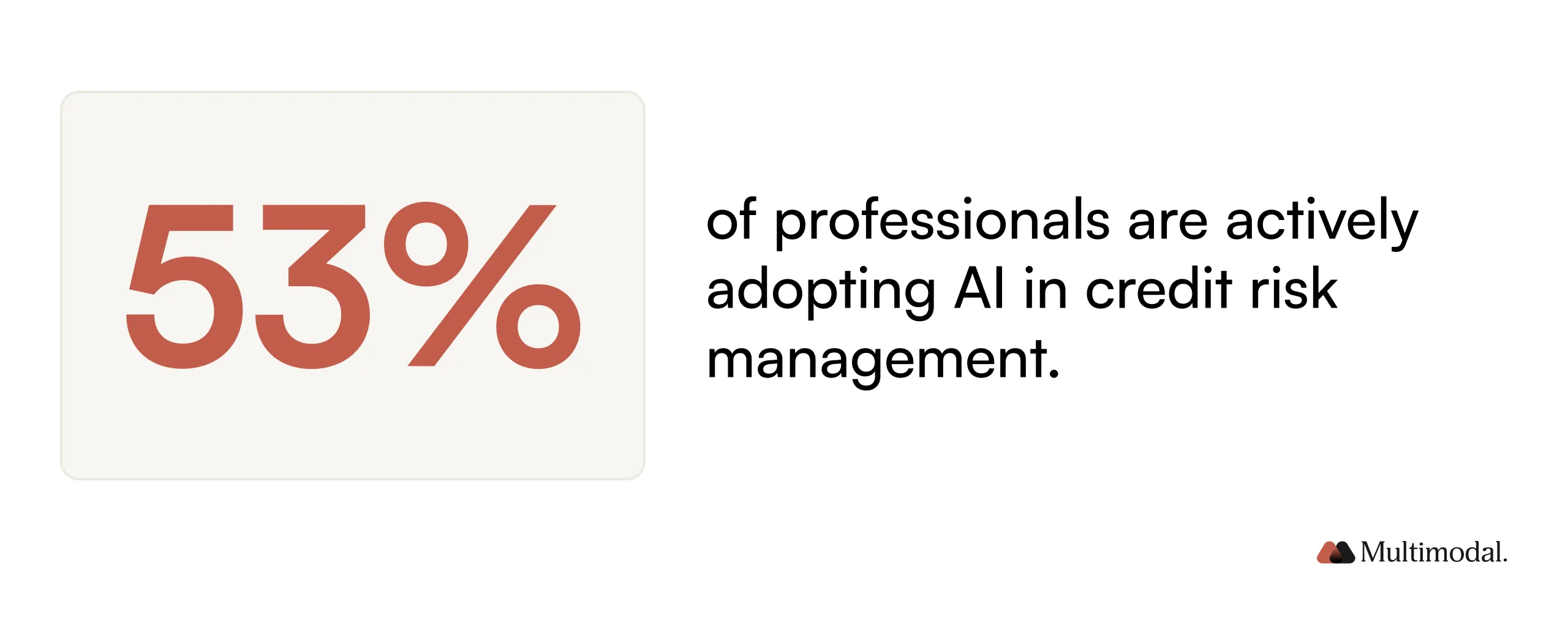
AI is revolutionizing how financial institutions manage credit risk. According to a 2025 Moody's study, 53% of risk management and compliance professionals are actively using or trialing AI in their processes.
Modern AI in credit risk management relies on analyzing vast amounts of financial data and diverse data sources, such as payment history, transactional behavior, and alternative data. By using machine learning and generative AI (gen AI) models, financial institutions can move beyond traditional methods and deliver accurate risk assessments that significantly improve risk management and enhance customer experience.
The technology is transforming everything from initial credit assessments to ongoing monitoring and even post-approval actions.
Some of the most impactful use cases for AI in credit risk management include:
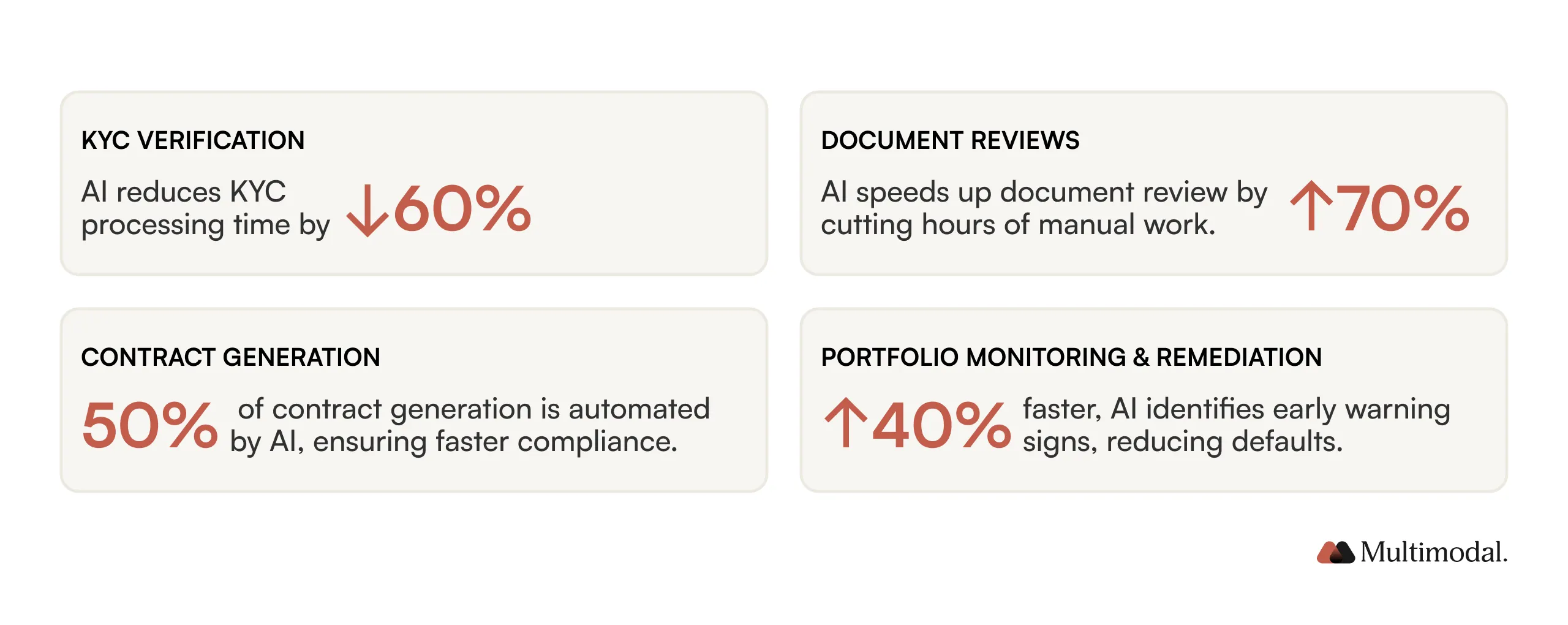
KYC Verification: AI can automate KYC processes, including verifying identity documents, detecting fraud, and cross-referencing data against global watchlists. This speeds up the process and reduces human error, making it a powerful tool for customer onboarding and enhancing customer experience.
Document Reviews: AI can streamline the review of financial documents, loan applications, and supporting materials by classifying, extracting data, and flagging inconsistencies. This reduces manual processing time, boosts operational efficiency, and ensures greater credit performance accuracy. It also allows risk managers to focus on high-priority tasks and make more accurate risk assessments.
Contract Generation: AI tools can draft or review contracts, ensuring they comply with regulatory standards and company policies. By automating this process, institutions can not only speed up workflows but also ensure compliance with all rules, particularly those related to credit lending agreements and credit reports.
Portfolio Monitoring and Remediation: Post-underwriting, AI can be applied to monitor credit portfolios and track risk factors in real time. AI-powered solutions can identify early warning signs of credit deterioration, enabling financial institutions to take proactive actions in collections or remediation, significantly improving risk management.
Mora highlights a powerful example from our own work: "By combining Document AI, Decision AI, and generative AI, we helped a financial institution automate the entire document lifecycle, from classification and extraction to decision-making and compliance checks."
This demonstrates the broad potential of AI in CRM, especially when integrating multiple systems to streamline workflows and enhance overall efficiency. AI helps financial institutions harness vast amounts of financial data, enabling them to make more informed credit decisions.
In addition to these core use cases, AI can also be used for credit scoring, fraud detection, and predictive analytics, enabling financial institutions to make more informed decisions. By leveraging AI, these institutions can make more accurate risk assessments, improve credit analysis, and reduce operational costs.
Challenges of Using AI in Credit Risk Management
The potential for AI to significantly improve risk management is immense, but it also comes with risks that must be managed carefully.
Michael S. Barr highlights one of the biggest concerns: AI’s impact on credit decisions. "While these technologies have enormous potential, they also carry risks of violating fair lending laws and perpetuating the very disparities that they have the potential to address," says Barr.
The use of AI and machine learning models in credit risk assessments can inadvertently perpetuate biases or inaccuracies, particularly if the data used to train these models is incomplete or unrepresentative. Financial institutions must ensure their AI models are designed to address these issues rather than inadvertently amplify them.
The Consumer Financial Protection Bureau (CFPB) Director, Rohit Chopra, also expressed concerns about the opacity of AI systems, stating: “The law gives every applicant the right to a specific explanation if their application for credit was denied, and that right is not diminished simply because a company uses a complex algorithm that it doesn’t understand.” This underscores a critical challenge in adopting AI for credit risk management: explainability.
Financial institutions must be able to provide clear, understandable reasons for why credit decisions are made, particularly when a customer’s credit report or application is denied. Lack of transparency in these decision-making processes can not only harm customer satisfaction but also expose financial institutions to regulatory risks.
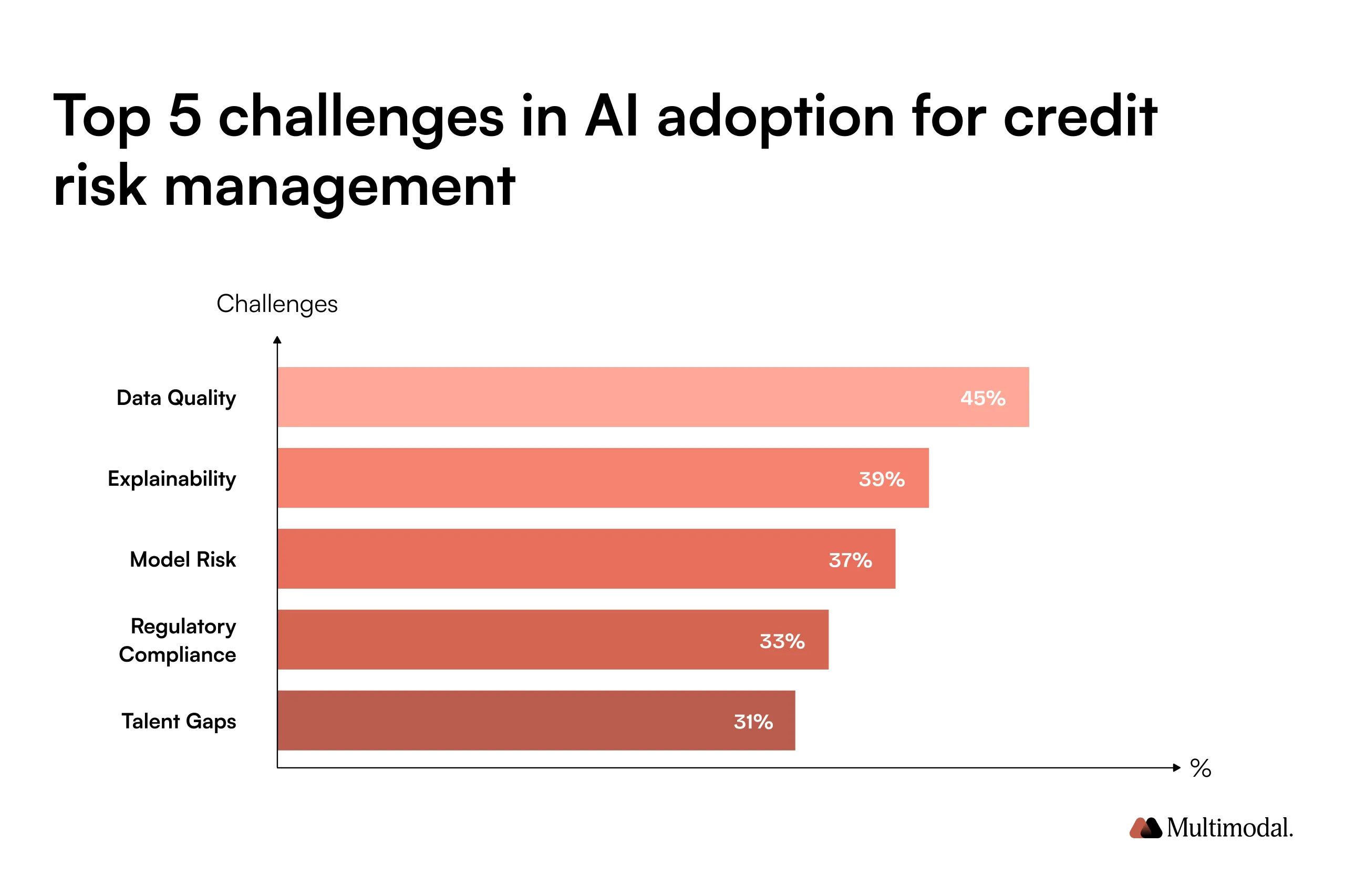
In addition to fairness and explainability, there are several other challenges that risk managers face when adopting AI in credit risk management:
Data quality: AI models rely heavily on high-quality, accurate financial data to make reliable decisions. Inconsistent, incomplete, or biased data can lead to inaccurate credit assessments, undermining the entire risk management process. Ensuring that data is clean and representative of all customer segments is crucial for the success of AI models in credit analysis.
Model risk: AI models must be continuously monitored and retrained to ensure they remain accurate and effective as market conditions change. Outdated models or models trained on biased data can result in poor credit performance or credit decisions, leading to financial loss or regulatory issues.
Governance and regulatory uncertainty:AI in financial services is still navigating a rapidly evolving regulatory landscape. Financial institutions must ensure that their AI systems comply with existing regulations, as well as emerging guidelines for AI use in credit decisioning. Ensuring compliance while adopting new technology can be a complex balancing act, and institutions must stay ahead of regulatory developments to avoid penalties.
Talent and integration gaps: Integrating AI into credit risk management systems often requires specialized expertise. Many banks and financial institutions struggle to find in-house talent to implement and maintain these AI systems. Additionally, integrating AI with legacy systems can be complex and resource-intensive.
Despite these challenges, the benefits of AI in credit risk management are clear. With the right safeguards in place, such as explainable AI models, continuous monitoring of financial data quality, and a robust governance framework, financial institutions can successfully leverage AI to improve credit decisions and mitigate risks.
Guidelines from Our Head of Customer Success
Implementing AI in credit risk management comes with its own set of challenges, but as Mora Freire, our Head of Customer Success at Multimodal, points out, with the right strategies and safeguards, these challenges can be addressed effectively.
Mora has worked closely with financial institutions to help them navigate the complexities of AI adoption. Here are her expert guidelines for ensuring AI integration is both successful and compliant:
1. Review Intermediate Steps, Not Just Final Credit Decisions
“Adopting agentic AI means reviewing all interconnected outputs, not just the final decision. Documents, extractions, validations, and decisions depend on each other. Skipping intermediate reviews can invalidate downstream outcomes,” Mora emphasizes.
When AI is involved in complex workflows, it’s easy to focus solely on the end result—the credit decision.
However, each stage of the process, from document extraction to validation and decision-making, is interconnected. If any intermediate step is overlooked, it can affect the final outcome, potentially resulting in incorrect or risky credit decisions.
Mora’s guidance is clear: Financial institutions should not just focus on the final decision, but on ensuring each step in the AI-driven process is reviewed and validated to guarantee consistency and accuracy throughout
2. Design for Failure Detection
“Understanding why something failed is critical to prevent bad approvals and diagnose issues. Clear failure signals allow teams to stop workflows on errors and understand what’s happening before moving forward,” says Mora.
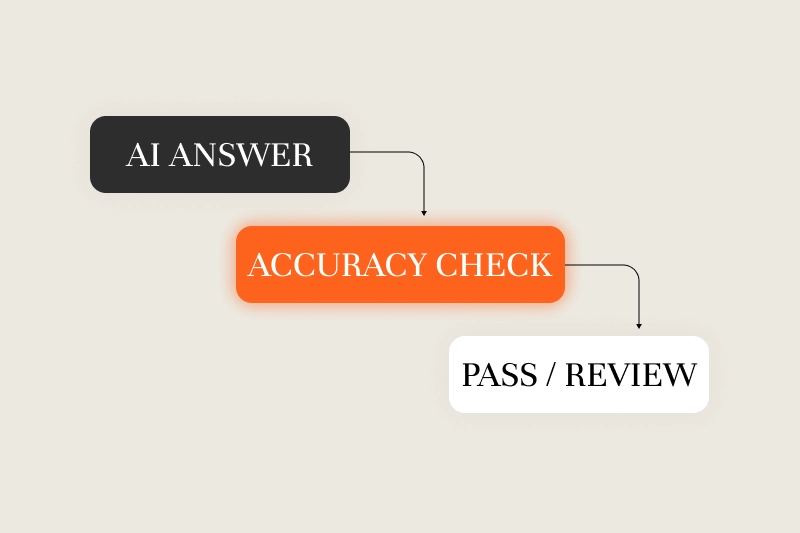
Designing AI systems that can easily detect failures is crucial for preventing the approval of risky loans or credit decisions. If AI models fail to identify or flag issues early in the process, the consequences can be significant, resulting in poor credit decisions that can harm both the financial institution and its customers.
By embedding failure detection into the system, financial institutions can immediately address problems as they arise. This allows teams to take corrective action before workflows proceed, ensuring that only accurate and reliable decisions are made.
3. Make Human Review the Default in Early Deployments
“This is why human-in-the-loop is the default, especially early on. Until there’s enough review data to build reliable accuracy metrics and confidence scores, structured human review is required as part of the standard workflow,” Mora explains.
While AI can automate complex tasks, Mora emphasizes the importance of human review in the early stages of deployment. Until sufficient historical data is collected to build confidence scores and accuracy metrics, human oversight is essential to ensure AI models are performing as expected.
Human reviewers play a vital role in identifying edge cases, validating AI’s decisions, and ensuring the system aligns with organizational goals and regulatory standards. This approach helps build trust in AI systems while reducing the risk of inaccurate decisions.
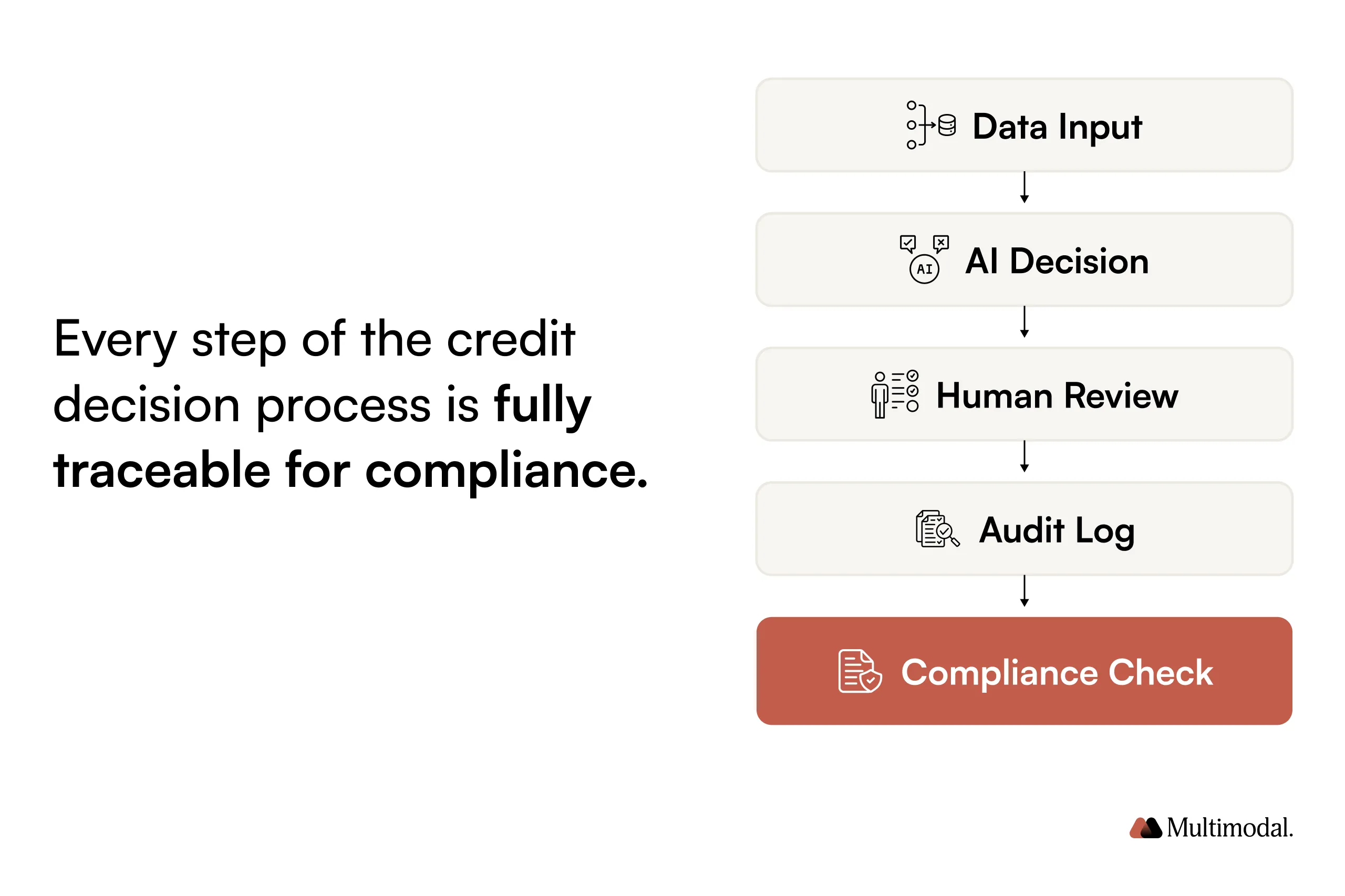
“Auditability is about knowing who reviewed what, when, and based on which outputs. Financial services institutions care about tracing human actions across the workflow for compliance, not about model internals,” says Mora.
Auditability is a key concern for financial services institutions. In a regulated environment, every credit decision needs to be traceable for compliance purposes. Mora stresses that it’s not enough to focus solely on the AI model’s internal workings; what matters is ensuring that human actions, such as reviews, approvals, and escalations, are well-documented and fully auditable.
Financial institutions must ensure that every step of the decision-making process, from initial assessments to final approvals, is logged and accessible for audit. This level of transparency is crucial to meet regulatory requirements and to provide customers with the transparency they deserve.
5. Create Internal Guidelines for Safe AI Usage
“Artificial intelligence cannot replace the brain,” as financial expert Defend puts it. “It’s equally important the interpretation, the understanding, and the check of what the algorithms are providing.”
Mora shares this perspective and adds that “it’s vital to create internal guidelines that govern AI usage within credit risk management.”
AI can enhance decision-making in credit risk management, but Mora stresses that it should never replace human judgment entirely. To ensure safe and ethical AI use, financial institutions must establish clear internal guidelines governing AI, including the roles humans play in overseeing AI’s decisions.
These guidelines should define when human oversight is required, how to handle edge cases, and the processes for continuously monitoring and retraining AI systems. By doing so, financial institutions can ensure that AI operates within ethical boundaries and in alignment with their organizational values.
Choose Solutions Built for Financial Services
As financial institutions integrate AI into credit risk management, it’s essential to choose solutions specifically built for the complexities of the financial services industry. General-purpose AI tools may not meet stringent regulatory requirements or provide the necessary customization.
AgentFlow was designed with these needs in mind, providing secure data handling, explainable AI, and regulatory compliance tailored to the financial services industry.
See AgentFlow Live
Book a demo to see how AgentFlow streamlines real-world finance workflows in real time.
By combining explainable AI, natural language capabilities, and a specific focus on auditability, AgentFlow delivers a competitive advantage for banks and lenders seeking a reliable, future-ready solution for credit risk management and future reference.
With it, financial institutions can significantly improve risk management, enhance customer experience, streamline workflows, and mitigate risk while ensuring full transparency and control. Our platform is built to seamlessly integrate into your existing systems, supporting both human judgment and AI-driven efficiency.
Ready to see AgentFlow in action? Book a demo today and experience how AI can transform your credit risk management processes.

.svg)
.svg)

.avif)
.png)