LP automation is raising the bar for fast, standardized, and traceable GP reporting.
Digital transformation ROI comes from removing manual work, not buying more tools.
Orchestrated AI across the lifecycle improves decisions while keeping outputs auditable.
Prioritize automation that reduces risk with early detection and strong controls.
Data-driven sourcing and valuation are accelerating, while legal automation remains underused.
Get 1% smarter about AI in financial services every week.
Receive weekly micro lessons on agentic AI, our company updates, and tips from our team right in your inbox. Unsubscribe anytime.
Thank you! Your submission has been received!
Oops! Something went wrong while submitting the form.
Private equity automation is no longer a "nice to have" for busy back offices. In today's modern investment landscape, it decides whether your team spends time on investment decisions or gets buried in data entry, investor reporting, and manual processes. LPs are automating fund monitoring, market data is getting noisier, and private equity firms that still run on spreadsheets will feel it first, in speed, accuracy, and portfolio performance. Here's a look at the automation practices defining the next generation of PE operations, and how to make them stick.
1. LPs Are Increasingly Automating Fund Monitoring
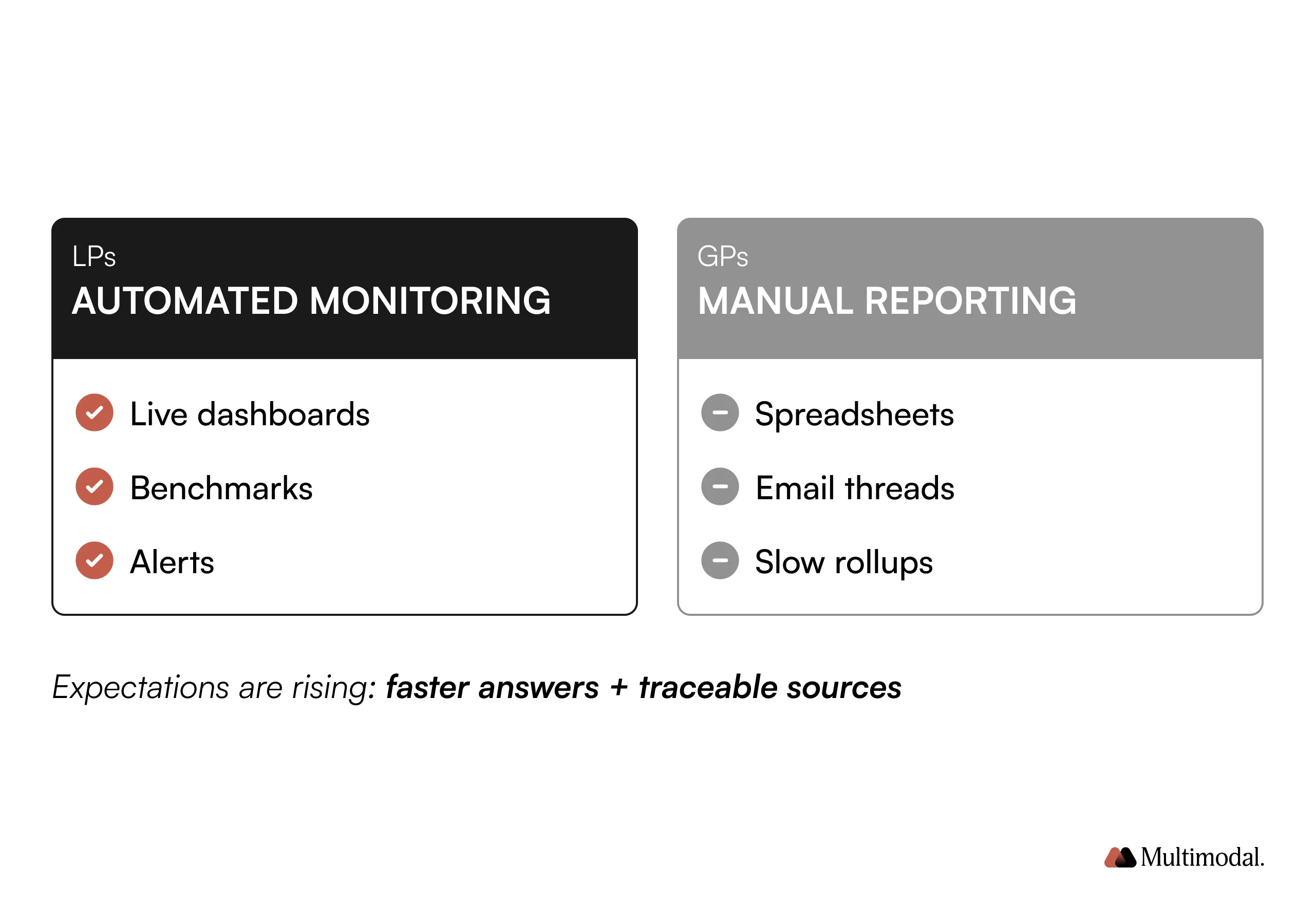
LPs have started deploying their own data analytics tools to track portfolio performance and benchmark fund returns in near real time, changing what they expect from GPs and how quickly they expect answers.
That shift creates a straightforward dynamic: fight fire with fire. If LPs use automated systems to ask sharper questions faster, GPs need workflow automation that lets them respond with equal precision. Otherwise, your team spends days assembling explanations that an LP's tooling can challenge in hours.
For private equity teams, the practical answer is building a monitoring-ready operating cadence. That means standardizing data capture across portfolio companies so quarterly reporting doesn't become a bespoke project every cycle, treating investor reporting as a repeatable workflow rather than a heroic push, and instrumenting portfolio monitoring so you can answer LP questions with traceable sources, not tribal knowledge. This is where the private equity industry is heading: continuous monitoring, not periodic catch-up.
2. 98% of PE Firms Undergoing Digital Transformation
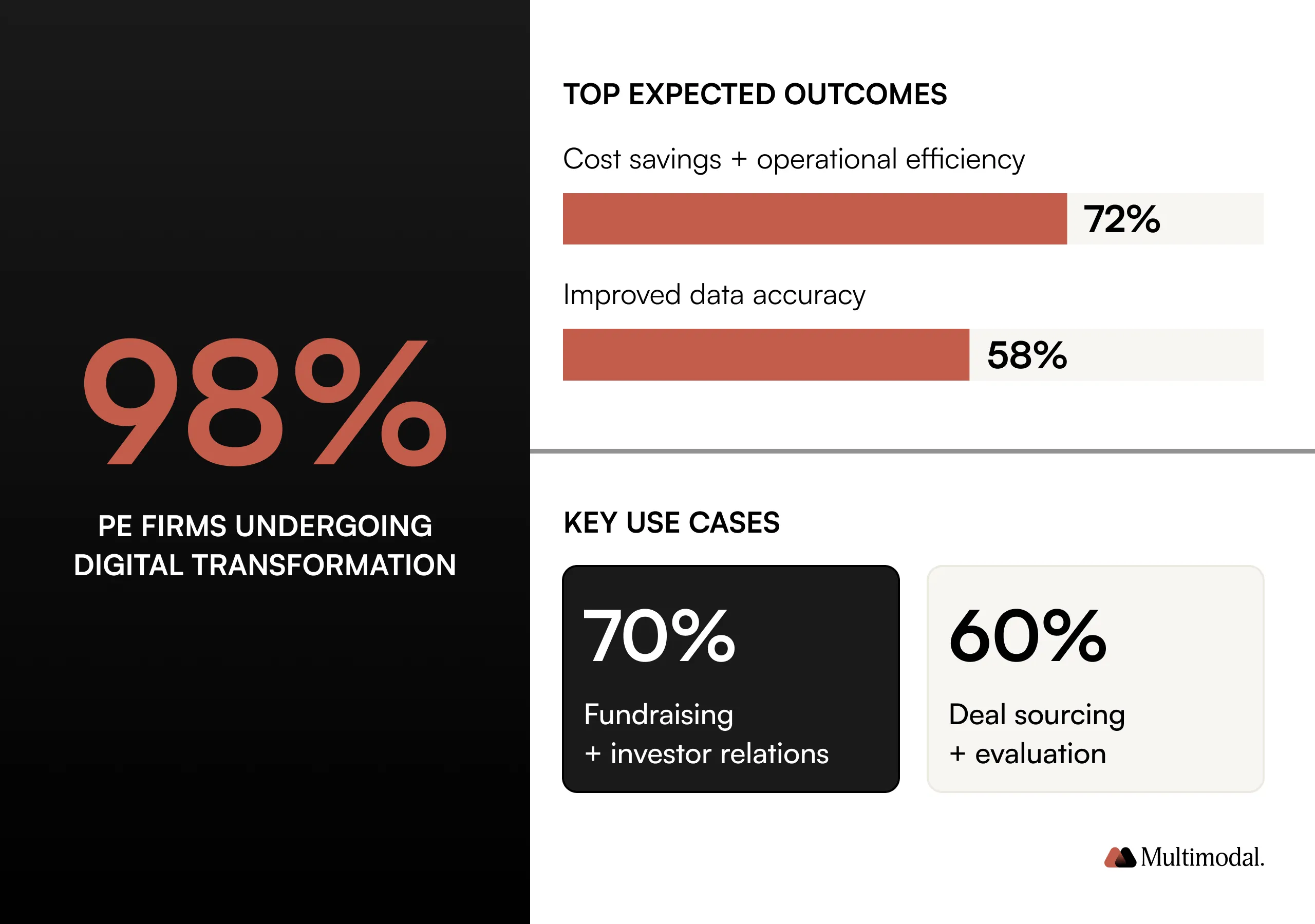
It's no wonder that digital transformation has become table stakes across private equity. According to research conducted with Ontra and Private Equity Wire, 98% of PE firms are at some stage of digital transformation, a near-universal acknowledgment that technology is no longer optional for competitive advantage.
But "in some stage" is the critical phrase. The top expected outcome from digital transformation is cost savings and operational efficiency (72%), followed by improved data precision and accuracy (58%). Fundraising and investor relations is the area firms say they stand to benefit from most (70%), with deal sourcing and evaluation a close second (60%).
Many private equity firms have adopted tools, yet still run core private equity operations through manual handoffs, resulting in repetitive tasks that drain investment teams, inconsistent document management, slow deal flow processing, and human error in reconciliations that should be automated.
The next-gen standard is measuring digital transformation in operational terms: not by tools purchased, but by how many routine tasks your teams no longer do manually.
3. AI Is Central in Digital Transformation Investments
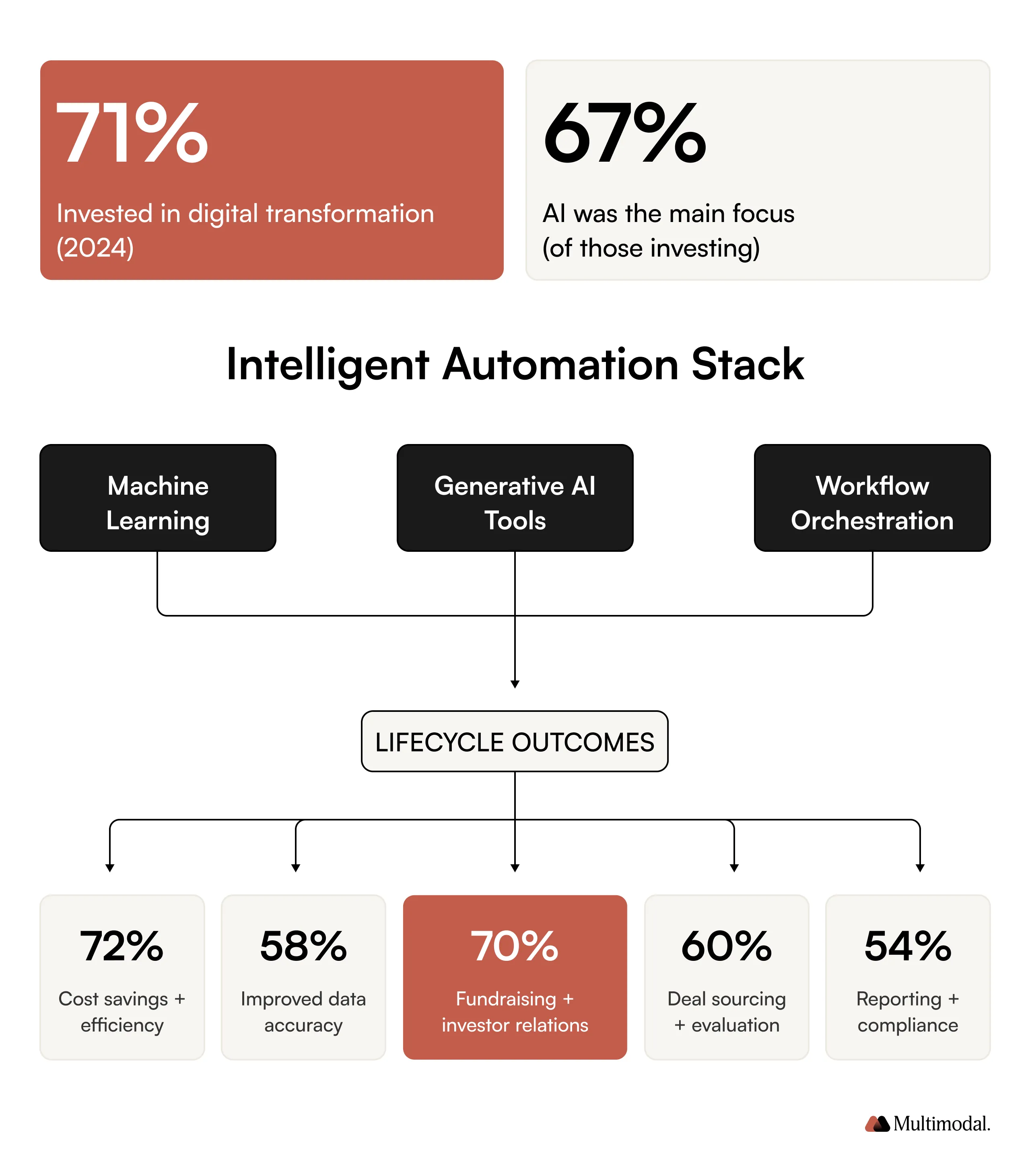
Of the PE firms actively investing in digital transformation, the concentration on artificial intelligence is pronounced. According to the PwC Private Equity Trend Report 2025, 71% invested in digitally transforming their firm or portfolio company business models in 2024, with AI the main focus for 67% of those that invested.
This reframes what automation solutions mean for the private equity industry. Automation is no longer limited to robotic process automation (RPA) handling repetitive clicks. Intelligent automation now blends machine learning, generative AI tools, and workflow orchestration, with the goal of improving decision-making across the full investment lifecycle, not just processing speed.
The firms building durable competitive advantage are anchoring each AI initiative to a specific stage: faster target qualification at deal sourcing, quicker extraction of unstructured data during due diligence, operational efficiency improvements inside portfolio companies during value creation, early risk management signals during portfolio monitoring, and clean audit trails at exit readiness.
4. AI Treated As an Operating Model, Not a Point Solution
PwC's analysis of how private equity firms are approaching AI transformation makes one thing clear: AI is not a point solution. It becomes the foundation of a new operating model for the management company.
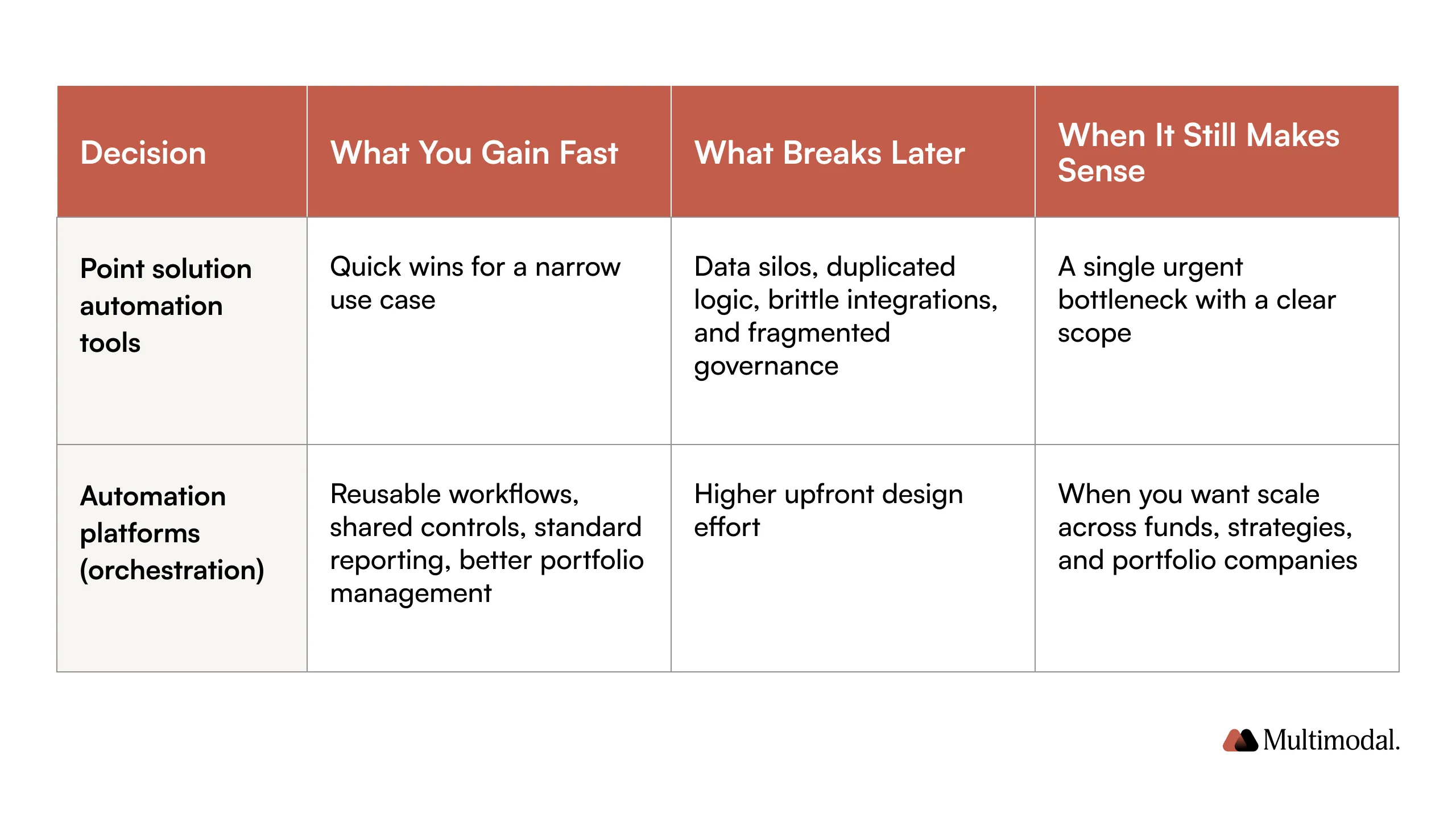
Buying a standalone bot for a single workflow produces local improvements but doesn't fix the system. A related perspective from Panamoure Consulting's intelligent automation report frames the opportunity: when AI capabilities are orchestrated across the value chain, intelligent automation becomes the foundation for an operating model that is more agile, scalable, and transparent, positioning firms to deliver superior outcomes for investors and portfolio companies alike.
This is where platforms matter, and it's why we've written about the difference between point solutions and orchestrated workflows before. For example, AgentFlow is designed specifically as an orchestration layer, connecting AI agents end-to-end, with workflow-building interfaces and hooks into existing systems, rather than replacing what works. The table below maps out the tradeoffs PE firms face when making this decision:
5. Digital Transformation Expected to Impact Risk Management the Most
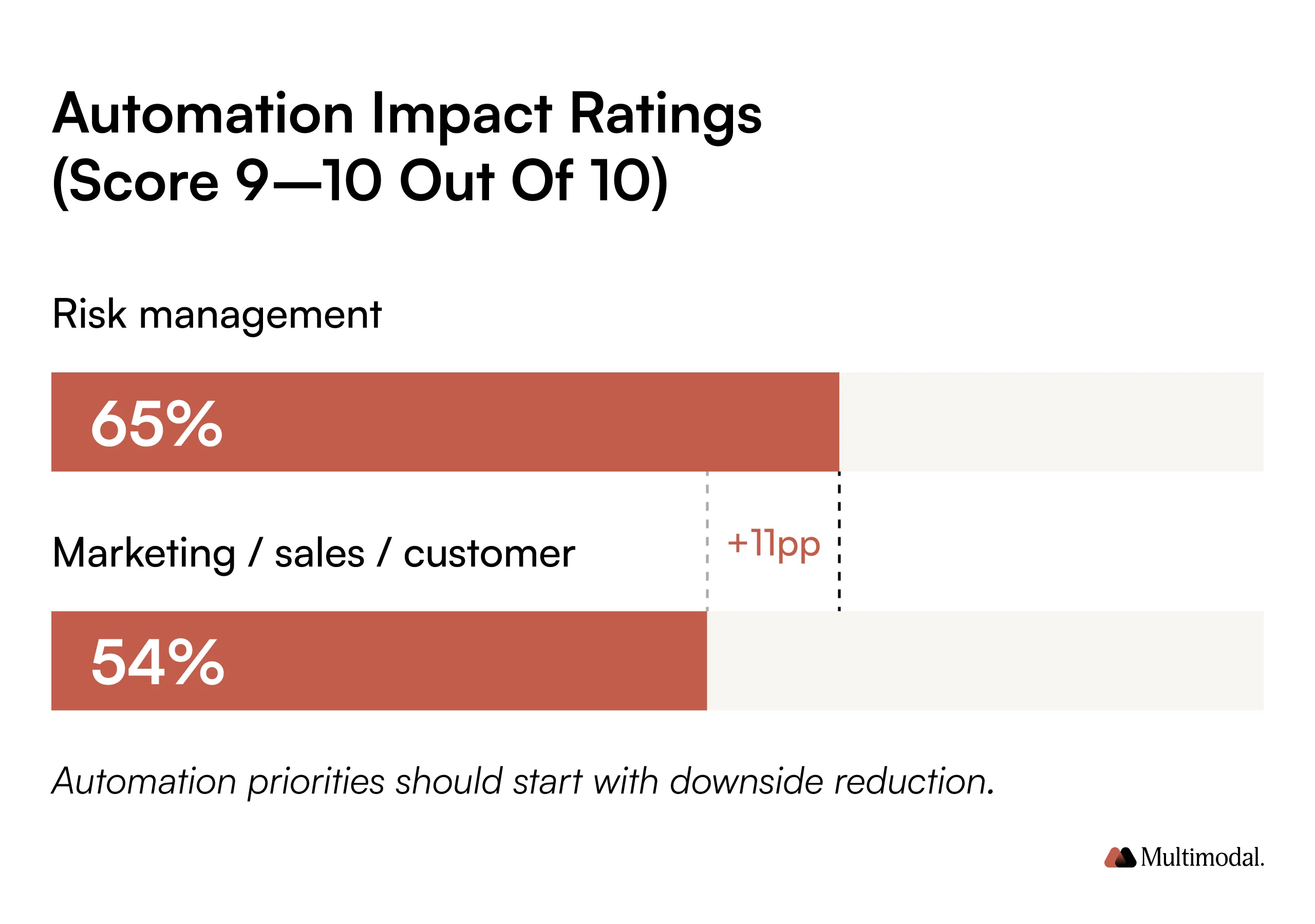
Risk management has moved to the center of PE's digital agenda. The PwC Private Equity Trend Report 2025 found that 65% of respondents gave risk management an impact rating of 9 or 10 out of 10 when asked where digital transformation would most affect their business model. Marketing, sales, and customer service came in second at 54%.
For private equity teams, this should redirect how automation priorities get set. The flashiest generative AI demos aren't the right starting point; workflows that reduce downside are.
Automated systems that detect variance in operational metrics across portfolio companies, flag anomalies in financial statements before board packs go out, track covenant thresholds and highlight drift early, and maintain traceable decision logs for sensitive investment decisions deliver exactly the kind of consistent, auditable controls that hold up to compliance review. Models that produce answers without sources quietly compound the risks teams are trying to manage.
6. Major Trends of Using Data Analytics and GenAI for Company Valuations
The same PwC report identifies a major trend in how PE firms approach valuations: 88% now use data analytics and/or generative AI tools for company valuations, and 80% expect to use them for due diligence, up from 65% in 2024.
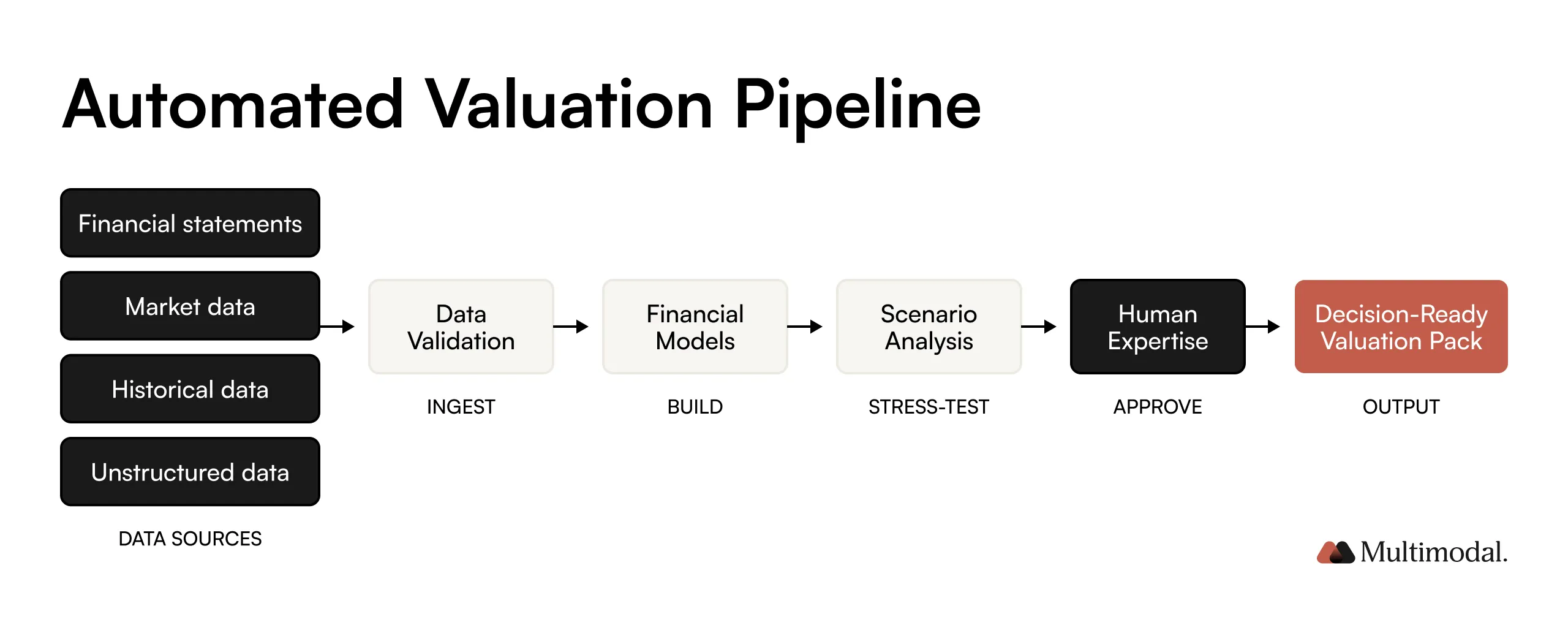
That shift matters because large data volumes are no longer an edge case; they're the norm. Firms winning on valuation work treat it as a data pipeline: automatically ingesting financial data and market data, normalizing and validating inputs, using machine learning models for pattern detection and scenario sensitivity, and keeping human expertise in the loop to validate assumptions and reconcile edge cases.
The teams still relying on spreadsheets and pure analyst judgment are operating with a narrower field of vision and slower cycle times than their data-driven competitors.
7. AI Is Used to Speed Up Deal Sourcing By 195x
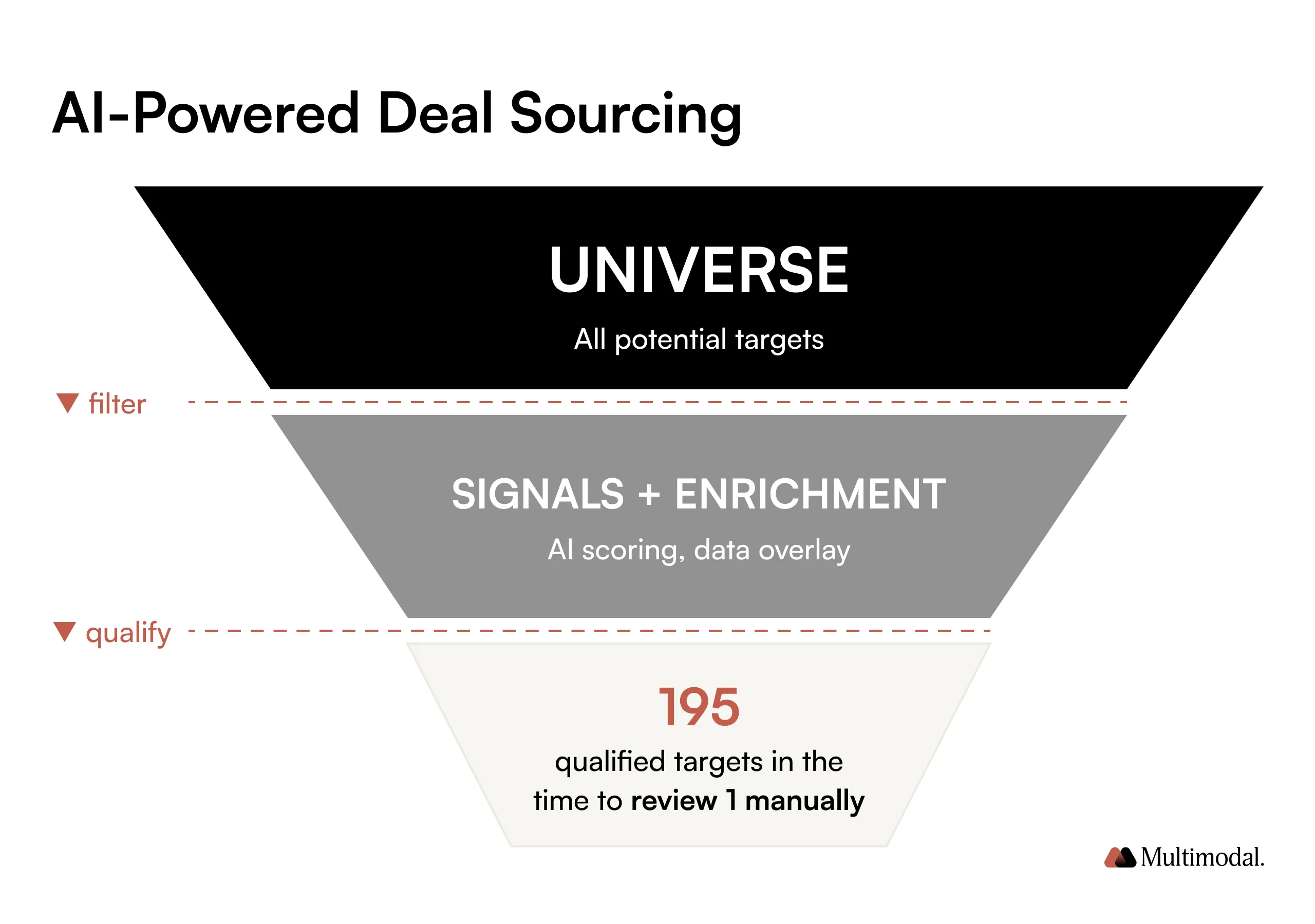
The speed advantage AI delivers in deal sourcing is among the most documented in recent research. According to the World Economic Forum, AI can identify 195 relevant companies in the time it would take a junior analyst to evaluate one. Firms like Blackstone and EQT are already investing in proprietary platforms that consolidate tens of thousands of data points for real-time M&A insights.
The goal is freeing investment teams to spend time on thesis fit, founder quality, and underwriting: automating routine tasks handles the list-building. A practical agentic workflow monitors signals across funding, hiring, product launches, and pricing changes; enriches targets with market data and comparable sets; and produces a sourced memo for the team to review. Our guide to AI-powered deal sourcing in private equity covers implementation best practices and how to keep these pipelines governed.
8. Automated Integration of ESG
AI's role in private equity isn't limited to operational efficiency and deal workflows. ESG integration, historically a backward-looking compliance exercise, is being transformed. As LPEA's analysis of AI in ESG integration highlights, AI enables not just efficient data collection but forward-looking insights that help firms identify sustainability risks and opportunities before they become material.
For PE firms managing global portfolio companies across different regulatory environments, this matters practically. Automating ESG data extraction from portfolio company reports, standardizing definitions for like-for-like comparisons, tying ESG signals to operational metrics, and feeding results into portfolio monitoring means ESG becomes part of how you run the asset, embedded in portfolio operations long before exit conversations begin. It also supports more credible investor reporting and stronger value creation narratives for buyers.
9. Only 16% Have Automated Legal Processes
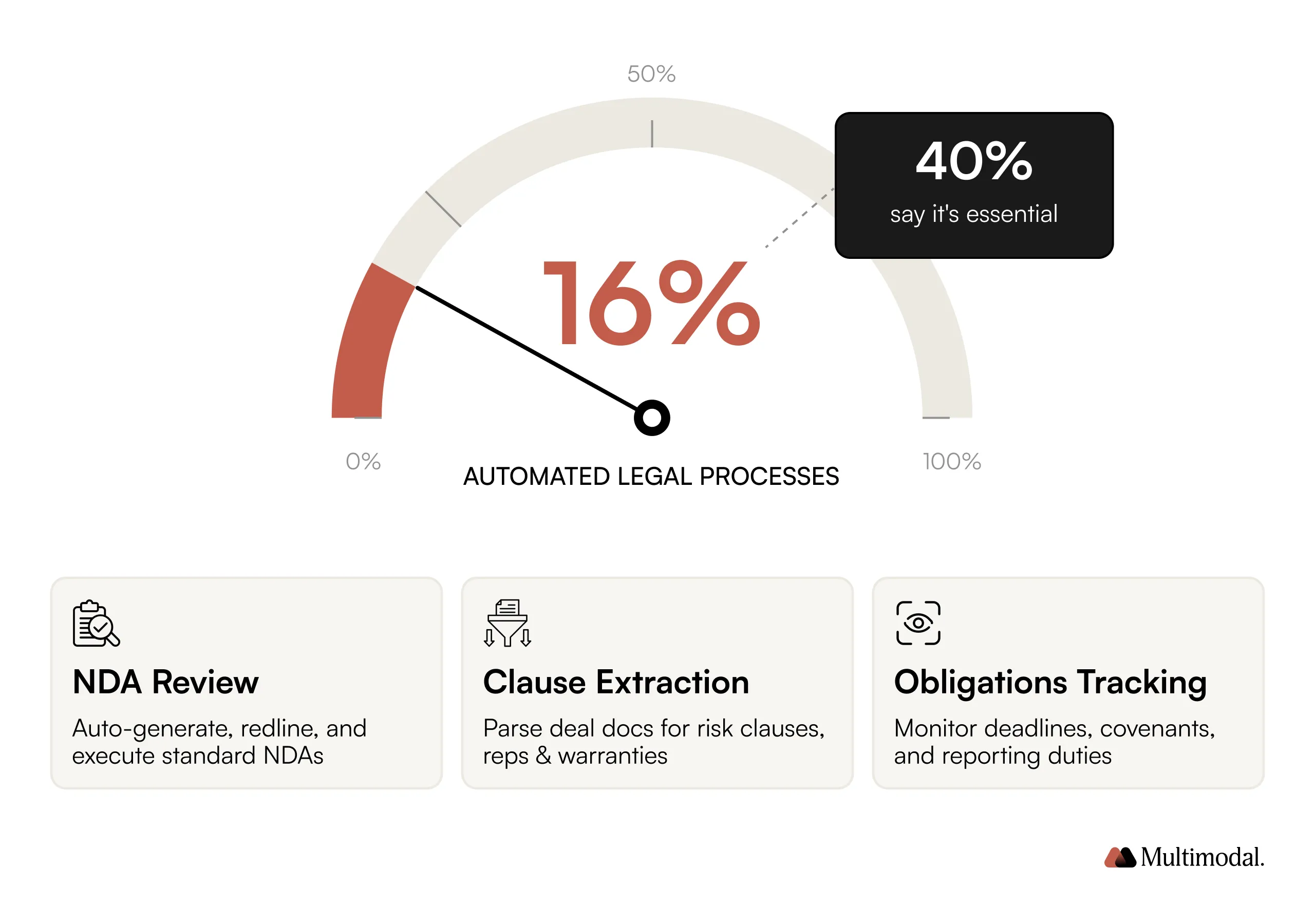
Despite broad momentum toward automation, legal workflows have remained largely untouched. Ontra's digital transformation research reports that while 40% of PE firms consider legal process automation essential for private markets, only 16% have actually adopted it.
That gap represents both significant vulnerability and significant opportunity, because legal work contains some of the most repeatable, high-volume steps in the investment process: NDA intake and tracking, side letter review, diligence checklist management, clause extraction and comparison, and obligations tracking post-close. Legal automation delivers real value when document extraction connects to downstream workflows, eliminating bottlenecks across the deal lifecycle, not just speeding up review cycles.
The goal isn't just faster review, it's removing bottlenecks across the deal lifecycle. Document AI approaches that parse and structure unstructured data from contracts, PDFs, and scanned exhibits, then feed outputs into workflow automation and reporting, are where the real efficiency lives. AgentFlow’s document processing capabilities are built for exactly this kind of end-to-end integration across the deal lifecycle.
Additional Insights From Our Team
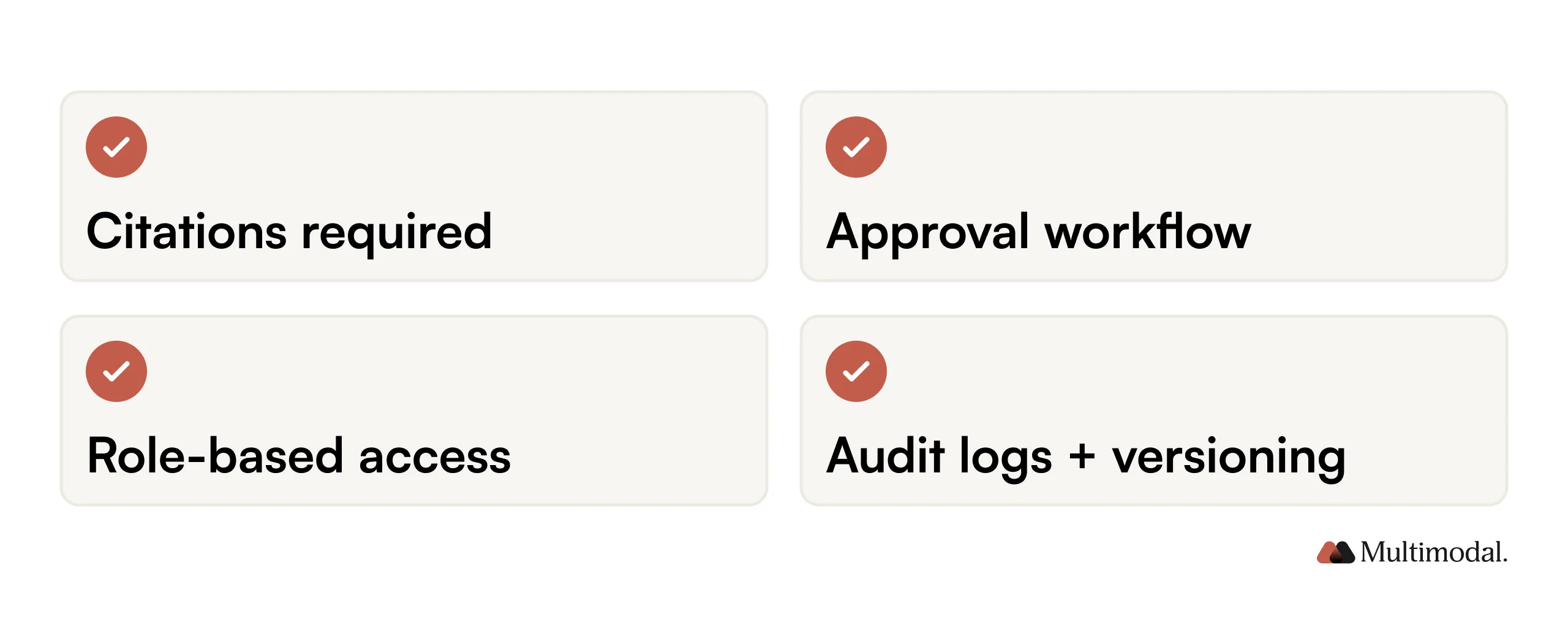
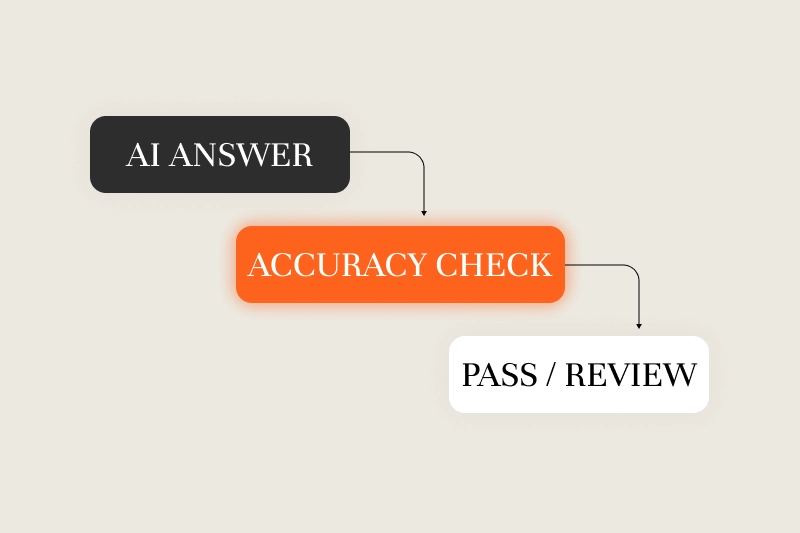
Build compliance and AI governance into the workflow from the start. PE firms need to care about AI governance because automation failures create audit headaches and reputational risk. Robust security measures and governance aren't features to add later; they're structural requirements. That means requiring citations for model outputs that influence investment decisions, logging inputs and human approvals for sensitive steps, using confidence scoring to route low-confidence work to human review, and enforcing role-based access controls to keep data within appropriate boundaries.
Prefer platforms for scale and future-proofing. If you automate one workflow today, you'll need ten tomorrow; that's how digital transformation actually unfolds across private equity operations. Picking tooling that supports multiple automated systems across investment and ops, orchestrates across existing systems, and provides central governance and monitoring is the difference between building a foundation and accumulating technical debt. AgentFlow is built as that orchestration layer for regulated environments where auditability matters.
Choose vendor partnerships that get you into production safely. Even PE firms with strong internal tech capabilities benefit from working with specialized providers. Most automation failures happen at deployment, integration, change management, governance, and measurement. Our AI Deployment Made Easy post lays out a partnership approach designed to move from prototype to production without stalling in demo-land.
Balance automation speed with decision quality. A useful warning from the field: for PE and VC teams, the risk isn't staying in pilot mode too long. The risk is pushing AI into production decisions before judgment, data quality, and governance are ready. What matters isn't how quickly AI is scaled across the organization, but whether it genuinely improves the quality of underwriting, diligence, valuation, and operating decisions, repeatedly and reliably. Gate AI by decision impact: automate data entry and report drafting at the low-risk end; keep humans as final approvers for underwriting assumptions and investment decisions at the high-risk end.
Where to Start in 30 Days
If you want private equity automation that creates real operational efficiency, pick one workflow from each bucket and measure the results:
Back-office painkiller: Automate data entry and reconciliation steps that drain team time. These produce quick wins with measurable hour savings.
Decision accelerator: Automate sourcing or diligence synthesis with sourced, auditable outputs. This is where speed-to-production becomes a competitive advantage.
Risk reducer: Automate exception detection in portfolio monitoring and reporting. This surfaces portfolio performance signals earlier and reduces human error in the process.
Measure time saved on routine tasks, error reduction, cycle time improvements in the investment process, and how much earlier you're surfacing portfolio monitoring signals.
Build a PE Operating Model That Runs on Automation
Next-gen private equity automation isn't about collecting automation tools. It's about building an operating model where intelligent automation supports the entire investment lifecycle, faster deal sourcing, tighter due diligence, better portfolio management, and investor reporting that holds up under scrutiny.
As LPs automate monitoring and market data keeps accelerating, private equity firms that orchestrate automation across workflows will gain the compounding edge: faster decision making, fewer manual processes, and more consistent value creation across portfolio companies. The question for PE leadership isn't whether to automate. It's whether you're moving fast enough, and whether you're building on the right foundation.
Automate The PE Lifecycle With Auditable AI
Move faster on sourcing, diligence, reporting, and risk monitoring—without sacrificing traceability, controls, or governance.
Ready to see what that looks like in your workflows? Book a demo, and we'll map the highest-ROI automation opportunities across your private equity operations.

.svg)
.svg)

.avif)
.png)