Agentic AI in Credit Unions: How Autonomous AI Agents Transform Lending, Fraud Prevention, and Member Service
Executive Summary
- Agentic AI agents work autonomously across lending, fraud, compliance, and member service.
- Credit unions report up to 70% faster loan processing and 20%+ higher approval rates.
- Real-time AI fraud detection helped PSCU avoid $35 million in losses.
- Approval thresholds and audit trails keep autonomous agents compliant.
- Smaller credit unions can now match the service scale of larger banks.
Agentic AI in credit unions refers to autonomous AI agents that plan and execute multi-step tasks across lending, fraud detection, compliance, and member service without waiting for human prompts at every step. Unlike chatbots that answer routine inquiries, agentic AI systems retrieve documents, verify borrower information, continuously monitor transactions, and escalate exceptions to staff. For credit union leaders, the technology automates labor-intensive operations while preserving the human relationships that set credit unions apart from larger institutions.
"Credit unions win on trust and relationships. Agentic AI protects both. When agents handle the document chasing, the compliance checks, and the 2 A.M. fraud alerts, your people get their time back for the conversations that actually grow the credit union."
Ankur PatelFounder & CEO, Multimodal
What Is Agentic AI in Credit Unions?
Agentic AI is a class of AI systems that can plan and execute multi-step tasks autonomously. Given a goal such as "process this loan application" or "investigate this flagged transaction," autonomous AI agents break the goal into steps, use tools and data systems to complete each one, and hand exceptions to a human for final decision-making.
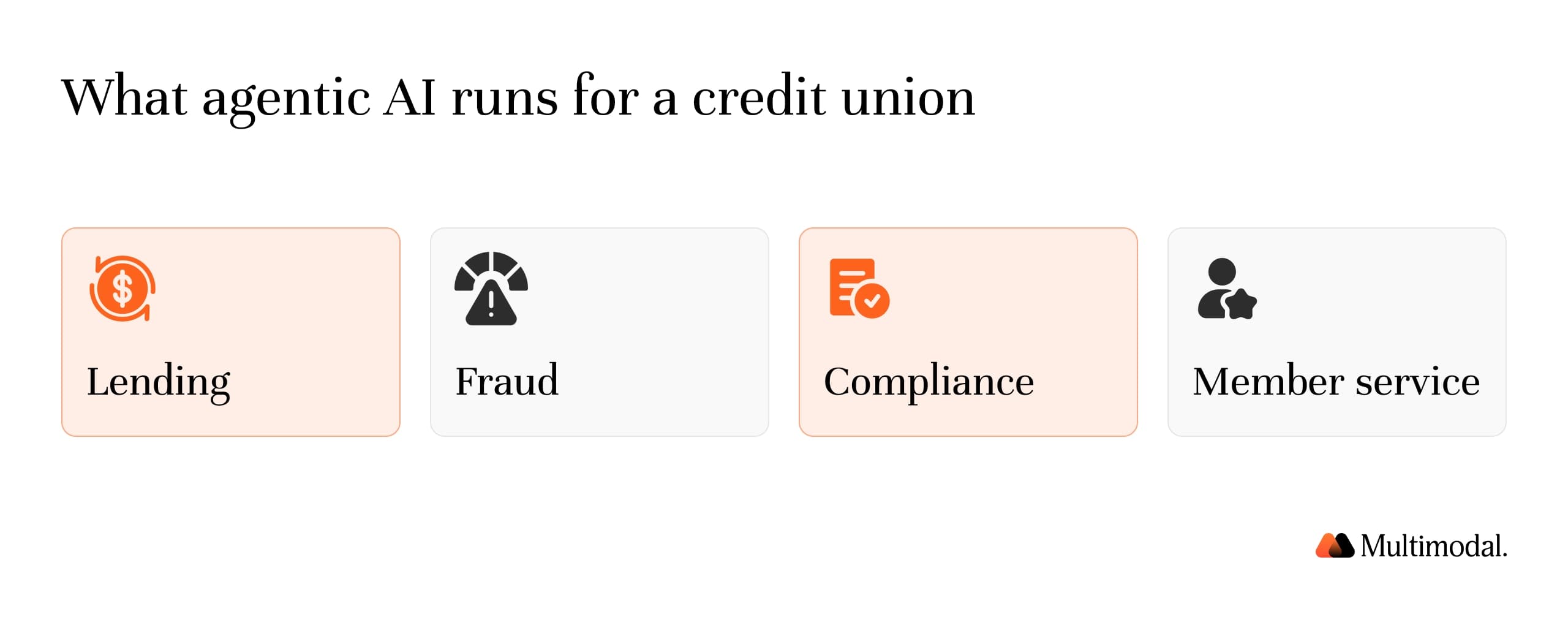
One platform covers the four core operations: lending, fraud, compliance, and member service.
This makes agentic AI fundamentally different from the AI tools most financial services organizations have already deployed. A chatbot answers routine inquiries. Robotic process automation follows a fixed script and breaks when a document arrives in the wrong format. Agentic AI adapts, reasons over documentation, and carries work forward across systems, which is why it can absorb the exceptions and manual reviews that legacy systems and older automation leave behind.
For credit unions and community banks, the timing matters. The always-on digital experience of the largest banks shapes member expectations. At the same time, most credit union teams are asked to deliver that experience with a fraction of the headcount. Agentic AI allows credit unions to automate labor-intensive tasks while maintaining the personalized service and human relationship their members joined for.
How Is Agentic AI Different From RPA and Chatbots?
The practical difference shows up in how each technology handles exceptions, the messy 20% of work where documents are incomplete, data conflicts, or a member's situation does not fit the script.
Capability | Chatbot | RPA | Agentic AI |
|---|---|---|---|
Scope | Routine inquiries, FAQs | Fixed, rule-based tasks | Multi-step workflows end-to-end |
Handles exceptions | No | No, breaks on variation | Yes, reasons through them or escalates |
Works across systems | Rarely | Limited, brittle integrations | Yes, orchestrates tools and data sources |
Improves decisions | No | No | Yes, surfaces actionable insights for staff |
Human role | Takes over when the bot fails | Fixes broken scripts | Reviews flagged exceptions and makes final credit decisions |
Multimodal's 2026 Field Report, drawn from 445 sales conversations with financial institutions, found that 97% of incoming loan packets arrive incomplete, and that RPA consistently fails on the last 20% of a workflow, exactly where exceptions live. That last 20% is what agentic AI was built for.
What Are the Top Agentic AI Use Cases for Credit Unions?
Across the industry, four use cases account for most early value: lending, fraud, compliance, and member service. Each targets a different operational challenge, and together they compound.
Loan Processing and Lending Automation
AI agents assist throughout the lending lifecycle by automating document retrieval, verifying borrower information, running loan-eligibility checks, and analyzing creditworthiness before an underwriter ever opens the file. The result is closer to straight-through processing: clean applications move automatically, and human underwriters focus on the exceptions that genuinely need judgment.
The measurable impact on loan processing is significant. Agentic AI can increase loan processing efficiency by up to 70%, automate 30-50% of lending workflows, and boost automated credit approvals by around 20% or more in some reported deployments, reducing manual effort while increasing underwriting capacity. For members, that means credit decisions in minutes instead of days, with no more waiting on a slow approval process for straightforward loans.
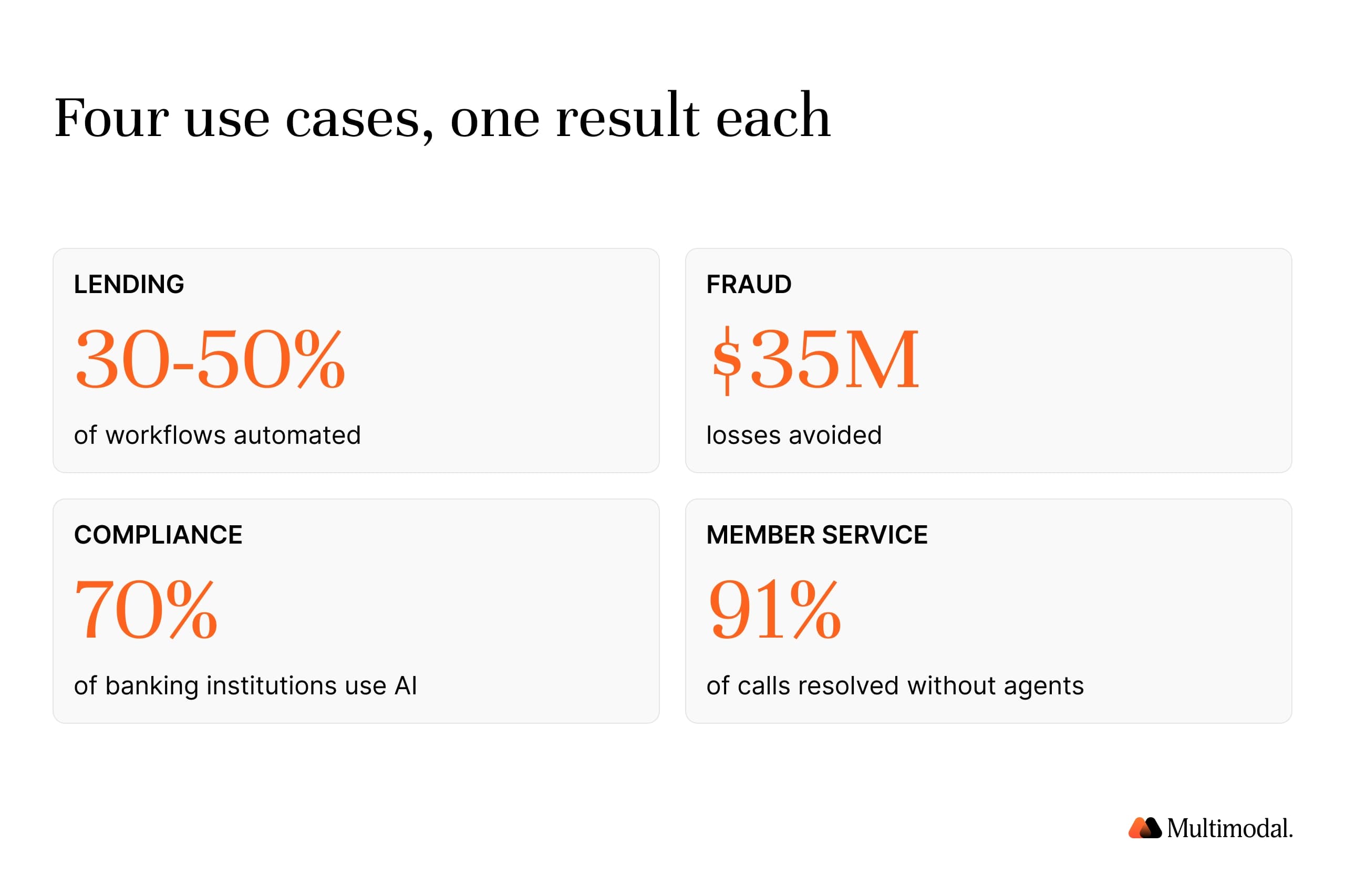
Every core workflow has a measurable outcome.
Fraud Detection and Prevention
AI agents continuously monitor transactions in real time, analyze large volumes of data quickly, flag anomalies, and proactively identify and escalate potential fraud cases. Instead of a nightly batch review, fraud prevention becomes an always-on function.
Regulatory Compliance and Risk Assessment
Agents automate compliance checks, maintain detailed audit trails, and flag transaction anomalies before they become compliance failures. AI also enhances risk assessment by analyzing diverse data points that manual reviews cannot cover at scale. Industry data indicates roughly 70% of banking institutions already leverage AI for compliance and risk management.
Member Service and Engagement
Agentic AI enables 24/7 autonomous support, resolving routine inquiries instantly and handing complex conversations to staff with full context. Florida Credit Union resolved 91% of phone calls without human agents. Agents can also analyze financial behavior to offer personalized advice, turning member service from reactive support into personalized member engagement.
How Can Credit Unions Use Agentic AI for Fraud Prevention?
Fraud is where autonomy pays off fastest, because speed is the whole game. An agentic fraud workflow runs in four steps: the system continuously monitors transactions, flags anomalies relative to each member's normal behavior, opens and conducts the preliminary investigation (pulling account history, verifying documentation, checking related accounts), and either resolves the clear-cut case or escalates it with a complete evidence file.
The approach reshapes both loss prevention and member trust. AI-enabled detection helped PSCU avoid $35 million in fraud losses, and Suncoast Credit Union prevented more than $800,000 in fraud within six months of deployment. Just as important, members get instant service on fraud resolution, including provisional credit in hours rather than days, at exactly the moment their trust in the institution is being tested.
What Results Are Credit Unions Seeing From Agentic AI?
Adoption is no longer theoretical. Recent banking research finds that 17% of credit unions have invested in or deployed agentic AI, compared with 7% of banks, and the AI agents market in financial services is projected to grow from $1.79 billion in 2025 to $6.54 billion by 2035. The reality on the ground:
Outcome | Result |
|---|---|
Fraud losses avoided | $35 million |
Fraud prevented in the first 6 months | $800,000+ |
Manual clicks eliminated | 8 million, reclaiming 13,000+ staff days |
Phone calls resolved without human agents | 91% |
Loan processing capacity | +50-70% |
Automated credit approvals | +20% or more |
Lending workflows automated | 30-50% |
Incoming loan packets that arrive incomplete | 97% |
Eliminating 8 million manual clicks is an operational efficiency story and an employee engagement story: staff freed from repetitive tasks report higher satisfaction and spend more time on complex decision-making and member relationships.
Is Agentic AI Compliant With Credit Union Regulatory Requirements?
Yes, when it is governed properly. Autonomous does not mean unsupervised. Well-designed agentic AI systems operate under clear approval thresholds, keep a human in the loop on credit decisions, and maintain comprehensive audit trails that record what the agent did, what data it used, and why.
Handled this way, agentic AI strengthens the compliance posture rather than threatening it. Agents enhance accuracy in compliance and fraud processing by minimizing human error, and detailed audit trails improve examination preparation because every action is documented by default. Credit union leaders should still anchor governance in regulatory requirements around fair lending, explainability, data security, and model risk, with the NCUA's AI resources and Filene's agentic AI research as reference points.
Implementation requires a clear strategy and a focus on data quality. Agents are only as reliable as the data and integrations underneath them, which is why integrating AI with core systems matters more than any individual model choice.
How Do Credit Unions Get Started With Agentic AI?
The pattern among successful adopters is consistent: start narrow, prove value, expand.
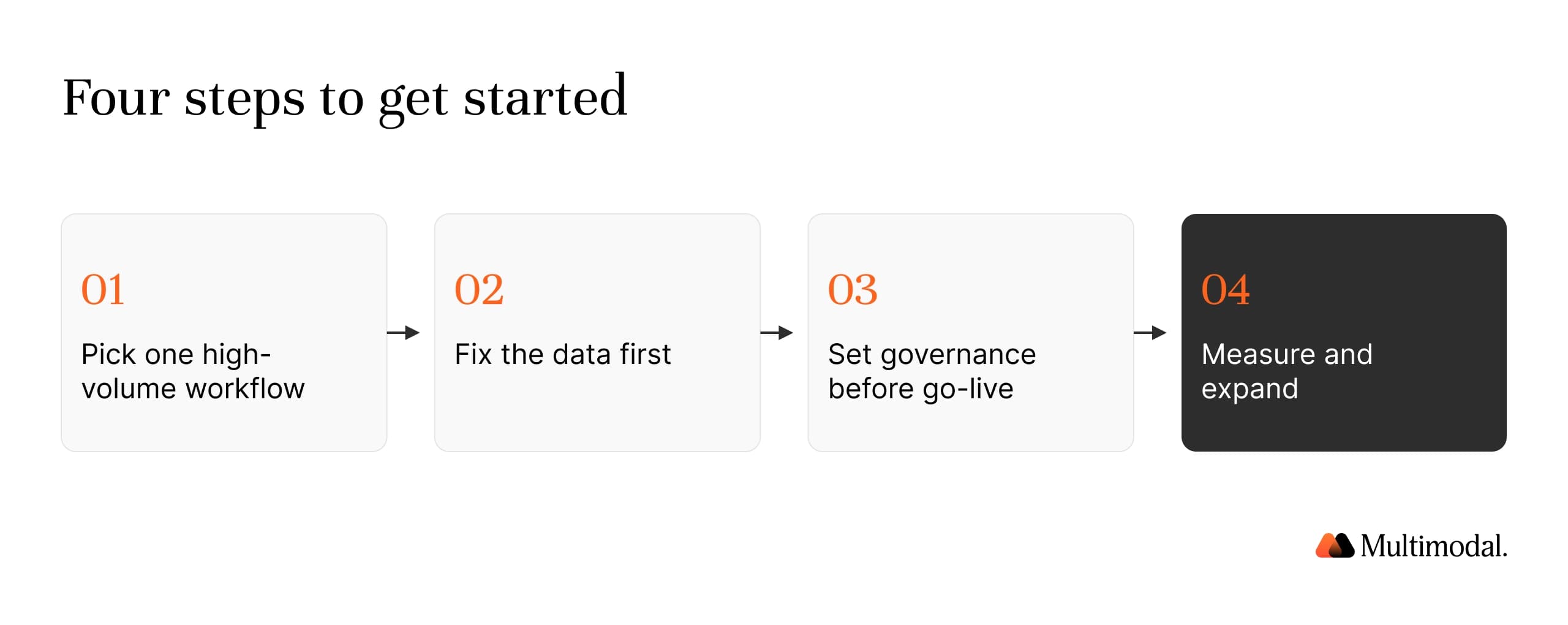
Start narrow, prove value, expand.
1. Pick one high-volume workflow
Loan processing, fraud triage, or contact center inquiries. Mature use cases with measurable baselines make the strongest first projects.
2. Fix the data first
Clean member data, document standards, and core system access determine how far agents can go.
3. Set governance before go-live
Approval thresholds, escalation rules, audit trails, and fair-lending review are design inputs on day one.
4. Measure and expand
Track processing time, exception rates, and member satisfaction, then extend agents to adjacent workflows.
This is also the equalizer for smaller institutions. Agentic AI enables smaller credit unions and community banks to offer service at a scale comparable to larger banks: 24/7 support, minutes-long loan decisions, and real-time fraud protection, without a larger bank's headcount. In a market where competition for members' loans and deposits continues to intensify, that capability defines the future of the credit union's operating model. Related reading: AgentFlow, agentic lending, and our AI for credit unions hub.
Frequently Asked Questions
What is agentic AI in credit unions?
Agentic AI in credit unions is autonomous AI software that plans and executes multi-step tasks such as loan processing, fraud investigation, compliance checks, and member service. Agents work across systems, handle exceptions, and escalate to humans, going beyond what chatbots or RPA can do.
How is agentic AI different from RPA in a credit union?
RPA follows fixed scripts and breaks when inputs vary, which is why it fails on the last 20% of most workflows. Agentic AI reasons through variations, retrieves missing documentation, verifies data, and completes multi-step workflows end-to-end, escalating only genuine exceptions.
How much can agentic AI improve loan processing?
Deployment data shows agentic AI can increase loan processing efficiency and capacity by 50-70%, automate 30-50% of lending workflows, and increase automated credit approvals by more than 20%, reducing manual reviews while keeping underwriters in control of final credit decisions.
Can agentic AI help credit unions with fraud detection?
Yes. AI agents continuously monitor transactions, analyze large volumes of data in real time, flag anomalies, and escalate potential fraud with a complete evidence file. AI-enabled detection helped PSCU avoid $35 million in fraud losses.
Is agentic AI safe for member data and regulatory compliance?
When governed properly, yes. Agents operate under defined approval thresholds, with comprehensive audit trails that record every action and data source. This supports fair lending, explainability, and data security requirements and improves audit preparation for examinations.
Will agentic AI replace credit union employees?
No. Agents automate routine, high-volume back-office tasks so employees can focus on complex decision-making and member relationships. Institutions like Teachers FCU used automation to reclaim more than 13,000 staff days for higher-value work.
Can small credit unions afford agentic AI?
Yes. Platform-based deployment removes the need to build in-house AI teams, and the economics scale down. Agentic AI enables smaller credit unions to offer 24/7 service, fast credit decisions, and real-time fraud protection comparable to those of larger banks.
What use case should a credit union start with?
Start with one mature, high-volume workflow with a measurable baseline: loan processing, fraud triage, or contact center automation. Prove the result, then expand to adjacent workflows on the same platform.
See what Multimodal does with your actual documents
Book a 30-minute proof-of-concept. We'll configure a playbook for your workflow, run your actual documents live, and show you production-ready output, not a slide deck.