Compare the best multi-agent AI frameworks in 2026, including LangGraph, CrewAI, Microsoft Agent Framework, and AgentFlow for regulated financial services.
Multi-agent systems split large jobs across specialized agents that run in parallel and recover if one agent fails.
Framework choice depends on project complexity, ecosystem, and deployment environment.
LangGraph leads in durable execution and explicit orchestration; CrewAI leads in fast, role-based collaboration.
AutoGen and Semantic Kernel now reside within the Microsoft Agent Framework, which reached version 1.0 in April 2026.
For compliance-heavy financial workflows, auditability and human oversight matter more than raw autonomy.
Get 1% smarter about AI in financial services every week.
Receive weekly micro lessons on agentic AI, our company updates, and tips from our team right in your inbox. Unsubscribe anytime.
Thank you! Your submission has been received!
Oops! Something went wrong while submitting the form.
The best multi-agent AI frameworks in 2026 are LangGraph, CrewAI, the Microsoft Agent Framework, the OpenAI Agents SDK, Google's Agent Development Kit, LlamaIndex Workflows, MetaGPT, and AgentFlow for regulated financial services. A multi-agent AI framework is software that lets multiple AI agents coordinate, share context, and solve complex problems that a single agent cannot handle alone.
Each framework fits a different job. Some prioritize explicit control and state management, others make natural language agent creation fast, and a few focus on production environments where auditability matters.
This guide compares the leading agent frameworks by architecture, key features, and financial-services fit, so enterprise teams can match the right tool to the right work.
What is a multi-agent AI framework?
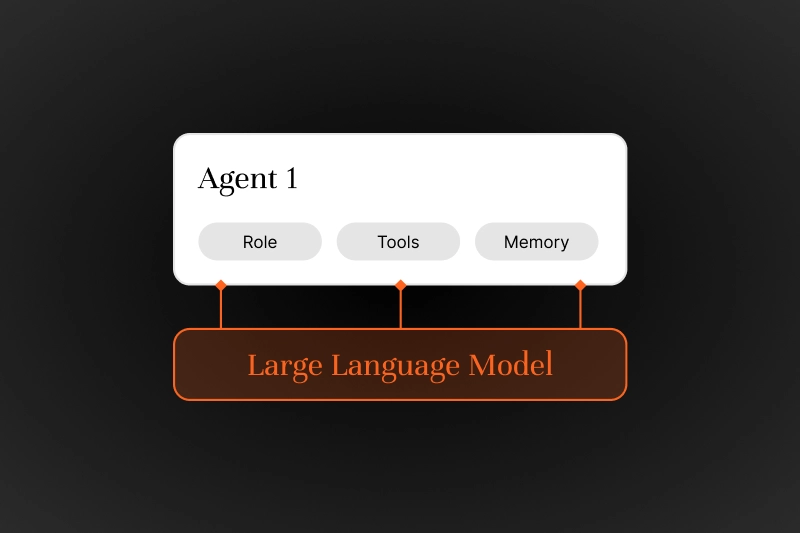
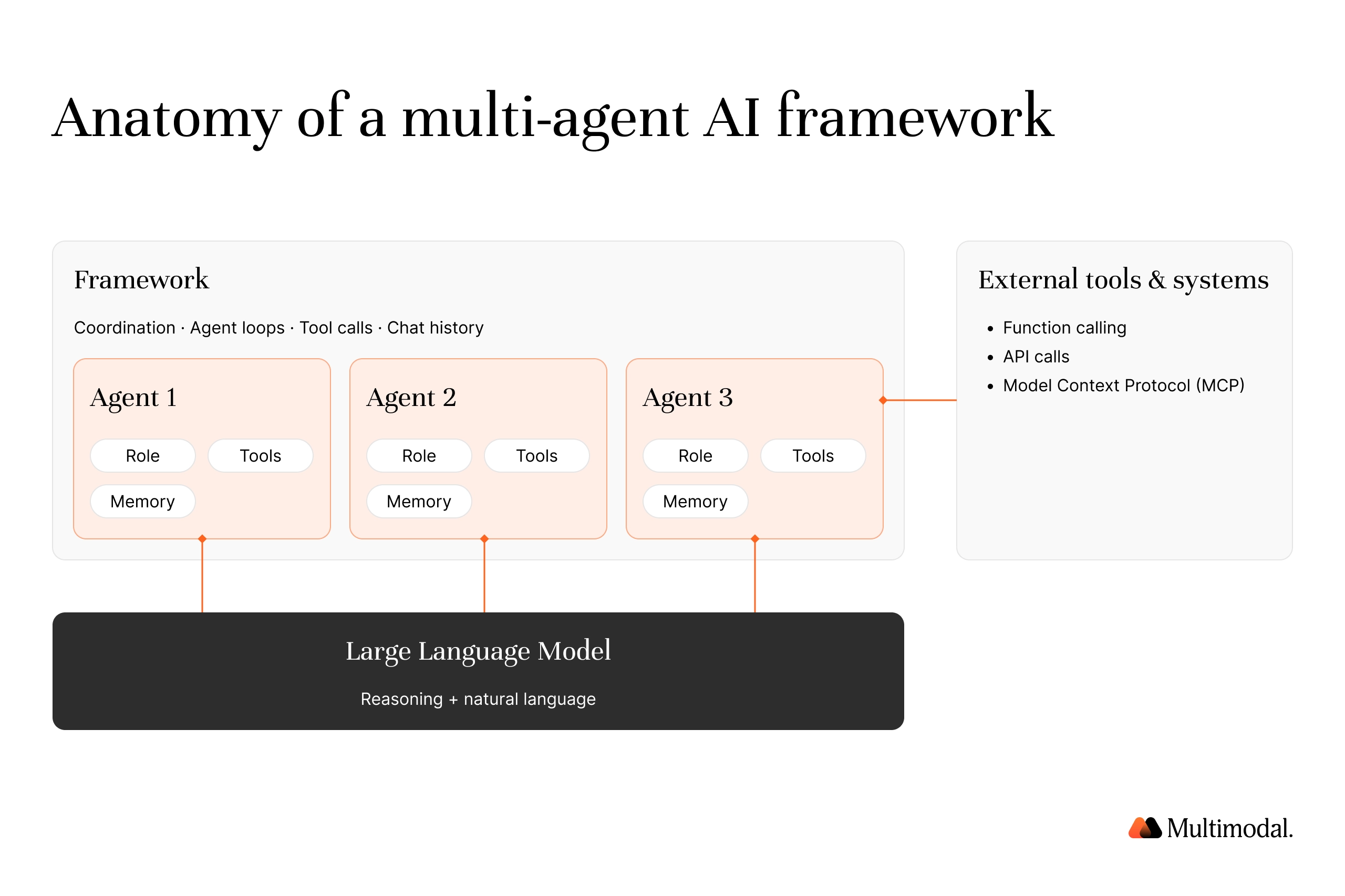
A multi-agent AI framework is a system for building systems in which several agents work together toward a shared goal. Each agent is an AI agent with its own role, tools, and memory. Instead of one agent handling every step, multiple agents divide the work, exchange messages, and combine results to solve complex tasks.
These frameworks supply the core components teams need: agent logic, agent data, tool integration, memory management, and coordination between agents. They connect agents to external tools and external systems through function calling, API calls, and the Model Context Protocol, so agents can read data, call other software, and take agent actions.
Most agent frameworks build on large language models. The LLM handles reasoning and natural language, while the framework manages agent behaviors, agent loops, tool calls, and the chat history that lets agents collaborate. Some frameworks also support natural language agent creation, so teams can define agents in plain language and let the framework scaffold them.
Single agent vs multi-agent systems
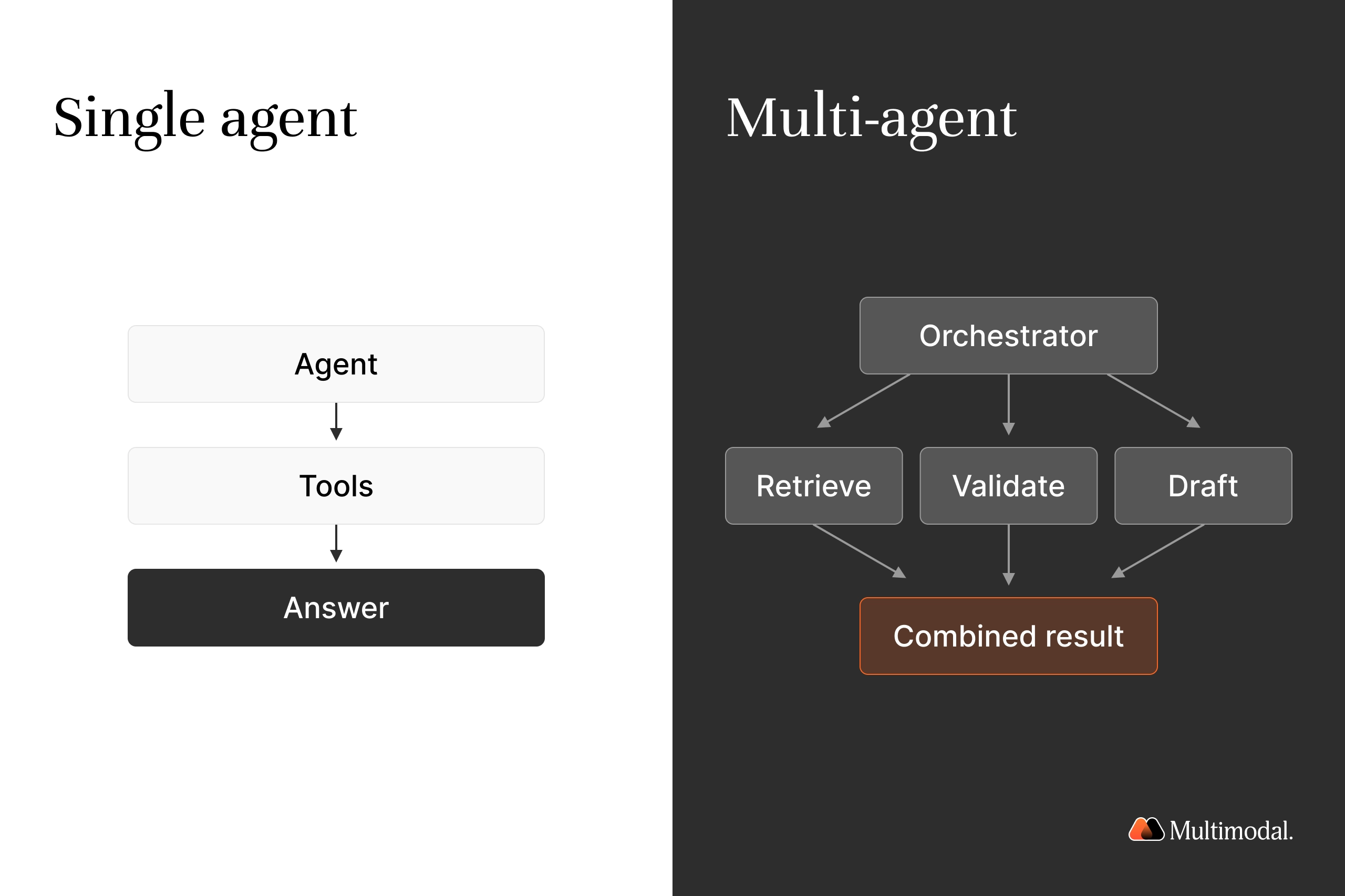
Single-agent systems use one agent to interpret a request, call tools, and return an answer. They work well for narrow, specific tasks such as answering questions from a knowledge base or writing code from a clear prompt. Simple AI agents of this kind are quick to build and easy to reason about.
Multi-agent systems assign work to specialized agents, each responsible for a part of the problem. One agent might retrieve documents, a different agent validates data, and another drafts a report. This division helps with complex workflows that involve many steps, multiple systems, and several agents working at once.
Both single-agent and multi-agent setups have a place. Start with one agent when the task is contained. Move to multi-agent patterns when the work needs parallelism, different skills, or independent agents that teams can test and scale on their own. Multi-agent applications now appear across industries, from supply chain management to defense systems, and in everyday flows, such as guiding a consumer through a purchase.
Why do multi-agent systems matter?
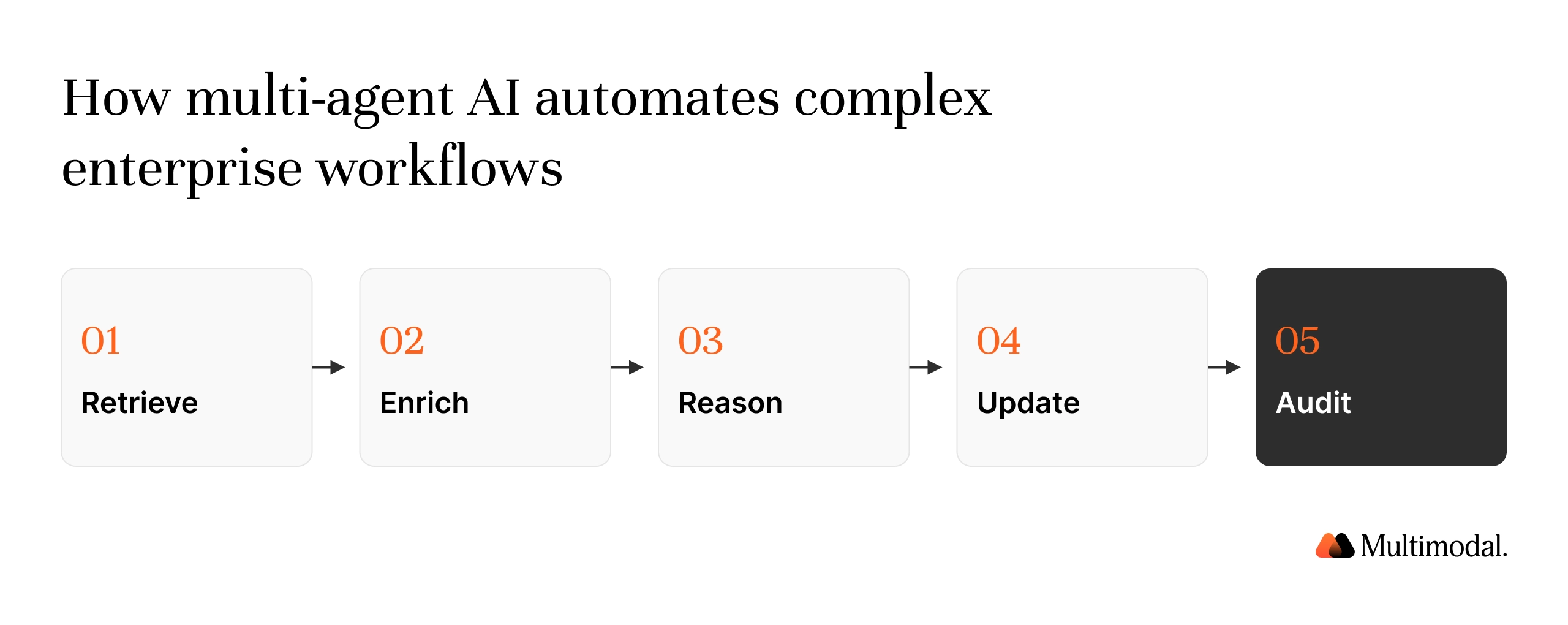
Modern enterprise work rarely fits into a single prompt. A single request can require retrieving data, enriching it with external data, reasoning over the content, updating databases, and auditing the results. Multi-agent workflows enable agent-based systems to handle this by splitting the job among agents that work concurrently.
The benefits are practical:
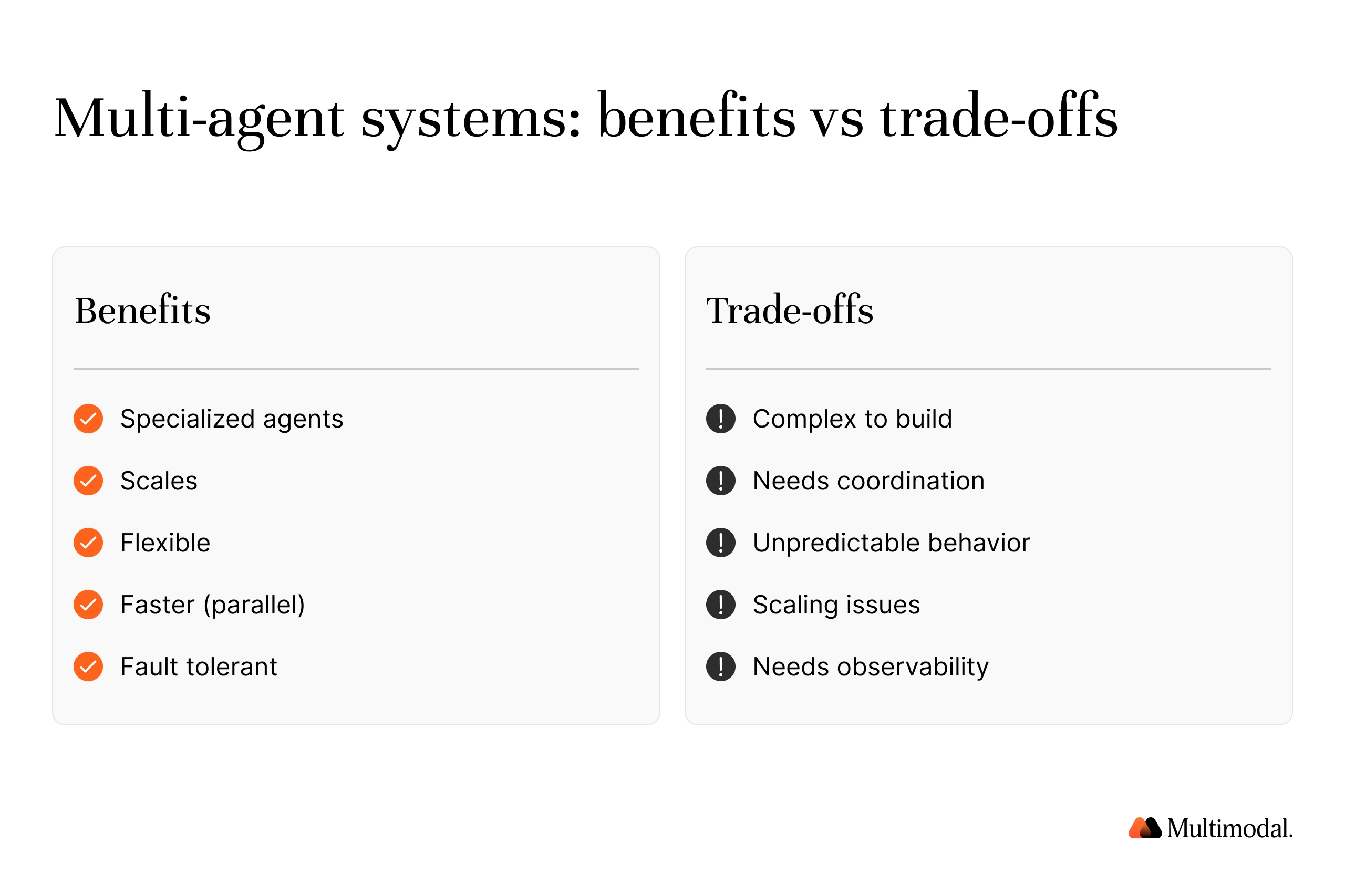
Specialized agents improve problem-solving because each agent focuses on what it does best.
The design scales, so teams add more agents without a loss in performance on the wider task.
Systems stay flexible and adapt to new information as it arrives.
Parallelizing tasks among several agents produces faster solutions.
Fault tolerance improves. If one agent fails, other agents can continue functioning, which keeps the system reliable.
The trade-offs need planning:
Multi-agent systems can be complex to design and implement.
They require robust coordination mechanisms and clear communication protocols for agent interaction.
Agent behavior can be unpredictable across multiple systems.
Scalability issues can arise as the number of agents grows.
Observability and resilience become important as systems grow, so teams need logging, tracing, and human-in-the-loop review.
The best multi-agent AI frameworks in 2026
Here are the frameworks worth evaluating, with what each does best and where it fits.
1. AgentFlow: Best for Financial Services
AgentFlow is an agentic AI platform built for the needs of financial services: credit unions, corporate banking, and private equity. It supports agent orchestration, knowledge search, agent-based decision-making, and creating new agents under human supervision, while connecting to third-party data systems from one middleware layer.
Its enterprise appeal comes from audit trails that record every agent action in chronological order, confidence scoring that flags uncertain outputs for review, and built-in explainability so stakeholders can trace how agents reach conclusions. AgentFlow offers white-glove and DIY configuration paths and keeps a human in the loop for sensitive decisions.
2. LangGraph: Best for Stateful, Auditable Orchestration
LangGraph is the orchestration layer of the LangChain stack and reached 1.0 general availability in October 2025. It models workflows as a graph where every transition is explicit, which gives teams precise control over how agents move through a task.
Durable execution and checkpointing are major differentiators. LangGraph can pause, persist state, and resume, which supports long-running multi-agent orchestration, human approvals, and recovery after failures. It suits complex workflows that need explicit control and careful state management.
3. CrewAI: Best for Role-based Collaboration
CrewAI is an orchestration framework for multi-agent AI solutions. You assign each agent a role, and the crew coordinates role-based execution across multi-step tasks. It supports connections to various large language models and to external tools, and it pairs role-based Crews with event-driven Flows for more explicit control.
CrewAI is a strong choice for enterprise teams that want fast multi-agent collaboration and a short path from an idea to a working system.
4. Microsoft Agent Framework: Best for the Microsoft Stack
The Microsoft Agent Framework unifies two earlier projects, AutoGen and Semantic Kernel, and reached 1.0 general availability in April 2026. AutoGen is an open-source framework for multi-agent AI applications that enables multiple agents to chat autonomously, and its Studio provides a low-code interface for developing agents. Semantic Kernel provides core abstractions for creating agents and connecting them to external systems.
Both now sit inside one framework with graph-based workflows and enterprise guardrails, which gives Microsoft-stack teams a single supported path. AutoGen and Semantic Kernel continue in maintenance mode, with migration guides pointing to the new framework.
5. OpenAI Agents SDK: Best for OpenAI-centered Teams
The OpenAI Agents SDK is OpenAI's production framework for building agents, and it succeeded the experimental Swarm project. It offers a light set of primitives: agents, handoffs to other agents, guardrails, and tracing for observability.
The SDK keeps abstractions minimal, so teams that already build on OpenAI models can define agents, connect custom tools, and ship with little overhead.
6. Google Agent Development Kit (ADK): Best for Google Cloud Teams
Google’s Agent Development Kit is an open-source AI agent framework that supports hierarchical agents, the Model Context Protocol, and agent-to-agent communication. It deploys to Vertex AI and works across several languages.
ADK fits teams building on Google Cloud that want multimodal agents and managed deployment for production environments.
7. LlamaIndex Workflows: Best for Document-grounded Pipelines
LlamaIndex offers Workflows for developing multi-agent systems as event-driven steps. It enables asynchronous workflow steps for dynamic applications, and its AgentWorkflow layer coordinates handoffs between different agents.
Because LlamaIndex began as a data framework for retrieval, it suits document-centric and retrieval-grounded pipelines where agents read, search, and summarize large document sets.
8. MetaGPT: Best for AI Software Development
MetaGPT treats agent orchestration like a software team. Given a natural language task, it assigns roles such as product manager, developer, and QA, then runs a structured multi-agent workflow to plan, write code, and review it.
MetaGPT is better suited to code-centric and application-development use cases than to highly domain-specific workflows such as loan-file processing or private equity due diligence. Its repository is now maintained under the FoundationAgents organization.
Also worth knowing: Haystack Agents from deepset for search-heavy workflows, Amazon Bedrock AgentCore with the Strands Agents SDK for AWS-native deployment, the Claude Agent SDK for tool-use-first builds, and AG2, a community fork that continues the original AutoGen model.
Multi-agent AI framework comparison
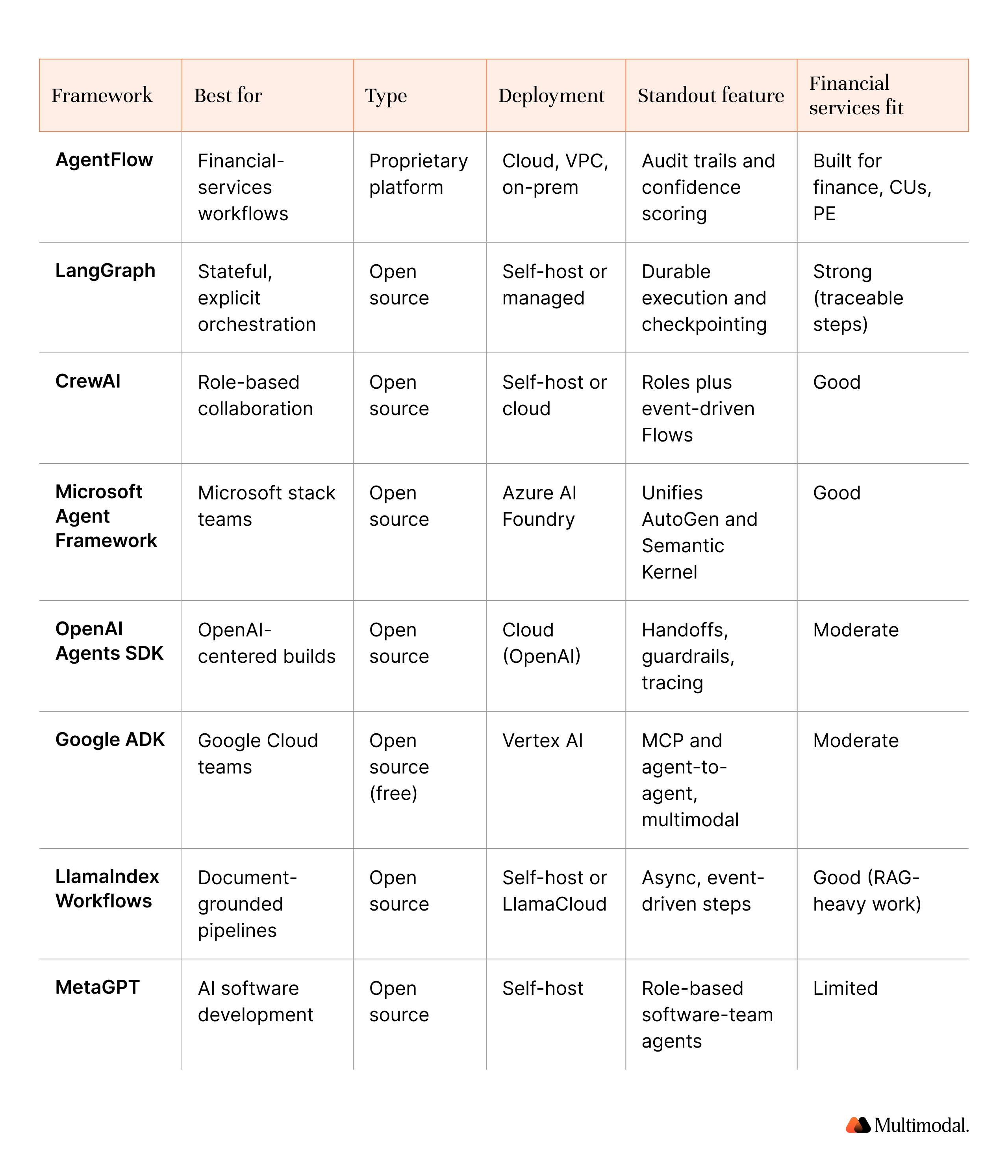
The table below compares the leading frameworks by type, deployment, standout feature, and fit for financial-services work.
How do you choose and implement a multi-agent AI framework?
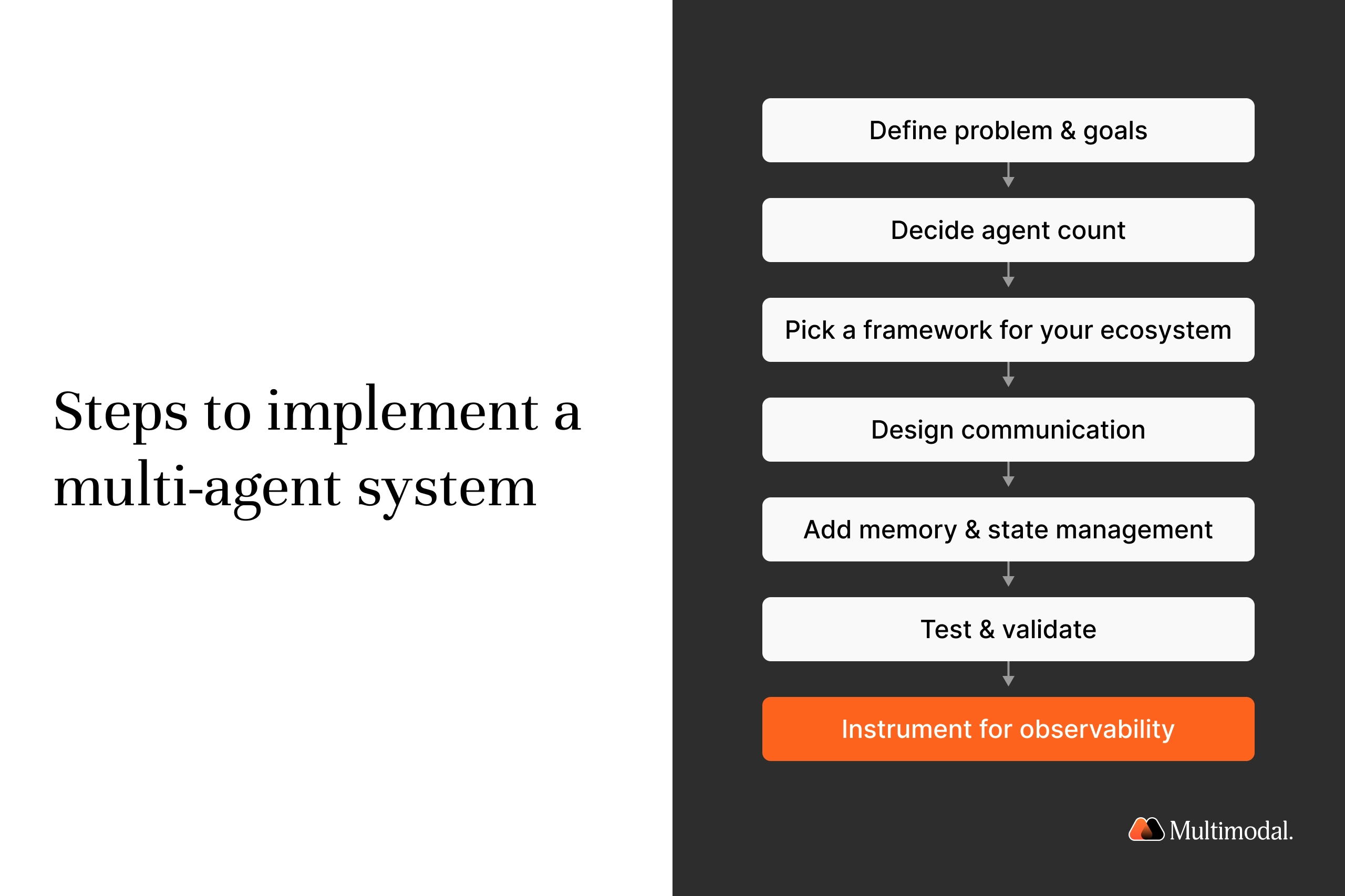
Choosing a multi-agent framework depends on project complexity and deployment environment. A prototype on a laptop has different needs from a governed system that runs in production environments. A simple, repeatable sequence keeps projects on track:
Define the problem and goals before implementing a multi-agent system. Map the tasks, data, and decisions that a human must approve.
Decide how many agents you need. Some jobs need one agent; others need several agents with distinct roles.
Pick a framework for building agents that matches your ecosystem. Use frameworks such as CrewAI or the Microsoft Agent Framework (formerly AutoGen) for general multi-agent applications, LangGraph for explicit control, or a governed platform for regulated work.
Design communication. Multi-agent systems require robust communication protocols for agent interaction, as well as custom tools and function calls to access external systems.
Add memory management and state management so agents keep chat history and context across steps.
Test and validate. Testing and validation are crucial for ensuring agent performance and collaboration before you scale.
Instrument for observability. Add tracing and human-in-the-loop review so teams can monitor agent behavior once autonomous agents enter production.
How do multi-agent systems work in financial services?
Financial institutions run the kind of multi-step work multi-agent systems handle well: intake documents, verify data across sources, check completeness, and produce an auditable result. Loan-file processing, KYC and AML case handling, underwriting support, and private equity due diligence all follow this pattern.
Multi-agent architectures also support compliance. Because each step traces to a specific agent, teams can show how a decision was reached, which helps with audits and oversight. A single black-box model makes it harder to produce that record.
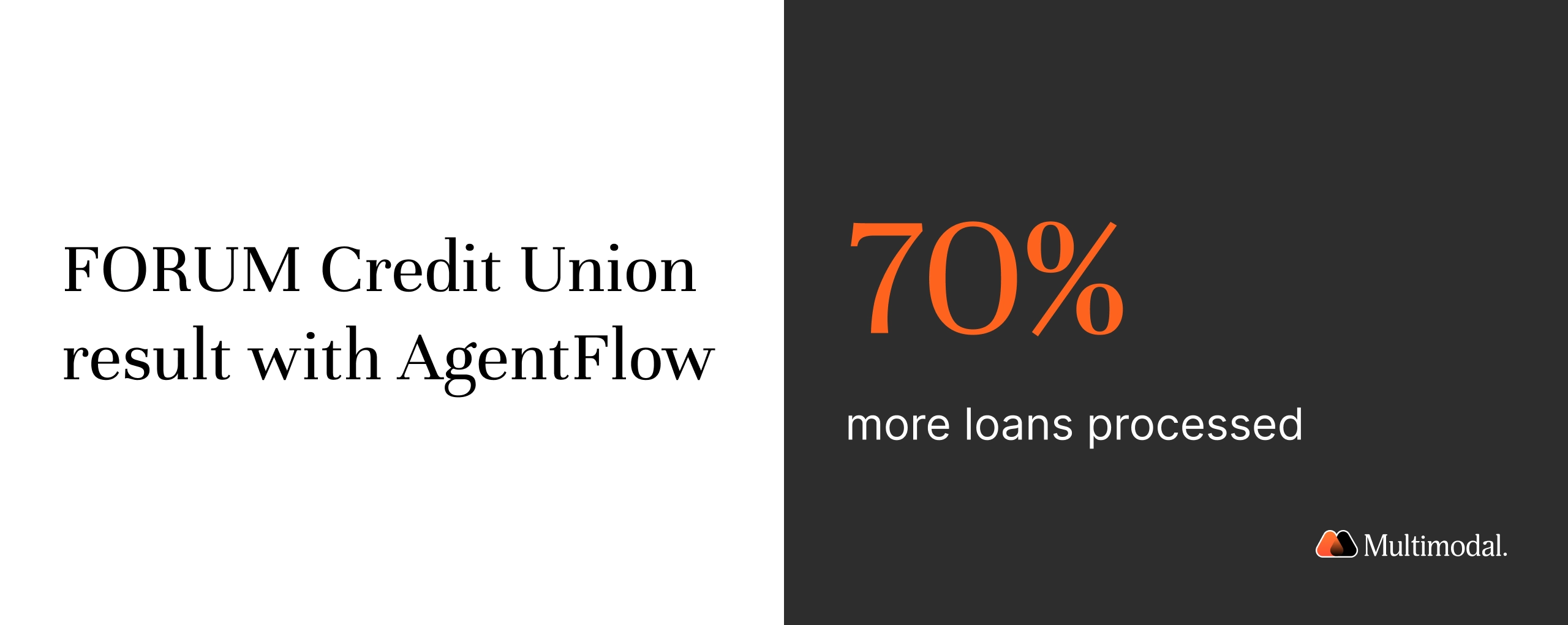
FORUM Credit Union uses AgentFlow to automate auto-loan processing and now processes 70% more loans. The pattern for AI solutions in finance stays consistent: pair autonomous agents with human review and a full audit trail, then expand agent by agent as confidence grows.
Frequently asked questions
What is a multi-agent AI framework?
A multi-agent AI framework is software for building systems where several AI agents coordinate to complete a task. It manages agent logic, tool integration, memory, and communication, so multiple agents can share context and solve problems that one agent cannot handle alone.
What is the best multi-agent AI framework in 2026?
There is no single winner. LangGraph suits stateful, explicit orchestration, CrewAI suits fast role-based collaboration, the Microsoft Agent Framework suits Microsoft-stack teams, and AgentFlow suits regulated financial-services workflows. The best choice depends on project complexity, ecosystem, and deployment environment.
Is LangGraph or CrewAI better for multi-agent systems?
LangGraph is better when you need explicit control, durable execution, and checkpointing for complex workflows. CrewAI is better when you want role-based multi-agent collaboration and a fast path to a working prototype. Many teams start with CrewAI and move to LangGraph as orchestration needs grow.
What happened to Microsoft AutoGen?
Microsoft merged AutoGen and Semantic Kernel into the Microsoft Agent Framework, which reached 1.0 in April 2026 (Microsoft, 2026). AutoGen remains available in maintenance mode, and a community fork called AG2 continues its conversational model, but the recommended path for new projects is the Microsoft Agent Framework.
Which multi-agent framework is best for financial services?
Regulated financial workflows reward auditability, confidence scoring, and human oversight. AgentFlow is built for financial services and provides audit trails and explainability out of the box. Open-source frameworks such as LangGraph can also work when teams add their own governance layer.
Are multi-agent frameworks safe for regulated workflows?
They can be when the design includes traceability, human-in-the-loop review, and strong observability. Multi-agent systems help here because each decision step maps to a specific agent, which makes the process easier to audit than a single opaque model.
Is there a free AI agent framework?
Yes. LangGraph, CrewAI, the Microsoft Agent Framework, the OpenAI Agents SDK, Google's Agent Development Kit, LlamaIndex Workflows, and MetaGPT are open source. Google's ADK is a free AI agent framework, and most of the others are free to self-host, with paid managed tiers available.
Choosing the Right Multi-agent AI Framework
The best multi-agent AI frameworks in 2026 reward a clear match between the job and the tool. LangGraph and CrewAI cover most open-source builds; the Microsoft Agent Framework, the OpenAI Agents SDK, and Google ADK anchor the major cloud ecosystems, and LlamaIndex Workflows and MetaGPT serve document and software work. For regulated financial workflows, the deciding factors are auditability, human oversight, and speed to production.
See a Multi-Agent System Run on Your Workflows
AgentFlow processes real loan files and due diligence packets, with audit trails and human oversight built in.
The path forward is practical. Define the problem, pick a framework that fits your ecosystem and deployment environment, and add specialized agents as confidence grows. That approach turns multi-agent systems from an experiment into dependable production infrastructure.
AgentFlow gives financial institutions the orchestration, deployment flexibility, and vertical playbooks to make that move, with built-in audit trails and human oversight. Book a demo to see how AgentFlow processes a real loan file or a due diligence packet in real time.

.svg)
.svg)

.avif)
.png)

.png)