Shadow AI at Credit Unions: A Policy Playbook for Staff and AI Agents
Shadow AI is staff using AI tools and agents that IT never approved. Get the policy template, agent approval record, and 90-day plan built for credit unions.
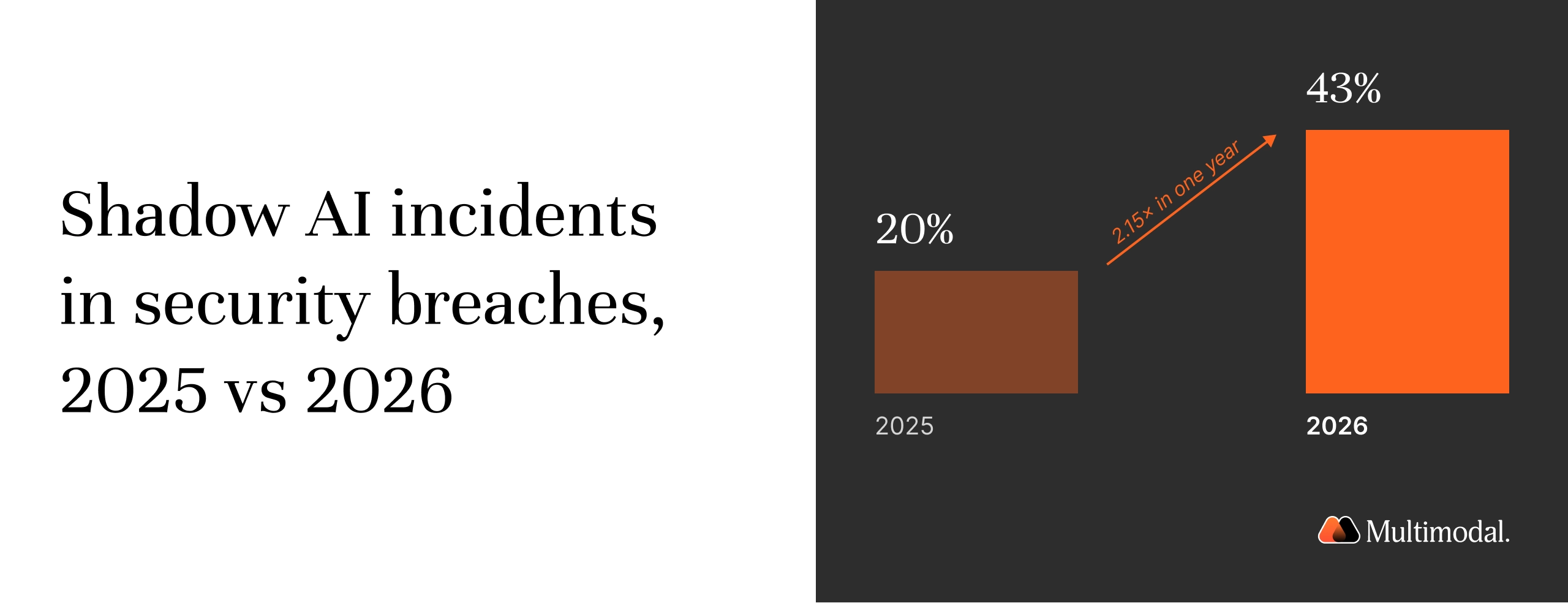
Shadow AI incidents more than doubled in 2026, from 20% to 43%.
68% of breached organizations lacked AI governance to detect shadow AI.
57% of employees hide their AI use; nearly half break policy.
A community bank filed an SEC 8-K in May 2026 over unauthorized AI.
NCUA has no AI-specific rules; Part 748 already covers member data.
Get 1% smarter about AI in financial services every week.
Receive weekly micro lessons on agentic AI, our company updates, and tips from our team right in your inbox. Unsubscribe anytime.
Thank you! Your submission has been received!
Oops! Something went wrong while submitting the form.
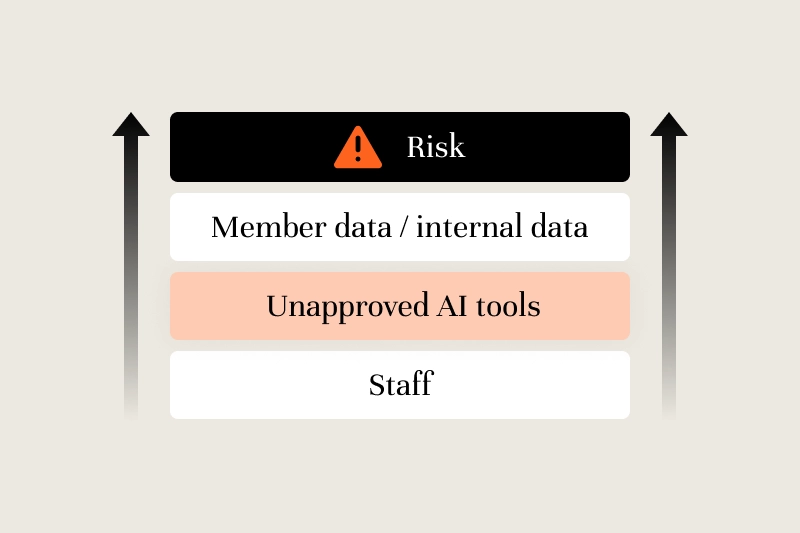
Shadow AI refers to the use of AI tools or agents for credit union work without approval from IT, security, or compliance. Think of a member email pasted into a free generative AI tool, or an assistant wired into a work inbox to sort internal communications.
The risks of shadow AI are no longer theoretical. In May 2026, Community Bank, the subsidiary of CB Financial Services, told the SEC that customer names, Social Security numbers, and dates of birth were disclosed through "an unauthorized artificial intelligence-based software application." IBM's 2026 Cost of a Data Breach Report found shadow AI in 43% of security incidents, up from 20% a year earlier.
What Is Shadow AI?
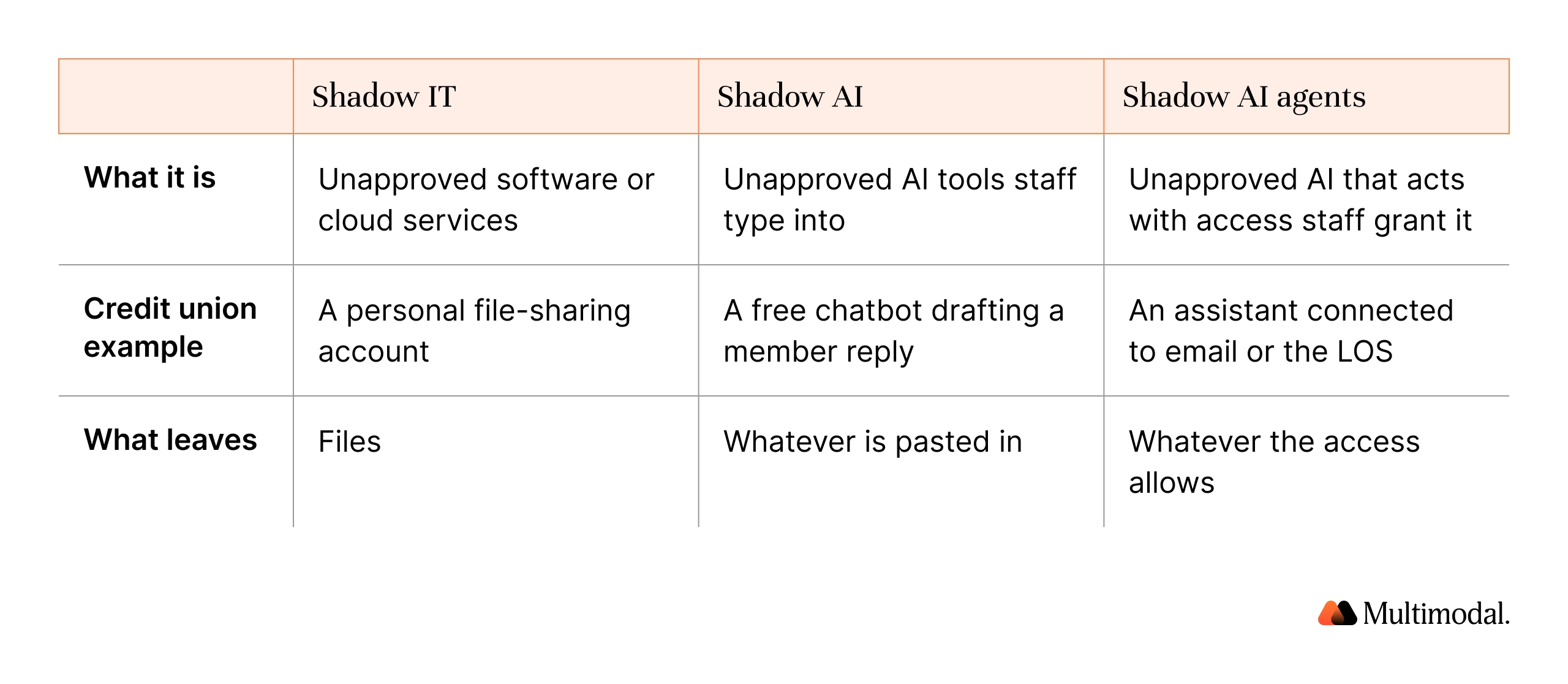
It is a subset of shadow IT, software and cloud services used without the IT department's approval. How does shadow AI differ from shadow IT? Shadow AI processes data, and the vendor decides whether to use AI prompts for training. Sanctioned AI systems run under access controls set by security teams; shadow AI systems run without security oversight.
AI agents raise the stakes: a chatbot leaks what is pasted in, but an agent connected to an inbox or the LOS can fetch data and act on it. See our guide to agentic AI governance.
AI usage outran governance early. In Microsoft and LinkedIn's 2024 Work Trend Index, 78% of AI users brought their own AI tools to work. The National Cybersecurity Alliance and CybSafe found in 2025 that 43% of workers had shared sensitive information with AI tools without their employer's knowledge, up from 38% in 2024. KPMG found 57% of employees hide their AI use, and almost half break company policy.
Reco's 2026 telemetry from 62 large enterprises found four in five AI tools running without IT oversight. Meanwhile, AI adoption continues to climb: 59% of credit unions have deployed generative AI. Employees adopt AI tools on their own when approved tools lag, trying new tools on personal devices. The fix is an approved path that, in our view, competes with AI for credit unions.
What Happens When Member Data Goes Into an Unapproved AI Tool?
CB Financial's Form 8-K says Community Bank "became aware of an internal incident involving the handling of certain non-public customer information using an unauthorized artificial intelligence-based software application." American Banker reported that an employee uploaded customer records for a presentation, believing the sensitive data had been removed, a textbook case of data exposure and data leakage.
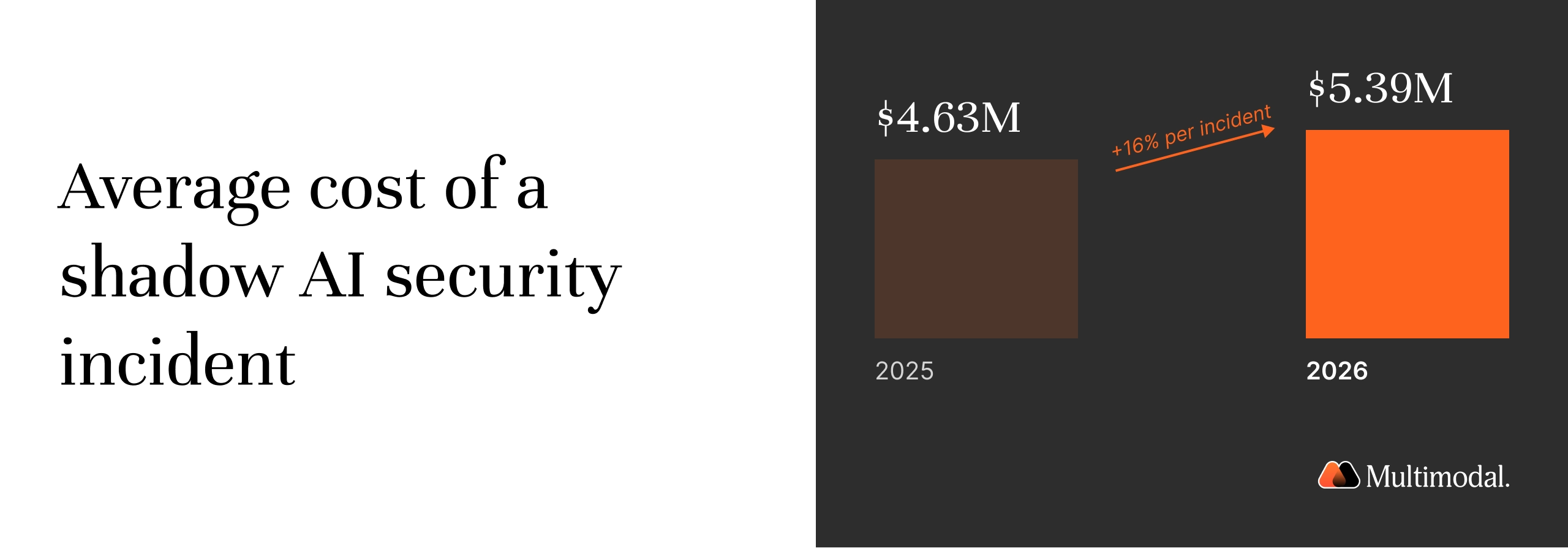
Costs associated with shadow AI are now being measured. In IBM's 2026 study of 602 organizations with data breaches, shadow AI incidents averaged $5.39 million, up from $4.63 million, and about one in five led to a reported regulatory fine. In the UK, about one in five of 250 security chiefs polled by RiverSafe in 2024 reported corporate data leaked through employee use of generative AI.
For credit unions, the compliance risk sits in existing rules. NCUA's AI FAQ says existing regulations "are technology-neutral and apply to AI use," and that "information security standards must be followed regardless of whether a credit union communicates via email, phone, or an AI-enabled tool." 12 CFR Part 748, Appendix A requires "access controls on member information systems," service-provider due diligence, and staff training. A free AI account that nobody vetted is a service provider that nobody vetted, and the NCUA "lacks the authority to examine technology service providers," as GAO noted in 2025.
Abroad, GDPR fines reach €20 million or 4% of worldwide turnover, and the EU AI Act lists AI that evaluates creditworthiness as high risk. For US credit unions, these data privacy regulations signal where data protection standards are heading.
Examiners have not written an AI rule. Our breakdown of NCUA AI guidance covers what they ask instead.
Why Banning ChatGPT Does Not Stop Shadow AI
Blocking public AI platforms moves the work onto personal devices, where there is no network traffic to monitor.
"You can take the burn-the-boat type position… which, I will tell you, is a faster and easier way to get through legal and risk, but it's probably not a very long-term vision. And then 18 months from now, I think you're going to see AI just baked into everything." — Phil Caputo, EVP and Director of the Enterprise Project Management Office, State Employees' Credit Union
New AI capabilities also arrive inside licensed software. Offer enterprise AI services with terms on data retention and model training, plus a list of approved tools.
Shadow AI Agents Raise the Stakes
Agents arrive as AI plug-ins, meeting bots on member calls, AI-powered tools with access to a work inbox, and staff automations wired into software-as-a-service apps. OWASP calls the core AI risk excessive agency: systems able "to undertake actions in response to a prompt."
Reco found that 62% of 500 public MCP servers, the connectors many agents use, combine local file access with outbound network connectivity. IBM found 92% of organizations with an AI-related breach lacked proper AI access controls.
"The thing that I think is the uncontrolled risk, especially when you start thinking about agentic, is data exfiltration… it's gonna start to work around your exfiltration systems because it knows that it can't get through there, so it's gonna look for another way to deliver that data." — Jeffrey Staw, Chief Information and Innovation Officer, Firefighters First Credit Union
Any agent acting outside the credit union needs a human-in-the-loop checkpoint and a named person who can switch it off.
What Should a Shadow AI Policy Include?
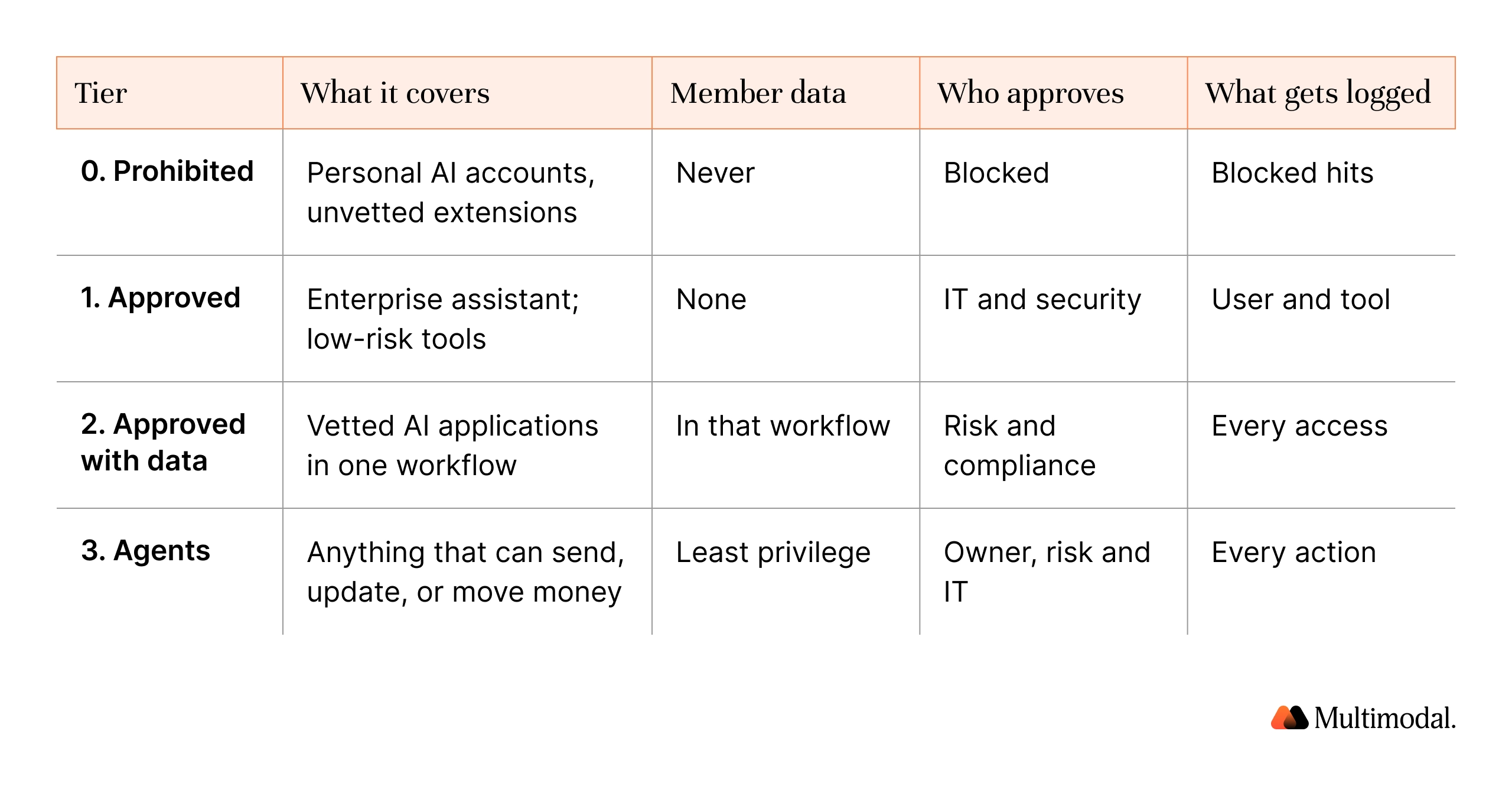
A shadow AI policy makes an AI acceptable use policy enforceable with risk tiers, an approved tools register and a fast request path.
Illustrative role rules:
Member service: customer data never goes into Tier 0 tools.
Lenders: data analysis on borrower financial data stays in Tier 2.
Marketing: AI-generated content is reviewed before publishing.
IT: no source code or credentials in AI prompts.
Ten clauses cover the written policy:
Scope: Tools, AI features and agents, on any device used for work.
Data classes: Sensitive company data, intellectual property, member and client data.
Approved tools register: Updated as new AI tools are approved.
Request path: A named owner and a response time.
Agent rules: Least privilege, a human checkpoint, a kill switch.
Logging and retention: What each tier logs, and for how long.
Training: Educate employees on what never goes into AI prompts.
Amnesty: A window to disclose unauthorized AI tools without penalty.
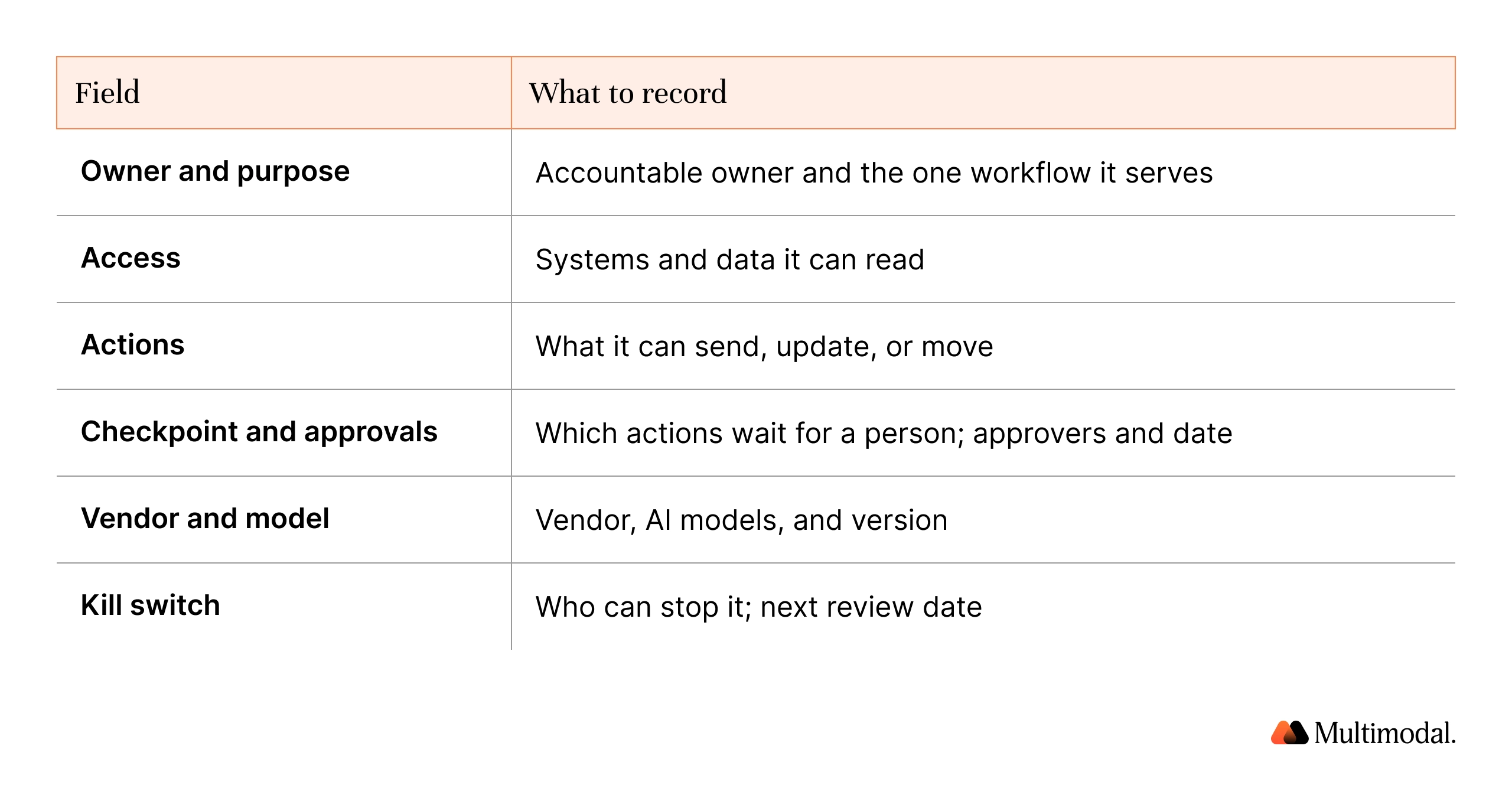
Every Tier 3 agent needs a signed record an examiner can pull, putting NIST AI RMF GOVERN 1.6 into practice: "Mechanisms are in place to inventory AI systems."
How Do You Find the Shadow AI Already in Use?
Only 29% of organizations in IBM's 2026 study ran regular audits for unsanctioned AI. Unmanaged shadow AI tools continue to create visibility gaps. Survey, gather evidence, then block:
Ask: a no-penalty survey of which artificial intelligence tools each team uses.
Network traffic: DNS logs for AI domains.
App grants: OAuth permissions given to AI apps.
Browsers: AI plug-ins and extensions.
Who Owns Shadow AI Governance?
The AI policy sits inside the information security program the board approves under Part 748. Security owns discovery and security posture, compliance owns the tiers and compliance issues, and internal audit tests it.
What This Looks Like in Practice
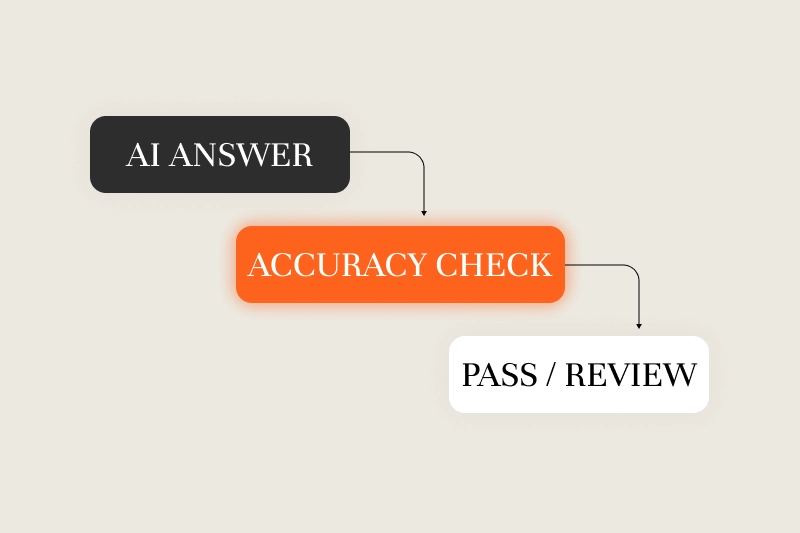
In AgentFlow, system updates and customer communications are "off unless specifically approved," and every execution leaves a reviewable record. See our security and trust page.
Your First 90 Days
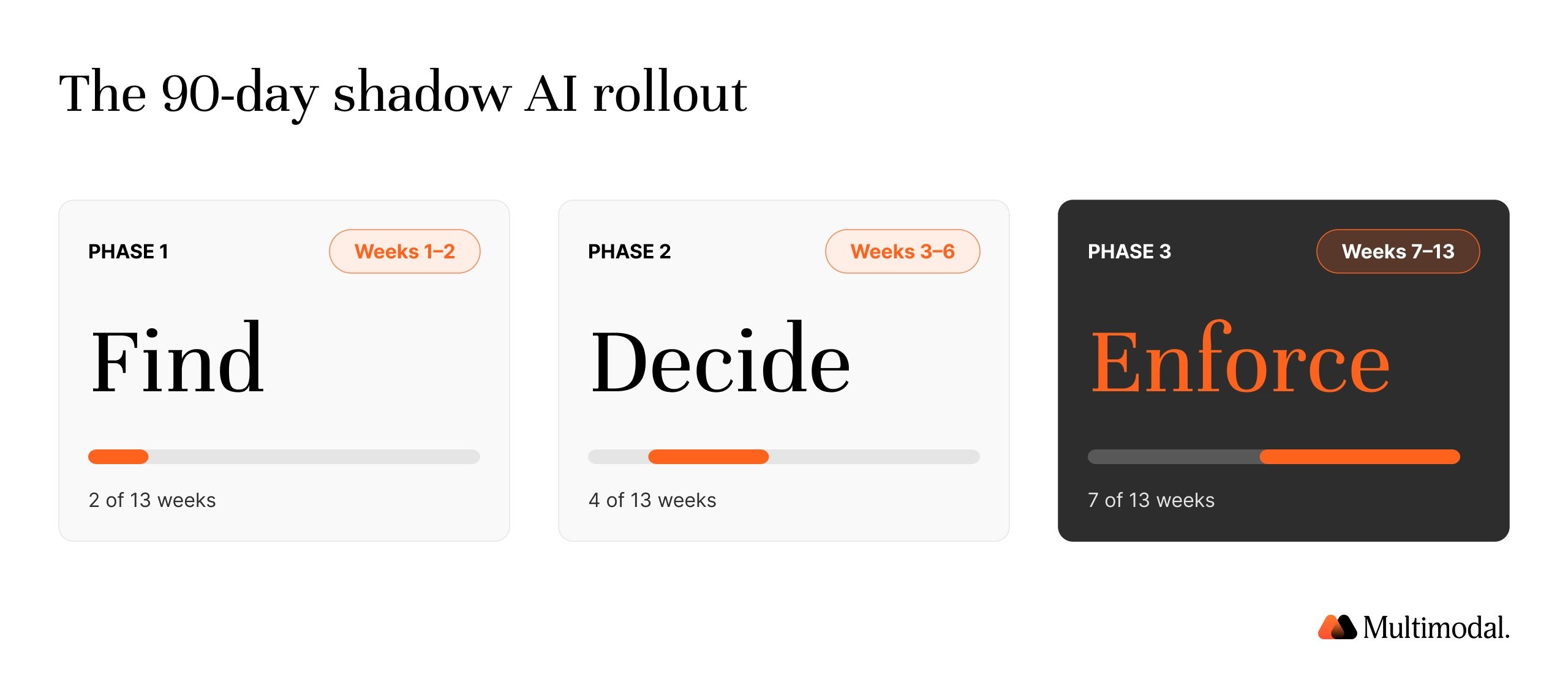
Find (weeks 1-2). Amnesty survey, log review, first inventory of shadow AI systems.
Enforce (weeks 7-13). Approved alternative live before any block, then training and agent approval records.
The Approved Path Has to Be the Fast One
Staff is already adopting AI tools; a community bank has filed an 8-K on it, and the NCUA will assess the outcome under existing rules. Credit unions that make the approved path faster than the workaround, and keep the records, will stay ahead.
Bring us one task your team runs in a personal AI tool. We will run it in AgentFlow with the controls your policy requires and hand back the approval record for your committee.
See Your Approval Record Before You Need It
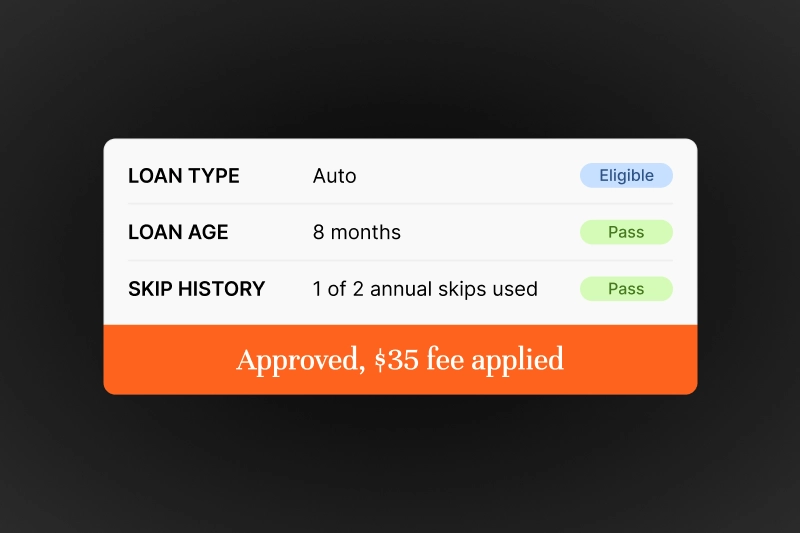
Bring us one task your staff already runs in a personal AI tool. We will rebuild it in AgentFlow with the checkpoints and logging your policy requires, then hand you the signed record your committee can review.

.svg)
.svg)

.avif)
.png)

.png)