NCUA AI Guidance 2026: What Examiners Will Actually Ask


Table of contents
Key Takeaways:
- AI does not appear in NCUA's 2026 supervisory priorities letter.
- Examiners benchmark AI against NIST, COSO, CISA, Treasury, and FinCEN sources.
- Credit unions carry vendor AI risk; NCUA cannot examine technology providers.
- Adverse action notices must provide specific reasons, even when based on complex models.
- Seven documented artifacts answer nearly every examiner AI question.
Get 1% smarter about AI in financial services every week.
Receive weekly micro lessons on agentic AI, our company updates, and tips from our team right in your inbox. Unsubscribe anytime.
There is no standalone NCUA AI guidance rule, and artificial intelligence does not appear in the agency's 2026 Supervisory Priorities letter. Examiners still ask about AI through stated priorities such as third-party relationships, fraud detection, and BSA/AML, which are benchmarked against the frameworks the National Credit Union Administration lists in its AI resources hub.
This guide maps those benchmarks to the questions credit unions are already hearing.
What Does NCUA Actually Say About AI in 2026?
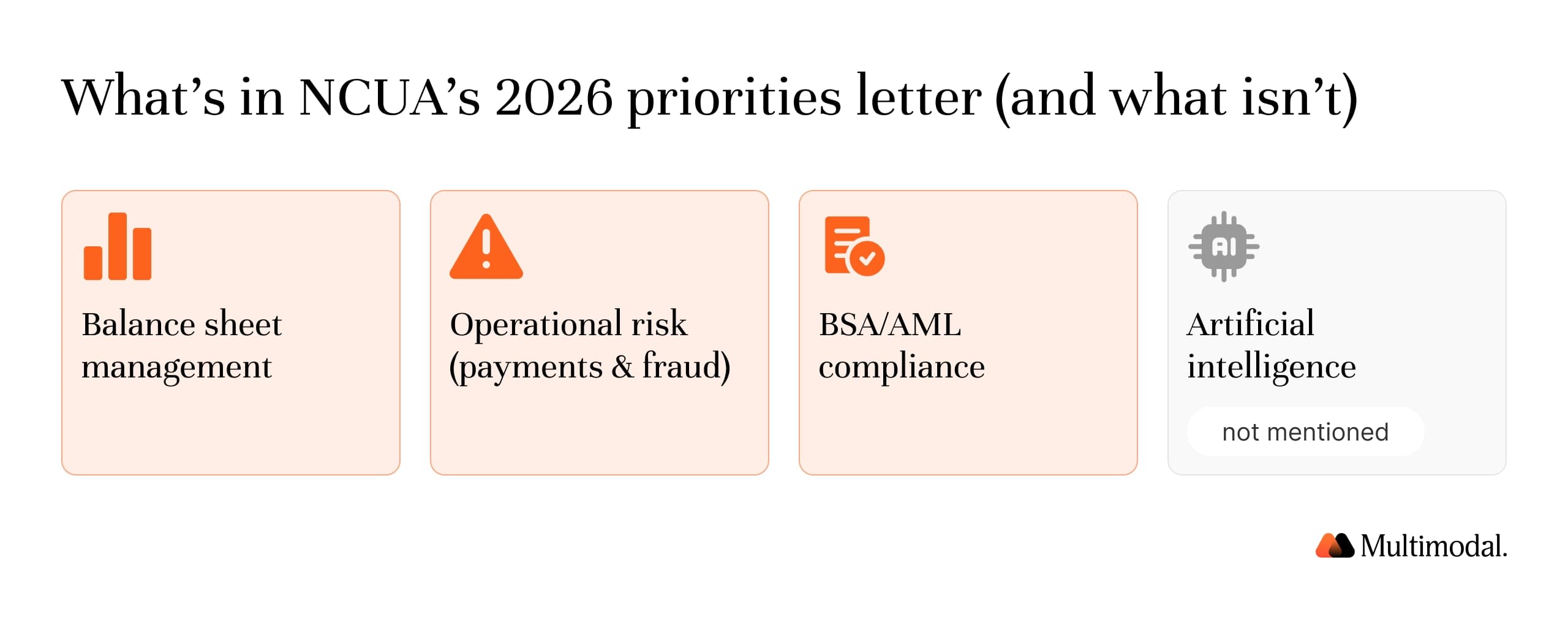
The 2026 letter names three priorities for federally insured credit unions: balance sheet management, operational risk with a focus on payments and fraud, and BSA/AML compliance. AI appears nowhere in it.
The agency's actual position on AI technologies lives in its Credit Union AI Resource Hub, updated April 2026: "Yes. Credit unions may use AI tools and technologies." The same page states that "existing regulations are technology-neutral and apply to AI use" and directs credit unions to identify risks unique to AI or automated tools.
One misreading to avoid: NCUA's 2025 AI Compliance Plan governs the agency's own internal AI use, so it is not supervisory guidance. The 2021 interagency RFI already flagged explainability challenges, and NCUA has said new regulatory requirements beyond model risk management would require rulemaking.
Why Will Examiners Ask About AI Anyway?
The current posture is deregulatory: extended exam cycles and expectations grounded in formal guidance rather than regulation by enforcement. No AI rulebook exists, yet examiners hold your compliance management program against a published benchmark list; credit unions "can expect NCUA examiners to look to these same sources as benchmarks". AI questions simply walk through the doors that are priorities.
"The most you're gonna get from an NCUA auditor right now is, let me see your AI governance policy. They haven't yet come in and started saying, show me how your AI agents work, show me that you're validating the data, show me that you're not discriminating. … We haven't seen that yet." — Jeffrey Staw, Chief Information and Innovation Officer, Firefighters First Credit Union, Main Street AI podcast
Per PYMNTS, citing Cornerstone Advisors, 46 percent of credit unions apply AI in lending. As more member services run on AI systems, more exam scope touches AI.
The Benchmark Stack: What Examiners Measure Against
NCUA's AI resources page names its sources. Treat the list as the benchmark stack for your compliance management systems, and build a folder that answers each row.
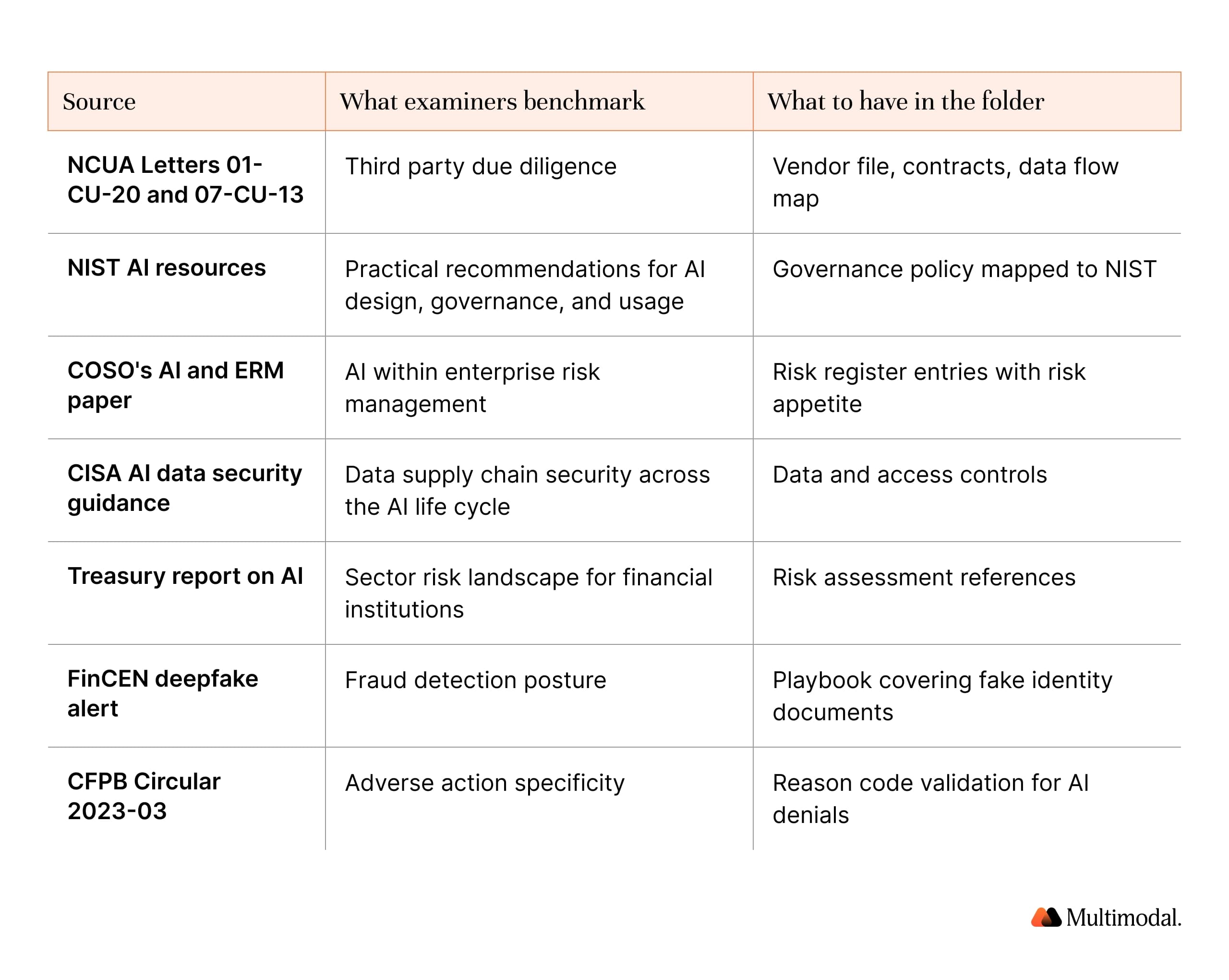
Commerce's National Institute of Standards and Technology supplies the governance and risk management resources, while COSO frames AI within your risk assessment methodologies. The Cybersecurity and Infrastructure Security Agency covers the data layer: deploying AI systems securely, operating AI systems developed by external entities, and protecting the operational data that powers AI systems, from model weights to maliciously modified data.
These AI data security frameworks help credit unions maintain system integrity in accordance with core security standards. And since generative AI can create fake identity documents at scale, examiners will expect fraud-detection capabilities that can catch synthetics.
The 7 Questions Examiners Will Actually Ask
Credit union leaders raised examiner readiness on four separate sales calls this year. Here is the exam conversation in seven questions.
1. Show me your AI governance policy. Named owners, approval gates, and documented board oversight.
2. What AI is running here? An inventory of AI implementations covering your models, different AI tools embedded in vendor systems, and staff use of generative tools.
3. How do you validate outputs and data? Confidence thresholds and continuous monitoring protocols that catch drift and trigger corrective actions.
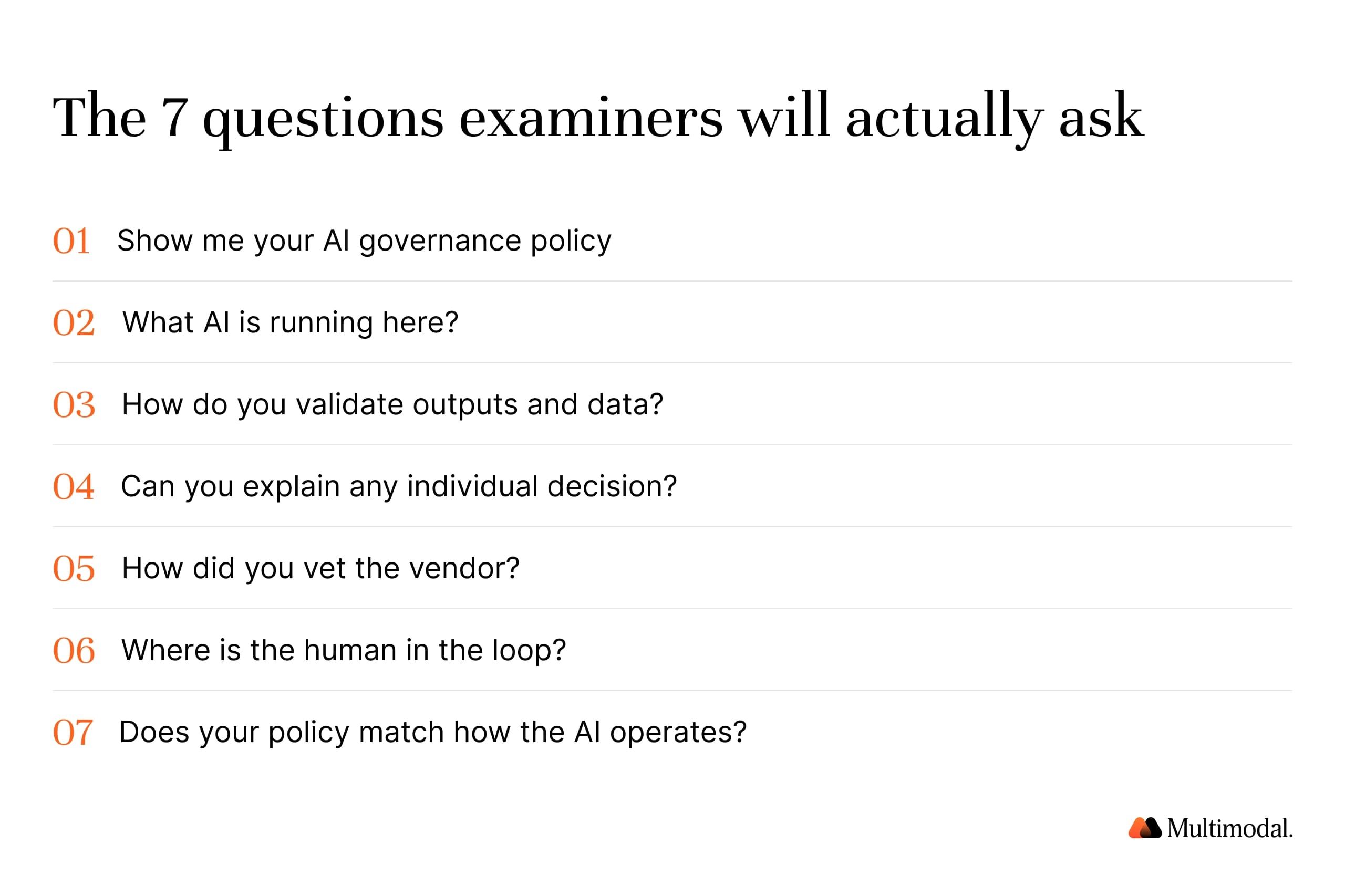
4. Can you explain any individual decision this system touched? Model risk meets fair lending here, covered below.
5. How did you vet the vendor? Due diligence artifacts under Letters 01-CU-20 and 07-CU-13: security review, data privacy terms, and AI training rights.
6. Where is the human in the loop, and can you prove it? Review queues and override logs; an unlogged human is indistinguishable from no human at all.
7. Does your written policy match how the AI actually operates? One credit union found its policy phrase "exceptions may be made" could not map onto an automated workflow; policies drafted for manual processes often need rewriting first.
The direction underneath all seven, in one credit union leader's words: the technology "can't be a black box, needs to be white box."
You Can't Outsource the Risk: Vendor Due Diligence
Most credit unions buy AI technologies from vendors or inherit them through CUSOs and sponsoring organizations. Accountability stays in place: the GAO confirmed that the NCUA cannot examine third-party technology providers, shifting compliance efforts onto the credit union.
"Although you may utilize a vendor to provide a certain product or service, you can't outsource the risk. The regulatory expectation is that even if you use a third party to offer that product or service … you're still on the hook at the end of the day." — Michael Heller, Associate Attorney, Mesick, Lauer & Smith, Main Street AI podcast
When something breaks, regulators focus on the credit union, not the vendor. The vendor file is therefore a compliance asset covering all external entities in your third-party relationships.
Explainability Is Where Exams Get Real
CFPB Circular 2023-03 is the strongest formal statement on AI in lending: creditors using complex models must provide specific and accurate reasons for adverse action, and they "cannot justify noncompliance with ECOA based on the mere fact that the technology they use to evaluate credit applications is too complicated".
Architecture choices become compliance choices here. Systems that record field-level confidence scores, maintain immutable audit trails, and log human reviews give you the raw material for exam responses. FORUM Credit Union, an AgentFlow customer, runs document-heavy lending with 99 percent extraction accuracy, with human review for every exception.
How to Get Examiner-Ready Before Your Next Exam
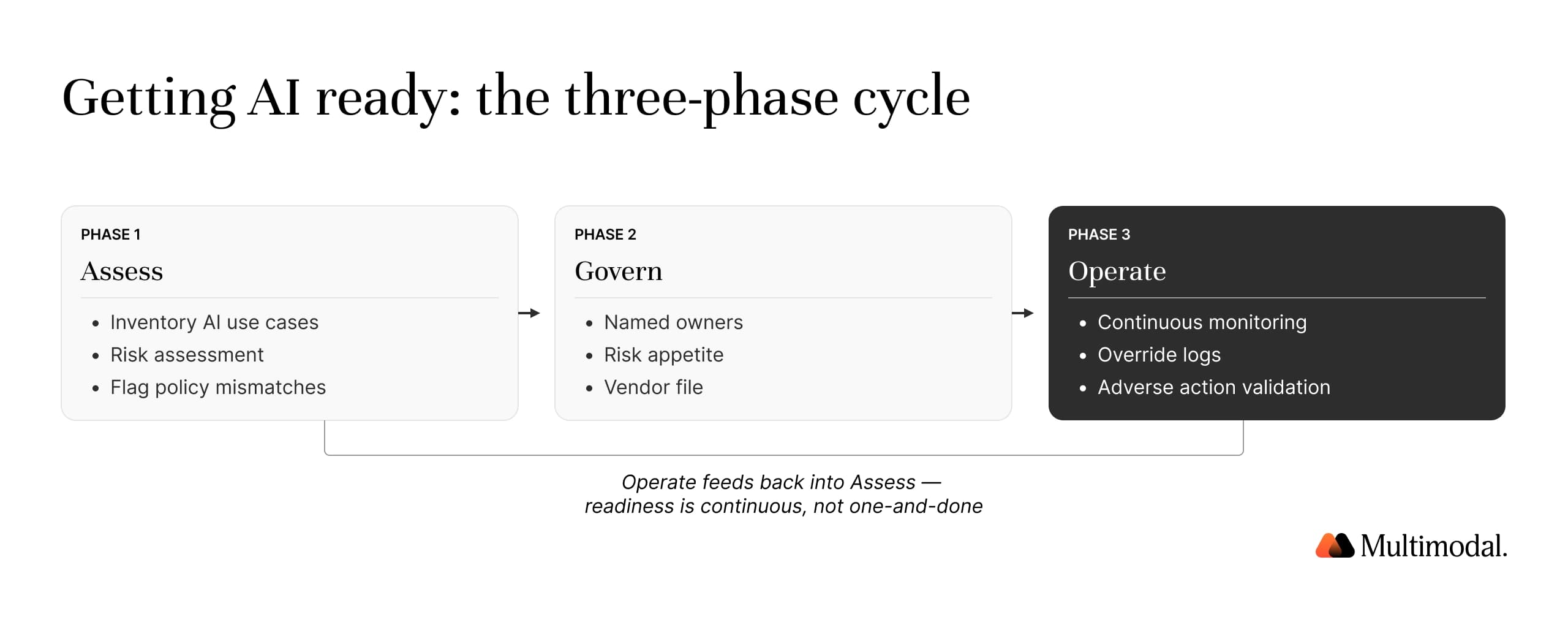
Getting AI ready works as a practical three-phase framework, a structured approach instead of a pre-exam scramble.
Phase 1: Assess. Inventory every AI use case, run a risk assessment against the benchmark stack, and flag mismatches between written policy and actual workflow, especially language written for manual processes.
Phase 2: Govern. Update the governance policy to include named owners and a risk appetite, integrate AI into enterprise risk management, and build the vendor file.
Phase 3: Operate. Run continuous monitoring, log overrides, validate adverse action codes, and refresh data security controls as technology rapidly evolves, allowing staff to provide feedback when reality drifts from the document.
Dedicated compliance management systems, such as CUNA's Credit Union Compliance Management System PLUS or ViClarity's centralized platform, monitor changing regulations and track compliance activities, and automated processes reduce the risk of human error. What they do not produce is AI-specific evidence: decision traces and review logs come from the AI platform itself. You need both layers.
The same controls deliver operational efficiency, streamline operations, and help credit unions remain competitive without adding headcount. Staff who build a daily AI practice stay relevant and strengthen their professional future. Leaders who creatively embrace change can secure early wins by pairing each automated workflow with its former manual owner, building adoption and operational resilience together.
Frequently Asked Questions (FAQs)
What is NCUA's AI guidance for credit unions?
There is no standalone rule. NCUA states that existing regulations are technology-neutral and apply to AI use, citing NIST, COSO, CISA, Treasury, and FinCEN materials.
Is AI in NCUA's 2026 supervisory priorities?
No. Letter 26-CU-01 covers balance sheet management, operational risk, and BSA/AML. AI questions are surfacing because AI now runs in those areas.
Do credit unions need NCUA approval to use AI?
No. Credit unions may use AI tools when implemented in a safe, sound, and compliant manner; the obligation is to manage risks, not to seek permission.
Who is responsible when an AI vendor makes a mistake?
The credit union. Regulators focus on the institution, so contracts and diligence files show the risk was managed.
How is examiner-ready AI different from compliance management software?
Compliance management software tracks regulations and deadlines. Examiner-ready AI produces evidence about its own behavior: decision traces, confidence scores, and audit logs. A complete compliance management program uses both.|
Could Your AI Survive These 7 Questions Today?
No slide deck. Send a sample loan file and we will process it live, then hand you the audit trail an examiner would ask for. You keep the output either way.
The Exam Question Is Whether You Can Show Your Work
NCUA has told credit unions they may use AI, has named the frameworks it trusts, and has said that anything more would require rulemaking. That is as much clarity as the regulatory landscape will offer for a while. The strongest credit unions treat the benchmark stack as a build spec: real governance, a defensible vendor file, and explainable decisions for every member.
Book a demo. We will run a sample loan file through AgentFlow and show you the audit trail and review logs that answer the seven questions above.