Explore 19 AI agent use cases in business for 2026, from lending and fraud detection to supply chain management, with verified results and adoption data.
AI agents execute multi-step tasks toward specific business goals, with human oversight where it matters.
Financial institutions see the fastest returns in lending, fraud detection, and compliance workflows.
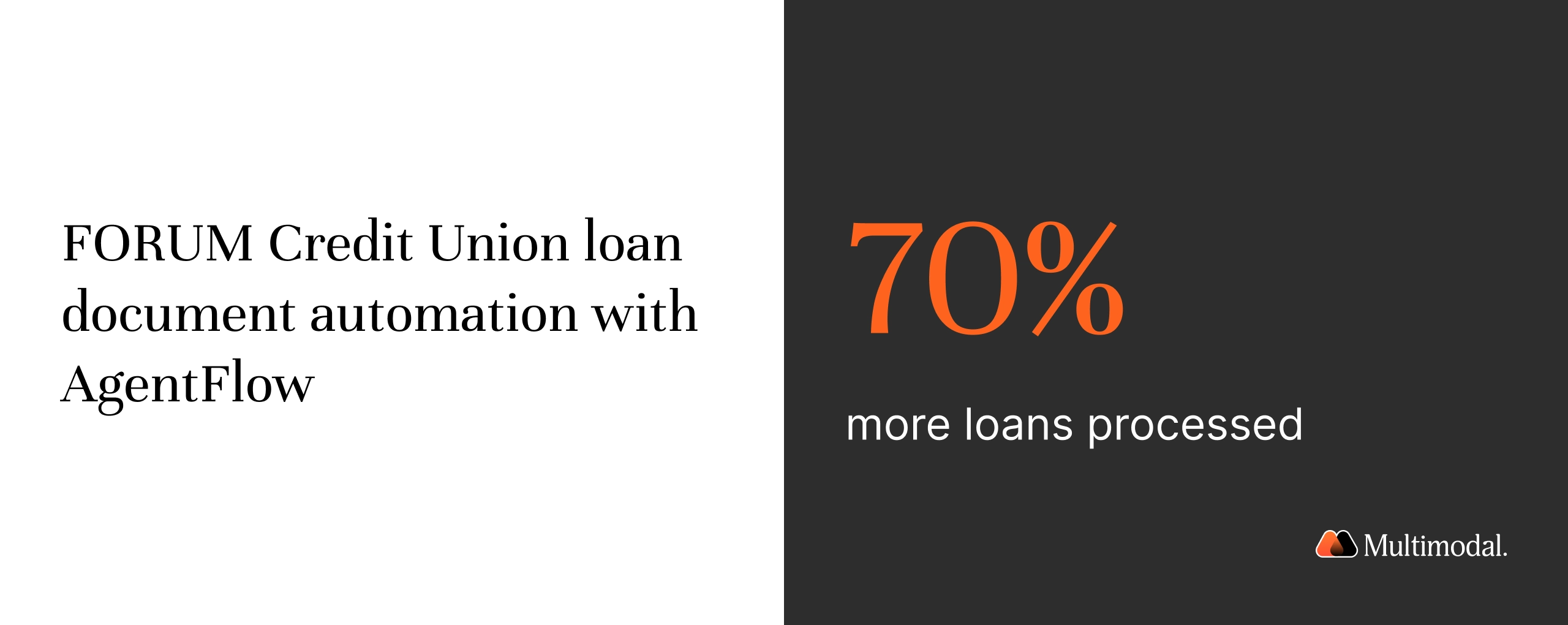
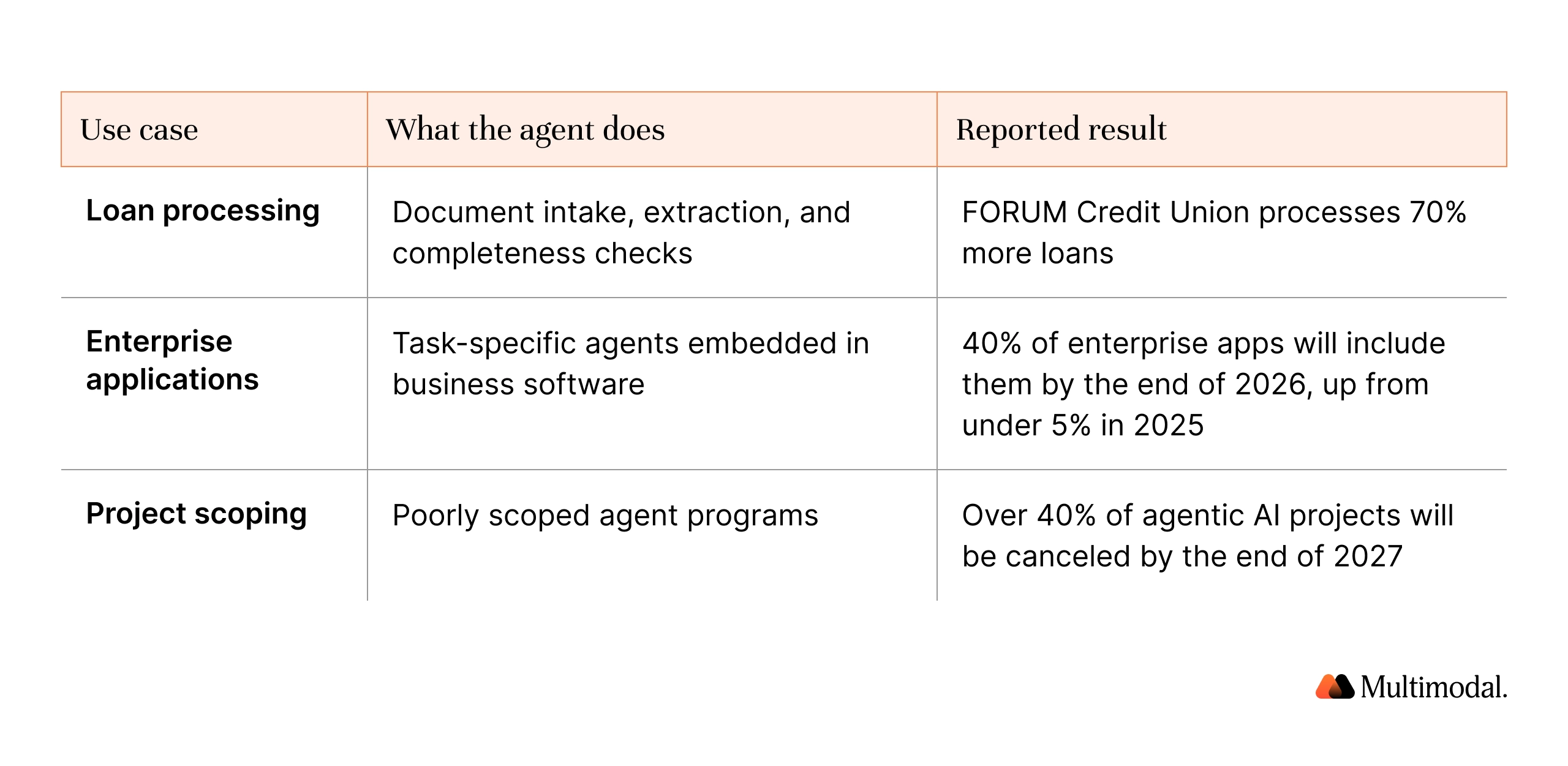
FORUM Credit Union processes 70% more loans after automating loan processing with AgentFlow.
Gartner expects 40% of enterprise applications to embed task-specific agents by the end of 2026.
Gartner also predicts over 40% of agentic AI projects will be canceled by 2027.
Get 1% smarter about AI in financial services every week.
Receive weekly micro lessons on agentic AI, our company updates, and tips from our team right in your inbox. Unsubscribe anytime.
Thank you! Your submission has been received!
Oops! Something went wrong while submitting the form.
AI agents are software systems that use large language models, natural language processing, and machine learning to plan and complete multi-step tasks with minimal human intervention.
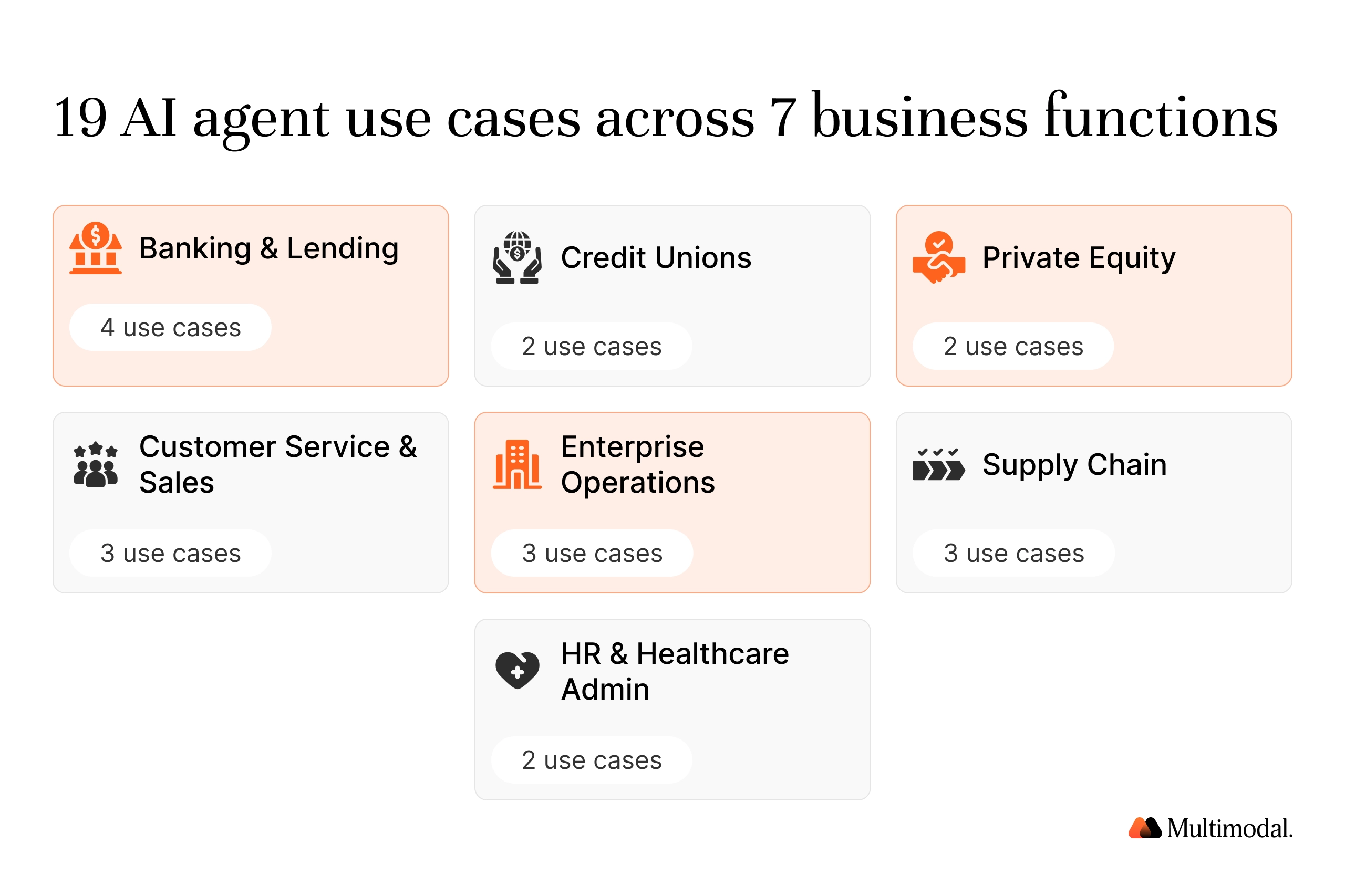
In 2026, the highest-value AI agent business use cases sit in lending, fraud detection, compliance, private equity operations, customer service, and supply chain management. Gartner projects that 40% of enterprise business applications will include task-specific AI agents by the end of 2026, up from less than 5% in 2025. Below are 19 AI agent examples, grouped by function, with verified results.
What Are AI Agents and How Do AI Agents Work?
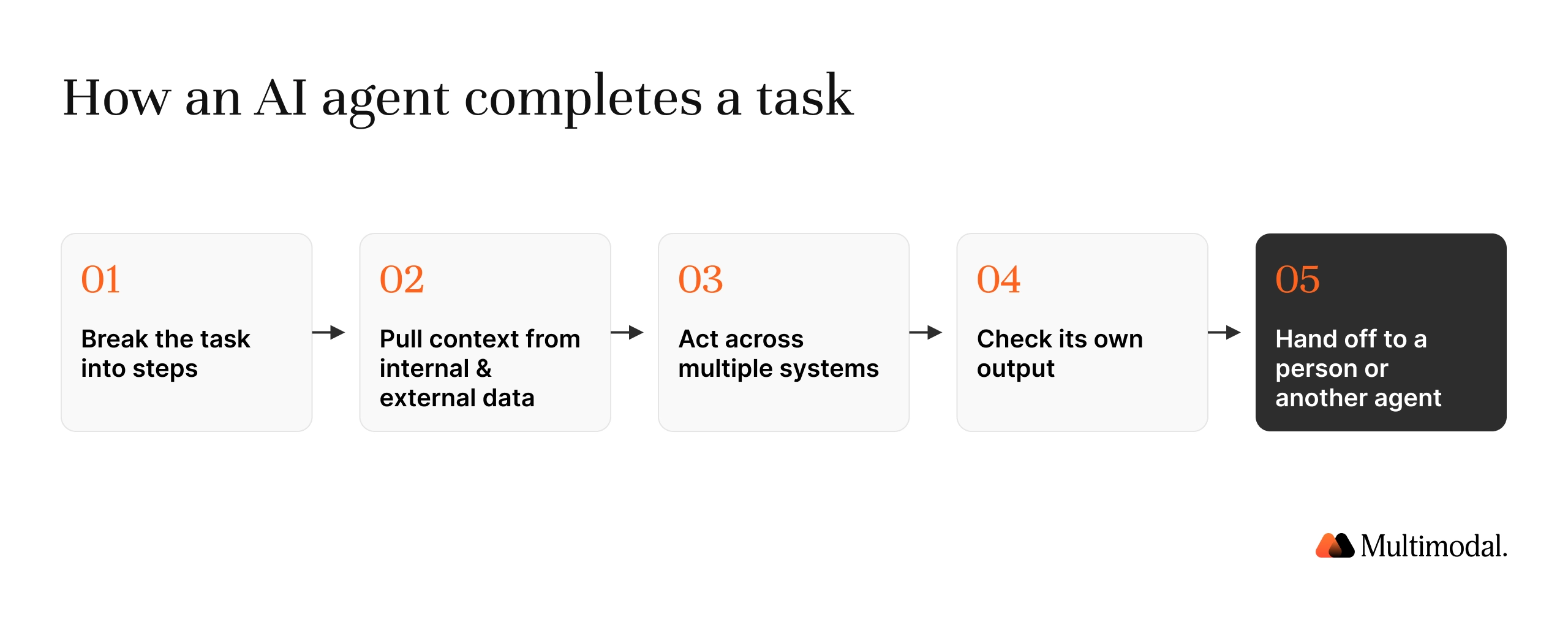
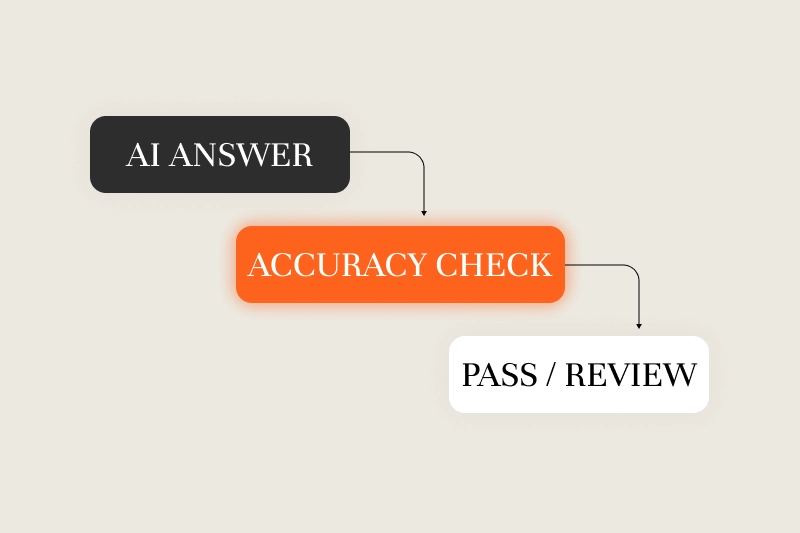
AI agents are autonomous systems that perceive their environment, analyze data, and act independently to achieve specific goals. They differ from traditional automation, such as robotic process automation, in that they reason and plan rather than follow fixed scripts. An agent breaks complex tasks into steps, pulls relevant context from internal and external data, takes action across multiple systems, and checks its own output before handing work to a person or to other agents.
The main types of AI agents range from simple reflex agents and model-based reflex agents, built for specific tasks, to goal-based agents and utility-based agents. Unlike reflex agents, which map inputs to fixed responses, goal-based and utility-based intelligent agents weigh options against outcomes.
Most production AI systems in 2026 combine several of these AI technologies into multi-agent systems, where specialized agents hand off work to complete complex workflows. Generative AI writes content when prompted. AI agents apply the same artificial intelligence models to automate tasks end-to-end with minimal human input.
What Are the Top AI Agents Use Cases in Business?
These 19 AI agent use cases show where businesses are getting measurable value today, starting with the regulated workflows that financial services firms run in production.
AI Agents for Banking and Lending
1. Credit underwriting. Agents automate credit underwriting by gathering borrower data, verifying documents, and applying credit policies consistently, thereby improving application processing speed and reducing bias from manual review.
"One of the main things was to be able to approve more loans without taking on additional risk. It's not all about reduction in staff... If we can give more loans to members without taking on a lot of additional risk, that's what we wanted to do." — Lisa Highley, Chief Lending Officer, University of Kentucky Federal Credit Union
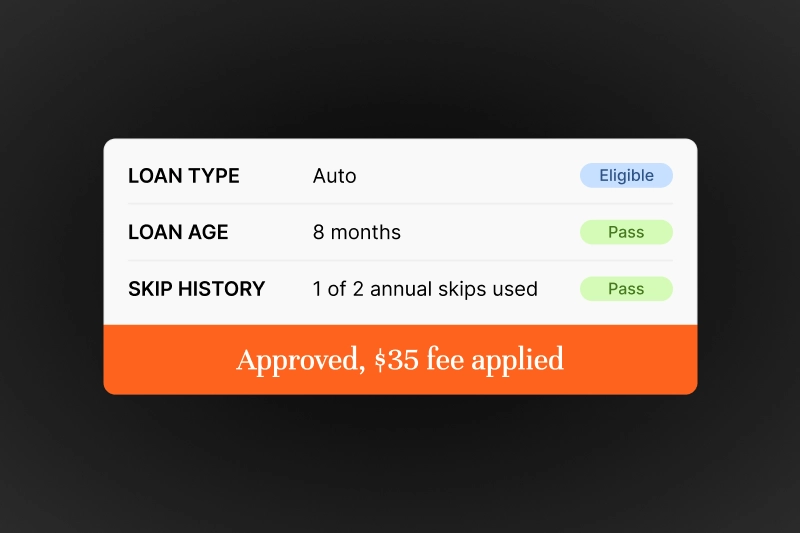
2. Loan document processing. Agents classify incoming documents, extract data, check funding packets for completeness, and flag exceptions for human experts. FORUM Credit Union processes 70% more loans after automating loan processing with AgentFlow.
3. Fraud detection and AML monitoring. Agents monitor transactions for suspicious activity in real time, clear low-risk fraud alerts in seconds, and escalate genuine risk to analysts. That shrinks alert backlogs without loosening controls.
4. Regulatory compliance reporting. Agents automatically generate compliance reports for regulatory submissions, maintain audit trails of every agent action, and track rule changes, thereby cutting the administrative burden on compliance teams at financial institutions.
AI Agents for Credit Unions
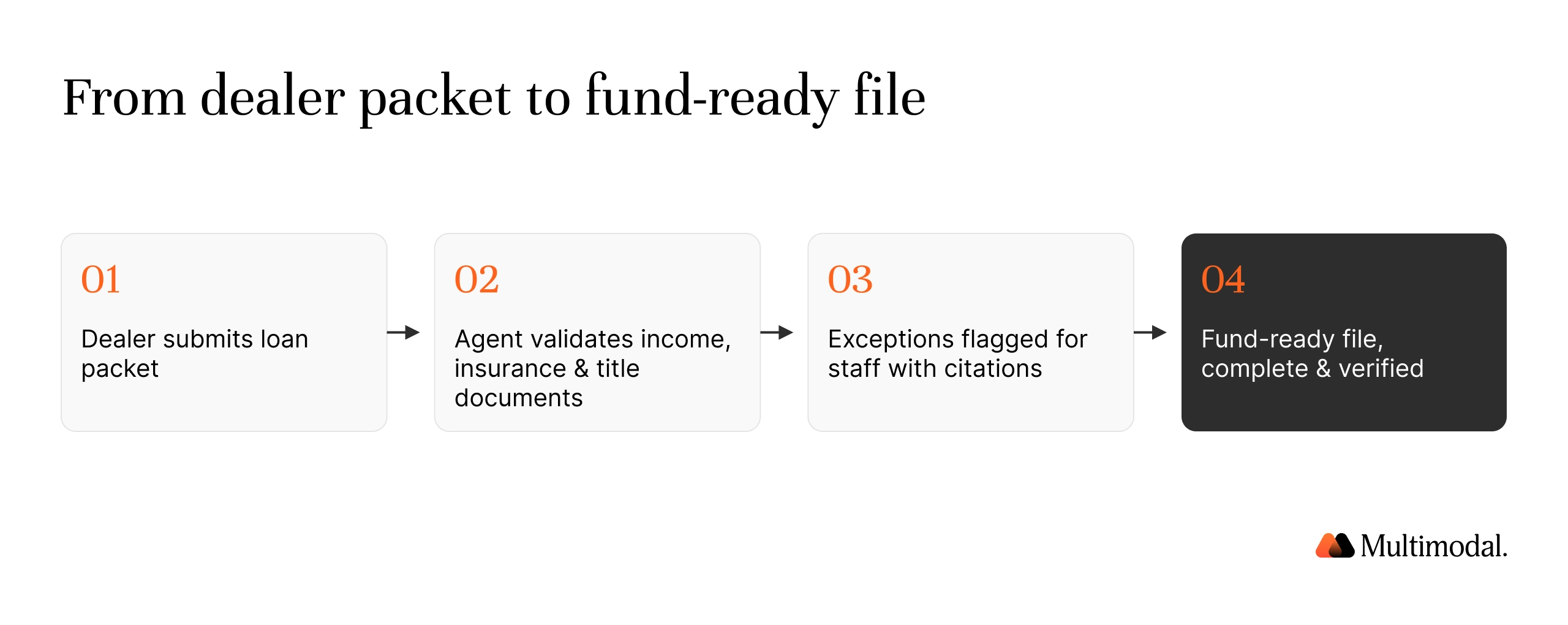
5. Indirect auto loan funding. Agents turn dealer-submitted packets into fund-ready files by validating income, insurance, and title documents against funding checklists, protecting dealer relationships that depend on funding speed.
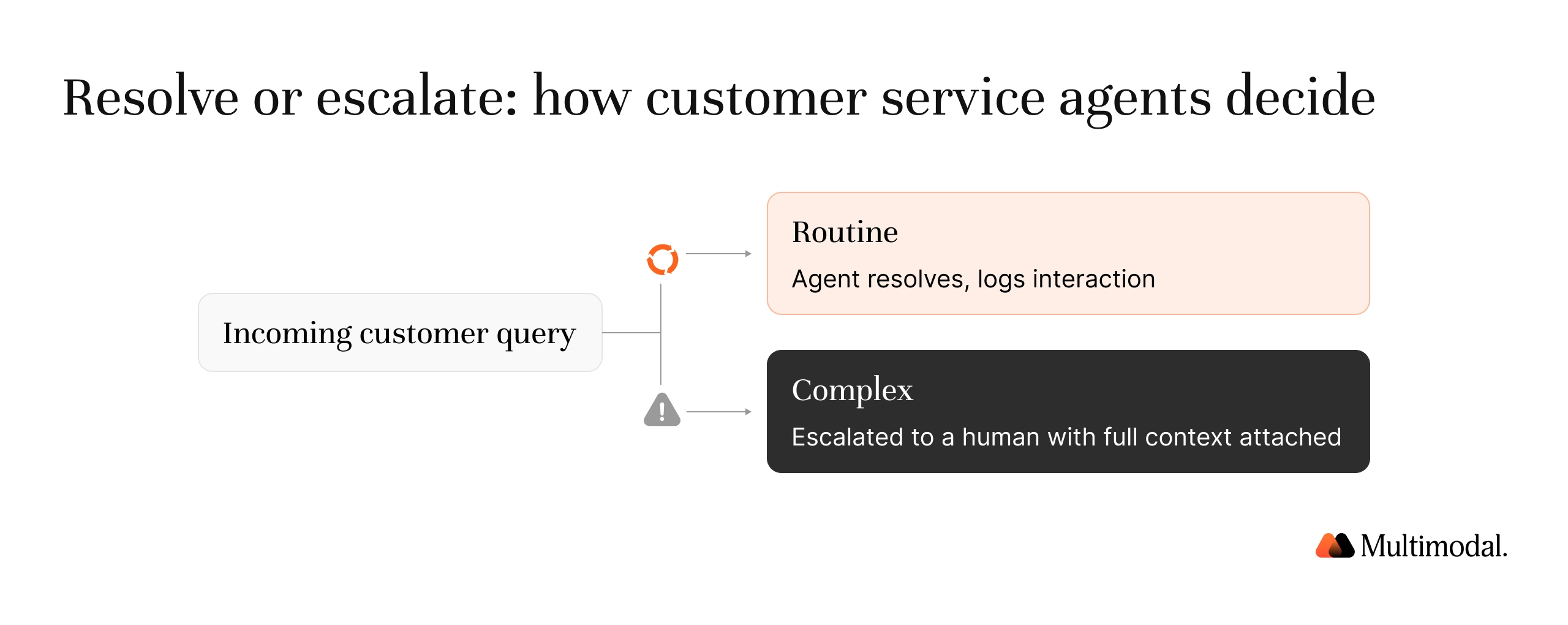
6. Member service operations.Credit unions deploy agents to resolve member requests, automate multi-step transactions, and route complex issues to human representatives with full context attached.
AI Agents for Private Equity
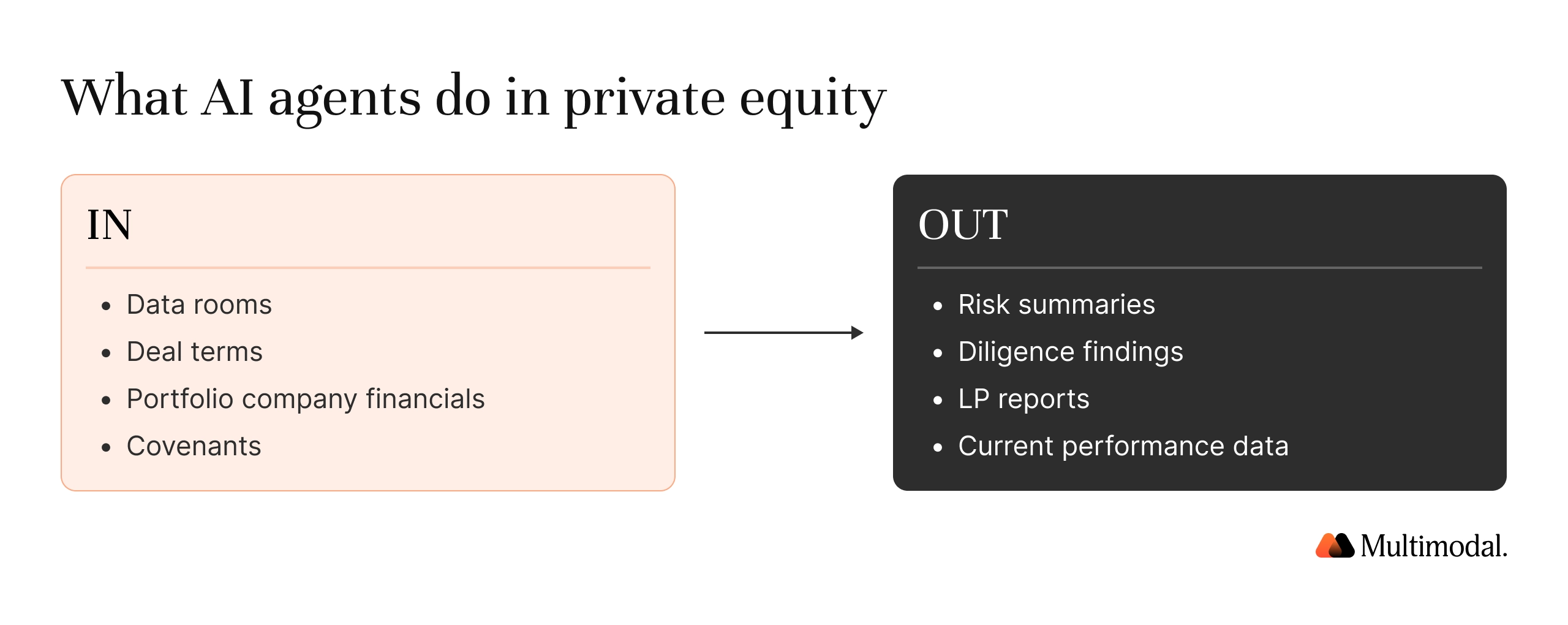
7. Due diligence document review. Agents review data rooms, extract deal terms, and summarize risk across thousands of pages, compressing diligence timelines for dealmaking teams.
8. Portfolio monitoring and fund reporting. Agents consolidate portfolio company financials, track covenants and market volatility, and draft LP reporting, providing fund operations teams with current data rather than quarter-old snapshots.
AI Agents for Customer Service and Sales
9. Customer service agents. Customer service agents use large language models for human-like conversations, apply sentiment analysis to customer interactions, recall relevant customer data in real time, and handle complex customer inquiries, escalating to human teams when necessary. The result is higher customer satisfaction and lower cost per resolved query.
10. Sales agents. Sales agents qualify leads, draft outreach messages, and update customer relationship management records automatically, so account executives can spend time selling instead of on data entry.
11. Marketing personalization. Agents analyze customer behavior to build customer personas grounded in data analysis, run hyper-targeted campaigns autonomously, and use predictive analytics to optimize ad performance and product recommendations in real time.
AI Agents for Enterprise Operations
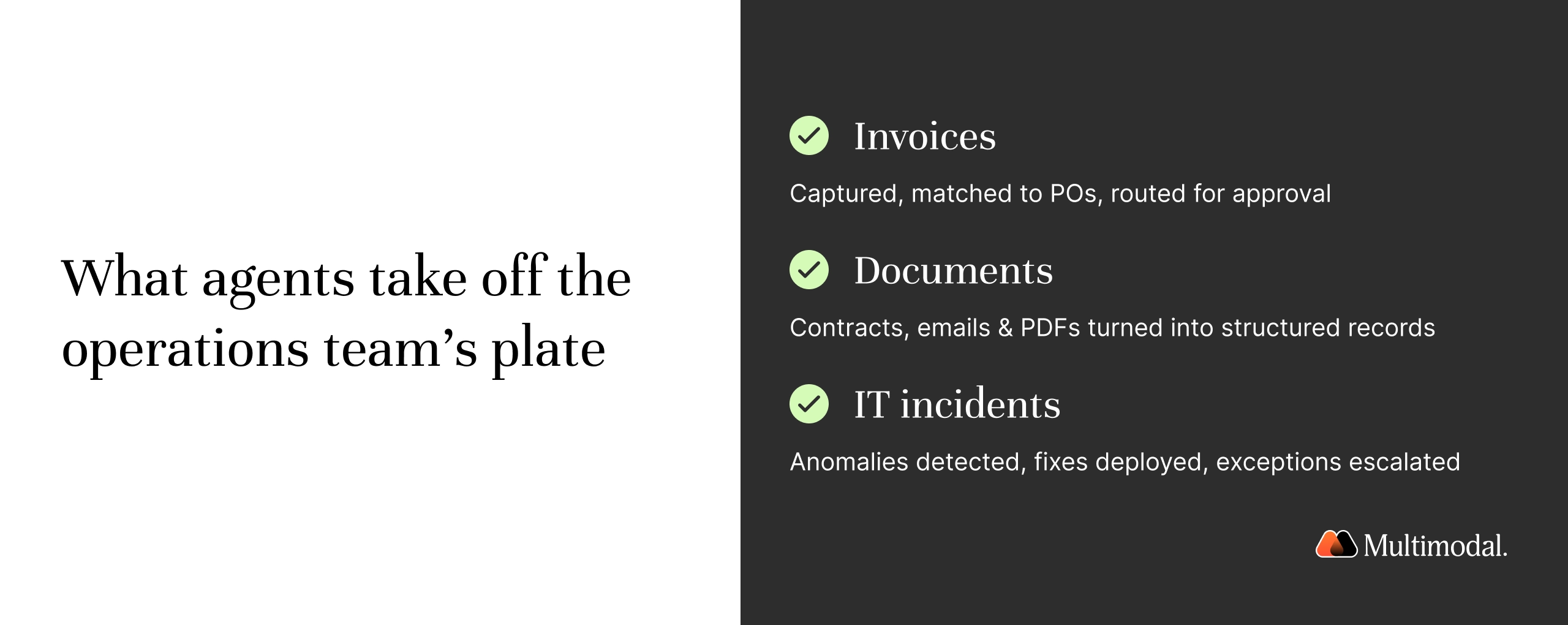
12. Invoice processing. Agents capture invoice data, match purchase orders, and route approvals, accelerating financial operations and improving cash flow with fewer manual errors.
13. Unstructured data processing. Agents convert contracts, emails, and PDFs into structured records, automate data processing and report generation, and feed data-driven insights back into internal processes, freeing analysts for higher-value work.
14. IT operations. Agents autonomously manage IT infrastructure, detect anomalies in real time, troubleshoot and deploy fixes, and reduce operational risk and downtime across the stack.
AI Agents for Supply Chain Management
15. Supply chain planning. Supply chains are complex networks, and agents improve planning by producing cost analyses and insights for short- and long-term decisions while monitoring regulatory compliance across suppliers.
16. Procurement and contracting. Agents streamline supplier selection based on cost-effectiveness and automate the contracting and purchase-ordering processes, shortening procurement cycles.
17. Inventory and logistics. Inventory agents manage stock in real time to prevent stock-outs and adjust pricing to demand. In logistics, intelligent routing reduces fuel consumption and delivery times, autonomous dispatching reroutes vehicles around traffic, and predictive maintenance prevents breakdowns before they idle a fleet.
AI Agents for HR and Healthcare Administration
18. Human resources. HR agents automate routine tasks such as resume analysis, interview scheduling, and leave requests, ensure policy compliance, and deliver personalized training recommendations that improve the employee experience.
19. Healthcare administration. Healthcare agents automate routine tasks in clinics and hospitals, optimize staffing and resources, monitor patient vitals in real time, and reduce administrative burdens, so clinicians spend more time on care.
What Results Do AI Agents Deliver?
The third row is the honest one. Gartner predicts that over 40% of agentic AI projects, nearly half of those underway, will be scrapped by the end of 2027 due to unclear business value and weak risk controls. The gap between the two Gartner numbers is execution: firms that pick one measurable workflow succeed, and firms deploying AI agents everywhere at once stall.
How Do Businesses Implement AI Agents?
Four steps separate production systems from pilots:
Pick one measurable workflow. Start where volume is high, and the outcome is countable, such as loan files processed or customer queries resolved.
Confirm data access and integrations. Agentic AI tools need to connect to core systems, CRMs, and document stores. Platforms that connect agents across multiple systems beat point tools.
Set human oversight rules. Regulated work needs audit trails of agent activity, confidence thresholds, and clear escalation to human experts. Minimal human oversight is the goal, not zero.
Measure agent performance against a baseline. Track cycle time, accuracy, and cost savings before scaling autonomous agents to multiple functions.
Horizontal copilots help individuals move faster. Regulated production workflows need a governed platform. AgentFlow is built for the second case, with prebuilt playbooks for lending, compliance, and private equity workflows.
Frequently Asked Questions
What are the main use cases of AI agents in business?
The main AI agent use cases in business are lending and credit underwriting, fraud detection, compliance reporting, customer service, sales and marketing, supply chain management, invoice processing, IT operations, and HR automation.
What is the most common AI agent use case?
Customer service is the most widely deployed use case. Agents resolve routine customer queries end-to-end and escalate complex issues to human representatives, thereby reducing response times and improving customer satisfaction.
How are AI agents used in financial services?
Financial services firms use agents to process loan documents, automate credit underwriting, monitor suspicious activity, and generate compliance reports. FORUM Credit Union processes 70% more loans after automating loan processing.
How do private equity firms use AI agents?
Private equity firms use agents to review due diligence documents, monitor portfolio company performance, and automate fund reporting, replacing manual data collection with current, verifiable numbers.
What is the difference between an AI agent and a chatbot?
A chatbot answers questions in conversation. An AI agent plans and executes multi-step tasks across systems, such as assembling a complete loan file, and asks for help only when it hits an exception.
Are AI agents safe for regulated industries?
Yes, when governed properly. Safe deployments log all agent actions, cite sources for every output, keep humans in the loop for consequential decisions, and restrict agents to approved systems and data.
See an AI Agent Run Your Workflow
Bring a real loan file to a 30-minute demo. Watch AgentFlow automate it, audit trail included.
Book a demo and bring a real workflow, such as a loan file, a funding packet, or a due diligence checklist. We will show you how AgentFlow automates it, with the audit trail and human oversight your examiners expect.

.svg)
.svg)

.avif)
.png)

.png)